

Section 1 of the bill creates a time-limited state sales and use tax exemption (tax holiday) for back-to-school items. The tax holiday applies to the last weekend of July 2027 and reoccurs at approximately the same time in 2028 and 2029. A "back-to-school item" means an article of clothing, a school supply, or a learning aid that is purchased primarily for use by an individual who is under 21 years old. The exemption for each item is limited by cost as follows:$100 for an article of clothing;$50 for a school supply; and$30 for a learning aid. Section 2 permits a town, city, or county to create a tax holiday for back-to-school items that is identical to the state tax holiday.(Note: This summary applies to this bill as introduced.)
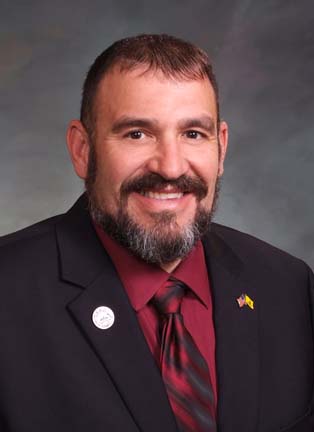
Rep. Ty Winter
Sponsored bills
The bill removes human trafficking for involuntary servitude and human trafficking for sexual servitude (human trafficking offenses) from the list of crimes of violence that are subject to enhanced sentencing if they involve the use, or possession and threatened use of, a deadly weapon or the infliction of serious bodily injury or death. Instead, the bill requires a court to sentence a person convicted of a human trafficking offense or a related attempt or conspiracy to the department of corrections for a term of at least the midpoint, but not more than twice the maximum, of the presumptive range authorized for the applicable offense. It clarifies that a class 3 felony human trafficking offense is also subject to sentencing modifications that are permitted under current law for crimes that present an extraordinary risk of harm to society.The bill subjects a person convicted of the following to enhanced sentencing:Pimping, if the victim is an at-risk person; andHuman trafficking for involuntary servitude, or human trafficking for sexual servitude, if the victim is an at-risk adult.The bill adds the source of money posted to satisfy a monetary condition of release, including the likelihood that the money is derived from criminal activity, to the list of criteria a court may consider in making a determination of the type of bond and conditions of release.The bill changes terminology related to child prostitution to commercial sexual activity in the crimes of soliciting for child prostitution, pandering of a child, keeping a place of child prostitution, pimping a child, inducement of child prostitution, and patronizing a prostituted child, including changing the name of the offenses for soliciting for child prostitution, keeping a place of child prostitution, inducement of child prostitution, and patronizing a prostituted child.In the crime of soliciting for commercial sexual activity with a child, the bill adds soliciting a child for commercial sexual activity as a means of committing the offense and requires that when arranging or offering to arrange a meeting, the offender must know that the meeting will facilitate commercial sexual activity with a child.(Note: This summary applies to this bill as introduced.)
Maddy summaryThis bill is a Senate Joint Resolution that formally recognizes the Colorado Mining Association for its 150th anniversary in 2026. It highlights the organization's historical significance and its role in supporting Colorado's mining industry, which contributes billions to the state's economy and supports tens of thousands of jobs. The resolution acknowledges the association's partnerships with state and federal agencies in promoting safety, environmental stewardship, and responsible mineral development. This measure does not change any laws or policies but serves as an official acknowledgment of the association's contributions to Colorado's history and economy.
The bill requires the state treasurer, on behalf of the state, to execute, no later than December 31, 2026, financed purchase of an asset or certificate of participation agreements (financing agreements) to finance a portion of the capital costs related to the capital renewal of a facility at the Colorado school of mines. The financing agreements are to be issued in an aggregate principal amount not to exceed $13 million plus reasonable and necessary administrative, monitoring, and closing costs and interest, including capitalized interest. The anticipated annual state-funded payments for the principal and interest components due under the financing agreements must not exceed the difference between $17.5 million and the amount of the annual state-funded payments for the agreements entered into pursuant to House Bill 24-1231, with principal amortization not occurring before July 1, 2027. The proceeds from the financing agreements will be used for the renewal of critical building systems of Guggenheim hall at the Colorado school of mines.(Note: This summary applies to the reengrossed version of this bill as introduced in the second house.)
The bill creates the Colorado nuclear workforce development and education council (council) in the Colorado school of mines to help meet growing workforce demand in the nuclear energy sector. The bill establishes a related grant program (grant program) to provide grants to institutions of higher education for the development or expansion of nuclear engineering degree or certificate programs or course offerings. The council shall convene advisory sessions with stakeholders from the nuclear, educational, and workforce development sectors; implement the grant program; and contract with one or more third-party entities for staffing and operational assistance. The council may seek, accept, and expend gifts, grants, and donations for council-related purposes. The state treasurer shall credit the gifts, grants, and donations to the Colorado nuclear workforce development and education cash fund (cash fund), which is created in the bill. The general assembly shall not appropriate general fund money to implement or maintain council operations or grant awards. The council shall convene and begin awarding grants only after the balance of the cash fund reaches or exceeds $500,000 (threshold) . The bill imposes requirements to report to the Colorado commission on higher education and the general assembly about the council's funding sources, grant program implementation, and other uses of the grant program money. If the cash fund balance does not reach the threshold on or before September 1, 2027, the council is repealed and the money in the cash fund is refunded to the grantors or donors. Otherwise, the bill repeals the council, effective September 1, 2033, unless the council is extended following a sunset review.(Note: Italicized words indicate new material added to the original summary; dashes through words indicate deletions from the original summary.)(Note: This summary applies to the reengrossed version of this bill as introduced in the second house.)
Under current law, the maximum amount of liability of the petroleum storage tank fund for an individual occurrence of a leak, spill, or release of a petroleum product from an underground storage tank (occurrence) is $2,000,000. The act allows an owner or operator of an underground or aboveground storage tank (owner or operator) to exceed this amount of liability with the permission of the director of the division of oil and public safety (director) and the petroleum storage tank committee (committee). If the director and the committee grant such permission, the director and committee shall establish a new maximum amount of liability per occurrence for the owner or operator. Under current law, all class I, II, and III liquid fuel products must comply with the most current applicable standards of ASTM International. The act allows the director to adopt a rule or issue policy guidance that provides exceptions to specific requirements established in an ASTM standard.(Note: This summary applies to this bill as enacted.)
In 2025, House Bill 25-1082 added physician assistants and advanced practice registered nurses to the professions subject to discipline for a failure to timely complete a medical certification for a certificate of death. The act adds the repeated or willful failure, without reasonable cause, to comply with the requirements of completing a medical certification for a certificate of death to the grounds for discipline in the 'Nurse and Nurse Aide Practice Act'.(Note: This summary applies to this bill as enacted.)
The act declares emergency medical services as an essential service in the state and an integral part of the state's health-care infrastructure. The act also declares that emergency medical service providers, whether responding on duty or as a volunteer and regardless of location, provide essential services when providing emergency ambulance services and nonemergency ambulance services. The act also updates certain definitions related to emergency medical services, including the addition of a definition of 'out-of-hospital services', which term is defined to mean the furnishing of necessary health-care goods and services outside of a hospital setting but does not include prehospital setting transports. The act clarifies that an off-duty emergency medical service provider is not obligated to respond to the scene of a medical emergency or provide emergency medical services.(Note: This summary applies to this bill as enacted.)
The act requires coaches of youth athletic activities to complete a biennial mental health education course. The required mental health education course must address a coach's impact on the mental health of a youth athlete, a wellness framework for youth athletes, mental health disorders, trauma, substance abuse, and suicide prevention. The act requires a coach of a youth athlete, or other designated personnel, to advise the parent or guardian of the youth athlete to seek a medical evaluation from a licensed health-care provider for appropriate medical and behavioral health guidance if the youth athlete is removed from play for a suspected concussion.(Note: This summary applies to this bill as enacted.)
Beginning January 1, 2027, the act requires an agricultural employer to pay certain agricultural employees overtime pay for time worked in excess of 56 hours in a workweek. The act also increases penalties for an agricultural employer who commits wage theft and repeals the authority of the director of the division of labor standards and statistics to adopt rules concerning overtime pay for agricultural employees.(Note: This summary applies to this bill as enacted.)