

The act requires the state auditor to conduct or cause to be conducted performance audits (audits) of the air pollution control division in the department of public health and environment and the division of unemployment insurance in the department of labor and employment (divisions). The audits will determine whether each of the divisions effectively and efficiently performs and fulfills its statutory obligations. In addition, as part of the audits, the state auditor is required to: Determine whether a division complies with statute and its statutory purpose; Assess the impact of a division's processes on providing access to program benefits and, for the labor and employment division audit only, identify any division processes that may be unnecessary, unreasonable, or cause delays; Determine whether a division's staffing and funding levels are sufficient for it to efficiently and effectively perform its statutory duties and responsibilities, which, in for the air pollution control division audit only, must include assessment of how funding or staffing changes made at the state level might impact local governments; and Determine whether a division requested and was appropriated additional resources and whether the approval or denial of such a request impacted program implementation and timing of implementation. The initial audit of the air pollution control division must begin and be completed in calendar year 2026, with an additional audit occurring in calendar year 2031. The initial audit of the division of unemployment insurance must begin and be completed in calendar year 2027, with an additional audit occurring in calendar year 2032. Upon completion of an audit, the state auditor is required to submit a written audit report to the legislative audit committee. (Note: This summary applies to this bill as enacted.)
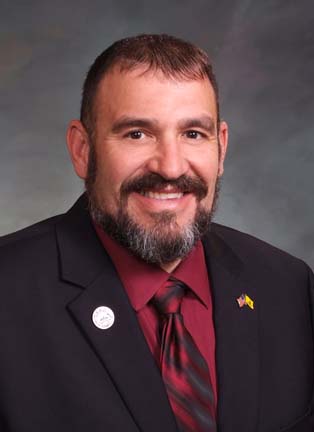
Rep. Ty Winter
Sponsored bills
The act creates an exception to the requirement that a member of the Colorado state patrol be bonded by a surety company or insured with third-party crime insurance if the Colorado state patrol is self-insured with the Colorado state office of risk management and is eligible to be compensated from the state self-insured property fund. (Note: This summary applies to this bill as enacted.)
Current law requires the division of administration (division) within the department of public health and environment to report annually to the water quality control commission (commission) and to include in the report any regulatory or legislative recommendations the division may have. The act requires the report to also include: Information on the division's timing in considering and issuing water quality permits (permits); and For the report submitted in 2026, a detailed discussion of how the division has prioritized reducing the permit backlog, implemented recommendations from water quality permittees (permittees) for permitting efficiency, and increased safe drinking water program inspections. The act requires the division, upon receipt of an application to modify a permit, to limit its review and its approval or denial of the application to the scope of the specific requests contained in the application. The act requires the commission to adopt rules on or before December 31, 2026, that establish procedures whereby the division, prior to giving public notice of a complete permit application for an individual permit and the division's preliminary analysis of the application, may provide a period of public notice and review of a preliminary draft prepared by the division. If a period of public notice and review is required by rules of the commission, the period of public notice and review may not exceed 14 days, and the purpose of the review is limited to identifying errors in the division's preliminary draft. On or before December 31, 2027, the division must propose rules to the commission that establish a time frame during which the division will either grant or deny applications for each type of permitting action. On or before June 30, 2028, the commission shall adopt rules based on the division's proposal. The rules must establish the time frames for permitting actions. The act requires the division to consider current debt service on existing local government water infrastructure when developing schedules of compliance for new effluent limits in local government permits. Any schedule of compliance for new effluent limits in local government permits must, consistent with state and federal law, consider the local government's financial capability to repay existing debt on water infrastructure or to fund water infrastructure upgrades before requiring new water infrastructure upgrades. To the extent allowable under federal law, the division may issue compliance schedules in a local government permit for a new effluent limit in excess of 20 years. The act states that, on and after May 1, 2026, after an application for permit modification or permit renewal has been pending before the division for 60 days, or for any application for permit modification or permit renewal that is pending before the division as of May 1, 2026, or if the division informs an applicant that the division will not process an application for preliminary effluent limitations, the applicant and the division may mutually agree to use a qualified and independent nongovernmental contractor (contractor) under the direction of the division to provide the division with technical assistance in completing the permit action. An applicant shall bear the contractor's costs for any technical assistance provided by the contractor and shall pay the contractor for such costs. The division may charge an applicant an additional fee in an amount not exceeding 10% of the contract amount for contract administration, technical review, and additional permit processing, which fee is credited to the clean water cash fund. The act requires the division, upon a permittee's request, to make available to the permittee all documents, data, and information the division relied upon in developing the permittee's permit modification or permit renewal, except to the extent that such materials are protected by an applicable privilege or exception. The act makes the following transfers of money: On July 1, 2025, $111,000 from the water quality improvement fund to the drinking water cash fund; On July 1, 2025, $3,518,564 from the perfluoroalkyl and polyfluoroalkyl substances cash fund to the clean water cash fund; On July 1, 2026, $3,002,435 from the perfluoroalkyl and polyfluoroalkyl substances cash fund to the clean water cash fund; and On July 1, 2026, $516,129 dollars from the perfluoroalkyl and polyfluoroalkyl substances cash fund to the drinking water cash fund. For the 2025-26 state fiscal year, the act appropriates $2,904,599 to the department of public health and environment. This appropriation consists of $446,315 from the drinking water cash fund and $2,458,284 from the clean water cash fund. For the 2025-26 state fiscal year, the act appropriates $160,611 to the department of law. This appropriation is from reappropriated funds received from the department of public health and environment. The act also makes and reduces certain appropriations as adjustments to the 2025 general appropriations act. (Note: This summary applies to this bill as enacted.)
The act creates a civil cause of action for a peace officer if the peace officer reports or discloses conduct that is in violation of, or the peace officer reasonably believes is in violation of, any law or policy and the report or disclosure is a contributing factor in the employer of the peace officer's decision to take adverse employment action against the peace officer. A peace officer may seek the following damages: Reinstatement; Back pay with interest; Any other equitable relief the court deems appropriate; Compensatory damages for other pecuniary losses, emotional pain and suffering, inconvenience, mental anguish, loss of enjoyment of life, and other nonpecuniary losses; and Reasonable attorney fees and costs. The act creates an affirmative defense to the action if the peace officer's employer would have taken the action that forms the basis of the suit against the peace officer based on a legitimate nonretaliatory basis. The action is not subject to the "Colorado Governmental Immunity Act". The statute of limitations to bring the action is 2 years. The act does not apply to an employee who provides false information or who does not follow internal reporting and administrative procedures related to whistleblower conduct. All law enforcement agencies shall provide a training to employees or a workplace posting, or both, regarding the requirements of the act. (Note: This summary applies to this bill as enacted.)
The act authorizes the owner of a trailer to register the trailer for as long as the owner owns the trailer. The trailer must be class B or class D personal property. To register the trailer, the owner must pay: 2 years of annual specific ownership tax; and $55.82 to cover fees. Upon the transfer of ownership of the trailer, the owner is required to notify the department of revenue of the transfer. (Note: This summary applies to this bill as enacted.)
The division of water resources in the department of natural resources (division) is responsible for administering water rights and issuing water well permits, among other duties. Under current law, after having received a permit to appropriate designated groundwater or construct a well outside the boundaries of a designated groundwater basin, a permit holder is required to construct the well within one year after the date of issuance of the permit. If the well is not constructed within one year, the permit expires; except that the ground water commission (commission) in the division or the state engineer, as applicable, may grant a single one-year extension. The act extends the time frame for construction of a well to 2 years, eliminating the need for the commission or the state engineer to approve a one-year extension to the initial one-year construction time frame, except for permits issued for federally authorized water projects. The act also removes the requirement that the commission or state engineer must mail a certified letter to the permit holder before a permit can be formally expired. The act allows the commission or state engineer to reinstate an expired permit if the applicant for reinstatement of the permit can show that the well was completed in a timely manner and submits a $30 fee. Under current law, the division engineer of each water division is required to decennially present to the water court a list of water rights that meet the criteria for abandonment. The act splits this decennial abandonment process into 2 batches, grouped by water division and spaced 5 years apart, beginning with 2030 and 2035. The act maintains the requirement that the abandonment process be performed every 10 years in each water division. The act extends certain time frames relating to the well permitting process. Lastly, the act eliminates final permitting requirements for non-Denver Basin bedrock aquifer wells in the designated basins. (Note: This summary applies to this bill as enacted.)
The act amends the statutes governing the capital development committee (CDC) and its purview to: Require CDC members to be appointed no later than the December 1 before the general assembly at which that CDC member will serve convenes and requires annual election of the chair and the vice-chair at the CDC's first December meeting; Align the statutes with current practices by changing from January 1, which is always a state holiday, to January 2 the date for the office of state planning and budgeting to submit to the CDC its updates to its recommended priority of funding for capital construction projects as part of the November 1 budget package; With respect to the Colorado commission on higher education's (commission) annual requests to the governing board of each state institution of higher education (institution) for a 2-year projection of certain capital construction projects, which is submitted to the CDC for review and approval: Require that projections be reviewed at the commission's next available meeting; Repeal the requirement that an institution amend the projection prior to commencing a project if the project is not in the institution's most recent projection; Repeal the requirement that the commission annually prepare a unified, 2-year report for capital construction or capital renewal projects acquired or constructed and operated and maintained solely using cash funds held by an institution that are not for new acquisitions of real property or new construction and are estimated to require total project expenditures exceeding $10 million; Repeal the requirement that the commission annually prepare a unified, 2-year report for capital construction projects for new acquisitions of real property or for new construction that are estimated to require total project expenditures exceeding $2 million; Clarify deadlines for the CDC to hold a hearing to review projections; Repeal the requirement that the CDC hold a hearing regarding projections whenever a projection is amended; and Repeal the requirement that the CDC review and approve guidelines prepared by the office of the state architect regarding the classification of facilities as academic facilities or auxiliary facilities. The act also specifies that agencies and institutions must encumber money for their capital construction projects within 6 months after the date on which the appropriation that includes the project becomes law or on or before November 1 of the state fiscal year for which the appropriation that includes the project is authorized, whichever is later. If an agency or institution will not encumber money for its capital construction project within the period specified, it may request that the CDC recommend to the controller that the deadline be extended for not more than a 6-month period , or, in the case of fee title acquisitions by the division of parks and wildlife in the department of natural resources, the deadline may be waived. The act also: Removes the requirement that the transportation commission annually submit capital requests to the CDC; Extends the deadline for the state treasurer's office to submit to the CDC and other agencies its annual report on the fiscal health of institutions from September 1 to March 1 of each state fiscal year, beginning with the report that is due for the 2025-26 fiscal year; Clarifies that any capital construction project that the CDC, in consultation with the council on creative industries, agrees does not meet the original purpose of the art in public places program may be exempt from the requirements of the program; and Clarifies that when a capital construction project receives a supplemental appropriation, it is available for the remainder of the state fiscal year for which the supplemental appropriation act was enacted and for the next 2 state fiscal years.(Note: This summary applies to this bill as enacted.)
For state fiscal years commencing on or after July 1, 2025, the act requires that: The state treasurer transfer any unappropriated balances or otherwise unexpended and unencumbered money remaining in the capital construction fund (fund) or the information technology capital account of the fund (IT subaccount), or any otherwise unexpended and unencumbered money remaining in the fund or the IT subaccount at the end of a fiscal year to the general fund; All unexpended or unencumbered money from an appropriation from the fund or the IT subaccount to a state agency or state institution of higher education reverts to the general fund at the end of the period for which the money is appropriated; and All interest and income derived from the deposit and investment of money in the fund and the IT subaccount be credited to the general fund. The act also requires the state treasurer to make the following transfers on July 1, 2025: $129,498,033 from the general fund to the fund; $500,000 from the general fund exempt account of the general fund to the fund; $20,557,433 from the general fund to the IT subaccount; and $3,230,000 from the marijuana tax cash fund to the IT subaccount.(Note: This summary applies to this bill as enacted.)
At the November 2024 statewide election, voters approved proposition 130, which requires the state to provide $350 million in additional funding to local law enforcement agencies to improve recruitment, training, and retention of local law enforcement officers and to provide a $1 million death benefit to the family of a first responder who is killed in the line of duty. The act modifies and implements proposition 130. The act creates the peace officer training and support fund (fund), and establishes a formula by which the department of public safety (department) disburses $350 million in additional funding to local law enforcement agencies from the fund for permissible purposes. Permissible purposes include initial and continuing education and training for peace officers and the compensation of peace officers. Beginning July 1, 2026, the formula requires the department to disburse an amount to each law enforcement agency equal to the total of $15,000 and an amount multiplied by the number of P.O.S.T-certified officers, noncertified deputy sheriffs, and detention officers budgeted by a local government for the law enforcement agency. Law enforcement agencies and local governments may not use these funds to supplant or supplement other spending. Local governments must include evidence of compliance with the no supplanting or supplementing requirement in their annual audit and provide a copy of this audit to the department. The department must review a subset of the audits provided by local governments for compliance with the requirements of the act. The act also establishes funding for the fund. First, the act directs the state treasurer to transfer $15 million from the general fund to the fund on July 1, 2026. Second, the act directs the state treasurer to issue warrants from the general fund totaling $500 million to the public employees' retirement association (PERA) between July 1, 2025, and September 30, 2025. Beginning July 1, 2027, until the state treasurer has transferred a total of $350 million from the general fund to the fund: The amount of each annual direct distribution made by the state to PERA is reduced by the amount of PERA's earnings from the $500 million, up to a maximum of $35 million; and The state treasurer annually transfers an amount equal to the amount of PERA's earnings from the $500 million, up to a maximum of $35 million, from the general fund to the fund. However, beginning July 1, 2027, and each July 1 thereafter until the state treasurer has transferred a total of $350 million from the general fund to the fund, the state treasurer is required to transfer at least $15 million from the general fund to the fund regardless of the amount of PERA's earnings from the $500 million. The general assembly may annually appropriate to the department no more than 2.5% of the amount that the state treasurer annually transfers from the general fund to the fund for the department's direct and indirect costs of administering the distribution of money from the fund. The act clarifies that the $500 million in the warrants that the state treasurer issues to PERA are included in the general fund reserve. Accordingly, the act prohibits a future general assembly from lowering the general fund reserve to an amount less than $1 billion. If the general assembly does so reduce the reserve, the general assembly shall also make corresponding reductions to the direct distributions made by the state to PERA. The act also requires the governor to adjust general fund expenditures so that they do not result in the general fund reserve being reduced to an amount less than $1 billion. The act establishes a process by which the department distributes a $1 million death benefit to the family of a first responder who dies on or after November 5, 2024, as either the direct and proximate result of a personal injury sustained while performing official duties as a first responder or because of an occupational disease arising out of and in the course of the first responder's employment or service as a first responder. These payments are paid out of the death benefit fund, which is created in the act. The act requires the state treasurer to transfer $5 million from the general fund to the death benefit fund on both July 1, 2026, and July 1, 2027, and to make annual transfers from the general fund thereafter as necessary to ensure that the fund maintains a balance of $10 million. The act also requires a survivor of an eligible first responder to deduct an amount equal to the amount of any death benefit received from their federal taxable income for the purpose of determining their state income tax liability unless the survivor qualifies for a corresponding federal income tax deduction. The act also requires the department to provide technical assistance to law enforcement agencies and local governments in complying with the requirements of the act and allows the executive director of the department to adopt rules as necessary to implement the act. For the 2025-26 fiscal year, $5,046,967 is appropriated from the death benefit fund to the department for implementation of the death benefit program. (Note: This summary applies to this bill as enacted.)
In current law, the sentencing structure for theft, except for auto theft, is based on the value of the item stolen. The act exempts theft of firearms from that sentencing structure and makes theft of a firearm a class 6 felony, regardless of the firearm's value. The act appropriates $324,225 from the general fund to the judicial department to implement the act. (Note: This summary applies to this bill as enacted.)