

The act requires hospitals, freestanding emergency departments, and licensed health-care facilities that hold themselves out to the public as providing emergency care (facility) to provide emergency medical services to a person who presents to the facility when the person requests or a request is made on the person's behalf for emergency medical services. For each person who presents to a facility and requests emergency medical services or for each request made on the person's behalf for emergency medical services, the act requires the facility to input into a central log whether the person refused treatment or was denied treatment; whether no treatment was required; or whether the person was transferred, admitted and treated, stabilized and transferred, or discharged. The act prohibits a facility from: Denying or discriminating in providing emergency medical services to a patient for a discriminatory or unlawful reason; Penalizing or taking adverse action against a health-care provider for refusing to transfer a patient with an emergency medical condition that has not been stabilized; Delaying providing emergency medical services to a person in order to inquire about the person's ability to pay for the services; and Transferring or discharging a patient with an emergency medical condition unless certain conditions are met. A facility or health-care provider does not violate the act's requirements if certain conditions are met. The act authorizes the department of public health and environment to investigate a facility that negligently violates the requirements of the act. A physician who negligently violates the act engages in unprofessional conduct and is subject to professional discipline. If a civil monetary penalty is imposed, the act requires the maximum civil monetary penalty to be reduced by any civil monetary penalty imposed pursuant to the federal "Emergency Medical Treatment and Active Labor Act" for the same violation. The act appropriates $82,768 from the health facilities general licensure cash fund to the department of public health and environment for use by the health facilities and emergency medical services division. (Note: This summary applies to this bill as enacted.)
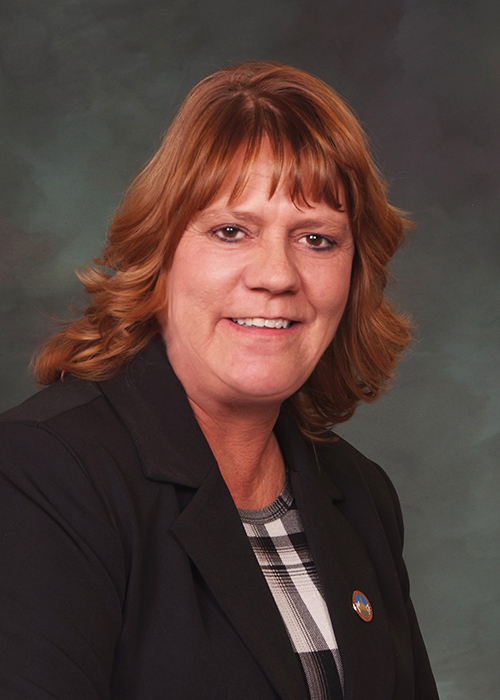
Rep. Tisha Mauro
Sponsored bills
When a catalytic converter mechanically fails or is stolen from a motor vehicle, current rules of the air quality control commission require the replacement to comply with the rules of the California air resources board. The bill creates a temporary exception that allows a person to use a replacement catalytic converter that complies with the standards established by rules of the federal environmental protection agency if: In the case of the theft of a catalytic converter, the theft has been reported to a law enforcement agency; and The owner or operator of the motor vehicle has made a reasonable effort to obtain the required replacement catalytic converter and has been unable to obtain the replacement catalytic converter. The exception is repealed, effective July 1, 2027. (Note: This summary applies to this bill as introduced.)
The state board of land commissioners (state board) serves as the trustee for lands granted to the state in public trust for the support of public schools (state trust lands). The state board is responsible for the management and protection of the state trust lands, including by protecting and enhancing the natural features, open space, and wildlife habitat of the state trust lands. The act requires various appointing authorities to appoint members to a state trust lands conservation and recreation work group (work group) to study opportunities to advance conservation and recreation activities on state trust lands as part of the state board's long-term stewardship of the state trust lands while maintaining the state board's fiduciary responsibilities regarding its management of the state trust lands. On or before September 1, 2026, the work group is required to make recommendations to the state board, the governor, the committees of the general assembly with jurisdiction over natural resources matters, and the executive director of the department of natural resources (department) based on the study. On or before February 15, 2027, the state board must take into consideration the work group's recommendations and adopt an administrative policy or rules to establish: A process governing the implementation of conservation leases and related instruments on state trust lands; A process to substantiate how the state board balances revenue generation with conserving the long-term value of state trust lands; A schedule to review and update by December 2028, if necessary, all existing stewardship trust management plans or other applicable plans; and Any other policies or rules the state board deems necessary to implement section 10 of article IX of the state constitution. For the 2025-26 state fiscal year, the act appropriates $393,506 from the state land board trust administration fund to the department for use by the state board. (Note: This summary applies to this bill as enacted.)
The act requires a form issued by the state or a local government that requests that the individual completing the form disclose the individual's race or ethnicity to include, in addition to spaces for any other racial or ethnic categories required by the federal office of management and budget, a space to indicate if the individual's race or ethnicity is Middle Eastern, North African, or South Asian. The state and local governments are exempt from the act's requirements if: The demographic data collected in the form is reported by the state or a local government to the federal government; and The federal government rejects or will reject the demographic data reported by the state or a local government because it includes Middle Eastern, North African, or South Asian as a primary demographic category. When exercising the exemption, the state and local governments shall include Middle Eastern, North African, or South Asian as a demographic subcategory of the nonspecific racial category on the form. (Note: This summary applies to this bill as enacted.)
For construction of multifamily, attached housing of 2 or more units, the act creates the multifamily construction incentive program (program). A builder may chose to participate in the program by: Providing a warranty that covers any defect and damage at no cost to the homeowner for specified periods; Having a third-party inspection performed on the property; and Recording a notice of election to participate in the program in the real property records before the property is offered for sale. For construction defect claims brought for the construction of housing for which the builder is a participant in the program, the act: Requires a claimant to file a certificate of review with the complaint, if the complaint is against an architect or engineer; Limits actions to claims that have resulted in: Actual damage to real or personal property; actual loss of the use of real or personal property; actual bodily injury or wrongful death; an unreasonable reduction in the capability of, or an actual failure of, a building component to perform an intended function or purpose; or an unreasonable risk of bodily injury or death to, or a threat to the life, health, or safety of, the occupants of the residential property; and Requires that a construction professional must send or deliver to the claimant an offer to settle the claim or a written response that identifies the standards that apply to the claim and explains why the defect does not require repair. For all construction defect claims, the act: Establishes a claimant's duty to mitigate an alleged construction defect and specifies how a claimant may satisfy this duty and the consequences to a claimant that fails to satisfy this duty; Requires a construction professional who is the defendant in a construction defect action to submit specified information to the claimant; Prohibits an insurer from cancelling, denying, or reducing coverage based on any claim for benefits covered by an existing liability insurance policy issued to a construction professional based on the construction professional's offer to repair or settle a construction defect claim; Tolls the statute of limitations or repose during a claimant's mitigation of an alleged construction defect; Increases the percentage of owners that an executive board of a unit owners' association (executive board) must obtain approval from before initiating a construction defect claim on behalf of the owners from a majority to 65%; and Requires an executive board that is successful in a construction defect claim or settlement to first use the net monetary damages or net proceeds received as a result of the claim to repair the construction defect. The act requires a local government to establish a fast-track approval process for an application for for-sale multifamily condominium projects in order to qualify for assistance from the state affordable housing fund. (Note: This summary applies to this bill as enacted.)
The bill requires nonprofit hospitals (hospitals) to use 340B profits to decrease out-of-pocket costs for low-income patients. details prohibited uses of 340B profits for nonprofit hospitals. The bill requires entities covered under the federal 340B drug pricing program that are hospitals licensed by the state to report information related to their participation in the 340B program, their use of 340B program profits, their provision of charity care, their payments to third parties for 340B program-related services and compliance, and their use of contract pharmacies. The bill grants sole community hospitals and critical access hospitals unrestricted access to, and delivery of, 340B drugs. The bill requires the joint budget committee to annually issue a request for information to the department of health care policy and financing and to the department of personnel and administration for information related to the losses and costs to the state medical assistance program that arise from a nonprofit hospital's participation in the 340B drug program. (Note: Italicized words indicate new material added to the original summary; dashes through words indicate deletions from the original summary.) (Note: This summary applies to the reengrossed version of this bill as introduced in the second house.)
Maddy summaryHouse Joint Resolution 25-1027 designates a specific portion of Colorado State Highway 1 in Larimer County, from East County Road 60 to Interstate 25, as the "Commissioner Lew Gaiter III Memorial Highway." It authorizes the Colorado Department of Transportation (CDOT) to accept donations for the initial placement of signs and to explore a cooperative agreement with Larimer County for sign maintenance.
Maddy summaryHJR 25-1026 designates Colorado State Highway 402, from United States Highway 287 to Interstate 25, as the "Rep. Hugh McKean Memorial Highway." It also authorizes the Colorado Department of Transportation (CDOT) to accept donations for the initial placement of signs and to explore agreements with Larimer County for sign maintenance.
Wildfire Matters Review Committee. Section 1 of the bill authorizes the Colorado cooperative extension service (extension) to expand and implement outreach programs and initiatives recommended by the Colorado forest health council for the purpose of increasing awareness of and interest in areas of forestry, wildland fire, and natural resources (forest health) in youth and young adults. The outreach programs and initiatives may be implemented for the 2025-26 state fiscal year through the 2027-28 state fiscal year and may include, in part: The expansion of 4-H programs and curricula in forest health; Partnerships with the forest health industry, local school districts, higher education institutions, conservation districts, the Colorado state forest service, the division of fire prevention and control in the department of public safety (division), and others to facilitate career and workforce readiness and entry into forest health careers; Outreach and support to youth and young adults relating to 2- and 4-year programs and certificates in forest health; Industry partnerships and scholarships for forest health certifications, such as wildland fire or chain saw certifications; Paid natural resources summer internships focused on forestry for high school students, including the potential to earn high school credit for completing the internship; and Paid internships in forest health careers offered by the extension, with mentoring of young adults by the extension, Colorado state university, the Colorado state forest service, and the division. The bill requires the extension to report annually to the department of natural resources and the house of representatives agriculture, water, and natural resources committee and the senate agriculture and natural resources committee on the implementation and outcomes of the outreach programs and initiatives. Section 2 authorizes the division to use money in the local firefighter safety and disease prevention fund to: Provide need-based grants to fire service governing bodies and volunteer fire departments for the cost of certain firefighter certification courses, course materials, textbooks, instructors, and written testing and to provide fire instructor I or equivalent certification for instructors who want to participate in a train-the-trainer program created by the division; Subject to appropriations by the general assembly, create a train-the-trainer program to ensure that all instructors providing grant-funded certification classes described in the bill teach a consistent curriculum; and Subject to appropriations by the general assembly, create a statewide outreach program to promote fire service careers, including marketing materials targeted to youth, an online portal to access career pathways and resources, and marketing materials that include social media. The bill requires the state treasurer to make an interest-free loan of $50 million from the unclaimed property trust fund (UPTF loan) to the department of local affairs (department). The department shall use the UPTF loan to create a zero-interest revolving loan program (loan program) to benefit fire departments. Eligible fire departments include town, city, county, and city and county fire protection organizations, fire protection districts, or other districts that provide fire protection, as well as volunteer fire departments. Eligible uses of loans made to fire departments under the loan program may include: The purchase of rolling stock, such as fire trucks, brush trucks, and fast attack vehicles, and associated apparatus; Capital improvements for existing or new facilities; The purchase of other facilities, infrastructure, or equipment for the state's firefighter workforce to respond to emergencies and ensure public safety; and Temporary bridge loans to cover unusual costs in response to emergencies. Prior to making loans to fire departments, the department shall consult with statewide associations representing fire chiefs and firefighters and the division of fire prevention and control in the department of public safety. The department may charge an administrative fee of up to one-half of one percent on the principal amount of the loans made to fire departments and may use earnings from the investment of the UPTF loan to administer the loan program. The bill creates a fund in the state treasury for use by the department for the UPTF loan and requires the department to pay the UPTF loan back to the UPTF not later than July 1, 2065. In addition, the bill creates the firefighter first homeownership program (homeownership program) and, if implemented, authorizes the state treasurer to invest money from the UPTF in the homeownership program. If implemented, the Colorado housing and finance authority or another entity selected by the state treasurer will serve as the program manager. The state treasurer shall purchase from the program manager mortgage products in tranches of reasonable amounts. The program manager shall establish guidelines and underwriting criteria that: Prioritize first-time homebuyers who use the home as a primary residence; Provide shared equity down payment assistance to firefighters; Allow appreciation-sharing benefits between the homeownership program and homeowner; If the program manager is the Colorado housing and finance authority, pair a borrower with a mortgage loan provided through the program manager's network of lenders that bears an interest rate at or below market rate; and Serve homebuyers across diverse geographic areas and housing markets. The program manager is entitled to normal and customary fees for managing the homeownership program and other costs related to the homeownership program, and shall annually report to the state treasurer concerning the homeownership program. (Note: Italicized words indicate new material added to the original summary; dashes through words indicate deletions from the original summary.) (Note: This summary applies to the reengrossed version of this bill as introduced in the second house.)
Maddy summarySenate Joint Resolution 25-015 designates a specific portion of Colorado State Highway 58 as the "Officer Evan A. Dunn Memorial Highway." This action honors Officer Evan A. Dunn, a Golden Police Department officer who died in the line of duty. The bill authorizes the Colorado Department of Transportation to accept donations for the initial placement of memorial signs and to explore a cooperative agreement with the City of Golden for their maintenance.