

Under Colorado law, a special event permit allows the service of alcohol beverages during special events. The act authorizes a special event permit to be issued to a chamber of commerce. Certain types of business are excluded from participating in the special event. The holder of a retail establishment permit may participate in the special event if the permit holder is not serving complimentary alcohol beverages sold at the same date and time as the special event. The act also requires the executive director of the department of revenue (department) to promulgate rules to authorize age-restricted tobacco festivals by means of a permit issued by the department. Standards are set for the rules. The executive director of the department may establish by rule an application fee for the tobacco festival permit. The application fee must be set at an amount that offsets the direct and indirect cost of implementing and enforcing the tobacco festival permit rules. APPROVED by Governor June 4, 2024 EFFECTIVE August 7, 2024(Note: This summary applies to this bill as enacted.)
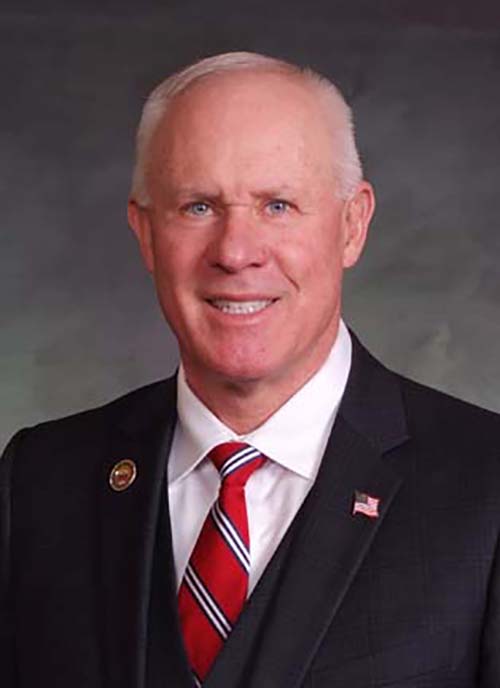
Rep. Tony Hartsook
Sponsored bills
The act requires all large group health benefit plans to provide coverage for biomarker testing to guide treatment decisions if the testing is supported by medical and scientific evidence. The act defines "biomarker testing" as an analysis of a patient's tissue, blood, or other biospecimen for the presence of an indicator of normal biological processes, pathogenic processes, or pharmacologic responses to a specific therapeutic intervention. The required testing under the act does not include biomarker testing for screening purposes or direct-to-consumer genetic tests. The act requires the commissioner of insurance to implement biomarker testing coverage for all large employer health benefit plans issued or renewed on or after January 1, 2025. To the extent biomarker testing is not in addition to the benefits provided pursuant to the benchmark plan, all individual and small group health benefit plans must provide coverage for biomarker testing. Within 120 days after the act takes effect, the division of insurance (division) shall submit to the federal department of health and human services (HHS) its determination of whether biomarker testing is in addition to essential health benefits and would require state defrayal of costs pursuant to federal law. The division shall implement the requirement for coverage for biomarker testing for individual and small group health benefit plans within 12 months after the earlier of the division receiving confirmation from HHS that biomarker coverage does not require defrayal or more than 365 days passing since the division submitted its determination that defrayal was not necessary. Biomarker testing is subject to the health benefit plan's annual deductibles, copayment, or coinsurance but is not subject to any annual or lifetime maximum benefit limit. APPROVED by Governor June 3, 2024 EFFECTIVE June 3, 2024(Note: This summary applies to this bill as enacted.)
The act requires the department of education to develop and offer a free, optional professional development program (program) to enhance pedagogy around research-based Colorado academic standards in science. The program must include opportunities for in-person and virtual instruction on interventions for students who are below grade level or struggling in science, children with disabilities, gifted students, and students who are English language learners. The program must create incentives for teacher participation by offering ongoing professional development credit toward licensure renewal. The program prioritizes professional development for eligible science teachers employed at local education providers in rural school districts and small rural school districts. For the 2024-25 state fiscal year, the act appropriates $3 million to the department of education from the state education fund for science teacher professional development. APPROVED by Governor May 23, 2024 EFFECTIVE August 7, 2024(Note: This summary applies to this bill as enacted.)
The act adopts the dentist and dental hygienist compact (compact) to facilitate the interstate practice of dentistry and dental hygiene. With the adoption of the compact, a dentist or dental hygienist who holds an active, unencumbered license in a participating state and does not have an encumbered license from any participating state may apply to another participating state (remote state) for a privilege to practice dentistry or dental hygiene, as applicable, (compact privilege) in that state. Under a compact privilege, the dentist or dental hygienist must practice within the scope of practice authorized for a dentist or dental hygienist licensed in the remote state and is subject to the remote state's licensing authority, which may, within the borders of the remote state, take adverse action against the dentist's or dental hygienist's compact privilege in order to protect the health and safety of its citizens. If a remote state, acting through its licensing authority, takes adverse action, the dentist's or dental hygienist's compact privilege in all remote states is removed until any restriction on the compact privilege is removed. Only the participating state in which the dentist or dental hygienist is licensed may take adverse action against the dental or dental hygienist's license; however, a remote state may take adverse action against the dentist's or dental hygienist's compact privilege in the remote state. The compact creates the dentist and dental hygienist compact commission (commission). The commission consists of one commissioner from each participating state who is selected by the state's licensing authority. The compact authorizes the commission to create the administrative structure for the compact, including granting the powers necessary to establish and operate the commission, adopt rules and bylaws, establish an executive committee, hire employees, establish an office, and conduct the commission's meetings. Further, the commission shall develop and maintain a coordinated database and reporting system to include significant investigatory information from participating states concerning the dentist's or dental hygienist's practice and to record any adverse action against the dentist or dental hygienist. To pay the costs associated with the compact, the compact authorizes the commission to levy and collect an annual assessment from each participating state and to impose fees on licensees for the granting or renewal of a compact privilege; except that an active military member or the member's spouse will not be required to pay the commission's fee for a compact privilege. The compact includes provisions governing disputes among participating states and between the commission and a participating state, enforcement provisions, and withdrawal of participating states from the compact. The compact is effective for participating states on the date on which the compact is enacted in the seventh participating state. For the 2024-25 state fiscal year, $78,750 is appropriated to the department of regulatory agencies from the division of professions and occupations cash fund for use by the department to implement the act. APPROVED by Governor May 17, 2024 EFFECTIVE August 7, 2024(Note: This summary applies to this bill as enacted.)
Under existing law, the department of military and veterans affairs (department) pays up to the full amount of tuition for members of the Colorado National Guard (members) pursuing a degree or certificate at certain institutions of higher education via a tuition assistance program (program). The tuition is paid from the Colorado National Guard tuition assistance fund (fund). The bill expands the program to include spouses and children (dependents) of members and to pay for fees charged by the institution of higher education. To qualify for tuition assistance, a dependent must be a dependent of a member who has served in the Colorado National Guard for at least 6 years and either is serving during the period of time that the dependent is receiving tuition and fee assistance or previously served in the Colorado National Guard for at least 12 years. The bill creates the National Guard dependents tuition assistance account (account) in the fund. Tuition for dependents is paid from the account. If the balance in the account is more than the amount necessary to pay for dependents' tuition in a fiscal year and the money in the fund is insufficient to satisfy the demand for tuition assistance for members, the adjutant general of the department may notify the state treasurer to transfer excess money from the account to the fund to pay for members' tuition assistance. (Note: This summary applies to this bill as introduced.)
The bill states that the Colorado prescription drug affordability review board has no authority to perform an affordability review of, or to establish an upper payment limit for, any prescription drug that is designated as a drug for a rare disease or condition by the federal food and drug administration. (Note: This summary applies to this bill as introduced.)
The new twenty-third judicial district exists beginning January 7, 2025. The act makes changes so that the crime victim compensation board and the victims and witnesses assistance and law enforcement board may provide compensation and services once the new judicial district exists. APPROVED by Governor April 4, 2024 EFFECTIVE April 4, 2024(Note: This summary applies to this bill as enacted.)
Current law includes a Colorado veterans' service-to-career program (program), which authorizes nonprofit agencies to partner with work force centers selected by the department of labor and employment to provide veterans and other eligible participants with skills training, internships, work placements, mentorship opportunities, career and professional counseling, and support services. The program requires that if a program participant is eligible for federal funding that federal funding must be used first. The act repeals that requirement. The act requires work force center staff to vet potential program participants and leverage additional funding sources to deliver comprehensive services. Obsolete language related to the program is repealed. The act extends the repeal date for the program to July 1, 2024. APPROVED by Governor June 6, 2023 EFFECTIVE August 7, 2023 NOTE: This act was passed without a safety clause and takes effect 90 days after sine die. (Note: This summary applies to this bill as enacted.)