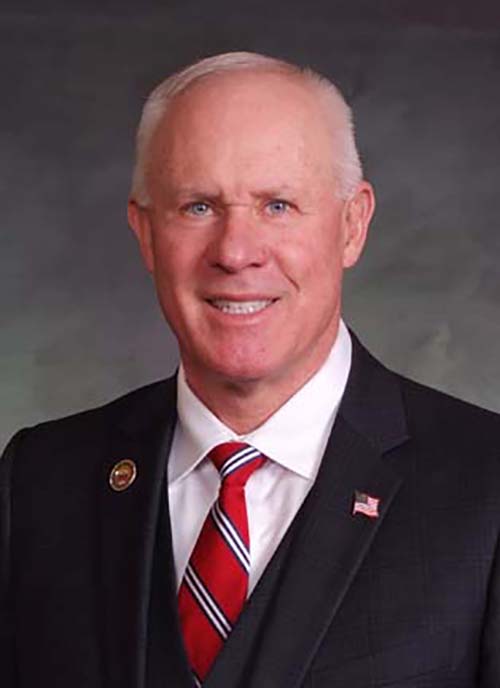
Photo of Tony Hartsook
R Colorado House · District 44 On the 2026 ballot

Rep. Tony Hartsook

Compare
Total votes
3,596
all sessions
Attendance
97%
91 missed
Higher than 83% of chamber peers
With party
93%
of cast votes
Near the chamber average
Bipartisan score
5%
crosses aisle rarely
Near the chamber average
Sponsored
157
bills & resolutions
Lower than 88% of chamber peers
Committees
3
assignments
157 bills and resolutions

Sponsored bills

Total
157
Primary
58
Co-sponsor
99
This page
157
matching current filters
Co-sponsor HJR 25-1003
Passed · Colorado House · Co-sponsor
Joint Session Address by Tribal Councils

Maddy summaryHJR 25-1003 is a procedural resolution that schedules a joint session of the Colorado General Assembly for January 16, 2025, to hear a message from representatives of the Ute Mountain Ute Tribe and Southern Ute Indian Tribe tribal councils. It directs the appointment of a committee consisting of three House members and three Senate members to escort tribal representatives to the session. The resolution does not create new laws or alter policies but formalizes a ceremonial meeting to recognize the tribes' historical and cultural contributions to Colorado. This is a standard procedural step for legislative recognition events, not a substantive policy change.

Passed Jan 22, 2025 1 co-sponsor
Co-sponsor HJR 25-1005
Passed · Colorado House · Co-sponsor
Commemoration of Martin Luther King Jr. Day

Maddy summaryHJR 25-1005 is a ceremonial resolution encouraging Colorado communities to observe Martin Luther King Jr. Day on January 20, 2025 - the 41st anniversary of the state holiday. It does not create new laws or alter existing policies but urges cities, schools, counties, and local governments to hold commemorative events. The resolution honors Dr. King’s legacy, noting Colorado’s early adoption of the holiday in 1985 and its ongoing observance through events like the annual Marade. This is a non-binding call for community engagement, not a substantive legislative change.

Passed Jan 22, 2025 1 co-sponsor
Co-sponsor SJR 25-003
Passed · Colorado Senate · Co-sponsor
Colorado Commission on Uniform State Laws Appointments

Maddy summaryThis bill appoints six specific individuals - Senator Marc Snyder, Representative Cecelia Espenoza, Bob Gardner, Claire Levy, Anne McGihon, and Joseph Whitfield - to the Colorado Commission on Uniform State Laws for two-year terms. It directly affects these appointees by granting them membership on the commission, which advises Colorado on adopting uniform state laws. The resolution implements a statutory requirement (C.R.S. § 2-3-601) for filling commission positions, with no policy changes or new provisions beyond the appointments themselves.

Passed Jan 16, 2025 1 co-sponsor
Co-sponsor HR 25-1002
Passed · Colorado House · Co-sponsor
House Officers & Employees

Maddy summaryThis bill (HR 25-1002) is a procedural measure concerning House officers and employees. The provided context includes no bill text, summary, or specific provisions describing its content or effects. Without the actual text or a substantive description of the bill's requirements, mechanisms, or who it directly affects, a factual summary cannot be generated. The recent actions (introduced, passed, signed) only confirm procedural steps, not the bill's policy content.

Passed Jan 13, 2025 1 co-sponsor
Primary SB 24-142
Signed into law · Colorado Senate · Lead sponsor
Oral Health Screening in Schools Pilot Program

The act amends the Colorado oral health community grants program administered by the department of public health and environment (department) to award grants for the implementation of oral health screening in public schools through the oral health screening pilot program (pilot program) created in the act. The purpose of the pilot program is to provide oral health screening to students in kindergarten and third grade at a minimum of 5 pilot program sites at school districts or schools of a school district, charter schools, institute charter schools, or boards of cooperative services (local education providers) to demonstrate the effectiveness of oral health screening in kindergarten and third grade in reducing dental decay, the costs of providing oral health screening to students, and best practices for providing oral health screening that could be scaled statewide. The department shall award at least 5 oral health screening grants to oral health screeners to conduct oral health screening activities in schools of local education providers. In selecting screening locations, the department shall select locations that represent a variety of school settings, including large and small local education providers in urban, rural, and frontier areas of the state, with priority given to schools with students who are likely to experience higher rates of undetected oral health concerns. The act includes requirements for the pilot program regarding: Qualifications for participating oral health screeners; The oral health screening; The selection by the department of an oral health screening tool; Notice to parents and legal guardians (parents), including the ability of parents to refuse oral health screening for their children; Reporting to parents about the outcome of the oral health screening and information and referral if dental concerns are identified for a student; and The protection of confidential health data. After completing oral health screening at a pilot program site during the 2024-25 and 2025-26 school years, no later than July 31, 2025, and July 31, 2026, respectively, a participating oral health screener shall provide data and information to the department for purposes of evaluating the effectiveness of the pilot program, including the number of students screened and oral health concerns identified, as well as other relevant data and information as determined by the department. On or before December 1, 2027, the department of education shall develop a plan for implementation of oral health screening in kindergarten and third grade in all public schools. No later than January 15, 2027, the department shall submit a report of the findings concerning the pilot program and its plan for implementation of oral health screening in all public schools to the health and human services and education committees of the house of representatives and of the senate, or their successor committees, and the department of education. The pilot program repeals July 1, 2031, after the screening and reporting on the pilot program is completed. For the 2024-25 state fiscal year, $84,425 is appropriated from the general fund to the department for use by the prevention services division to implement the pilot program. APPROVED by Governor June 7, 2024 EFFECTIVE June 7, 2024(Note: This summary applies to this bill as enacted.)

Signed into law Jun 7, 2024 0 co-sponsors
Primary SB 24-203
Signed into law · Colorado Senate · Lead sponsor
Prescription Drug Board Consider Rare Disease Advisory Council

Current law requires the Colorado prescription drug affordability review board (board) to take certain measures in determining whether to conduct an affordability review for an identified prescription drug. The act requires the board, in making such a determination, to consider whether the drug has an approved orphan drug designation for one or more rare diseases and no other indications and, if so, to consider input from consumers and the Colorado rare disease advisory council (council). Current law requires the board, in performing an affordability review, to consider certain information. The act requires the board to consider input from the council. APPROVED by Governor June 6, 2024 EFFECTIVE August 7, 2024(Note: This summary applies to this bill as enacted.)


Signed into law Jun 6, 2024 0 co-sponsors
Primary HB 24-1371
Signed into law · Colorado House · Lead sponsor
More Uniform Local Massage Facilities Regulation

The law has allowed, but has not required, a county or a municipality to adopt a resolution or ordinance that either establishes business licensure requirements for massage facilities or regulates and prohibits unlawful activities to prevent the operation of illicit massage businesses that engage in human trafficking-related offenses. The act: Makes a legislative finding and declaration that it is a matter of mixed statewide and local concern to establish a statewide requirement that a massage facility operator, owner, or employee, including an independent contractor who is involved in the routine operations of a massage facility (employee), submit to a background check, which generally means a fingerprint-based criminal history record check (background check); Requires every county, city and county, and municipality (local government) that has a massage facility within its jurisdictional boundaries to adopt a local process that ensures that the required background checks are conducted; Requires such a local process to also require, as a condition for a person remaining as or becoming a massage facility operator, owner, or employee, that: Every current operator, owner, and employee submit to a background check on or before the earlier of October 1, 2025, or any other date specified in the local process; and Every prospective operator or owner to submit to a background check at least 30 days before being granted a license to operate the massage facility or assuming an ownership interest in a massage facility; Prohibits a person from being a massage facility owner if the person either has not submitted to a required background check or has either: Been convicted of or entered an accepted plea of nolo contendere for a felony or misdemeanor of solicitation of a prostitute, a human trafficking offense, or money laundering; or Is registered as a sex offender or is required by law to register as a sex offender; Prohibits a massage facility operator or owner from employing at a massage facility a person who has not submitted to a required background check; Authorizes an operator or owner to employ at a massage facility a person who has been convicted of or entered an accepted plea of nolo contendere for a felony or misdemeanor of solicitation of a prostitute, a human trafficking offense, or money laundering, or who is registered as a sex offender or is required by law to register as a sex offender, if the operator or owner believes that the person does not pose a threat to customers or employees of the massage facility; Authorizes the local licensing authority for a local government that has established massage facility business licensure requirements to suspend or revoke the license of any massage facility that has an owner or an employee who is prohibited from being a massage facility owner or employee; Requires a county and a municipality within the county to consult with each other when developing, as is still authorized but not required, a resolution or ordinance to establish business licensure requirements for massage facilities or regulate and prohibit unlawful activities to prevent the operation of illicit massage businesses that engage in human trafficking-related offenses, and, by mutual agreement between a county and a municipality within the county, allows a municipality to elect to have a county's resolution or ordinance apply to massage facilities operating within the jurisdictional boundaries of the municipality in lieu of adopting its own ordinance or resolution; and Because a massage therapist is required by current law to submit to a background check to obtain a license to practice massage therapy, exempts a licensed massage therapist from the act's background check requirement. APPROVED by Governor June 6, 2024 EFFECTIVE August 7, 2024(Note: This summary applies to this bill as enacted.)
Signed into law Jun 6, 2024 0 co-sponsors
Primary SB 24-109
Signed into law · Colorado Senate · Lead sponsor
Continue Colorado Veterans' Service-to-Career Program

The Colorado veterans' service-to-career program (program) authorizes nonprofit agencies to partner with work force centers selected by the department of labor and employment (department) to provide veterans and other eligible participants with skills training, internships, work placements, mentorship opportunities, career and professional counseling, and support services. Under current law, the general assembly is allowed to annually appropriate money from the marijuana tax cash fund to the department to be used for the program. The act extends the repeal date for the program from July 1, 2024, to September 1, 2027. In addition, the act removes the provision permitting the appropriation of money from the marijuana tax cash fund and instead allows the general assembly to appropriate money from the general fund to be used for the program. APPROVED by Governor June 6, 2024 EFFECTIVE June 6, 2024(Note: This summary applies to this bill as enacted.)

Signed into law Jun 6, 2024 0 co-sponsors
Primary SB 24-055
Signed into law · Colorado Senate · Lead sponsor
Agricultural & Rural Behavioral Health Care

The act creates the agricultural and rural community behavioral health program (program) in the behavioral health administration (BHA). The BHA is required to identify a specific BHA staff person to serve as a liaison between the BHA, the department of agriculture (department), behavioral health-care providers, rural community leaders, agricultural communities, and nonprofit organizations that serve agricultural communities. The program shall: Engage in statewide community outreach to educate communities on behavioral health issues facing farmers, ranchers, other agricultural industry workers, their families, and rural communities; Establish interdepartmental relationships; and Develop an understanding of and address the root causes of behavioral health issues in the agricultural industry and in rural communities. The act creates the agricultural behavioral health community of practice work group (work group) in the department. The purpose of the work group is to convene a group of leaders and experts in agriculture and behavioral health care to improve access to behavioral health care for those involved in agriculture and their families. The work group consists of at least 7 members and shall: Compile best practices to provide behavioral health care to those involved in agriculture and their families; Identify gaps in the provision of behavioral health care to those involved in agriculture; Engage with other stakeholders involved in behavioral health care focused on those involved in agriculture; Collect data, as permitted by state and federal data privacy laws, on behavioral health-care outcomes in agricultural communities and steps taken to support those involved in agriculture through behavioral health initiatives and programs; and Report to the department and the BHA on the data collected and recommend legislative or policy changes to further improve agricultural behavioral health care. The work group is scheduled for sunset review and repeal on September 1, 2029. The act establishes the agricultural behavioral health grant program (grant program) in the department. Subject to available appropriations, the department may administer the grant program. The purpose of the grant program is to: Continue existing programs or create new programs that address the root causes of behavioral health issues in the agricultural industry or in rural communities; Strengthen collaborative efforts between organizations and communities in addressing the root causes of behavioral health issues in the agricultural industry or in rural communities; and Improve access to health, wellness, and behavioral health care for farmers, ranchers, other agricultural industry workers, and their families. The act requires the department to contract with a statewide agricultural organization to convene an in-person annual summit for organizations with an interest in promoting and providing behavioral health care to agricultural communities. The department and the BHA are required to enter into an interagency agreement to share data collected in the course of addressing behavioral health-care issues in the agricultural industry and in rural communities. The interagency agreement must state that the data shared will be aggregated and anonymized, and data sharing must be in compliance with state and federal data privacy laws. On or before January 1, 2026, and each January 1 thereafter, the department is required to submit a report summarizing data collected by the work group, and data collected from grant recipients, to the agriculture, water, and natural resources committee and the health and human services committee of the house of representatives and the agriculture and natural resources committee and the health and human services committee of the senate, or their successor committees, and the BHA. On or before January 1, 2027, and each January 1 thereafter, the department shall include in the report a summary of the data collected regarding the in-person annual summit. For the 2024-25 state fiscal year, the general assembly appropriates $61,989 from the general fund for use by the department to implement the act. For the 2024-25 state fiscal year, the general assembly appropriates $145,116 to the department of human services for use by the BHA to implement the act. APPROVED by Governor June 6, 2024 EFFECTIVE August 7, 2024(Note: This summary applies to this bill as enacted.)

Signed into law Jun 6, 2024 0 co-sponsors
Primary HB 24-1463
Signed into law · Colorado House · Lead sponsor
Restrictions on Tap Fees

The act requires that the board of a special district, within 30 days of receiving a written request from any county, city and county, or municipality within the boundaries of which the special district operates or partly operates, provide the rate schedule for the special district's tap fees, system development fees, or other fees and charges that contemplate future water or sanitation system usage, and, upon request of the local government, provide any professional analyses and a detailed written justification of the costs and methodologies used to calculate those fees. APPROVED by Governor June 5, 2024 EFFECTIVE August 7, 2024(Note: This summary applies to this bill as enacted.)

Signed into law Jun 5, 2024 0 co-sponsors
Showing 131 to 140 of 157 bills
Previous 1 … 13 14 15 … 16 Next