Maddy summaryThis bill designates a two-mile stretch of Colorado Highway 14 in Weld County as 'Mono & Matt Road' to honor Edwardo 'Mono' Hernandez and Matthew Garcia, two high school basketball players who died in a 2014 traffic accident. The legislation authorizes the Colorado Department of Transportation to install signs for the new name and allows the department to accept donations for this purpose while exploring a cooperative agreement with Weld County for future maintenance. By placing the names on a specific roadway, the bill creates a permanent physical tribute to the students in the location where the accident occurred.

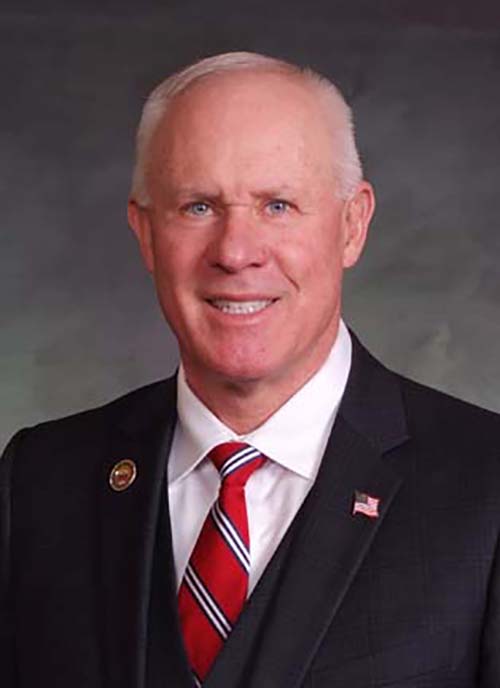
Rep. Tony Hartsook
Sponsored bills
Maddy summaryHR 1007 is a commemorative resolution honoring Colorado's 150th anniversary of statehood in 2026. The bill directly affects the people of Colorado and various government officials by formally recognizing the state's history, culture, and achievements. Its key provisions call on citizens to celebrate this milestone with gratitude and dedication to liberty while committing to preserve natural resources, promote civic education, and strengthen infrastructure. The resolution does not create new laws or funding but serves as a symbolic acknowledgment of the state's legacy and future goals.
Maddy summaryThis bill is a resolution that formally honors Colorado law enforcement officers for their service and sacrifices. It expresses gratitude for their role in protecting communities and encourages residents to engage with police to build trust. The measure does not create new laws or funding but serves as a public acknowledgment of officers' work and challenges.
The act changes terminology related to child prostitution to commercial sexual activity with a child in the crimes of soliciting for child prostitution, pandering of a child, keeping a place of child prostitution, pimping a child, inducement of child prostitution, and patronizing a prostituted child, including changing the name of the offenses for soliciting for child prostitution, keeping a place of child prostitution, inducement of child prostitution, and patronizing a prostituted child. A court is required to sentence an offender convicted of one of the listed offenses, other than soliciting for commercial sexual activity with a child, to at least the minimum of the presumptive range for the level of offense associated with the crime. For an offense of soliciting for commercial sexual activity with a child, if the court sentences the person to probation, the court shall order as a condition of probation that the person serve 364 days in the county jail. In the crime of soliciting for commercial sexual activity with a child, the act adds knowingly soliciting a child for commercial sexual activity as a means of committing the offense and requires that when arranging or offering to arrange a meeting, the offender must know that meeting will facilitate commercial sexual activity with a child. The act removes the spousal exception from the crime of engaging in commercial sexual activity with a child. The act makes the penalty for internet luring of a child a class 3 felony when the offense is committed with the intent to meet for the purpose of engaging in commercial sexual activity. In this circumstance, a court is required to sentence the offender to at least the minimum of the presumptive range for the class 3 felony.(Note: This summary applies to this bill as enacted.)

For purposes of the 'Victim Rights Act', the act prohibits a defendant or alleged offender in the underlying case from being the 'lawful representative' of a victim or the victim's designee if the victim is a child or an at-risk adult. The act creates new rights for a victim under the 'Victim Rights Act', including the right to:Be notified by the district attorney if the district attorney receives a notice that a crime laboratory employee engaged in a wrongful action that includes a crime against the victim and a notice that an evidentiary hearing on post-conviction petition for relief is held;Request to be referred to by an abbreviation, pseudonym, initials, or another preferred name during hearings; andBe heard at a restitution assessment hearing.(Note: This summary applies to this bill as enacted.)

In current law, a person who is a member of the Colorado National Guard who is accepted for enrollment at a designated institution of higher education (member) has all their tuition costs waived. All tuition waiver costs are currently funded by the state from money in the Colorado National Guard tuition fund. The act changes the funding mechanism of the Colorado National Guard tuition waiver program by requiring each designated institution of higher education to waive the remaining balance of a member's tuition cost in excess of the amount of any private, state, or federal financial assistance received. The act requires the department of military and veterans affairs to reimburse each institution for 50% of the cost of tuition waived by the institution and requires the general assembly to appropriate money to the Colorado National Guard tuition fund to cover the reimbursement.(Note: This summary applies to this bill as enacted.)
The act extends the availability of the conservation easement tax credit from income tax year 2031 through income tax year 2036. The act also prohibits the division of conservation from issuing any additional credit certificates or amending previously issued credit certificates as a result of the additional authority granted by the act for a donation made prior to the effective date of the act.(Note: This summary applies to this bill as enacted.)
The act requires a volunteer lobbyist to register and file a registration statement attesting they are not being compensated. The act exempts volunteer lobbyists from registration fees. The act provides that the judicial department may designate one individual for the judicial department and one individual for each independent agency in the judicial department who may lobby on behalf of the judicial department or an independent agency in the judicial department (judicial lobbyist). A person designated by a principal executive department to be responsible for lobbying a state official or employee on behalf of the department (legislative liaison), a judicial lobbyist, or an individual who lobbies on behalf of the offices of the governor or lieutenant governor as a member of the governor's cabinet or as a personal staff employee in the offices of the governor or the lieutenant governor (governor's lobbyist) must register with the secretary of state annually. In addition to annually registering with the secretary of state, a legislative liaison, judicial lobbyist, or a governor's lobbyist must file a monthly disclosure statement with the secretary of state (disclosure statement). The act provides that a legislative liaison, judicial lobbyist, or a governor's lobbyist must indicate on the disclosure statement the bill number of any legislation for which they have lobbied or will lobby a covered official and their position regarding the legislation. The legislative liaison, judicial lobbyist, or a governor's lobbyist must update their position on the disclosure statement within 72 hours of a change in position. The act prohibits a statewide elected official or member of the general assembly from being a legislative liaison or governor's lobbyist for a period of 2 years following vacation of office. $91,000 is appropriated from the department of state cash fund to the department of state.(Note: This summary applies to this bill as enacted.)
Current law allows the department of revenue (department) to retain an amount equal to its administrative costs in collecting, administering, and enforcing the production fees for clean transit and wildlife and land remediation, the enterprise per ride fees, the retail delivery fees, and the enterprise retail delivery fees. Current law also allows the department to retain 3% of the prepaid wireless trust cash fund to mitigate administrative costs. The money retained by the department is currently transmitted into multiple individual cost recovery cash funds that are used to mitigate the department's administrative costs of collecting those fees and charges. These cash funds include the oil and gas production fees collection fund, the enterprise per ride fees fund, and the retail delivery fees fund (cost recovery funds). The act repeals each of these cost recovery funds and directs the state treasurer to transmit the money retained by the department to mitigate the department's administrative costs for all the programs into a single cost recovery cash fund, which is created in the act. The act also requires the department to submit an annual report starting November 1, 2027, to the joint budget committee with information about the costs associated with collecting, administering, and enforcing the fees and, where applicable, the specific tasks that contribute significantly to the fee collection workload.(Note: This summary applies to this bill as enacted.)
The act prohibits using an automated driving system to drive a commercial motor vehicle unless an individual who holds a commercial driver's license is in the vehicle, monitors the vehicle's driving, and intervenes, if necessary, to avoid illegal or unsafe driving. The individual must be in the driver's seat if hazardous materials are being transported. The penalty is $1,000 for a first offense, is $2,000 for a second offense, and doubles for each subsequent offense. The act does not apply to a light-duty vehicle or a truck-mounted attenuator. The prohibition is repealed September 1, 2031. The chief of the Colorado state patrol will analyze the act's effects on commercial vehicle safety on highways. By November 1, 2030, the chief of the Colorado state patrol will issue a report to the relevant committees of the house of representatives and senate. The report must make recommendations as whether to continue the prohibition and, if continued, any recommended legislation to improve the prohibition. For the 2026-27 state fiscal year, $14,357 is appropriated to the department of revenue from the Colorado DRIVES vehicle services account in the highway users tax fund to implement the act.(Note: This summary applies to this bill as enacted.)