

Under current law, a political party must ensure that any person, upon request, is able to participate in a precinct caucus or a party assembly with the use of a video conferencing platform or alternative means of participation. The failure of any political party to make a reasonable effort to comply with these accessibility requirements constitutes discrimination on the basis of disability in a place of public accommodation. The act clarifies that only a person who is otherwise eligible pursuant to statute to participate in a precinct caucus or a party assembly may request video conferencing or another alternative means of participation. The act also clarifies that a person who is subjected to a violation of a political party's duties regarding these accessibility requirements may file suit only against the central committee of the political party holding the caucus or assembly. An individual, including a member of the central committee of the political party or a volunteer for a political party, may not be held liable for a violation of these accessibility requirements. Upon a finding of a violation of these accessibility requirements, a court may require compliance with the applicable accessibility requirement and either actual monetary damages or a statutory fine of $3,500 for each violation.(Note: This summary applies to this bill as enacted.)
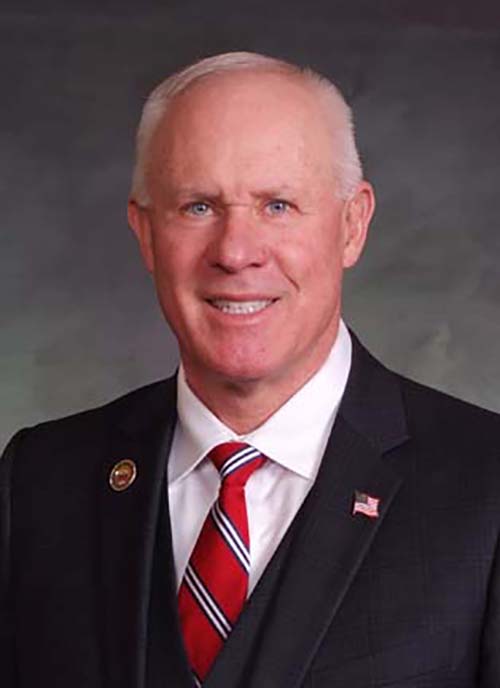
Rep. Tony Hartsook
Sponsored bills
Maddy summaryThis bill designates April 9, 2026, as "Home Education Day" in Colorado to honor parents who educate their children at home. It does not change any laws or affect how education is administered but serves as a symbolic recognition of home schooling within the state. The resolution highlights the number of home-educated students in Colorado and the estimated financial savings to taxpayers associated with this educational choice. Ultimately, the measure is a ceremonial gesture that celebrates home educators without altering existing policies or regulations.
The bill states that the Colorado prescription drug affordability review board has no authority to perform an affordability review of, or to establish an upper payment limit for, a prescription drug that is:Designated as a drug for a rare disease or condition by the food and drug administration (FDA) of the federal department of health and human services; orA licensed biological product that is derived from human whole blood or plasma as indicated on product labeling approved by the FDA.(Note: This summary applies to the reengrossed version of this bill as introduced in the second house.)
Maddy summaryThis Senate Joint Resolution formally recognizes the 43rd anniversary of the sister-state relationship between Colorado and Taiwan while expressing support for their ongoing trade and academic exchanges. The bill highlights recent cooperation in emerging technologies such as quantum computing and semiconductors, and it advocates for Taiwan's participation in international organizations like the World Health Organization and the United Nations. Additionally, the resolution commends Taiwan's democratic system and supports the signing of a U.S.-Taiwan agreement on avoiding double taxation. As a non-binding legislative statement, it does not alter laws or budgets but serves to publicly endorse these diplomatic and economic ties.
The concurrent resolution submits a constitutional amendment to the voters of the state at the 2026 general election that adds to the nonexclusive list of inalienable rights of all persons the right to direct the upbringing, education, and care of their children.(Note: This summary applies to this concurrent resolution as introduced.)
Maddy summaryThis bill designates a specific section of Interstate 25 in Denver County, stretching from Mile Marker 204.51 to 213.13, as the Governor Roy Romer Memorial Highway to honor his public service. The legislation authorizes the Colorado Department of Transportation to accept donations and place signs marking this stretch of road, while also allowing for cooperation with local authorities to maintain those signs. This measure directly affects the state's transportation department and the communities along the designated highway by creating a permanent tribute to former Governor Roy Romer.
Maddy summaryThis bill officially recognizes April as Sexual Assault Awareness Month and designates April 29, 2026, as Colorado Denim Day. The resolution commemorates the global campaign where people wear jeans to protest victim-blaming attitudes toward sexual assault survivors. It also acknowledges the work of organizations like the Colorado Coalition Against Sexual Assault in supporting survivors and addressing sexual violence. The measure is a symbolic gesture that does not change laws or allocate funding, but instead raises public awareness about the issue.
Maddy summaryThis House Joint Resolution formally asks the people of Colorado to remember the Holocaust and acknowledges specific survivors, including Fred Bryner, Samuel Weinberg, and Silvia Weinberg. It encourages schools and universities to promote antibias and bullying prevention programs to stop antisemitic incidents targeting Jewish students. The resolution also declares that citizens should understand the power of words and commit to preventing future atrocities, and it directs copies of the document to various local and national organizations focused on Holocaust education and remembrance.
Maddy summaryThis bill designates a specific section of State Highway 92 in Delta County as the "Educators and Teachers Memorial Highway" to honor the contributions of local educators and teachers. The designated stretch runs from mile marker 3 to mile marker 7, passing through the unincorporated community of Read, Colorado, which historically housed the headquarters for Delta County Joint School District 50J. The resolution authorizes the Colorado Department of Transportation to accept donations and grants for installing commemorative signs along this highway segment. This measure serves as a symbolic recognition of the role schools and teachers play in the community without changing any laws or regulations.
The act imposes requirements regarding a contract or agreement between an insurance carrier (carrier) and a third party concerning access to dental care services, including:Prohibiting a carrier from entering into a third-party network lease agreement to provide access to dental care services or contractually agreed-upon discounts provided by a dental provider who is contracted as a participating provider (provider) with the carrier, unless the provider gives affirmative consent to allow the third party to access the provider's dental care services and contractually agreed-upon discounts;Prohibiting a carrier from canceling or entering into a contract with a provider on the grounds that the provider refuses to allow access by a third party to the dental care services and contractually agreed-upon discounts provided by the provider; andIf a provider allows a third party to access the provider's dental care services and contractually agreed-upon discounts through a contract between a carrier and a third party, requiring the carrier to comply with specified obligations. The act creates exemptions from the prohibitions on specified contract provisions in contracts between carriers and dental providers, including if:A provider network contract for dental services is provided to beneficiaries of programs for medical assistance sponsored by the state of Colorado; orAccess to a provider network contract is granted to a dental carrier or an entity operating in accordance with the same brand licensee program as the contracting entity, and a list of the carriers or entities with the same brand licensee program as the contracting entity is made available to a provider on the contracting entity's website.(Note: This summary applies to this bill as enacted.)