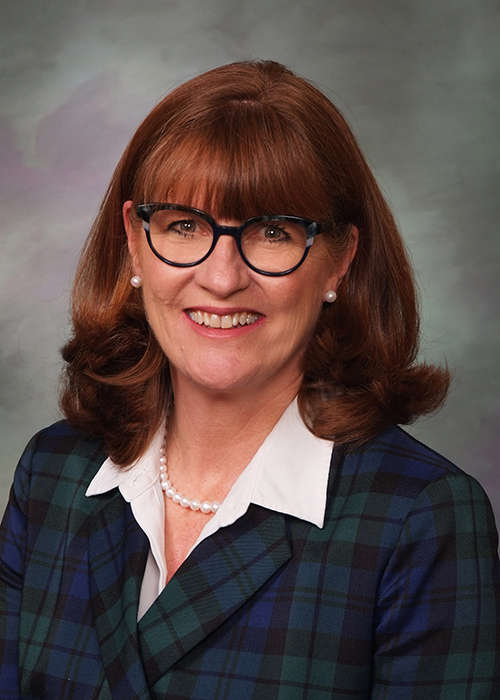
Photo of Julie McCluskie
D Colorado House · District 13

Rep. Julie McCluskie

Compare
Total votes
3,441
all sessions
Attendance
98%
71 missed
Lower than 83% of chamber peers
With party
98%
of cast votes
Higher than 98% of chamber peers
Bipartisan score
1%
crosses aisle rarely
Among the lowest in the chamber
Sponsored
615
bills & resolutions
Higher than 90% of chamber peers
Committees
3
assignments
615 bills and resolutions

Sponsored bills

Total
615
Primary
76
Co-sponsor
539
This page
615
matching current filters
Primary SB 154
Signed into law · Colorado Senate · Lead sponsor
Modify Colorado Channel Authority Board Appointments

Maddy summaryThis bill would change how members are appointed to the Colorado Channel Authority Board by removing the requirement that certain appointees must currently serve as state legislators. Under current law, four board members must be active members of the state legislature, with two appointed by the House leadership and two by the Senate leadership. The proposed change would allow these positions to be filled by individuals who are not serving in the General Assembly, while maintaining the existing appointment structure and political party balance requirements. The bill would take effect in August 2026 unless a referendum petition is filed, which would require voter approval for the changes to proceed.

Signed into law May 29, 2026 0 co-sponsors
Co-sponsor HB 1336
Signed into law · Colorado House · Co-sponsor
Increase Access to Pharmacy Services

If certain conditions are met, the act requires health benefit plans that provide hospital, surgical, or medical expense insurance to provide reimbursement for health-care services provided by a pharmacist that are within the pharmacist's scope of practice without entering into a collaborative pharmacy practice agreement. Similarly, under the medical assistance program (medicaid), the act authorizes reimbursement for services that are within a pharmacist's scope of practice and not duplicative of other pharmacist services or programs reimbursed by medicaid.     Further, solely on the basis of the type of license or certification, a health benefit plan or health insurance company (carrier) shall not discriminate against a pharmacist who is acting within the scope of the pharmacist's license or certification under state law, with respect to participation, referral, reimbursement of covered services, or indemnification, or prohibit a pharmacist from membership in a provider network; except that, in selecting pharmacist providers, the act does not:Prohibit a health benefit plan or carrier from including providers in its provider network only to the extent necessary to meet the needs of the plan or from limiting referrals or establishing quality control measures;Require a health benefit plan or carrier to contract with any provider willing to abide by the terms and conditions for participation established by the health benefit plan or carrier; orRequire coverage for any health-care service that is not otherwise covered.     The act makes changes to the definitions in the pharmacy practice statutes to include a definition for 'final product verification'. For drug, device, or product orders that are not for controlled substances, final product verification may be delegated by a supervising pharmacist to a certified pharmacy technician or pharmacy intern. A pharmacy or other outlet shall have a continuous quality assessment system in place to periodically verify the accuracy of the final drug, device, or product and must create a plan for final product verification, including how pharmacists' hours will be maintained to provide direct patient care. The state board of pharmacy is required to adopt rules relating to final product verification no later than December 31, 2026.     Under current law, a pharmacist may administer certain tests to patients who are 12 years old or older for certain conditions and prescribe drugs to treat the tested conditions. The act adds to the definition of the 'practice of pharmacy' independent prescriptive authority for drugs that are not controlled substances, drug categories, or devices that are prescribed to patients who are 5 years old or older but under 12 years old for conditions that do not require a new diagnosis, that are minor and self-limiting, or that have a test that guides diagnosis and are not medications that may only be prescribed pursuant to a certified education program and a limited distribution network. If a pharmacist tests or treats any patient who is under 18 years old, the act requires a pharmacist to notify the patient's primary care provider consistent with health-care privacy laws or, if the patient does not have or disclose a primary care provider, refer the patient to a primary care provider for further care.(Note: This summary applies to this bill as enacted.)

Signed into law May 29, 2026 1 co-sponsor
Co-sponsor HB 1320
Signed into law · Colorado House · Co-sponsor
Accessible Language Statutory Ballot Title Requirements

Under current law, the title board must set a ballot title for an initiative petition that is brief, does not conflict with another title for an initiative petition filed for the same election, and is in the form of a question that may be answered 'yes/for' or 'no/against' and that unambiguously states the principle of the provision sought to be added, amended, or repealed by the initiative. The act adds a requirement that the title board write a ballot title using accessible language, which means plain language that is understood by the widest possible audience. In determining whether a ballot title is written using accessible language, the title board may consider whether the title:Avoids using legal, technical, or specialized terminology when possible;Clearly identifies the principal change in law or policy proposed by the proposed statutory or constitutional amendment;Avoids unnecessary qualifiers, double negatives, and overly complex phrasing;Organizes clauses so that the effect of a 'yes/for' or 'no/against' vote is readily understood; andPresents necessary information within the ballot title in a logical and readable order.     In addition, current law requires that specific language appear in the ballot title for certain initiatives that increase or reduce tax revenue. For initiatives that reduce state tax revenue or local district property tax revenue through a tax change, this required language must appear at the beginning of the ballot title. For initiatives that increase tax revenue for any district through a tax change, this required language must appear directly after language required by the Taxpayer's Bill of Rights. The act modifies these statutory provisions so that the required ballot title language must only be substantially similar to the specific statutory language and may appear anywhere in the ballot title.     The act applies to initiative petitions submitted to the secretary of state for title setting on or after the effective date of the act.(Note: This summary applies to this bill as enacted.)

Signed into law May 29, 2026 1 co-sponsor
Co-sponsor HB 1338
Signed into law · Colorado House · Co-sponsor
2026 Water Projects Bill

The act appropriates the following amounts for the 2026-27 state fiscal year from the Colorado water conservation board (CWCB) construction fund to the CWCB or the division of water resources in the department of natural resources for the following projects:Continuation of the satellite monitoring system, $380,000 (section 1 of the act);Continuation of the floodplain map modernization program, $500,000 (section 2);Continuation of the weather modification permitting program, $500,000 (section 3);Continuation of the Colorado Mesonet project, $200,000 (section 5);Continuation of the water forecasting partnership project, $2,500,000 (section 6);Continuation of Colorado decision support system operation and maintenance, $750,000 (section 7);Support for water plan agency actions, $1,350,000 (section 9);Continuation of the Colorado watershed restoration and flood mitigation projects, $5,000,000 (section 10); andContinuation of the upper Colorado river commission planning, $750,000 (section 11).     Section 4 directs the state treasurer to transfer up to $6,000,000 from the CWCB construction fund to the CWCB litigation fund on or before July 1, 2026.     Section 8 restores the fish and wildlife resources fund balance by transferring $2,000,000 from the CWCB construction fund to the fish and wildlife resources fund.     Section 12 authorizes the CWCB to make a loan in an amount of $151,500,000 from the severance tax perpetual base fund to the city of Fort Collins to support the Halligan water supply project.     Section 13 authorizes the CWCB to make a loan in an amount of $20,166,670 from the severance tax perpetual base fund to the Lower Latham Reservoir Company for the Jurgens reservoir construction project.     Section 14 appropriates $37,700,000 from the water plan implementation cash fund to the CWCB to award grants that will help implement the state water plan.     Section 15 clarifies that the money that is currently in the turf replacement fund is appropriated for designated purposes to the CWCB until June 30, 2028. Any money remaining in the turf replacement fund on July 1, 2028, is transferred to the CWCB construction fund.     Section 16 makes technical corrections so that money appropriated in 2025 is available to the department of natural resources executive director's office for the purpose of paying for a study by the Colorado water center at Colorado state university.     Under current law, the CWCB may authorize loans up to $10 million from the CWCB construction fund or severance tax perpetual base fund without legislative authorization. The act increases that amount to $30 million (section 17).(Note: This summary applies to this bill as enacted.)


Signed into law May 29, 2026 1 co-sponsor
Co-sponsor HB 1100
Signed into law · Colorado House · Co-sponsor
Guardianship for Incapacitated Adults

The act establishes a bill of rights for adults subject to guardianship (ward) and details what decisions a court may authorize a guardian to make on behalf of a ward.     The act updates the duties of a guardian to include a duty to notify the ward at least 30 days before the ward is permanently moved to a nursing home, mental health institution, or other facility that restricts the ward's ability to leave the facility or have visitors.     On or before November 1, 2027, and November 1, 2028, the act requires the state court administrator's office to submit a report detailing the fiscal impact of this act on the judicial department to the joint budget committee, the senate judiciary committee, and the house of representatives judiciary committee, or their successor committees, and requires the state court administrator's office to create the report using existing data sources.(Note: This summary applies to this bill as enacted.)
Signed into law May 29, 2026 1 co-sponsor
Co-sponsor SB 114
Signed into law · Colorado Senate · Co-sponsor
Spirituous Liquor Manufacturer Sales Rooms & Other Alcohol

A manufacturer of spirituous liquors (manufacturer) that seeks to serve and sell alcohol beverages acquired from wholesalers licensed in the state (wholesaler) at the manufacturer's licensed premises and any approved sales room is required to apply for a permit from the local and state licensing authorities for on-premises consumption for each location where the manufacturer will serve and sell alcohol beverages acquired from a wholesaler.     Prior to issuing the permit, the local licensing authority shall provide public notice and consider the reasonable requirements of the neighborhood, zoning restrictions, and other local licensing concerns. The act includes fees that a permit applicant must pay to a local licensing authority. Upon approval from the local licensing authority, a manufacturer shall apply to the state licensing authority for a state permit. If the state permit is approved:The manufacturer must serve sandwiches and light snacks if selling and serving alcohol beverages acquired from a wholesaler; andThe proceeds from the sale of alcohol beverages acquired from wholesalers must not account for more than 50% of the manufacturer's gross annual revenue from alcohol beverage sales.      The state permit is valid until the expiration of the local permit or for one year after the date of issuance of the state permit, whichever is sooner, unless the permit is inactive, suspended, or revoked.     If a manufacturer does not obtain a permit from the local and state licensing authority to serve and sell alcohol beverages acquired from a wholesaler, the manufacturer may purchase and use common alcohol modifiers to combine with the manufacturer's spirituous liquors to produce cocktails for consumption on and off the sales room premises.(Note: This summary applies to this bill as enacted.)

Signed into law May 29, 2026 1 co-sponsor
Co-sponsor HB 1239
Signed into law · Colorado House · Co-sponsor
County Enforcement Authority

The act updates county enforcement authority in connection with:Providing for and compelling the removal of rubbish, including trash, junk, and garbage, from property within the county;Providing for and compelling the removal of weeds and brush from property within the county;Providing for and compelling the removal or securing of any building or structure in the county, with specified exceptions, that, due to its condition, presents a substantial danger or hazard to the public health, safety, or welfare; andThe unlawful erection, construction, reconstruction, alteration, or use of any building or structure in the county or the use of any land in the county in violation of a zoning resolution or ordinance adopted by the board of county commissioners.     For the removal actions described above, the act requires county ordinances to include provisions for applying for and exercising an administrative entry and seizure warrant. The act also allows counties to assess the reasonable costs of removal, including a 10% fee for inspection and incidental costs, as a lien against the property.     The act modifies the civil penalties that a court may impose and the factors that a court must consider in determining the appropriate civil penalty when a property owner violates a county ordinance or building code regarding the removal of rubbish or weeds and brush from property within the county, the removal or securing of a building or structure in the county, or the unlawful erection, construction, reconstruction, alteration, or use of a building or structure in the county.(Note: This summary applies to this bill as enacted.)

Signed into law May 29, 2026 1 co-sponsor
Co-sponsor HB 1260
Signed into law · Colorado House · Co-sponsor
Updates to Child Care Assistance Programs

The act extends the implementation dates for capping family copayments for child care at 7% of family income, for paying child care providers in advance of the provision of services, and for utilizing grants and contracts to improve access to child care for underserved populations to August 1, 2028.     The act modifies existing reporting requirements to include the total amount of child care assistance program (CCCAP) allocation that is spent by the department and each county on administrative expenses, county indirect expenses, program implementation costs, and direct service expenses.(Note: This summary applies to this bill as enacted.)

Signed into law May 29, 2026 1 co-sponsor
Co-sponsor HB 1263
Signed into law · Colorado House · Co-sponsor
Conversational Artificial Intelligence Service Operator Requirements

The act defines a 'conversational artificial intelligence service' as an artificial intelligence system that is accessible to the general public and that primarily simulates human conversation and interaction through adaptive textual, visual, or aural communications.     Effective January 1, 2027, the act creates requirements and prohibitions for a person, partnership, corporation, or entity that develops and makes publicly available a conversational artificial intelligence service or offers a conversational artificial intelligence service to a consumer (operator).     An operator is required to use commercially reasonable methods or generally accepted methods to estimate the age of a consumer who has or opens an account or profile to use a conversational artificial intelligence service (account holder) and the age of other users of a conversational artificial intelligence service. If an operator knows that an account holder or user is a minor, an operator is:Required to provide certain disclosures;Prohibited from providing the minor account holder or minor user with points or rewards to encourage engagement with the conversational artificial intelligence service;Required to institute technically feasible measures to prevent the conversational artificial intelligence service from producing explicit sexual conduct, intimate digital depictions, or statements that simulate emotional dependence;Required to implement a protocol for a conversational artificial intelligence service to stop engaging in response to a user prompt regarding sexual conduct with a minor; andRequired to provide tools for the minor account holder or minor user or a parent or guardian of the minor account holder or minor user to manage the minor account holder's or minor user's privacy and account settings.     The act also requires an operator to provide a disclosure to a user that a conversational artificial intelligence service is artificial intelligence, implement a protocol for user prompts regarding suicidal ideation or self-harm, and annually report to the attorney general's office information regarding the protocol the operator is implementing. The act prohibits an operator from stating that any output data provided by a conversational artificial intelligence service is provided by, endorsed by, or equivalent to services provided by certain licensed or certified professionals.     The act clarifies that nothing in the act limits an individual's ability to access certain information and resources pursuant to the state constitution, requires an operator to disclose confidential information, or authorizes content moderation practices inconsistent with the United States constitution.(Note: This summary applies to this bill as enacted.)

Signed into law May 29, 2026 1 co-sponsor
Co-sponsor HB 1081
Signed into law · Colorado House · Co-sponsor
Optimize Colorado Electric Transmission System

Section 3 of the act defines 'advanced transmission technologies' as hardware or software technologies that increase the capacity, efficiency, reliability, or resiliency of an existing or new transmission facility.     Section 4 requires the Colorado public utilities commission (commission) to adopt rules requiring a regulated electric utility to consider advanced transmission technologies in the electric utility's 10-year transmission plan and to identify strategies to reduce the costs of, and obtain financing for, new transmission. The commission is directed to minimize duplication of transmission planning processes, technical studies, or analyses conducted through an applicable regional transmission organization or independent system operator.     Section 5 requires the Colorado electric transmission authority (authority) to, as much as practicable, engage and coordinate with formal subregional transmission planning organizations.     Under current law, the authority is required to annually submit a report of its activities, including a complete operating and financial statement covering the operations of the authority for the previous state fiscal year, to certain committees of reference of the general assembly. Section 6 requires that the annual report also include a description of the activities and accomplishments of the authority during the previous calendar year.     Section 7 adds a nonvoting seat to the authority's board of directors for the director of the commission or the director's designee.     Section 8 clarifies that a project that includes advanced transmission technologies and meets certain criteria is an energy sector public works project. Section 9 states that an energy sector public works project that includes advanced transmission technologies must meet applicable prevailing wage requirements and apprenticeship utilization requirements.(Note: This summary applies to this bill as enacted.)

Signed into law May 29, 2026 1 co-sponsor
Showing 91 to 100 of 615 bills
Previous 1 … 9 10 11 … 62 Next