

Maddy summaryThis bill would amend federal law to strengthen penalties for organized retail crime by expanding definitions of theft to include digital goods, gift cards, and setting a $5,000 aggregate value threshold for charges over a 12-month period. It would establish a new "Organized Retail and Supply Chain Crime Coordination Center" under Homeland Security to coordinate Federal, State, local, and Tribal law enforcement efforts against cross-jurisdictional theft groups. The Center would share information with retailers, transportation companies, and law enforcement agencies, track crime trends, and produce annual reports on organized retail crime. This legislation directly affects retailers, supply chain businesses, and law enforcement agencies, while targeting organized crime groups responsible for a 93% increase in larceny incidents and rising safety concerns for retail employees. The bill aims to address significant financial losses and supply chain disruptions noted in the National Retail Federation's 2023 data.
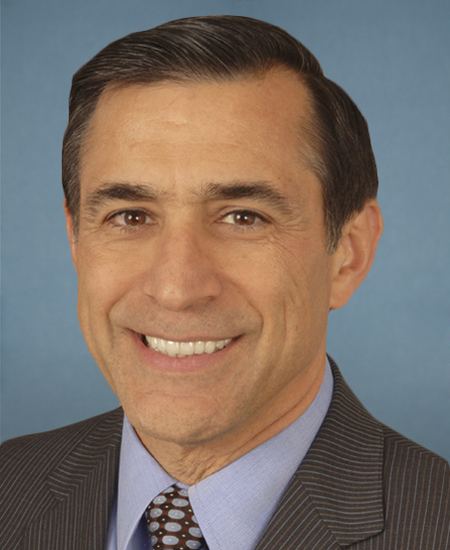
Rep. Darrell Issa
Sponsored bills
Maddy summaryHR 2488 designates the U.S. Postal Service facility at 3817 Marysville Boulevard in Sacramento, California, as the "Grantland Johnson Post Office." This bill updates all federal references in laws, maps, and documents to use the new name for that specific location. It directly affects the postal service facility and any federal records mentioning it. The bill is purely procedural, with no policy changes or financial impacts beyond the name designation.
Maddy summaryThis House Resolution proposes to formally "expunge" the two impeachments of President Donald Trump that passed the House of Representatives on December 18, 2019, and January 13, 2021. If passed, the resolution specifies that these impeachments would be treated "as if such Articles had never passed the full House of Representatives." This action directly affects President Trump by aiming to remove these impeachment proceedings from his official record and would alter the historical legislative record of the House. The resolution's text outlines several reasons for this action, including claims of wrongful accusations, lack of due process, and political bias in the original impeachment proceedings.
Maddy summaryThis bill aims to improve the efficiency and transparency of export license processing by the Bureau of Industry and Security at the Department of Commerce. It requires the agency to make licensing decisions within 90 days of receiving an application and mandates notifications to applicants if a decision is delayed beyond 120 days. The legislation also establishes quarterly reports to Congress detailing license application statistics, processing times, and reasons for delays, while directing the Government Accountability Office to conduct an audit of the current licensing process.
Maddy summaryThis bill requires the U.S. government to produce a detailed report on how effective current export controls on semiconductors and related technology are against China. The report must evaluate each control's impact on China's military, AI development, and semiconductor industry, while also analyzing effects on U.S. companies and global competitiveness. It mandates that the State Department, in coordination with Commerce and intelligence agencies, gather data from industry stakeholders and submit an unclassified version of the findings to Congress within 360 days. The document will also identify which controls are working, which are failing, and offer recommendations for improving enforcement and closing loopholes.
Maddy summaryThis bill modifies the Export Control Reform Act of 2018 to require the Under Secretary for Industry and Security to consider whether a license application represents the first export authorization for an item to a specific buyer. It mandates that if an initial license is granted, the agency must promptly process any subsequent applications from other parties seeking to export similar items to the same buyer. The legislation also requires annual reports to Congress detailing the number of initial licenses issued, information about competing applications, and explanations for why initial licenses were granted despite other requests. These changes aim to increase transparency in export licensing procedures while maintaining flexibility for national security and foreign policy decisions.
Equal Representation Act This bill requires that the statement sent by the President to Congress after the decennial census indicating the number of persons in each state exclude noncitizens. (This statement is the basis for reapportionment of U.S. Representatives.) The bill also requires any questionnaire used in the decennial census to include a checkbox or other similar option for respondents to indicate whether the respondent and each household member is (1) a U.S. citizen, (2) a U.S. national but not a citizen, (3) a non-U.S. national ( alien under federal law) lawfully residing in the United States, or (4) a non-U.S. national unlawfully residing in the United States. The Department of Commerce must make public the number of persons in each state, disaggregated by each of these four categories.
Maddy summaryHR 1071, the "No Censors on our Shores Act," amends U.S. immigration law to make certain foreign government officials inadmissible or deportable if they censor U.S. citizens within the United States. Specifically, it targets officials who directly carried out censorship against U.S. citizens in the U.S. that would violate the First Amendment if done by a U.S. official. The bill adds new grounds for inadmissibility (under Section 212(a)(2)(J)) and deportability (under Section 237(a)(2)(G)) based on this censorship. It directly affects foreign government officials whose actions meet this standard, not the general public or U.S. citizens. The law focuses on immigration consequences for foreign officials engaging in speech suppression that would breach First Amendment protections domestically.
Maddy summaryHR 7669, the "Rejecting the Erasure of Afghan Women and Girls Act," requires the U.S. Secretary of State to submit a report within 180 days of enactment. The report must detail Taliban-imposed restrictions on Afghan women and girls since August 2021 and determine whether these restrictions constitute crimes against humanity, torture under the Convention against Torture, or gross human rights violations under U.S. law. This bill directly addresses the situation of Afghan women and girls under Taliban rule by mandating a formal U.S. government assessment of those restrictions. The legislation focuses on establishing a factual basis for potential policy responses through this required report.
Bill to Outlaw Wounding of Official Working Animals Act or the BOWOW Act This bill establishes that a non-U.S. national ( alien under federal law) convicted of, or who admits to having committed, an offense related to harming animals used in law enforcement is inadmissible and deportable.