

Maddy summaryHR 1919, the "Anti-CBDC Surveillance State Act," prohibits the Federal Reserve from developing, testing, or issuing any central bank digital currency (CBDC) or similar digital assets. It specifically bans the Fed from offering direct financial products to individuals, maintaining individual accounts, or issuing CBDCs directly or indirectly through intermediaries like banks. The bill also blocks the Fed from using any digital asset for monetary policy and clarifies that physical currency's privacy protections remain intact. This policy directly affects the Federal Reserve System's ability to create or manage digital monetary tools.
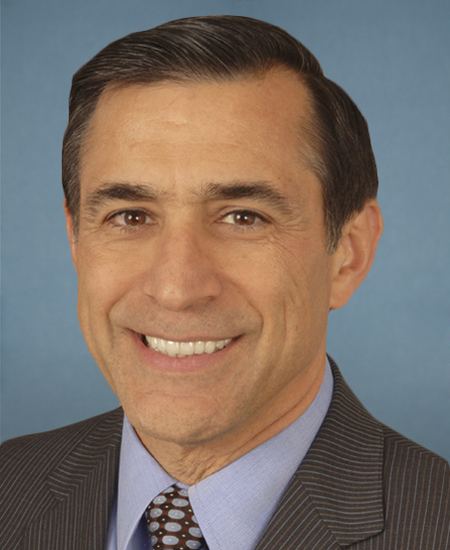
Rep. Darrell Issa
Sponsored bills
Maddy summaryHR 4454, the SOIL Act of 2025, prohibits China, Iran, North Korea, and Russia (or entities controlled by them) from buying or leasing property within 10 miles of designated sensitive sites. These sites include U.S. military installations, ports, government facilities, and any property that could enable foreign intelligence gathering or expose national security activities to surveillance. The bill amends the Defense Production Act to create this restriction, effective upon enactment, and requires the Committee to notify Congress of any violations. It directly affects foreign entities from the specified countries seeking to acquire property near these defined national security locations.
Maddy summaryThis bill changes the federal tax rate for hookah tobacco (also called waterpipe tobacco) from $2.83 per pound to $0.57 per pound, while keeping the higher tax rate for regular pipe tobacco. It directly affects manufacturers and importers of hookah tobacco products like shisha and maassel by lowering their tax burden. The bill also formally defines "waterpipe tobacco" to include common terms like hookah, shisha, and argileh, ensuring clear tax application. These changes apply to tobacco products manufactured or imported after the bill's enactment date.
Maddy summaryHR 4382 authorizes the U.S. Mint to produce commemorative coins for the 2028 Los Angeles Olympics/Paralympics and 2034 Salt Lake City Winter Olympics/Paralympics. It specifies gold, silver, and half-dollar coin designs with defined mintage limits (e.g., up to 100,000 $5 gold coins for each event), all bearing inscriptions like "2028" or "2034" and standard coin features. A surcharge ($5-$50 per coin) is added to sales, with all funds directed to the respective Olympic committees to support event hosting and legacy programs like youth sports. The bill ensures no net cost to the government by requiring surcharge revenues to cover all design, production, and marketing expenses before funds are disbursed.
Maddy summaryHRES 571 is a symbolic resolution passed by the U.S. House of Representatives to commemorate the one-year anniversary of the July 13, 2024, attempted assassination of President Donald J. Trump in Butler, Pennsylvania. It condemns two assassination attempts against the President (in Butler and West Palm Beach), honors victims Corey D. Comperatore (who died shielding his family), David Dutch, and James Copenhaver (who were critically injured), and expresses gratitude to first responders. The resolution also condemns incitement of violence against political officials and calls for unity against political violence. As a non-binding resolution, it does not create new laws or policies but formally states the House’s position on these events.
Maddy summaryHRES 516 is a formal resolution condemning the violent riots that occurred in Los Angeles, California, on June 6, 2025. It specifically addresses acts of arson, looting, property destruction, and attacks on law enforcement officers during protests related to federal immigration enforcement actions. The resolution does not create new laws or policies but expresses the House’s condemnation of the violence, calls on local and state leadership to collaborate with federal authorities to restore order, and thanks law enforcement agencies for their response. This is a symbolic statement with no direct impact on affected individuals or new legislative mechanisms.
Maddy summaryHR 875 amends immigration law to make non-citizens with DUI convictions inadmissible (preventing entry) and deportable (requiring removal after entry). It applies to any conviction for driving while intoxicated or impaired under state, tribal, or local law, regardless of whether the offense is classified as a misdemeanor or felony. The bill directly affects non-citizens convicted of driving under the influence of alcohol or drugs, including impairment from other substances. This policy change expands immigration consequences for DUI offenses beyond current standards.
Maddy summaryHR 4199, the Modernize the Au Pair Program Act of 2025, updates federal regulations for the au pair program to improve affordability and flexibility for host families. The bill requires the Department of State to propose new rules within 90 days, including a revised stipend formula reflecting room, board, and childcare costs without making the program prohibitively expensive. It also mandates greater program flexibility to accommodate military families, first responders, single parents, and shift workers with non-traditional schedules. The bill explicitly prohibits states from regulating the program, ensuring all rules remain uniform under federal law as intended by Congress. This directly affects American host families seeking affordable childcare and au pairs participating in the cultural exchange program.
Maddy summaryThe WILTR Act of 2025 provides tax relief for landowners conducting wildfire prevention work. It excludes from taxable income grants or services received for hazardous fuel reduction activities (like creating firebreaks or prescribed burns) and allows a new deduction for expenses related to these activities. Landowners must have their work certified by a state, local, tribal, or federal fire agency to qualify. This directly affects property owners in wildfire-prone areas who undertake fuel reduction projects to reduce fire risk.
Maddy summaryHR 4073 reauthorizes and updates the Tsunami Warning and Education Act to modernize U.S. tsunami warning systems. It requires NOAA to improve data management (including real-time GNSS network data), update inundation maps, evaluate alert terminology with communities, and integrate tsunami warnings into the USGS Earthquake Early Warning System. The bill mandates $32 million annually (2026-2030) for these efforts, with 27% funding state-level tsunami hazard mitigation programs and 8% supporting tsunami research. This directly affects coastal communities at risk, NOAA warning centers, and federal agencies like USGS and NASA through enhanced forecasting, data sharing, and standardized warning protocols.