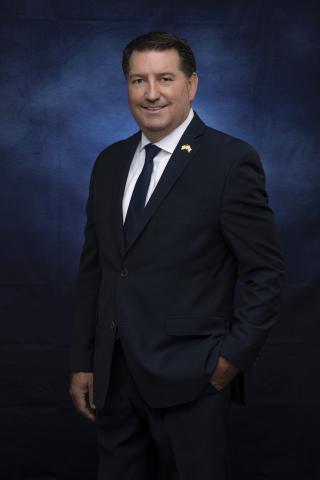
This measure would designate the East End Complex-Block 171 in Sacramento as the Mario Obledo Building, and would request the Department of General Services to determine the cost of erecting appropriate plaques and markers showing the designation and, upon receiving donations from nonstate sources, to cover that cost to erect signage.
Sponsored bills
This measure would urge the United States Congress to amend the United States Social Security Administration's index of earnings to ensure that a decline in aggregate wages due to COVID-19 does not result in decreased benefits.
This measure would designate the interchange of Interstate 80 and Interstate 780 in the City of Vallejo in the County of Solano as the Congressional Gold Medal Memorial Interchange. The measure would request that the Department of Transportation determine the cost of appropriate signs showing this special designation and, upon receiving donations from nonstate sources covering that cost, erect those signs.
This measure would, among other things, on the first anniversary of the attack on the United States Capitol on January 6, 2021, urge the Select Committee to Investigate the January 6th Attack on the United States Capitol to uncover the facts, circumstances, and causes relating to the attack, and honor the individuals who died or were injured as a result of the attack.
This measure would urge the United States Secretary of Education to establish and submit to the United States Congress for approval a monthly student loan payment plan for federal student loans, based on the personal savings rate as published by the federal Bureau of Economic Analysis.
This measure would designate the portion of State Route 5 from El Horno Street, at postmile 10.001, to Crown Valley Parkway, at postmile 13.776, in the County of Orange as the Senior Master Sergeant John James Paoletti Memorial Highway. The measure would request that the Department of Transportation determine the cost of appropriate signs showing this special designation and, upon receiving donations from nonstate sources covering that cost, erect those signs.
This measure would designate a portion of State Route 119, between E Kern Street, postmile 0.34, and Cedar Street, postmile 1.300, in the County of Kern as the Corporal Luis Carlos Ruan Memorial Highway. The measure would request the Department of Transportation to determine the cost of appropriate signs showing this special designation and, upon receiving donations from nonstate sources covering that cost, to erect those signs.
(1) Existing law provides for the compensation of victims and derivative victims of specified types of crimes by the California Victim Compensation Board from the Restitution Fund, a continuously appropriated fund, for specified losses suffered as a result of those crimes. Existing law defines various terms for purposes of these provisions. This bill would define "law enforcement officer" consistently with specified provisions. The bill would define "victim services provider" to mean an individual, whether paid or serving as a volunteer, who provides services to victims under the supervision of either an agency or organization that has a documented record of providing services to victims, or a law enforcement or prosecution agency. (2) Existing law requires that a person be ineligible for compensation under specified conditions, including, among other things, if the board determines that denial of the claim for compensation is appropriate because of the nature of the victim's involvement in the events leading to the crime or the involvement of the person whose injury or death gives rise to the application. Existing law requires the board to deny an application if it finds that the victim failed to cooperate reasonably with a law enforcement agency in the apprehension and conviction of a criminal committing the crime. This bill, in the case of a claim based on a victim's serious bodily injury or death that resulted from a law enforcement officer's use of force, would prohibit the board from denying an application based on the victim's or other applicant's involvement in the crime, except as specified, or the victim's failure to cooperate. The bill would require the board, solely for the purposes of eligibility for compensation, to accept as sufficient evidence forms of documentation, as described, that describe or demonstrate a person suffered serious bodily injury or death as a result of a law enforcement officer's use of force. The bill, in the case of a claim based on a victim's death as a result of a crime, would prohibit the board from denying an application based on the deceased victim's involvement in the crime or the victim's or derivative victim's failure to cooperate, except as provided. By expanding the types of crime for which compensation can be paid from a continuously appropriated fund, the bill would make an appropriation. (3) Existing law requires that the California Victim Compensation Board be subrogated to the rights of the recipient to the extent of any compensation granted by the board. This bill would specify that the above-described subrogation of the board applies to compensation by the board for a claim based on serious bodily injury or death that resulted from a law enforcement officer's use of force, as specified.
Existing law, the Ralph C. Dills Act (Dills Act) , governs collective bargaining between the state and recognized state public employee organizations. Existing law excludes certain employees from coverage under the Dills Act, including, among others, managerial employees, supervisory employees, and confidential employees, as defined. Existing law creates the Public Employment Relations Board and authorizes it, among other things, to determine appropriate state employee bargaining units, as specified. This bill would enact the Legislature Employer-Employee Relations Act, to provide employees of the Legislature the right to form, join, and participate in the activities of employee organizations of their own choosing for the purpose of representation on all matters of employer-employee relations. The bill would prescribe rights, duties, and prohibitions in this context that parallel those in the Dills Act. The bill would prohibit the Public Employment Relations Board from including employees of the Legislature in a bargaining unit that includes employees other than those of the Legislature. The bill would make it a misdemeanor for any person to willfully resist, prevent, impede, or interfere with any member of the board, or any of its agents, in the performance of duties pursuant to its provisions. By expanding the definition of a crime, this bill would impose a state-mandated local program. The bill would provide that the provisions of the Legislature Employer-Employee Relations Act are severable. The bill would become operative on July 1, 2024. The California Constitution requires the state to reimburse local agencies and school districts for certain costs mandated by the state. Statutory provisions establish procedures for making that reimbursement. This bill would provide that no reimbursement is required by this act for a specified reason.

This measure would commend the Congress of the United States for enacting legislation that will alleviate and remedy the congestion of California's ports. The measure also would urge the Congress of the United States to enact further legislation to ensure that the state's importing and exporting capabilities are returned to prepandemic levels.