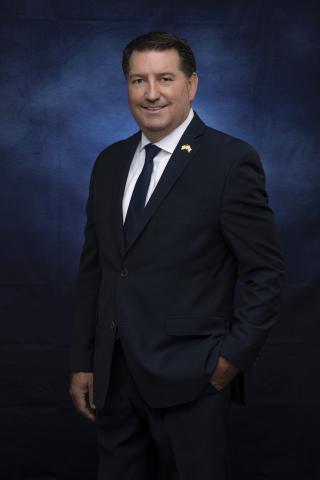
Photo of Tim Grayson
D California Senate · District 9

Sen. Tim Grayson

Compare
Total votes
25,590
all sessions
Attendance
95%
945 missed
Higher than 80% of chamber peers
With party
99%
of cast votes
Higher than 77% of chamber peers
Bipartisan score
0%
crosses aisle rarely
Lower than 85% of chamber peers
Sponsored
1,741
bills & resolutions
Near the chamber average
Committees
14
assignments
1,741 bills and resolutions

Sponsored bills

Total
1,741
Primary
246
Co-sponsor
1,495
This page
1,741
matching current filters
Primary AB 429
died · California House · Lead sponsor
State water policy: water rights: use and transferability.

Existing law declares that the growing water needs of the state require the use of water in an efficient manner and that the efficient use of water requires certainty in the definition of property rights to the use of water and transferability of those rights. This bill would make nonsubstantive changes to those declarations.

died Feb 1, 2018 0 co-sponsors
Co-sponsor SB 603
In committee · California Senate · Co-sponsor
San Francisco Bay Area Rapid Transit District: work stoppages.

Existing law creates the San Francisco Bay Area Rapid Transit District (BART) , governed by an elected board of directors, with various duties and responsibilities relative to the operation of a passenger rail transit system. Existing law establishes provisions regulating the collective bargaining of BART employees and its board of directors. This bill would prohibit BART from entering into an agreement that would limit its ability to prepare for a work stoppage or operate during a work stoppage. By imposing new duties on a local governmental entity, the bill would create a state-mandated local program. The California Constitution requires the state to reimburse local agencies and school districts for certain costs mandated by the state. Statutory provisions establish procedures for making that reimbursement. This bill would provide that, if the Commission on State Mandates determines that the bill contains costs mandated by the state, reimbursement for those costs shall be made pursuant to the statutory provisions noted above.

In committee Feb 1, 2018 1 co-sponsor
Primary AB 704
Failed · California House · Lead sponsor
Multidisciplinary teams: human trafficking and domestic violence.

Existing law requires every law enforcement agency in the state to develop, adopt, and implement written policies and standards for officers' responses to domestic violence. Existing law also authorizes counties to establish multidisciplinary personnel teams regarding issues like child abuse to allow various agencies to collaborate. This bill would authorize a county to establish a domestic violence multidisciplinary personnel team and a human trafficking multidisciplinary personnel team to allow agencies to share confidential information in order to investigate reports of suspected crimes. This bill would authorize members of those multidisciplinary personnel teams to disclose to one another information and records that are relevant to the prevention, identification, or treatment of those crimes.

Failed Feb 1, 2018 0 co-sponsors
Co-sponsor ACR 109
Passed · California House · Co-sponsor
Relative to Red Ribbon Week.

This measure would proclaim the period of October 23, 2017, to October 31, 2017, inclusive, as Red Ribbon Week and would encourage all Californians to help build drug-free communities and to participate in drug prevention activities.

Passed Jan 3, 2018 1 co-sponsor
Primary AB 1655
Signed into law · California House · Lead sponsor
University of California: requests from the California State Auditor's Office: prohibition on coordination.

(1) The California Constitution provides that the University of California constitutes a public trust administered by the Regents of the University of California, a corporation in the form of a board, with full powers of organization and government, subject to legislative control only for specified purposes. The University of California system includes 10 campuses, which are respectively located in Berkeley, Davis, Irvine, Los Angeles, Merced, Riverside, San Diego, San Francisco, Santa Barbara, and Santa Cruz. This bill, whenever a request for information relating to the security of funds of the University of California is made by the California State Auditor's Office pursuant to these provisions to one or more campuses of the University of California, would prohibit those campuses from coordinating their responses with, or seeking counsel, advice, or similar contact regarding their response from, the Office of the President of the University of California before submitting the requested information to the California State Auditor's Office. The bill would require the California State Auditor's Office, when requesting information under these provisions, to include a statement in the request that it is requesting the information pursuant to these provisions and that the request for information is not to be shared with the Office of the President of the University of California. (2) Existing law requires the University of California to report biennially to the Legislature and the Department of Finance on its total costs of education, as specified. Under existing law, these reports are required to be submitted on or before October 1 of each even-numbered year, commencing in 2014 and continuing until the requirement for submission of these biennial reports becomes inoperative on January 1, 2021. This bill would express the intent of the Legislature to ensure that the Legislature has accurate information upon which to base funding decisions relating to the University of California. The bill would require that the amounts included in the reports be based on publicly available information. The bill would require that the costs reported be prior year actual expenditures. The bill would change the date on which the requirement for submission of these biennial reports becomes inoperative to January 1, 2023.

Signed into law Oct 14, 2017 0 co-sponsors
Primary AB 1674
Signed into law · California House · Lead sponsor
University of California: nonresident student enrollment.

Existing law expresses the intent of the Legislature that the University of California establish nonresident student tuition policies that are consistent with their resident student fee policies. The provisions are applicable to the University of California only if the Regents of the University of California act, by resolution, to make them applicable. This bill would request the University of California, in collaboration with the Academic Senate of the University of California, to ensure that implementation of any admissions policy regarding admission of nonresident undergraduate students includes guidance that ensures the academic qualifications for admitted nonresident undergraduate students generally exceeds the academic qualifications of resident undergraduate students, and would request the University of California to report specified information to the Legislature annually regarding implementation of the policy.

Signed into law Oct 14, 2017 0 co-sponsors
Co-sponsor AB 1106
Signed into law · California House · Co-sponsor
Child care and development services: alternative payment programs.

The Child Care and Development Services Act, administered by the State Department of Education, provides that children from infancy to 13 years of age are eligible for federal and state subsidized child development services if their families meet at least one requirement in each of certain areas. The act requires the department to contract with local contracting agencies to provide for alternative payment programs, and authorizes alternative payment programs for services provided in licensed centers and family day care homes and for other types of programs that conform to applicable law. The act requires the department to expand existing alternative payment programs and fund new alternative payment programs to the extent that funds are provided by the Legislature. This bill would require an alternative payment program, with certain exceptions, to have no less than 36 months to expend funds allocated to that program in any fiscal year, and would require the Superintendent of Public Instruction to develop a process that provides alternative payment programs no less than 36 months to expend funds allocated to that program in any fiscal year.

Signed into law Oct 12, 2017 1 co-sponsor
Co-sponsor AB 1647
Signed into law · California House · Co-sponsor
Petroleum refineries: air monitoring systems.

Existing law generally designates air pollution control and air quality management districts with the primary responsibility for the control of air pollution from all sources other than vehicular sources. Existing law authorizes the State Air Resources Board or the air district to require the owner or the operator of an air pollution emission source to take any action that the state board or the air district determines to be reasonable for the determination of the amount of air pollution emissions from that source. This bill would require a refinery-related community air monitoring system, as defined, to be installed on or before January 1, 2020, as specified, and would require an air district to design, develop, install, operate, and maintain the refinery-related community air monitoring system or to contract with a third party to provide those services. The bill would require an owner or operator of a petroleum refinery to develop, install, operate, and maintain a fence-line monitoring system, as defined, on or before January 1, 2020, as specified. The bill would require the air district and the owner or operator of a refinery to collect real-time data from these monitoring systems, to provide that data as quickly as possible in a publicly accessible format, and to maintain records of that data. The bill would require the owner or operator of a petroleum refinery to be responsible for the costs associated with the refinery-related community air monitoring system and the fence-line monitoring system, except as specified. By adding to the duties of air districts, this bill would impose a state-mandated local program. The California Constitution requires the state to reimburse local agencies and school districts for certain costs mandated by the state. Statutory provisions establish procedures for making that reimbursement. This bill would provide that no reimbursement is required by this act for a specified reason.

Signed into law Oct 8, 2017 1 co-sponsor
Co-sponsor AB 249
Signed into law · California House · Co-sponsor
Political Reform Act of 1974: campaign disclosures.

(1) Existing law, the Political Reform Act of 1974, provides for the comprehensive regulation of campaign financing and activities. The act requires a committee that supports or opposes ballot measures to name and identify itself using a name or phrase that clearly identifies the economic or other special interests of its major donors of $50,000 or more. The act also requires that the identity of a common employer shared by major donors be disclosed. This bill would repeal these provisions. (2) The act defines "expenditure" as a payment, a forgiveness of a loan, a payment of a loan by a 3rd party, or an enforceable promise to make a payment, unless it is clear from the surrounding circumstances that it is not made for political purposes. This bill, which would be known as the California Disclose Act, would describe circumstances in which a payment would be made for political purposes within the meaning of the definition of "expenditure." (3) The act prohibits a candidate or committee from sending a mass mailing unless the name, street address, and city of the candidate or committee are shown on the outside of each piece of mail in the mass mailing, as specified. This bill would additionally require the name of such an entity to be disclosed in a mass electronic mailing, as defined, that the entity sends. The bill would provide that these disclosure requirements do not apply if the mass mailing or mass electronic mailing is paid for by an independent expenditure. (4) The act prohibits a candidate, committee, or slate mailer organization from expending campaign funds to pay for specified telephone calls that advocate support of, or opposition to, a candidate, ballot measure, or both, unless the name of the organization that authorized or paid for the call is disclosed to the recipient of the call during the course of each call. This bill would instead apply these requirements to a candidate, a candidate controlled committee established for an elective office for the controlling candidate, a political party committee, and a slate mailer organization that expends campaign funds to pay for such telephone calls. The bill would provide that these disclosure requirements do not apply if the telephone call is paid for by an independent expenditure. (5) The act also requires advertisements, as defined, to include prescribed disclosure statements, including, among others, a requirement that the disclosure statements include the names of the persons who made the 2 highest cumulative contributions, as defined, to the committee paying for the advertisement. This bill would repeal and recast provisions of the act relating to advertisement disclosure statements. The bill would revise the definition of "advertisement" to exclude a number of communications, including communications that involve wearing apparel, sky writing, and certain electronic media communications, as specified. The bill would also replace existing advertisement disclosure statements with newly prescribed disclosure statements that identify the name of the committee paying for the advertisement and the top contributors to that committee. The bill would define "top contributors" for purposes of these provisions as the persons from whom the committee paying for the advertisement received its 3 highest cumulative contributions, as specified. The bill would exempt certain committees, including committees that make independent expenditures totaling $1,000 or more in a calendar year, from the requirement to disclose the top contributors in advertisement disclosure statements. The bill would also prescribe location and format criteria for the disclosure statements that are specific to radio and telephone, television and video, print, and electronic media advertisements. (6) The act imposes, in addition to other penalties, a fine of up to triple the amount of the cost of an advertisement on a person who violates the disclosure requirements for advertisements. This bill would revise the scope of violations subject to that fine by specifying that it applies to certain disclosure requirements and intentional violations. (7) The act prohibits a person from making a contribution as an intermediary on behalf of another person without disclosing to the recipient of the contribution specified information about both the intermediary and the source of the contribution. The act also prohibits a person from making a contribution to a committee on the condition or with the agreement that it will be contributed to a particular candidate unless the contribution is disclosed in compliance with those requirements for contributions made by an intermediary. This bill would prohibit a person from making a contribution to a committee or candidate that is earmarked unless the contribution is disclosed in compliance with the requirements for contributions made by an intermediary. The bill would also describe circumstances in which a contribution is deemed to be earmarked. The bill would impose additional disclosure requirements in connection with earmarked contributions from one committee to another. (8) Because a violation of the act is punishable as a misdemeanor, this bill would impose a state-mandated local program. The California Constitution requires the state to reimburse local agencies and school districts for certain costs mandated by the state. Statutory provisions establish procedures for making that reimbursement. This bill would provide that no reimbursement is required by this act for a specified reason. (9) The Political Reform Act of 1974, an initiative measure, provides that the Legislature may amend the act to further the act's purposes upon a 23 vote of each house of the Legislature and compliance with specified procedural requirements. This bill would declare that it furthers the purposes of the act. This bill would declare that it is to take effect immediately as an urgency statute.


Signed into law Oct 7, 2017 1 co-sponsor
Showing 1,561 to 1,570 of 1,741 bills