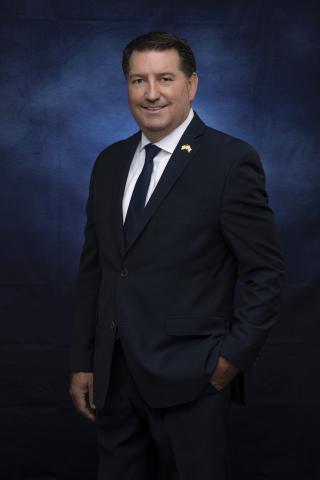
This measure would honor the late Reverend Dr. Martin Luther King, Jr. and commemorate Dr. Martin Luther King, Jr. Day.
Sponsored bills
Existing law requires the Commission on Peace Officer Standards and Training to adopt and amend rules establishing minimum standards relating to the recruitment and training of local public safety dispatchers, who have the primary responsibility for providing dispatching services for local law enforcement agencies. Under existing law, those requirements apply to cities, counties, cities and counties, and districts receiving specified state aid and to consolidated dispatch centers operated by independent joint powers agencies. This bill would require the commission, on or before January 1, 2021, to adopt training requirements for local public safety dispatchers that include 3 hours of training in recognizing the signs of human trafficking. The bill would require a person hired on or after January 1, 2021, to have received the training before beginning duty and would require a person employed as a local public safety dispatcher prior to January 1, 2021, to receive the training no later than January 1, 2022. By requiring local entities to train, or obtain training for, local public safety dispatchers, this bill would impose a state-mandated local program. The California Constitution requires the state to reimburse local agencies and school districts for certain costs mandated by the state. Statutory provisions establish procedures for making that reimbursement. This bill would provide that, if the Commission on State Mandates determines that the bill contains costs mandated by the state, reimbursement for those costs shall be made pursuant to the statutory provisions noted above.
Existing law, the Elder Abuse and Dependent Adult Civil Protection Act, establishes procedures and requirements for the reporting, investigation, and prosecution of elder and dependent adult abuse. Existing law imposes various reporting requirements on mandated reporters of suspected financial abuse, as defined, of an elder or dependent adult, and imposes a civil penalty for a violation of these provisions. Under existing law, all officers and employees of financial institutions, as defined, are mandated reporters of suspected financial abuse. Existing law, the Money Transmission Act, provides for the licensure and regulation, by the Commissioner of Business Oversight, of certain persons engaged in the business of money transmission. This bill would require a business that is licensed under the Money Transmission Act whose primary business function is transmitting money, that operates out of a physical storefront or location and that does not engage in other transactions, to provide notice to customers who are 65 years of age or older making the customer aware that fraud has been committed in recent years by means of money transmittals. The bill would govern the manner for providing the notice and would require the customer who receives the notice to provide confirmation that the customer has read and understood the notice before proceeding with the transaction. The bill would require the notice to be in a form prescribed by the commissioner and would require the commissioner to prescribe that form. The bill would require a civil penalty in the amount of $5,000 to be imposed for the willful failure to provide this notice.
(1) Under the Higher Education Facilities Bond Act of 1986, the Higher Education Facilities Bond Act of 1988, and the Higher Education Facilities Bond Act of June 1992, the issuance, pursuant to the State General Obligation Bond Law, of bonds in an amount not to exceed $400,000,000, $600,000,000, and $900,000,000, respectively, and the expenditure of the revenues therefrom, were authorized for the purpose of aid to the University of California and the California State University for, among other things, the construction and equipping of educational facilities, as specified. Existing law establishes the Higher Education Facilities Finance Committee to administer those acts, and to authorize the issuance and sale of bonds to the extent necessary to fund the education facilities construction apportionments expressly authorized by the Legislature in the annual Budget Act. More recently, the Class Size Reduction Kindergarten-University Public Education Facilities Bond Act of 1998, the Kindergarten-University Public Education Facilities Bond Act of 2002, the Kindergarten-University Public Education Facilities Bond Act of 2004, and the Kindergarten-University Public Education Facilities Bond Act of 2006 authorized the issuance of bonds and the expenditure of revenues therefrom for the University of California and the California State University, as well as for the California Community Colleges and public elementary and secondary schools. Article XVI of the California Constitution requires measures authorizing general obligation bonds to specify the single object or work to be funded by the bonds, and further requires a bond act to be approved by a 23 vote of each house of the Legislature and a majority of the voters. This bill would enact the Higher Education Facilities Bond Act of 2020 which, upon approval by the state electorate, would authorize the issuance of state general obligation bonds in the total amount of $7,000,000,000. The proceeds of the bonds issued and sold under the bill would be available for the construction, reconstruction, and remodeling of existing or new facilities, as specified, at the University of California, the Hastings College of the Law, and the California State University in specified proportions, including $3,000,000,000 for the construction of new campuses of the California State University. (2) This bill would provide for the submission of the Higher Education Facilities Bond Act of 2020 to the voters at the November 3, 2020, statewide general election.

Existing law creates a civil cause of action for using the name, voice, signature, photograph, or likeness of another person, without their consent, in any manner, for the purpose of advertising, selling, or soliciting goods or services. Existing law also creates a civil cause of action for capturing or attempting to capture, in a manner that is offensive to a reasonable person, any type of image or recording of a person engaging in a private, personal, or familial activity. Existing law prohibits the distribution of an intimate image, as described, of an identifiable person that was taken under circumstances in which the person agreed or understood that the image was to remain private. This bill would define a "deepfake" as a recording that has been created or altered in a manner that it would falsely appear to a reasonable observer to be an authentic record of the actual speech or conduct of the individual depicted in the recording. The bill would criminally prohibit a person from preparing, producing, or developing, without the depicted individual's consent, a deepfake that depicts an individual engaging in sexual conduct, under specified circumstances involving the distribution, exhibition, or exchange of the deepfake. This bill would also criminally prohibit a person from preparing, producing, or developing, without the depicted individual's consent, a deepfake with the intent that the deepfake coerce or deceive any voter into voting for or against a candidate or measure in an election that is occurring within 60 days, under specified circumstances involving the distribution, exhibition, or exchange of the deepfake. This bill would appropriate $25,000,000 from the General Fund to the University of California to fund research to identify and combat the inappropriate use of deepfake technology. By creating a new crime, this bill would impose a state-mandated local program. The California Constitution requires the state to reimburse local agencies and school districts for certain costs mandated by the state. Statutory provisions establish procedures for making that reimbursement. This bill would provide that no reimbursement is required by this act for a specified reason.
Existing law establishes the Department of Housing and Community Development in the Business, Consumer Services, and Housing Agency. The department is responsible for administering various housing and home loan programs throughout the state. Existing law requires the department, on or before January 1, 2019, to establish the Housing for a Healthy California Program to create supportive housing opportunities through grants to counties for capital and operating assistance, as specified, or operating reserve grants and capital loans to developers, or both. This bill would require the department, upon appropriation by the Legislature, to establish a competitive grant program to award grants to cities and counties to offset up to 100% of any transportation-related impact fees exacted upon a qualifying housing development project, as defined, by the local jurisdiction.
Existing law requires the Department of Veterans Affairs to disburse funds, appropriated to the department for the purpose of supporting county veterans service officers pursuant to the annual Budget Act, on a pro rata basis, to counties that have established and maintain a county veterans service officer in accordance with the staffing level and workload of each county veterans service officer under a formula based upon performance developed by the department. This bill would define a workload unit for purposes of these provisions to mean a specific claim activity that is used to allocate subvention funds to counties, which is approved by the department, and performed by county veterans service officers. The bill would appropriate on an annual basis the sum of $11,000,000 from the General Fund to the Department of Veterans Affairs to be available for allocation to counties to fund the activities of county veterans service officers, as specified. The bill would also delete obsolete provisions and would make conforming changes. This bill would declare that it is to take effect immediately as an urgency statute.
Existing law, the Planning and Zoning Law, authorizes a local agency to provide, by ordinance, for the creation of manufactured homes in single-family and multifamily residential zones and sets forth required ordinance standards, including, among others, maximum unit size, parking, and roof overhang standards. This bill would prohibit a local agency from imposing additional building standards for projects that are constructed using prefabricated and manufactured units, beyond those set forth in the California Building Standards Code.
Existing law, the Electronic Communications Privacy Act, generally prohibits a government entity from compelling the production of or access to electronic communication information or electronic device information, as defined, without a search warrant, wiretap order, order for electronic reader records, subpoena, or order for a pen register or trap and trace device, except for emergency situations, as defined. The Act does not limit the authority of a government entity to use an administrative subpoena to require a service provider to provide subscriber information, as defined. This bill would, notwithstanding the Electronic Communications Privacy Act, allow a peace officer investigating the sexual exploitation of children to issue an administrative subpoena to require the production of specified information relating to an internet service account, including any internet protocol address or username associated with the account, from a service provider.