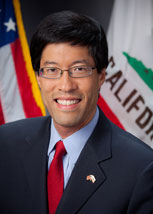
Photo of Richard Pan
D California Senate · District 6

Sen. Richard Pan

Compare
Total votes
26,098
all sessions
Attendance
98%
456 missed
Near the chamber average
With party
99%
of cast votes
Near the chamber average
Bipartisan score
0%
crosses aisle rarely
Lower than 77% of chamber peers
Sponsored
951
bills & resolutions
Lower than 83% of chamber peers
Committees
0
assignments
951 bills and resolutions

Sponsored bills

Total
951
Primary
341
Co-sponsor
610
This page
951
matching current filters
Co-sponsor SCR 96
Signed into law · California Senate · Co-sponsor
Relative to anniversary of Los Angeles Riots.

This measure would recognize the 30th anniversary of the Los Angeles Riots on April 29, 2022, as a time of building and reflection for the citizens of Los Angeles and the citizens of California.

Signed into law May 27, 2022 1 co-sponsor
Primary SB 908
In committee · California Senate · Lead sponsor
Student Board Member Advisory Commission.

Existing law establishes the State Board of Education and requires the state board to adopt rules and regulations, not inconsistent with the laws of the state, to govern the public elementary and secondary schools of the state. Existing law provides that the state board consists of 10 members, who are appointed by the Governor to 4-year terms with the advice and consent of 23 of the Senate. Existing law also provides for the appointment by the Governor, with the advice and consent of 23 of the Senate, of a student member to a single one-year term commencing on August 1. Existing law requires the state board to determine all questions of policy within its powers. This bill would create the Student Board Member Advisory Commission in the state government consisting of 13 commissioners, including the student member of the state board, who is required to chair the commission, and 12 other voting student members who meet certain requirements, including representing prescribed regions of the state, and are appointed by the state board. The bill would require commissioners to serve one-year terms, and prescribe provisions pertaining to reappointment, vacancies, and reimbursement of expenses. The bill would require the commission to study and provide assistance and advice to the student member of the state board, the state board, the Superintendent of Public Instruction, the Legislature, and the Governor in education policy as it relates to the experience of the state's pupils, and would require the commission to undertake certain other actions and activities. The bill would repeal these provisions on January 1, 2028.

In committee May 19, 2022 0 co-sponsors
Primary SB 1390
In committee · California Senate · Lead sponsor
Social media platforms: amplification of harmful content.

Existing law prohibits a person, among others, from making or disseminating in any advertising device, or in any manner or means whatsoever, including over the internet, any statement concerning real or personal property or services that is untrue or misleading, as specified. Existing law defines "libel" as a false and unprivileged publication, including by writing, printing, or picture, that exposes any person to hatred, contempt, and ridicule, among other things. This bill would prohibit a social media platform, as defined, from amplifying harmful content in a manner that results in a user viewing harmful content from another user with whom the user did not choose to share a connection. The bill would define "amplify" to mean to take action, either through manual or automatic means, that has the effect of increasing the viewership of certain material. The bill would provide that harmful content includes libel or slander, as specified, threats of imminent violence against governmental entities, and disinformation or misinformation, including, but not limited to, false or misleading information regarding medicine or vaccinations, false or misleading information regarding elections, and conspiracy theories. This bill would require a social media platform to establish a complaint process for users to access within the platform to report harmful content they believe has been amplified, and track each complaint in a database that is shared with the Attorney General, as specified. The bill provides that a platform violates these provisions if the platform continues to amplify reported harmful content after 24 hours of receiving notice from the Attorney General that the platform was amplifying that harmful content. This bill would authorize the enforcement of these provisions by civil action in a court of competent jurisdiction by the Attorney General and specify civil penalties to which violators would be subject. The bill would prohibit its provisions from being deemed to create a private right of action or limit any existing private right of action. The bill would exempt any information shared with the Attorney General pursuant to this chapter from disclosure under the California Public Records Act. Existing constitutional provisions require that a statute that limits the right of access to the meetings of public bodies or the writings of public officials and agencies be adopted with findings demonstrating the interest protected by the limitation and the need for protecting that interest. This bill would make legislative findings to that effect.

In committee Apr 21, 2022 0 co-sponsors
Primary SB 1464
In committee · California Senate · Lead sponsor
Law enforcement: public health orders.

Existing law requires all sheriffs to execute all lawful orders of a department in their counties. Existing law authorizes each sheriff to enforce all orders of the State Department of Public Health or of the local health officer issued for the purpose of preventing the spread of any contagious, infectious, or communicable disease. Existing law authorizes each peace officer of every political subdivision of the county to enforce within the area subject to their jurisdiction all orders of the State Department of Public Health or of the local health officer issued for the purpose of preventing the spread of any contagious, infectious, or communicable disease. This bill would instead require those sheriffs and peace officers to enforce those orders. By expanding the duties of local law enforcement, this bill would create a state-mandated local program. The bill would additionally prohibit state funds allocated for the purpose of pandemic response from being provided to any law enforcement agency that publicly announces that they will not follow, or adopts a policy stating that they will not follow, a public health order. The bill would, if funds are withheld, require those funds to instead be reallocated to the county public health department of the county in which the law enforcement agency operates for public health purposes. The California Constitution requires the state to reimburse local agencies and school districts for certain costs mandated by the state. Statutory provisions establish procedures for making that reimbursement. This bill would provide that, if the Commission on State Mandates determines that the bill contains costs mandated by the state, reimbursement for those costs shall be made pursuant to the statutory provisions noted above.

In committee Apr 19, 2022 0 co-sponsors
Co-sponsor AB 1993
In committee · California House · Co-sponsor
Employment: COVID-19 vaccination requirements.

Existing law, the California Fair Employment and Housing Act (FEHA) , establishes the Department of Fair Employment and Housing within the Business, Consumer Services, and Housing Agency and sets forth its powers and duties relating to the enforcement of civil rights laws with respect to housing and employment. Existing federal law, the Federal Food, Drug, and Cosmetic Act, authorizes the United States Secretary of Health and Human Services to approve new drugs and products, including vaccines, for introduction into interstate commerce, and authorizes the secretary to authorize vaccines for use in an emergency upon declaring a public health emergency. On February 4, 2020, the secretary determined that there is a public health emergency and declared circumstances exist justifying the authorization of emergency use of drugs and biological products. The secretary subsequently authorized the emergency use of 3 vaccines for the prevention of COVID-19, and on August 23, 2021, the secretary approved a vaccine for the prevention of COVID-19. The California Emergency Services Act authorizes the Governor to declare a state of emergency during conditions of disaster or extreme peril to persons or property, including epidemics. On March 4, 2020, the Governor declared a state of emergency relating to the COVID-19 pandemic. Pursuant to this authority, the Governor issued several executive orders requiring individuals in specified employment, health care, school, or other settings to provide proof of a COVID-19 vaccination status, unless specified exceptions are met. This bill would require an employer to require each person who is an employee or independent contractor, and who is eligible to receive the COVID-19 vaccine, to show proof to the employer, or an authorized agent thereof, that the person has been vaccinated against COVID-19. This bill would establish an exception from this vaccination requirement for a person who is ineligible to receive a COVID-19 vaccine due to a medical condition or disability or because of a sincerely held religious belief, as specified, and would require compliance with various other state and federal laws. The bill would require proof-of-vaccination status to be obtained in a manner that complies with federal and state privacy laws and not be retained by the employer, unless the person authorizes the employer to retain proof. This bill would require, on January 1, 2023, each employer to affirm, in a form and manner provided by the department, that each employee or independent contractor complied with these provisions, and would require the employer to affirm that each new employee or independent contractor is in compliance at the time of hiring or contracting with that person. The bill would require the department to impose a penalty of an unspecified amount on an employer for any violation of these provisions. This bill would repeal these provisions when the federal Centers for Disease Control and Prevention's Advisory Committee on Immunization Practices determines that COVID-19 vaccinations are no longer necessary for the health and safety of individuals. This bill would include findings that changes proposed by this bill address a matter of statewide concern rather than a municipal affair and, therefore, apply to all cities, including charter cities. This bill would declare that its provisions are severable.


In committee Apr 18, 2022 1 co-sponsor
Co-sponsor SCR 81
Signed into law · California Senate · Co-sponsor
Relative to school nutrition programs.

This measure would proclaim March 7, 2022, to March 11, 2022, inclusive, as School Breakfast Week and would recognize the importance of school nutrition programs and school nutrition staff in addressing the needs of the state's pupils.

Signed into law Apr 4, 2022 1 co-sponsor
Showing 41 to 50 of 951 bills
Previous 1 4 5 6 96 Next