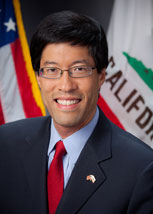
Photo of Richard Pan
D California Senate · District 6

Sen. Richard Pan

Compare
Total votes
26,098
all sessions
Attendance
98%
455 missed
Near the chamber average
With party
99%
of cast votes
Near the chamber average
Bipartisan score
0%
crosses aisle rarely
Lower than 76% of chamber peers
Sponsored
951
bills & resolutions
Lower than 78% of chamber peers
Committees
0
assignments
951 bills and resolutions

Sponsored bills

Total
951
Primary
341
Co-sponsor
610
This page
951
matching current filters
Primary AB 2287
Failed · California Assembly · Lead sponsor
Free and reduced-price meals: gluten-free meals.

(1) Existing law provides for a school lunch program under which eligible pupils receive free or reduced-price meals. This bill would require school districts and county superintendents of schools to consider incorporating into the free or reduced-price meals application packet or notification of eligibility for the free or reduced-price meals program a notification and request for a gluten-free meal if a child qualifies for free or reduced-price school meals and the child has a statement from a licensed physician supporting a need for gluten-free meals, as specified. The bill would require school districts and county superintendents of schools to consider making meal substitutions for a child who does not meet the definition of disability pursuant to federal law but does have celiac disease, a wheat allergy, or a gluten intolerance and the child has provided a written statement to the school signed by a licensed physician identifying the child as having one of these conditions. By imposing additional requirements on school districts and county superintendents of schools, the bill would create a state-mandated local program. (2) The California Constitution requires the state to reimburse local agencies and school districts for certain costs mandated by the state. Statutory provisions establish procedures for making that reimbursement. This bill would provide that, if the Commission on State Mandates determines that the bill contains costs mandated by the state, reimbursement for those costs shall be made pursuant to these statutory provisions. (3) This bill would declare that it is to take effect immediately as an urgency statute.

Failed Nov 30, 2014 0 co-sponsors
Primary AB 540
Failed · California Assembly · Lead sponsor
Reporting and tracking of violent deaths.

Existing law establishes the State Department of Public Health, which is responsible for various programs relating to the health and safety of people in the state, including licensing health facilities, regulating food and drug safety, and monitoring and preventing communicable and chronic diseases. This bill would authorize the department to establish and maintain the California Electronic Violent Death Reporting System. The bill would further authorize the department to collect data on violent deaths, as specified, contract with counties to collect certain data, and apply for grants to implement these provisions. The bill would also make related legislative findings and declarations.

Failed Nov 30, 2014 0 co-sponsors
Co-sponsor AB 1805
Failed · California Assembly · Co-sponsor
Medi-Cal: reimbursement: provider payments.

Existing law establishes the Medi-Cal program, administered by the State Department of Health Care Services, under which basic health care services are provided to qualified low-income persons. The Medi-Cal program is, in part, governed and funded by federal Medicaid Program provisions. Existing law requires, except as otherwise provided, Medi-Cal provider payments to be reduced by 1% or 5%, and provider payments for specified non-Medi-Cal programs to be reduced by 1%, for dates of service on and after March 1, 2009, and until June 1, 2011. Existing law requires, except as otherwise provided, Medi-Cal provider payments and payments for specified non-Medi-Cal programs to be reduced by 10% for dates of service on and after June 1, 2011. This bill would, instead, prohibit the application of those reductions for payments to providers for dates of service on or after June 1, 2011. The bill would also require payments for managed care health plans for dates of service following the effective date of the bill to be determined without application of some of those reductions. The bill would require the Director of Health Care Services to implement this provision to the maximum extent permitted by federal law and for the maximum time period for which the director obtains federal approval for federal financial participation for those payments. This bill would declare that it is to take effect immediately as an urgency statute.

Failed Nov 30, 2014 1 co-sponsor
Primary AB 2114
Failed · California Assembly · Lead sponsor
Taxation: qualified heavy equipment.

The California Constitution authorizes the Legislature to classify personal property for differential taxation or for exemption by means of a statute approved by a 23 vote of the membership of each house. This bill would, pursuant to this constitutional authorization, impose a tax on every qualified renter for the privilege of renting qualified heavy equipment in this state at the rate of .75% of the gross receipts of the rental price from the renting of qualified heavy equipment. This bill would require a qualified renter to pay and remit the tax, as provided. This bill would provide that this tax shall be in lieu of any personal property tax on qualified heavy equipment. This bill would require the tax to be administered by the State Board of Equalization and to be collected pursuant to the procedures set forth in the Fee Collection Procedures Law. This bill would require all revenues, interest, penalties, and other amounts, less refunds and the board's costs of administration, derived from the imposition of the tax to be deposited in the General Fund. Existing property tax law requires the county auditor, in each fiscal year, to allocate property tax revenue to local jurisdictions in accordance with specified formulas and procedures, and generally requires that each jurisdiction be allocated an amount equal to the total of the amount of revenue allocated to that jurisdiction in the prior fiscal year, subject to certain modifications, and that jurisdiction's portion of the annual tax increment, as defined. Existing property tax law also reduces the amounts of ad valorem property tax revenue that would otherwise be annually allocated to the county, cities, and special districts pursuant to these general allocation requirements by requiring, for purposes of determining property tax revenue allocations in each county for the 1992–93 and 1993–94 fiscal years, that the amounts of property tax revenue deemed allocated in the prior fiscal year to the county, cities, and special districts be reduced in accordance with certain formulas. It requires that the revenues not allocated to the county, cities, and special districts as a result of these reductions be transferred to the Educational Revenue Augmentation Fund in that county for allocation to school districts, community college districts, and the county office of education. This bill would, for the 2015–16 fiscal year and for each fiscal year thereafter, require the county auditor to increase the total amount of ad valorem property tax revenue that is otherwise required to be allocated among the county and each city and special district in the county by the qualified heavy equipment reimbursement amount, as defined, and to commensurately decrease the amount of ad valorem property tax revenue that is otherwise required to be allocated to the county Educational Revenue Augmentation Fund and, if necessary, the amount of those revenue otherwise required to be allocated to school districts, as specified, by the qualified heavy equipment reimbursement amount. By expanding the application of the Fee Collection Procedures Law, the violation of which is a crime, and by imposing new duties upon local officials in the allocation of ad valorem property tax revenues, this bill would impose a state-mandated local program. The California Constitution requires the state to reimburse local agencies and school districts for certain costs mandated by the state. Statutory provisions establish procedures for making that reimbursement. This bill would provide that with regard to certain mandates no reimbursement is required by this act for a specified reason. With regard to any other mandates, this bill would provide that, if the Commission on State Mandates determines that the bill contains costs so mandated by the state, reimbursement for those costs shall be made pursuant to the statutory provisions noted above. Section 2229 of the Revenue and Taxation Code requires the Legislature to reimburse local agencies annually for certain property tax revenues lost as a result of any exemption or classification of property for purposes of ad valorem property taxation. This bill would provide that, notwithstanding Section 2229 of the Revenue and Taxation Code, no appropriation is made and the state shall not reimburse local agencies for property tax revenues lost by them pursuant to the bill.


Failed Nov 30, 2014 0 co-sponsors
Co-sponsor AJR 14
Failed · California Assembly · Co-sponsor
Relative to sequestration.

This measure would request the Congress of the United States to, among other things, act immediately to avert federal spending cuts known as "sequestration" to protect the California and national economies.

Failed Nov 30, 2014 1 co-sponsor
Co-sponsor SB 1005
Failed · California Senate · Co-sponsor
Health care coverage: immigration status.

Existing law, the federal Patient Protection and Affordable Care Act (PPACA) , requires each state to establish an American Health Benefit Exchange that facilitates the purchase of qualified health plans by qualified individuals and qualified small employers, and meets certain other requirements. PPACA specifies that an individual who is not a citizen or national of the United States or an alien lawfully present in the United States shall not be treated as a qualified individual and may not be covered under a qualified health plan offered through an exchange. Existing law creates the California Health Benefit Exchange for the purpose of facilitating the enrollment of qualified individual and qualified small employers in qualified health plans as required under PPACA. Existing law governs health care service plans and insurers. A violation of the provisions governing health care service plans is a crime. This bill would create the California Health Exchange Program for All Californians within state government and would require that the program be governed by the executive board that governs the California Health Benefit Exchange. The bill would specify the duties of the board relative to the program and would require the board to, by January 1, 2016, facilitate the enrollment into qualified health plans of individuals who are not eligible for full-scope Medi-Cal coverage and would have been eligible to purchase coverage through the Exchange but for their immigration status. The bill would require the board to provide premium subsidies and cost-sharing reductions to eligible individuals that are the same as the premium assistance and cost-sharing reductions the individuals would have received through the Exchange. The bill would create the California Health Trust Fund For All Californians as a continuously appropriated fund, thereby making an appropriation, would require the board to assess a charge on qualified health plans, and would make the implementation of the program's provisions contingent on a determination by the board that sufficient financial resources exist or will exist in the fund. The bill would enact other related provisions. The bill would require health care services plans and health insurers to fairly and affirmatively offer, market, and sell in the Exchange at least one product within each of 5 levels of coverage, as specified. Because a violation of the requirements imposed on health care service plans would be a crime, the bill would impose a state-mandated local program. Existing law provides for the Medi-Cal program, which is administered by the State Department of Health Care Services, under which qualified low-income individuals receive health care services. The Medi-Cal program is, in part, governed and funded by federal Medicaid Program provisions. The federal Medicaid Program provisions prohibit payment to a state for medical assistance furnished to an alien who is not lawfully admitted for permanent residence or otherwise permanently residing in the United States under color of law. This bill would extend eligibility for full-scope Medi-Cal benefits to individuals who are otherwise eligible for those benefits but for their immigration status. The bill would require that benefits for those services be provided with state-only funds only if federal financial participation is not available. Because counties are required to make Medi-Cal eligibility determinations and this bill would expand Medi-Cal eligibility, the bill would impose a state-mandated local program. The California Constitution requires the state to reimburse local agencies and school districts for certain costs mandated by the state. Statutory provisions establish procedures for making that reimbursement. This bill would provide that with regard to certain mandates no reimbursement is required by this act for a specified reason. With regard to any other mandates, this bill would provide that, if the Commission on State Mandates determines that the bill contains costs so mandated by the state, reimbursement for those costs shall be made pursuant to the statutory provisions noted above.

Failed Nov 30, 2014 1 co-sponsor
Co-sponsor AB 2177
Failed · California Assembly · Co-sponsor
Early voting.

Existing law establishes procedures for voters to apply for a vote by mail ballot and use the ballot to vote in an election. Existing law allows a jurisdiction in which vote by mail ballots are cast to begin processing vote by mail ballots 29 days before the election. This bill would require the Secretary of State to provide guidance to local elections officials in performing specified tasks for the purpose of promoting and expanding the practice of early voting, as defined, consistent with specified statutory authority. The bill would define "early voting" to mean voting a vote by mail ballot in person at the office of the elections official or another location designated by the elections official either before or on the day of the election. The bill would allow county elections officials to apply for funding to provide early voting. If a county obtains funding sufficient to satisfy all associated costs, the bill would require an elections official, on at least one Saturday and Sunday on or after the date the elections official first delivers ballots to vote by mail voters for a statewide election, or for any other election as determined by the elections official based on voter demand, to allow voters to vote in the election by means of early voting at the early voting location designated for this purpose, provided that the location is accessible and complies with disability access requirements under federal and state law. The bill would permit the elections official to determine the hours of operation for the designated early voting location or locations for each Saturday and Sunday on which early voting is offered, provided that each location shall be open to voters for a minimum of 6 hours on each designated Saturday and Sunday. These provisions regarding Saturday and Sunday voting would not apply to elections conducted wholly by mail or to precincts in which each voter is furnished with a vote by mail ballot, as specified. This bill would become operative on January 1, 2016.

Failed Nov 30, 2014 1 co-sponsor
Primary AB 2452
Failed · California Assembly · Lead sponsor
Advance health care directive registry.

Existing law directs the Secretary of State to establish an Advance Health Care Directive Registry to receive and release specified information from a person who has executed a written advance health care directive. Existing law requires the Secretary of State to charge a fee to each registrant in an amount such that, when all fees charged to registrants are aggregated, the aggregated fees do not exceed the actual cost of establishing and maintaining the registry. Existing law provides that failure to register with the Secretary of State does not affect the validity of an advance health care directive. This bill would require the Secretary of State to transfer the contents of its Advance Health Care Directive's Registry to the State Department of Public Health on January 1, 2016. The bill would require the department to maintain a health care decision registry, to be referred to as the California Health Care Decisions Online Registry, and commencing on January 1, 2016, to establish and maintain access, as specified, to a secure portion of the department's Internet Web site that provides an electronic reproduction of an advance health care directive and other specified documents submitted to the registry system. The bill would require this access to include the ability to view the electronic reproduction on the Internet Web site, as well as download, print, and otherwise retrieve a copy of the electronic reproduction. The bill would, among other things, require the department to establish procedures to register, replace, and remove an advance health care directive, as specified. The bill would require that on or before January 1, 2020, the registry be fully supported by fees charged by the State Department of Public Health to each registrant. The bill would require the State Department of Public Health to develop and submit to the Legislature a financial sustainability plan, as specified, on or before January 1, 2018.

Failed Nov 30, 2014 0 co-sponsors
Showing 471 to 480 of 951 bills
Previous 1 … 47 48 49 … 96 Next