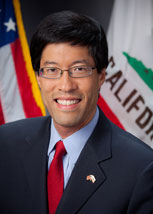
Photo of Richard Pan
D California Senate · District 6

Sen. Richard Pan

Compare
Total votes
26,098
all sessions
Attendance
98%
455 missed
Near the chamber average
With party
99%
of cast votes
Near the chamber average
Bipartisan score
0%
crosses aisle rarely
Lower than 76% of chamber peers
Sponsored
951
bills & resolutions
Lower than 78% of chamber peers
Committees
0
assignments
951 bills and resolutions

Sponsored bills

Total
951
Primary
341
Co-sponsor
610
This page
951
matching current filters
Co-sponsor ACR 66
Signed into law · California Assembly · Co-sponsor
Relative to Filipino American History Month.

This measure would recognize the month of October 2015 as Filipino American History Month and the 428th anniversary of the first presence of Filipinos in the continental United States.

Signed into law Sep 10, 2015 1 co-sponsor
Co-sponsor SCR 78
Signed into law · California Senate · Co-sponsor
Veterans: Team AMVETS.

This measure would commend AMVETS Department of California, also known as Team AMVETS, for providing benefits and services to veterans, and for playing an important role in the community for 70 years.

Signed into law Sep 8, 2015 1 co-sponsor
Primary SB 600
Signed into law · California Senate · Lead sponsor
Discrimination: citizenship: language: immigration status.

Existing law finds and declares that all protections, rights, and remedies available under state law, except any reinstatement remedy prohibited by federal law, are available to all individuals regardless of immigration status who have applied for employment, or who are or who have been employed, in this state. Existing law, the Unruh Civil Rights Act, provides that all persons within the jurisdiction of this state are entitled to full and equal accommodations in all business establishments regardless of their sex, race, color, religion, ancestry, national origin, disability, medical condition, genetic information, marital status, or sexual orientation. This bill would extend the protections of the Unruh Civil Rights Act to persons regardless of citizenship, primary language, or immigration status. The bill would specify that those protections do not require the provision of services or documents in a language other than English, beyond that which is otherwise required by law.

Signed into law Sep 8, 2015 0 co-sponsors
Co-sponsor SB 315
Passed · California Senate · Co-sponsor
Health care access demonstration project grants.

Existing law, the California Health Facilities Financing Authority Act, establishes a program for the California Health Facilities Authority to award grants that do not exceed $1,500,000 to one or more projects designed to demonstrate specified new or enhanced cost-effective methods of delivering quality health care services to improve access to quality health care for vulnerable populations or communities, or both, that are effective at enhancing health outcomes and improving access to quality health care and preventive services. Existing law requires a recipient of that grant to adhere to all applicable laws relating to scope of practice, licensure, staffing, and building codes. Existing law authorizes the authority, if a demonstration project receiving a grant is successful at developing such a new method of delivering high-quality and cost-effective health care services, to implement a 2nd grant program, as specified, to replicate in additional California communities the model developed by that demonstration project. Existing law requires the authority to prepare and provide a report to the Legislature and the Governor on the outcomes of the demonstration grant program that includes, among other information, the total amount of grants issued and the amount of each grant issued. This bill would create the California Health Access Model Program Two Account within the California Health Facilities Financing Authority Fund for purposes of administering a 2nd competitive grant selection process, in accordance with existing grant provisions, to fund one or more projects designed to demonstrate specified new or enhanced cost-effective methods of delivering quality health care services to improve access to quality health care for vulnerable populations or communities, or both. The bill would authorize the authority to transfer moneys up to a total of $3,000,000 from the California Health Facilities Financing Authority Hospital Equipment Loan Program Fund to the account for the purposes of the bill if the authority decides to administer the 2nd competitive grant selection process, and would require that any moneys remaining in the account as of January 1, 2023, revert to the California Health Facilities Financing Authority Hospital Equipment Loan Program Fund. By expanding the purposes for which a continuously appropriated fund may be used, this bill would make an appropriation. The bill would also require the authority to prepare and provide a report to the Legislature and the Governor every 2 years, commencing January 1, 2017, on the 2 grant selection programs, that includes, among other information, the total amount of grants issued and the amount of each grant issued, as specified. This bill would also make the existing requirement for adherence to all applicable laws relating to scope of practice, licensure, staffing, and building to codes applicable to a recipient of a grant provided pursuant to the 2nd grant program described above. Existing law defines health facility, for purposes of the act, to include a multilevel facility that is an institutional arrangement where a residential facility for the elderly is operated as a part of, or in conjunction with, an intermediate care facility, a skilled nursing facility, or a general acute care hospital. Existing law defines elderly, for purposes of this provision, to mean a person 62 years of age or older. This bill would instead define elderly to mean a person 60 years of age or older. This bill would become operative only if AB 648 is enacted and takes effect on or before January 1, 2016.


Passed Sep 8, 2015 1 co-sponsor
Co-sponsor SJR 13
Signed into law · California Senate · Co-sponsor
Voting: apportionment.

This measure would urge the Supreme Court of the United States to uphold the federal constitutional principle of "one person, one vote" and not deny California's children and immigrants equal protection under the law.

Signed into law Sep 4, 2015 1 co-sponsor
Primary SB 453
Signed into law · California Senate · Lead sponsor
Prisons: involuntary medication.

Existing law provides that if a defendant in a criminal proceeding is found mentally incompetent, the trial or judgment shall be suspended until the person becomes mentally competent. Existing law provides that the court shall order that the mentally incompetent defendant be delivered by the sheriff to a state hospital for the care and treatment of the mentally disordered, as directed by the State Department of State Hospitals, or to any other available public or private treatment facility approved by the community program director that will promote the defendant's speedy restoration to mental competence, or placed on outpatient status as specified. Existing law further specifies commitment proceedings to include circumstances for the voluntary and involuntary administration of antipsychotic medication. Under existing law, if consent for antipsychotic medication is withdrawn or if the treating psychiatrist later determines that antipsychotic medication is medically necessary and appropriate, the treating psychiatrist is required to make efforts to obtain consent for that medication. Existing law provides that if the treating psychiatrist certifies that antipsychotic medication has become medically necessary and appropriate for the defendant, antipsychotic medication may be administered to the defendant for a maximum of 21 days, provided, however, that, within 72 hours of the certification, the defendant is provided a medication review hearing before an administrative law judge to be conducted at the facility where the defendant is receiving treatment. This bill would authorize the treating psychiatrist, if he or she determines that there is a need, based on preserving rapport with the patient or preventing harm, to request that the facility medical director designate another psychiatrist to act in the place of the treating psychiatrist for purposes of seeking an order for involuntary medication. If the medical director of the facility designates another psychiatrist to act, this bill would require the treating psychiatrist to brief the acting psychiatrist of the relevant facts of the case and would require the acting psychiatrist to examine the patient prior to the hearing.

Signed into law Sep 3, 2015 0 co-sponsors
Co-sponsor SB 8
In committee · California Senate · Co-sponsor
Public transit: funding.

Existing law requires all moneys, except for fines and penalties, collected by the State Air Resources Board from the auction or sale of allowances as part of a market-based compliance mechanism relative to reduction of greenhouse gas emissions to be deposited in the Greenhouse Gas Reduction Fund. Existing law continuously appropriates 10% of the annual proceeds of the fund to the Transit and Intercity Rail Capital Program and 5% of the annual proceeds of the fund to the Low Carbon Transit Operations Program. This bill would instead continuously appropriate 20% of those annual proceeds to the Transit and Intercity Rail Capital Program, and 10% of those annual proceeds to the Low Carbon Transit Operations Program, thereby making an appropriation.

In committee Sep 2, 2015 1 co-sponsor
Primary SB 216
Signed into law · California Senate · Lead sponsor
The Public Employees' Retirement System.

(1) The Public Employees' Retirement Law (PERL) creates the Public Employees' Retirement System (PERS) for the purpose of providing pension benefits to specified public employees and prescribes the rights and duties of members and annuitants of the system. PERL vests management and control of PERS in the Board of Administration. The California Constitution and PERL grant the board control over the investment of the retirement fund subject to certain restrictions. PERL directs the board to invest not less than 25% of all funds that become available in a fiscal year for new investments in specified obligations and securities connected with residential realty, subject to the board's authority to substitute other investments consistent with its fiduciary obligations to the retirement system and standards for prudent investment. PERL requires the board to report on these investments. This bill would repeal the provisions regarding investing in residential realty, described above. (2) PERL authorizes the board to require employers participating in the system to provide specified information, as deemed necessary by the board, for examination and copying in the course of an audit to determine the correctness of retirement benefits, reportable compensation, enrollment in the system, and reinstatement to the system. This bill would provide that the authority described above also applies to determining the eligibility for retirement benefits. (3) PERL requires the board to submit a quarterly review of system assets to the Legislature, which is required to include reporting on the system's portfolio on the basis of cost and market value, among other things. This bill would change the frequency of this report to semiannual, would eliminate the requirement to report on the investments on a cost basis, and would make other changes to the content of the report. (4) PERL permits a member who returns to active service following an employer-approved uncompensated leave of absence, as defined, because of his or her serious illness or injury to purchase service credit for that period of absence upon the payment of contributions, as specified. This bill would specify that the option to purchase service credit shall be elected prior to retirement, that the member be returning to state service, and would make other related and clarifying changes.

Signed into law Sep 2, 2015 0 co-sponsors
Showing 431 to 440 of 951 bills
Previous 1 … 43 44 45 … 96 Next