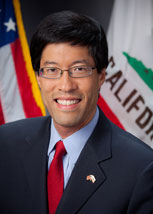
This measure would recognize the month of October 2017 as Filipino American History Month and the 430th anniversary of the first presence of Filipinos in the continental United States.
Sponsored bills
Existing law establishes a workers' compensation system, administered by the Administrative Director of the Division of Workers' Compensation, to compensate an employee for injuries sustained in the course of his or her employment. Existing law requires the administrative director to develop and make available informational material written in plain language that describes the overall workers' compensation claims process, as specified. This bill would require the administrative director to adopt regulations to provide employees with notice regarding access to medical treatment following the denial of a claim under the workers' compensation system. Existing law requires the Administrative Director of the Division of Workers' Compensation of the Department of Industrial Relations to develop a workers' compensation information system in consultation with the Insurance Commissioner and the Workers' Compensation Insurance Rating Bureau, with certain data to be collected electronically and to be compatible with the Electronic Data Interchange System of the International Association of Industrial Accident Boards and Commissions. Existing law requires the administrative director to assess an administrative penalty of not more than $5,000 in a single year against a claims administrator for a violation of those data reporting requirements. This bill would increase that penalty assessment to not more than $10,000. The bill would require the administrative director to post on the Division of Workers' Compensation Internet Web site a list of claims administrators who are in violation of the data reporting requirements. Existing law requires every employer to establish a utilization review process, and defines "utilization review" as utilization review or utilization management functions that prospectively, retrospectively, or concurrently review and approve, modify, delay, or deny, based in whole or in part on medical necessity to cure and relieve, treatment recommendations by physicians, prior to, retrospectively, or concurrent with providing medical treatment services. Existing law also provides for an independent medical review process to resolve disputes over utilization review decisions, as defined. This bill would revise and recast provisions relating to utilization review, as specified, with regard to injuries occurring on or after January 1, 2018. Among other things, the bill would set forth the medical treatment services that would be subject to prospective utilization review under these provisions, as provided. The bill would authorize retrospective utilization review for treatment provided under these provisions under limited circumstances, as specified. The bill would establish procedures for prospective and retrospective utilization reviews and set forth provisions for removal of a physician or provider under designated circumstances. On and after January 1, 2018, the bill would establish new procedures for reviewing determinations regarding the medical necessity of medication prescribed pursuant to the drug formulary adopted by the administrative director, as provided. The bill would make conforming changes to related provisions to implement these changes. The bill would, commencing July 1, 2018, require each utilization review process to be accredited by an independent, nonprofit organization to certify that the utilization review process meets specified criteria, including, but not limited to, timeliness in issuing a utilization review decision, the scope of medical material used in issuing a utilization review decision, and requiring a policy preventing financial incentives to doctors and other providers based on the utilization review decision. The bill would require the administrative director to adopt rules to implement the selection of an independent, nonprofit organization for accreditation purposes, as specified. The bill would authorize the administrative director to adopt rules to require additional specific criteria for measuring the quality of a utilization review process for purposes of accreditation and provide for certain exemptions. The bill would require the administrative director to develop a system for electronic reporting of documents related to utilization review performed by each employer, to be administered by the division. The bill would require the administrative director, on or after March 1, 2019, to contract with an outside independent research organization to evaluate and report on the impact of provision of medical treatment within the first 30 days after a claim is filed, for claims filed on or after January 1, 2017, to January 1, 2019. The bill would require the report to be completed before January 1, 2020, and to be distributed to the administrative director, the Senate Committee on Labor and Industrial Relations, and the Assembly Committee on Insurance. Existing law requires every lien claimant to file its lien with the appeals board in writing upon a form approved by the appeals board. Existing law requires a lien to be accompanied by a full statement or itemized voucher supporting the lien and justifying the right to reimbursement, as specified. This bill would require certain lien claimants that file a lien under these provisions to do so by filing a declaration, under penalty of perjury, that includes specified information. The bill would require current lien claimants to also file the declaration by a specified date. The bill would make a failure to file a declaration under these provisions grounds for dismissal of a lien. Because the bill would expand the crime of perjury, the bill would impose a state-mandated local program. The bill would also automatically stay any physician or provider lien upon the filing of criminal charges against that person or entity for specified offenses involving medical fraud, as provided. The bill would authorize the administrative director to adopt regulations to implement that provision. The bill would state findings and declarations of the Legislature in connection with these provisions. Existing law prohibits the assignment of a lien under these provisions, except under limited circumstances, as specified. This bill would, for liens filed after January 1, 2017, invalidate any assignment of a lien made in violation of these provisions, by operation of law. Existing law requires the administrative director, in consultation with the Commission on Health and Safety and Workers' Compensation, to adopt, after public hearings, a medical treatment utilization schedule to incorporate evidence-based, peer-reviewed, nationally recognized standards of care recommended by the commission, as specified. This bill would authorize the administrative director to make updates to the utilization schedule by order, which would not be subject to the Administrative Procedure Act, as specified. The bill would require any order adopted pursuant to these provisions to be published on the Internet Web site of the division. Existing law requires a deponent to receive certain expenses and reimbursements if an employer or insurance carrier requests a deposition to be taken of an injured employee, or any person claiming benefits as a dependent of an injured employee. Existing law authorizes the deponent to receive a reasonable allowance for attorney's fees, if represented by an attorney licensed in this state. This bill would authorize the administrative director to determine the range of reasonable fees to be paid to a deponent. Existing law provides that it is the responsibility of any party producing a witness requiring an interpreter to arrange for the presence of a qualified interpreter. Existing law sets forth the qualifications of a qualified interpreter for these purposes, and provides for the settings under which a qualified interpreter may render services. This bill would require the administrative director to promulgate regulations establishing criteria to verify the identity and credentials of individuals that provide interpreter services under these provisions. Existing law requires physicians, as defined, who attend to injured or ill employees to file reports with specific information prescribed by law. This bill would revise those reporting requirements, as prescribed. This bill would incorporate changes to Section 4610 of the Labor Code proposed by AB 2503, to be operative as specified if both bills are enacted. Existing constitutional provisions require that a statute that limits the right of access to the meetings of public bodies or the writings of public officials and agencies be adopted with findings demonstrating the interest protected by the limitation and the need for protecting that interest. This bill would make legislative findings to that effect. The California Constitution requires the state to reimburse local agencies and school districts for certain costs mandated by the state. Statutory provisions establish procedures for making that reimbursement. This bill would provide that no reimbursement is required by this act for a specified reason.

Existing law provides for protection, care, and assistance for people of the state by providing appropriate aid and services to the needy and distressed. Programs established for this purpose include the California Work Opportunity and Responsibility to Kids program (CalWORKs) , which provides cash assistance and other social services to needy families, using federal Temporary Assistance for Needy Families (TANF) block grant program, state, and county funds. Existing law prohibits an applicant from being granted public assistance under CalWORKs until he or she is personally interviewed by the county human services agency or state hospital staff. Existing law also requires the county department to verify if an applicant is incapable of acting on his or her own behalf by personal contact with the applicant before aid is authorized. This bill would authorize the county human services agency to conduct this personal interview telephonically or through electronic means, as specified. The bill would require a county, if that county elects to conduct the personal interview telephonically or through other electronic means, to conduct an in-person personal interview if requested by an applicant.
Existing federal law provides for tax-qualified retirement plans and individual retirement accounts or individual retirement annuities by which private citizens may save money for retirement. Existing law, the California Secure Choice Retirement Savings Trust Act, establishes the California Secure Choice Retirement Savings Program, administered by the California Secure Choice Retirement Savings Investment Board, contingent on specified funding and interest criteria being met. Existing law prescribes the composition of the board and its duties and provides that it acts as trustee in entering contracts and accepting moneys, among other things. Existing law prohibits the board from permitting enrollment in the program until enactment of a statute expressing legislative approval of program implementation. The program requires specified eligible employers, as defined, to offer a payroll deposit retirement savings arrangement and requires eligible employees, as defined, who do not opt out of the program, to contribute a portion of their salary or wages to a retirement savings account in the program, as specified. Existing law requires contributions from the wages of employees participating in the program to be deposited in the California Secure Choice Retirement Savings Trust, which is continuously appropriated and administered by the board. Existing law authorizes the board to adjust the employee contribution amount between 2% and 4%, inclusive, of the employee's annual salary or wages, as specified. This bill would express legislative approval of the program and its implementation on January 1, 2017. The bill would require the board, prior to opening the program for enrollment, to make a report to the Governor and Legislature affirming that certain requirements have been met, including that the program is structured to meet a United States Department of Labor regulation, as specified. The bill would require the board to design and implement the program and would prescribe certain parameters that the board is to consider and utilize in establishing the design. The bill would require the board, for up to 3 years following implementation, to establish managed accounts invested in United States Treasury securities, in myRAs, as defined, or in similar investments and would make conforming changes in this connection in provisions related to mitigating risk in the investment portfolio and payment of the costs of administration. The bill would require the board, after this period, to annually prepare and adopt a written statement of investment policy containing specified elements. The bill would require the board to consider the statement and any changes in the investment policy at a public hearing. The bill would specify that funding and first year administrative costs may be appropriated in the annual budget from the General Fund and would require the board to repay the amount appropriated, plus interest, as specified. On and after 6 years from the date the program is implemented, the bill would prohibit expenditures for the purpose of paying operative costs and administering the trust from exceeding 1% of the total program fund. The bill would revise the purposes for which administrative and program funds may be expended. The bill would provide that investment policy decisions, including asset allocation and investment options, are entrusted to the board as a fiduciary, and would revise certain principles that the board is to consider in connection with investment policy. The bill would exempt the California Secure Choice Retirement Savings Trust from specified provisions regarding the qualification of securities for sale. The bill would make various changes to existing duties of the board, including those regarding dissemination of information and the entities with which the board is to collaborate and cooperate. The bill would require the Treasurer to appoint an executive director of the board, to serve at its pleasure, and to determine the duties of the office and its compensation. The bill would eliminate the duty of the board to ensure that insurance or some other mechanism is in place to protect the value of individual accounts and would eliminate the requirement to secure private underwriting and reinsurance, as specified. The bill would repeal the duty of the board to conduct an initial market analysis to determine if the condition for the implementation of the program can be met and associated provisions. The bill would eliminate the authority of the board to establish certain investment options. This bill would require eligible employers that do not offer specified retirement plans or accounts to have a payroll deposit retirement savings arrangement so that employees may participate in the program within specified time periods based on the number of eligible employees that the employer has, and the bill would authorize the board to extend these time periods. The bill would provide that employers retain the right at all times to set up and offer their own qualified retirement plans. The bill would define an employer of a provider of in-home supportive services as an employer if a specified determination and certification are made and would require the state or a county that makes a direct payment to a provider to assume obligations regarding retirement savings accounts, including payroll deposit IRA arrangements offered under the program. The bill would authorize the board to adjust the employee contribution amount described above up to 5% and would prescribe other limits on increasing employee contributions. The bill would authorize the board to make annual, automatic escalations of employee contributions subject to certain limitations, including that the employee may opt out, as specified. By authorizing the board to increase moneys that are deposited into the California Secure Choice Retirement Savings Trust, which is continuously appropriated, the bill would make an appropriation. The bill would authorize the board to adopt regulations to implement the program and would provide that the adoption, amendment, repeal, or readoption of a regulation authorized by this section is deemed to address an emergency. The bill would make various conforming changes.
Existing law defines specified terms for purposes of the California Residential Mortgage Lending Act, which generally prohibits a person from engaging in the business of making residential mortgage loans or servicing residential mortgage loans without first obtaining a license from the Commissioner of Business Oversight in accordance with the act. Existing law defines a lender as a person who is an approved lender for the Federal Housing Administration, the Veterans Administration, the Farmers Home Administration, the Government National Mortgage Association, the Federal National Mortgage Association, or the Federal Home Loan Mortgage Corporation, who directly makes residential mortgage loans, and who makes the credit decision in the loan transactions. Existing law requires a licensee issued a license for purposes of making or servicing residential mortgage loans to continuously maintain a minimum tangible net worth of $250,000. This bill would specify that the term "lender" includes a person, other than a natural person, and a natural person who is also an independent contractor, who engages in the activities of a loan processor or underwriter for residential mortgage loans, but does not solicit loan applicants, originate mortgage loans, or fund mortgage loans, as specified. The bill would authorize the commissioner to require a licensee who is engaged in the processing or underwriting of residential mortgage loans to continuously maintain a minimum tangible net worth in an amount that is greater than $250,000, but that does not exceed the net worth required of an approved lender under the Federal Housing Administration.
Existing law provides specified requirements in awarding certain public contracts. This bill would authorize the Governor to execute games support contracts, not to exceed a specified amount, in connection with the site selection process for the City of Los Angeles to become the host for the 2024 Olympic Games and Paralympic Games, that accept financial liability to provide the state security for amounts owed by the Organizing Committee for the Olympic Games (OCOG) , as specified, and for any financial deficit accruing to the OCOG as a result of the hosting of the games by the endorsing municipality, as defined. This bill would make legislative findings and declarations that, among other things, the endorsing municipality has developed a self-sufficient bid for financing the games.
Existing law requires a county coroner to inquire into and determine the circumstances, manner, and cause of certain deaths. Existing law either requires or authorizes a county coroner, under certain circumstances, to perform, or cause to be performed, an autopsy on a decedent. Existing law imposes certain requirements on a postmortem examination or autopsy conducted at the discretion of a coroner, medical examiner, or other agency upon an unidentified body or human remains. Existing law requires the coroner to perform an autopsy pursuant to a standardized protocol developed by the State Department of Public Health in any case where an infant has died suddenly and unexpectedly. Existing law authorizes the board of supervisors of a county to consolidate the duties of certain county offices in one or more of specified combinations, including, but not limited to, sheriff and coroner, district attorney and coroner, and public administrator and coroner. Existing law authorizes the board of supervisors of a county to abolish the office of coroner and provide instead for the office of medical examiner, as specified, and requires the medical examiner to be a licensed physician and surgeon duly qualified as a specialist in pathology. This bill would require that a forensic autopsy, as defined, be conducted by a licensed physician and surgeon. The bill would require that the results of a forensic autopsy be determined by a licensed physician and surgeon. The bill would require the manner of death to be determined by the coroner or medical examiner of a county. The bill would authorize trained county personnel who are necessary to the performance of an autopsy to take body measurements or retrieve blood, urine, or vitreous samples from the body of a decedent at the direction and supervision of a coroner, a medical examiner, or a licensed physician and surgeon. The bill would require, if a licensed physician and surgeon conducts a forensic autopsy, the coroner or medical examiner to consult with the licensed physician and surgeon in the determination of the manner of death. The bill would require the coroner to conduct an evaluation pursuant to a standardized protocol developed by the State Department of Public Health in any case where an infant has died suddenly and unexpectedly. The bill would require, for health and safety purposes, that all persons in the autopsy suite be informed of the risks presented by bloodborne pathogens and be informed that they should wear personal protective equipment, as specified. The bill would require that only individuals who are directly involved in the investigation of the death of the decedent be allowed into the autopsy suite but would permit individuals to be in the autopsy suite for educational and research purposes at the discretion of the coroner, in consultation with any licensed physician and surgeon conducting an autopsy. The bill would prohibit law enforcement personnel directly involved in the death of an individual who died due to involvement of law enforcement activity from being involved with any portion of the postmortem examination or being inside the autopsy suite during the performance of the autopsy. The bill would define a postmortem examination for this purpose to be the external examination of the body where no manner or cause of death is determined. The bill would require specified materials that are in the possession of law enforcement and are related to a death that is incident to law enforcement activity to be made available to the physician and surgeon who conducts the autopsy prior to the completion of the investigation of the death. The bill would specify that these provisions shall not be construed to limit the practice of an autopsy for educational or research purposes. By imposing additional duties upon local officials and law enforcement agencies, this bill would create a state-mandated local program. The California Constitution requires the state to reimburse local agencies and school districts for certain costs mandated by the state. Statutory provisions establish procedures for making that reimbursement. The bill would provide that, if the Commission on State Mandates determines that the bill contains costs mandated by the state, reimbursement for those costs shall be made pursuant to these statutory provisions.
The Alcoholic Beverage Control Act, administered by the Department of Alcoholic Beverage Control, regulates the granting of licenses for the manufacture, distribution, and sale of alcoholic beverages within the state. Under existing law, any on-sale license authorizes the sale of the alcoholic beverage specified in the license for consumption on the premises where sold. Currently, the Licensee Education on Alcohol and Drugs (LEAD) program is a voluntary prevention and education program for retail licensees, their employees, and applicants, regarding alcohol responsibility and the law. This bill would, in addition to the LEAD program, establish the Responsible Beverage Service (RBS) Training Program Act of 2016, beginning July 1, 2020, that would require an alcohol server, as defined, to successfully complete an RBS training course offered by an accredited training provider within 3 months of employment and every 3 years thereafter. The bill would require a nonprofit organization that obtained a temporary daily on-sale or off-sale license to designate a person or persons to receive RBS training before the event and would require that person or those persons to remain on site for the duration of the event. The bill would provide that an RBS training course include information on, among other things, state laws and regulations relating to alcoholic beverage control and the impact of alcohol on the body. The bill would require the Department of Alcoholic Beverage Control, on or before January 1, 2020, to establish a list published on the department's Internet Web site of RBS training courses and would authorize the department to collect fees to cover the reasonable costs of review and approval of accreditation agencies. The bill, beginning January 1, 2019, would require the department to provide information on RBS training requirements on applications for, and renewals of, authorized licenses. The bill, beginning July 1, 2020, would require all authorized licensees to maintain, and provide upon request by the department, all records necessary to establish compliance with these provisions. The bill, beginning July 1, 2020, would provide that an authorized licensee, the licensee's agent or employee, or an alcohol server who knowingly and intentionally violates any of these provisions is subject only to civil and administrative penalties, as specified.
Existing law establishes the State Department of Public Health, which is responsible for various programs relating to the health and safety of people in the state, including licensing health facilities, regulating food and drug safety, and monitoring and preventing communicable and chronic diseases. This bill would, to the extent that funding is appropriated by the Legislature or available through private funds in each fiscal year, require the department to establish and maintain the California Electronic Violent Death Reporting System. The bill would further require the department to collect data on violent deaths, as specified, and to post on the department's Internet Web site a summary and analysis of the collected data. The bill would authorize the department to enter into a contract, grant, or other agreement with a local agency to collect certain data, within the agency's own jurisdiction or through other local agencies, as specified, and would authorize the department to apply for grants to implement these provisions. The bill would, to the extent that funding is available for this purpose, authorize a law enforcement agency to report to the department data on the circumstances surrounding all violent deaths from investigative reports and laboratory toxicology reports to be used by the department for the limited purpose of conducting public health surveillance and epidemiology. The bill would also make related legislative findings and declarations.