

Passed Sep 6, 2019
0 co-sponsors
Total votes
23,049
all sessions
Attendance
95%
896 missed
Higher than 87% of chamber peers
With party
99%
of cast votes
Near the chamber average
Bipartisan score
0%
crosses aisle rarely
Near the chamber average
Sponsored
741
bills & resolutions
Near the chamber average
Committees
0
assignments
741 bills and resolutions
Sponsored bills
Total
741
Primary
265
Co-sponsor
476
This page
741
matching current filters
Passed Sep 6, 2019
0 co-sponsors
Pawnbrokers: fees and charges.
(1) Existing law permits a pawnbroker to charge a loan setup fee of the greater of $5 or 3% of the loan amount, not to exceed $30. This bill would adjust the permitted loan setup fee to the greater of either $7.50 or 3.5% of the loan amount, not to exceed $90. (2) Existing law permits a pawnbroker to collect a handling and storage charge for pawned articles at the time property is redeemed or a replacement loan is issued. Existing law establishes the maximum amount that may be charged based on the size of pawned articles, as specified. This bill would increase the permitted handling and storage charges depending on the size of the pawned articles, as specified. (3) Existing law permits a pawnbroker to impose a processing charge in the amount of $4 for each pawned firearm. This bill would increase the processing charge to $20 for each pawned firearm. (4) Existing law permits a pawnbroker to charge a fee in the amount of up to $3 for preparing a 10-day notice when a pledged item is not redeemed during the loan period. This bill would increase that maximum noticing fee to up to $5. (5) Existing law requires pawnbrokers to provide written notice to a pledgor when a pledged item is not redeemed during the loan period and extends the pledgor's right of redemption 10 days from the date of the notice. Under existing law, the pawnbroker becomes vested with all right, title, and interest to the pledged article upon the expiration of the 10-day notice period. This bill would make nonsubstantive changes to those provisions.
Signed into law Aug 30, 2019
1 co-sponsor
Taxation: renters' credit.
The Personal Income Tax Law authorizes various credits against the taxes imposed by that law, including a credit for qualified renters in the amount of $120 for spouses filing joint returns, heads of household, and surviving spouses if adjusted gross income is $50,000, as adjusted, or less, and in the amount of $60 for other individuals if adjusted gross income is $25,000, as adjusted, or less. Existing law requires the Franchise Tax Board to annually adjust for inflation these adjusted gross income amounts. For 2018, the adjusted gross income limit is $83,282 and $41,641, respectively. Existing law requires any bill authorizing a new tax credit to contain, among other things, specific goals, purposes, and objectives that the tax credit will achieve, detailed performance indicators, and data collection requirements. Existing law establishes the continuously appropriated Tax Relief and Refund Account in the General Fund and provides that payments required to be made to taxpayers or other persons from the Personal Income Tax Fund are to be paid from that account, including any amount allowable as an earned income tax credit in excess of any tax liabilities. This bill, for taxable years beginning on or after January 1, 2020, and before January 1, 2025, and only when specified in a bill relating to the Budget Act, would increase the credit amount for a qualified renter to $220 and $434, as provided. In the event the increased credit amount is not specified in a bill relating to the Budget Act, the existing credit amounts of $120 and $60, as described above, respectively, would be the credit amounts for that taxable year. The bill would require the Franchise Tax Board to annually recompute for inflation the credit amount for taxable years on or after January 1, 2021, and before January 1, 2025, unless otherwise provided. The bill would provide findings and declarations relating to the goals, purposes, and objectives of this credit. The bill, for credits allowable for taxable years beginning on or after January 1, 2020, and before January 1, 2025, would provide that the credit amount in excess of the qualified renter's liability would be refundable and paid from the Tax Relief and Refund Account to the qualified renter upon appropriation by the Legislature. This bill would take effect immediately as a tax levy.
Passed Aug 30, 2019
1 co-sponsor
Initiative for Californians Abroad.
Existing law requires the Governor's Office of Business and Economic Development (GO-Biz) to develop and implement an International Trade and Investment Program and authorizes the Director of GO-Biz to establish international trade and investment offices, as specified. Existing law requires that the Lieutenant Governor serve as the chair of the International Affairs and Trade Interagency Committee, which shall create a California Trade and Service Office Advisory Group. Existing law specifies that the advisory group, consisting of private sector and nongovernmental leaders, shall explore and identify the use of nonstate funds to open and support offices promoting California trade and services globally. This bill would require the Initiative for Californians Abroad to be established in GO-Biz. The bill would require the office to serve, for purposes of the initiative, as the direct point of contact for Mexican entities on matters relating to California. The bill would, at the request of GO-Biz, authorize the Lieutenant Governor, the California Community College Chancellor's office, the California State University, and the Regents of the University of California to assist the Director of GO-Biz in establishing the initiative. The bill would specify the programs and services that the initiative may provide and authorize the director to create an advisory board to provide guidance with respect to overseeing the program and creating a strategy for using metrics to evaluate the success of the program. The bill would specify that the costs of implementation are to be supported through public and private sector moneys. The bill would require GO-Biz to annually report on its activities on the commission's internet website within 90 days following the close of the fiscal year, including outcomes of those activities and current and emerging issues impacting the California and Mexico relationship.
Passed Aug 30, 2019
0 co-sponsors
Income taxes: credits: qualified employees.
The Personal Income Tax Law and the Corporation Tax Law allow various credits against the taxes imposed by those laws, including hiring credits within the specified economic development areas. Existing law requires any bill authorizing a new tax credit to contain, among other things, specific goals, purposes, and objectives that the tax credit will achieve, detailed performance indicators, and data collection requirements. This bill would, under both laws for taxable years beginning on or after January 1, 2020, and before January 1, 2022, allow a credit against those taxes in an amount equal to 50% of qualified wages paid by a qualified taxpayer, as defined, to qualified full-time employees, defined to mean, among other things, that the person is between 18 and 25 years of age who has completed a work readiness program, substance abuse treatment program, cognitive behavioral therapy treatment program, or anger management program, not to exceed $15,000 per qualified taxpayer per taxable year. The bill would also provide that the credit amount is $0 for each taxable year beginning on or after January 1, 2020, and before January 1, 2022, unless otherwise specified in a bill providing for appropriations related to the Budget Act. The bill would provide findings and declarations relating to the goals, purposes, and objectives of this credit. This bill would take effect immediately as a tax levy.
Passed Aug 30, 2019
0 co-sponsors
Small independent telephone corporations: rates.
Under existing law, the Public Utilities Commission has regulatory authority over public utilities, including telephone corporations. Existing law authorizes the commission to fix just and reasonable rates and charges for public utilities. Existing law requires the commission to exercise its regulatory authority to maintain the California High-Cost Fund-A program, until January 1, 2023, to provide universal service rate support to small independent telephone corporations, as defined, in furtherance of the state's universal service commitment to the continued affordability and widespread availability of safe, reliable, high-quality communications services in rural areas of the state. This bill would authorize a small independent telephone corporation to initiate a rate case through either an advice letter or application. If a rate case is initiated by an advice letter, the bill would require that the case be processed according to the commission's rules governing advice letters. If a rate case is initiated by application, the bill would require that the case be processed according to the commission's rules governing formal proceedings. The bill would authorize the commission, following review of a rate case advice letter, to require that it be resubmitted as an application, if the commission adopts a resolution within 120 days that includes specified factual findings.
Passed Aug 30, 2019
1 co-sponsor
Immigration: Development, Relief, and Education for Alien Minors Act: Deferred Action for Childhood Arrivals: Deferred Enforced Departure: Temporary Protected Status.
This measure would urge the President and the Congress of the United States to enact legislation to provide permanent legal status and a path to citizenship for immigrant youths and individuals with Deferred Enforced Departure and Temporary Protected Status.
Signed into law Aug 27, 2019
1 co-sponsor
In committee Aug 14, 2019
1 co-sponsor
California Promise Neighborhoods Act of 2019.
Existing law establishes a system of public elementary and secondary schools in this state, and authorizes local educational agencies throughout the state to operate schools and provide instruction to pupils in kindergarten and grades 1 to 12, inclusive. Existing law establishes the State Department of Education, under the administration of the Superintendent of Public Instruction, and assigns to the department numerous duties relating to the financing, governance, and guidance of the public elementary and secondary schools in this state. This bill would enact the California Promise Neighborhoods Act of 2019. The bill would establish the California Promise Neighborhood Grant Program, to be administered by the department, to award grants, on a competitive basis, except as specified, to eligible entities to implement a comprehensive, integrated continuum of cradle-to-college-to-career solutions through a pipeline of coordinated services based on the best available evidence in neighborhoods with high concentrations of low-income families, schools identified for differentiated assistance or intensive intervention, and other indicators of at-risk youth or high need. The bill would require the department to develop an application process for eligible entities to apply to become Promise Neighborhoods consistent with specified criteria. The bill would require the department to establish performance standards to measure progress on indicators and results relevant to the evaluation of the grant program, including prescribed results and indicators. The bill would require the department to competitively award grants, each not to exceed $5,000,000, to up to 20 eligible entities across the state. The bill would require each grant recipient to contribute matching funds in an amount equal to not less than 100% of the grant award, with at least 10% coming from private sources, except as specified. The bill would require each grant recipient to prepare and submit an annual report to the department that includes specified information relating to the expenditures and outcomes of programs provided by the grant recipient. The bill would provide that the operation of the provisions of the act are contingent on the enactment of an appropriation in the annual Budget Act for these purposes.
Passed Aug 14, 2019
1 co-sponsor
Ask Maddy
·
AI policy assistant
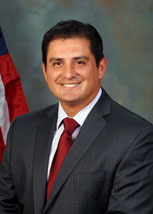
Ask Maddy about Ben Hueso
Scope: california
Hi! I can help you understand Ben Hueso's legislative record. What would you like to know?
Try one of these
i
Maddy answers using official bill text and legislative records. Always verify before sharing.
Sources cited inline