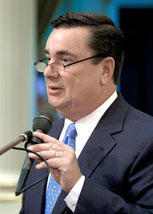
Photo of Joel Anderson
R California Senate · District 38 · Former member

Sen. Joel Anderson

Compare
Total votes
26,170
all sessions
Attendance
96%
801 missed
Near the chamber average
With party
94%
of cast votes
Lower than 93% of chamber peers
Bipartisan score
4%
crosses aisle rarely
Higher than 92% of chamber peers
Sponsored
925
bills & resolutions
Near the chamber average
Committees
0
assignments
925 bills and resolutions

Sponsored bills

Total
925
Primary
226
Co-sponsor
699
This page
925
matching current filters
Primary SB 545
Signed into law · California Senate · Lead sponsor
Name change: minors.

Existing law provides that if a petition for a change of name alleges a specified reason or circumstance and the petitioner is a participant in a specified address confidentiality program, the action for a change of name is exempt from the publication requirement. This bill would provide that in order for the action for a change of name to be exempt from the publication requirement, the petitioner would also be required to establish that the name he or she is seeking to acquire is on file with the Secretary of State.

Signed into law Jun 25, 2014 0 co-sponsors
Co-sponsor AB 2205
Failed · California Assembly · Co-sponsor
Mammals: use of dogs to pursue bears.

(1) Existing law, with specified exceptions, makes it unlawful to permit or allow a dog to pursue any bear, as defined, at any time. Existing law authorizes the Department of Fish and Wildlife to capture a dog not under the reasonable control of its owner or handler that is pursuing any bear in violation of this prohibition or to capture or dispatch a dog inflicting injury or immediately threatening to inflict injury on any bear at any time. This bill would eliminate the authority for the department to capture a dog not under the reasonable control of its owner or handler when the dog is pursuing any bear or to capture or dispatch a dog inflicting injury or immediately threatening injury on any bear. This bill would require the Department of Fish and Wildlife to make a specified report to the Fish and Game Commission on the status of bear populations, management, and related issues every 3 years. The bill would require the first report to be submitted on or before December 15, 2015, and would require the department, not later than December 15 of each year the report is submitted, to notify, by certified mail, the board of supervisors of each county affected by bear interactions with the general public, of public safety impacts or concerns, bear depredation permit requests, and economic impacts due to bear damage to the extent of those incidences or impacts, and of its recommendations to the commission. This bill would generally prohibit a person from using dogs to hunt, pursue, or molest bears, except when recommended to the Department of Fish and Wildlife by a vote of the board of supervisors of any affected county following a public hearing, as specified. The bill would require the commission to authorize the use of dogs under those circumstances. This bill would permit the use of one dog per hunter for the hunting of bears during open deer season, and the use of more than one dog per hunter during the open bear season except during the period when archery deer seasons or regular deer seasons are open. By imposing new duties on local public officials, the bill would impose a state-mandated local program. (2) Existing law permits the Department of Fish and Wildlife to authorize qualified individuals, educational institutions, governmental agencies, or nongovernmental organizations to use dogs to pursue bears for the purpose of prescribed scientific research. Existing law allows the pursuit of bears by dogs that are guarding or protecting livestock or crops on property owned, leased, or rented by the owner of the dogs if the dogs are maintained with, and remain in reasonable proximity to, the livestock or crops being guarded or protect. This bill would eliminate these authorizations. (3) Existing law authorizes the Fish and Game Commission to establish a hound tag program, imposing certain requirements on the licensure and use of hounds, as defined, to pursue mammals. For these purposes, existing law defines a hound as a dog used to pursue mammals. This bill would repeal this authorization. This bill would define a hound as a dog used to pursue bears and require a hound stamp issued by the Department of Fish and Wildlife to lawfully pursue bears with hounds in a county where the use of hounds to pursue or take bears has been authorized by the commission. This bill would require the amount of the fee to be determined by the commission to fully recover, but not exceed, all reasonable administrative and implementation costs of the department and commission relating to the hound stamp and the use of dogs to pursue bears. This bill would require the revenues from the fee for a hound stamp to be deposited in the Bear Report Account, which this bill would create, in the Fish and Game Preservation Fund, and available upon appropriation by the Legislature, to permit separate accountability for the receipt and expenditure of these funds. (4) Under existing law, except as excluded, violations of the Fish and Game Code are misdemeanors. By changing the definition of a crime, this bill would impose a state-mandated local program. (5) The California Constitution requires the state to reimburse local agencies and school districts for certain costs mandated by the state. Statutory provisions establish procedures for making that reimbursement. This bill would provide that with regard to certain mandates no reimbursement is required by this act for a specified reason. With regard to any other mandates, this bill would provide that, if the Commission on State Mandates determines that the bill contains costs so mandated by the state, reimbursement for those costs shall be made pursuant to the statutory provisions noted above.

Failed May 28, 2014 1 co-sponsor
Co-sponsor ACA 1
Signed into law · California Assembly · Co-sponsor
A resolution to propose to the people of the State of California an amendment to the Constitution of the State, by directing the Secretary of State to withdraw from the consideration of the people of the State of California Assembly Constitutional Amendment No. 4 (Resolution Chapter 174 of the Statutes of 2010) and proposing to the people of the State of California an amendment to the Constitution of the State, by adding Section 12.5 to Article IV thereof, and by adding Sections 21 and 22 to, and repealing and adding Section 20 of, Article XVI thereof, relating to state finance.

Existing provisions of the California Constitution require the Governor to submit to the Legislature a budget for the ensuing fiscal year within the first 10 days of each calendar year and prohibit the Legislature from sending to the Governor for consideration a Budget Bill that would appropriate from the General Fund a total amount that exceeds General Fund revenues for that fiscal year estimated as of the date of the Budget Bill's passage. This measure would require the Director of Finance to submit estimates of General Fund revenues and expenditures for the ensuing fiscal year and the 3 fiscal years thereafter within 10 days following the submission of a budget by the Governor, following the submission of proposed adjustments to the Governor's Budget, as required by statute, and following the enactment of the Budget Bill. Existing provisions of the California Constitution require the Legislature to establish a prudent state reserve fund in an amount the Legislature deems reasonable and necessary. Existing provisions of the California Constitution, approved by the electors on March 2, 2004, additionally establish the Budget Stabilization Account in the General Fund and require the Controller, commencing no later than September 30, 2006, and for each fiscal year thereafter, to transfer from the General Fund to the account a specified percentage of estimated General Fund revenues. Section 8 of Article XVI of the California Constitution (Proposition 98) sets forth a formula for computing the minimum amount of General Fund revenues that the state is required to appropriate for the support of school districts, as defined, and community college districts for each fiscal year. This measure would establish a replacement version of the Budget Stabilization Account, and would require the Controller, commencing with the 2015–16 fiscal year and each fiscal year thereafter, to transfer from the General Fund to the account 1.5% of the estimated amount of General Fund revenues for that fiscal year. Commencing with the 2015–16 fiscal year, this measure would also require the Controller to annually transfer from the General Fund to the account amounts determined pursuant to specified formulae, consisting of General Fund proceeds of taxes derived from personal income taxes paid on net capital gains that exceed a designated level, based on estimates provided in the Budget Act. This measure, for the 2015–16 fiscal year through the 2029–30 fiscal year, would require the Legislature to appropriate 50% of these total amounts for one or more designated fiscal obligations of the state, including accrued school funding obligations, repayment of budgetary loans, payment of accrued claims for mandate costs, and payment of unfunded pension liabilities and prefunding of other postemployment benefits. For the 2030–31 fiscal year and each fiscal year thereafter, this measure would instead authorize the Legislature to appropriate up to 50% of these total amounts for one or more of these designated fiscal obligations of the state. This measure would require the Department of Finance, commencing with the 2015–16 fiscal year, to annually report to the Legislature certain fiscal information necessary to calculate the amount of the transfer from the General Fund to the Budget Stabilization Account for that fiscal year, and would require certain of these estimates to be included in the annual Budget Act. Commencing with the 2017–18 fiscal year, the measure would require the department to provide updated estimates for each of the 2 preceding fiscal years, calculated separately, for the purpose of determining the maximum allowable transfer from the General Fund to the Budget Stabilization Account for each of these fiscal years. This measure would prohibit the balance in the Budget Stabilization Account from exceeding 10% of estimated General Fund proceeds of taxes. It also would limit the use of funds, that otherwise would be transferred to the account, to appropriation for the funding of infrastructure, as defined in a specified statute, including deferred maintenance. This measure would establish the Public School System Stabilization Account, to provide a reserve for public school funding. Commencing with the 2015–16 fiscal year and pursuant to specified calculations, the Controller would transfer certain moneys from the General Fund into the Public School System Stabilization Account, for subsequent allocation to school districts and community college districts in fiscal years for which the minimum state funding obligation under Proposition 98 falls below specified levels. The measure would prohibit the transfer of moneys into the Public School System Stabilization Account for a fiscal year for which a maintenance factor is created under Proposition 98 or before a previously determined maintenance factor has been fully reimbursed. The measure would also prohibit the transfer of funds into the account in a fiscal year in which provisions of Proposition 98 have been suspended. The funds transferred into the Public School System Stabilization Account under the measure in a fiscal year would be counted toward the state's annual funding obligation for that fiscal year under Proposition 98, rather than in a fiscal year in which those funds are allocated. The measure would authorize the Controller to utilize funds in the account, that he or she determines to be unnecessary to meet foreseeable obligations, to help manage General Fund daily cash flow needs if that use does not interfere with the purpose of the account. Existing provisions of the California Constitution authorize the Governor to issue a proclamation declaring an emergency in specified circumstances. This measure would authorize the Legislature, upon the Governor's proclamation declaring a budget emergency, as described, to enact a statute that returns funds from the Budget Stabilization Account to the General Fund for appropriation to address the budget emergency, appropriates funds in the Public School System Stabilization Account for the support of school districts and community college districts, or suspends or reduces the transfer of funds from the General Fund to the Budget Stabilization Account or the Public School System Stabilization Account. Existing law requires the Secretary of State to submit ACA 4 of the 2009–10 Regular Session, a proposed legislative constitutional amendment relating to state finance, to the voters at the November 4, 2014, statewide general election. This bill would direct the Secretary of State to withdraw ACA 4 from the ballot.

Signed into law May 16, 2014 1 co-sponsor
Co-sponsor SCR 92
Signed into law · California Senate · Co-sponsor
Relative to California Agriculture Day.

This measure would recognize the week of March 23, 2014, to March 29, 2014, inclusive, as National Agriculture Week, and would designate March 19, 2014, as California Agriculture Day.

Signed into law Apr 9, 2014 1 co-sponsor
Co-sponsor ACA 5
Failed · California Assembly · Co-sponsor
A resolution to propose to the people of the State of California an amendment to the Constitution of the State, by adding Section 32 to Article I thereof, relating to abortion.

The California Constitution establishes a right of privacy. Existing statutory law, the Reproductive Privacy Act, contains provisions regulating abortions, including a requirement that the procedure be performed by a physician and surgeon. The act prohibits the state from denying or interfering with a woman's right to choose or obtain an abortion prior to viability of the fetus, or if the abortion is necessary to protect the life or health of the woman. This measure, which would be known as the Parental Notification, Child and Teen Safety, Stop Predators Act, would prohibit a physician and surgeon from performing an abortion on an unemancipated minor, as defined, unless the physician and surgeon or his or her agent has delivered written notice to the parent of the unemancipated minor, or until a waiver of that notice has been received from the parent or issued by a court pursuant to a prescribed process. The measure would require the physician and surgeon performing an abortion on an unemancipated minor to report specified information to State Department of Public Health and would require the department to compile an annual statistical report with that information. The measure would impose civil and criminal liability for violation of this measure, as specified.

Failed Feb 18, 2014 1 co-sponsor
Primary SB 779
died · California Senate · Lead sponsor
Capital punishment: appeals.

(1) Existing law requires the Governor to appoint a State Public Defender and requires the State Public Defender, among other things, to formulate plans for the representation of indigents in the Supreme Court and each appellate district. This bill would delete the provision requiring the State Public Defender to formulate plans for the representation of indigents. The bill would require the State Public Defender to report annually to the Governor and the Legislature on the status of, and appointment of counsel for, indigent persons with respect to death penalty appeals. (2) Existing law provides that the duties prescribed by the State Public Defender in existing law are not exclusive, and allows the State Public Defender to perform any acts consistent with his or her prescribed duties in carrying out the functions of the office. This bill would delete these provisions. (3) Existing law establishes the California Habeas Corpus Resource Center in the judicial branch of state government and authorizes the center employ up to 34 attorneys who may be appointed by the Supreme Court to represent any person convicted and sentenced to death in this state, who is without counsel, and who is determined by a court to be indigent, for the purposes of instituting and prosecuting postconviction actions in state and federal courts, challenging the legality of the judgment or sentence imposed against that person, and preparing petitions for executive clemency. Among other things, existing law requires the center to establish and periodically update a roster of attorneys qualified as counsel in postconviction proceedings in capital cases. Existing law requires the Supreme Court to offer to appoint counsel to represent all state prisoners subject to a capital sentence for state postconviction proceedings and enter an order to appoint one or more counsel to represent the prisoner in postconviction state proceedings upon a finding that the prisoner is indigent or unable to completely decide whether to accept or reject that offer. Existing law grants the center the power to employ investigators and staff to provide services to appointed counsel, and to provide legal or other advice or, to the extent not otherwise available, any other assistance to the appointed counsel in postconviction proceedings as is appropriate. This bill would instead require the superior court which imposed the death sentence to offer to appoint counsel to represent state prisoners subject to a capital sentence for purposes of state postconviction proceedings, and would require the superior court to appoint one or more counsel to represent the prisoner in a state habeas corpus proceeding. The bill would require the Legislature to ensure funding to fulfill these requirements, and would authorize the Legislature to consider utilizing funds that were formerly appropriated for the support of the Supreme Court. The bill would provide that the center shall annually recommend attorneys to the Supreme Court for inclusion in a roster of attorneys qualified as counsel in postconviction proceedings in capital cases, provided that the final determination of whether to include an attorney in a roster shall be made by the Supreme Court and not delegated to the center. This bill would remove the power of the center to provide any other assistance to appointed counsel other than employing investigators and staff, or providing legal or other advice. The bill would provide that the center may only represent a person sentenced to death on one federal habeas corpus petition, and only if certain requirements are met, including that the center was appointed to represent that person on a state petition for habeas corpus. (4) Existing law requires that the executive director of the California Habeas Corpus Resource Center be chosen by a 5-member board of directors and confirmed by the Senate, as provided. This bill would eliminate the provisions regarding the 5-member board of directors and instead require the executive director to be appointed by the Supreme Court. The bill would provide that the executive director shall receive the salary that is specified in existing law for the State Public Defender and would require all other attorneys employed by the center to be compensated at the same level as comparable positions in the office of the State Public Defender. (5) Existing law requires the Judicial Counsel and the Supreme Court to adopt binding and mandatory competency standards for the appointment of counsel in death penalty direct appeals and habeas corpus proceedings. This bill would instead provide that an attorney shall be deemed competent for appointment as counsel in a death penalty direct appeal or habeas corpus proceeding if the attorney has been admitted to practice in a court of appeal for not less than 5 years, and has had not less than 3 years of experience in handling appeals in that court in felony cases, as specified in federal law. The bill would allow the Judicial Council and the Supreme Court to adopt mandatory competency standards in lieu of the above provision, as specified, and would require the above standard to be in effect until the Judicial Council or the Supreme Court has adopted new standards. (6) Existing law requires the California Habeas Corpus Resource Center to report annually to the Legislature, the Governor, and the Supreme Court on the status of appointment of counsel for indigent persons in postconviction capital cases, and on the operations of the center. This bill would require the report to list all cases in which the center is providing representation. For each case that has been pending for more than one year in any court, the bill would require the report to state the reason for the delay and actions the center is taking to bring the case to completion. The bill would require the report to be made available on the center's Internet Web site or by another medium providing equal or better access to the public. (7) Existing law, for purposes of the death penalty, defines the "entire record" as including the normal and additional record prescribed in the rules adopted by the Judicial Council pertaining to an appeal taken by the defendant from a judgment of conviction, a copy of any other record on file or lodged with the superior court, and a transcript of any other oral proceeding reported in the superior court. This bill would instead define the record for purposes of death penalty cases and provide that jury questionnaires filled out by jurors who were excused without having been seated in the jury box during the selection process and who were not excused for cause are not part of the record. (8) Existing law requires the record on appeal to be expeditiously certified in 2 stages, first for completeness and 2nd for accuracy, in any case in which the death sentence has been imposed. Existing law requires the clerk of the superior court to provide trial counsel copies of the clerk's transcript within 30 days of the imposition of the death sentence. Existing law requires trial counsel to alert the court's attention to any errors in the transcripts incidentally discovered by counsel while reviewing them in the normal course of trial preparation. Existing law requires the trial court to certify the record for completeness and for incorporation of all corrections no later than 90 days after entry of the imposition of the death sentence unless good cause is shown, except that existing law provides this time period may be extended if the trial transcript exceeds 10,000 pages. Existing law requires the trial court to hold one or more hearings for trial counsel to address the completeness of the record and any outstanding errors that have come to their attention and to certify that they have reviewed all docket sheets to ensure that the record contains transcripts for any proceedings, hearings, or discussions that are required to be reported. Existing law requires the trial court to certify the record for accuracy no later than 120 days after the record has been delivered to appellate counsel, except that existing law provides that this time may be extended, as provided. This bill would delete the requirement that the record be certified in 2 stages for completeness and accuracy. The bill would require the superior court to provide trial counsel with copies of the clerk's transcript, the reporter's transcript, and a comprehensive journal of proceedings, as provided. The bill would require trial counsel to undertake to identify and promptly alert the court's attention to any errors in the transcript of proceedings and to provide a list of any proposed corrections to the reporter's transcript. The bill would remove the exception to the 90-day certification requirement for proceedings in which the trial transcript exceeds 10,000 pages. The bill would require the clerk of the trial court to deliver a copy of the record on appeal to the Attorney General. The bill would provide that no additional motion for correcting the record may be entertained after the record is certified, except that either party may file in the Supreme Court a motion for referral to the trial court for correction of a material error in the record, as provided. The bill would require the Supreme Court to rule on the motion not later than 21 days after it is filed. (9) Under existing law, when an appeal lies on behalf of a defendant or the people, the appeal may be taken in the manner provided in the rules adopted by the Judicial Counsel. Under existing law, when a judgment of death is rendered, an appeal is automatically taken by the defendant without any action by him or his or her counsel. This bill would provide that the appellate court may require the appellant to be represented by counsel, but would require counsel to respect the right of the client to determine the goals of representation. (10) Existing law authorizes the Supreme Court to appoint counsel other than the State Public Defender in cases where a judgment of death has been rendered. This bill would instead prohibit the State Public Defender from being appointed in a noncapital case at any time when there is a backlog of capital cases awaiting appointment of more than 3 months and the State Public Defender is unable to take all of the cases for which the State Public Defender would otherwise be appointed. The bill would require the clerk of the Supreme Court to notify the State Public Defender of a case promptly upon docketing, and would require the State Public Defender to notify the Supreme Court if the office is unable to represent the appellant within 30 days. The bill would require the Supreme Court to promptly issue an order appointing the State Public Defender as counsel for the appellant if notice is not received within the 30 days. The bill would require any attorney who is qualified for appointment in capital appeals to agree to accept any appointments as a condition of remaining on the list of attorneys for appointment by a court of appeals in noncapital cases, as provided. (11) Existing law provides that every person unlawfully imprisoned or restrained of liberty may prosecute a writ of habeas corpus to inquire into the cause of the imprisonment or restraint. Existing law requires that the person upon whom the writ is served to file a return. Existing law requires that if the party is held under illegal restraint or custody, he or she shall be discharged, and if not, he or she shall be restored to the care or custody of the person entitled thereto. Existing law provides that an appeal may be taken from a final order of a superior court upon the return of a writ of habeas corpus discharging the defendant to the court of appeal in all criminal cases, except that existing law requires the appeal to be to the Supreme Court in cases where judgment of death has been rendered. This bill would provide the exclusive procedure for collateral attack on a judgment of death. The bill would require any petition for writ of habeas corpus filed by a person in custody pursuant to a judgment of death to be filed in, or transferred to, the court that imposed the sentence unless good cause is shown for the petition to be heard by another court. The bill would require that the prisoner be offered counsel, and would authorize the prisoner or the State to appeal the decision on the petition to the court with jurisdiction over the appeal from the underlying criminal judgment. The bill would prohibit a successive petition to be used as a means of reviewing a denial of habeas relief. The bill would require the initial petition to be filed within one year of appointing counsel or of the defendant's rejecting of counsel, unless the court finds, by a preponderance of all available evidence that the defendant is actually innocent of the crime or is ineligible for the sentence of death. The bill would require that a successive petition claiming innocence or ineligibility for the sentence of death to disclose all material information relating to guilt in possession of the petitioner. (12) Existing law requires that every male person upon whom a judgment of death has been imposed to be delivered to the warden of the California state prison designated by the department for the execution of the death penalty, and requires the person to be kept there until the execution of judgment. Existing law allows an inmate who commits specified crimes to be housed in secure condemned housing. Existing law requires that a judgment for imprisonment where the judgment is for death to direct the defendant to be delivered to the warden of the California Prison at San Quentin. This bill would instead allow the department to transfer any inmate, without regard to gender, to another prison which the department determines provides a level of security sufficient for the inmate, and would require the inmate to be returned to the prison designated for execution of the death penalty after an execution date has been set. The bill would allow a condemned inmate to be housed in any state prison designated by the Secretary of the Department of Corrections and Rehabilitation for the housing of condemned prisoners. (13) Existing law requires a court, if a judgment of death remains in force and has not been executed, to enter an order appointing a day upon which the judgment shall be executed that is not less than 30 days, nor more than 60 days from the time of making the order. This bill would instead require the court enter an order specifying a period of 30 days during with the judgment shall be executed, as provided. The bill would make conforming changes. (14) Existing law requires that, in order to expedite certification of the entire record on appeal in all criminal cases, the defendant's trial counsel and the prosecutor continue to represent the respective parties. Existing law specifies that each counsel's obligations extend to taking all steps necessary to facilitate the preparation and timely certification of the record of superior court proceedings. Existing law specifies that these provisions do not foreclose the defendant's appellate counsel from requesting additions or corrections to the record on appeal in either the trial court or the Supreme Court in a manner provided by the rules of court adopted by the Judicial Council. This bill would delete these provisions. (15) Under existing law, when a defendant has been charged with a public offense triable in any court, he or she may, and in cases other than those for which the punishment may be death, the people may, have witnesses examined conditionally, as specified. This bill would allow witnesses to be examined conditionally by the defendant and by the people in any case where the defendant has been charged with a public offense triable in any court, as provided. (16) Existing law requires a judgment of death to be executed within the walls of the California State Prison at San Quentin. Existing law requires every female person, upon whom has been imposed the judgment of death, to be delivered to the warden of the Central California Women's Facility, to be held pending appeal. Upon affirmance of her appeal, existing law requires the female person sentenced to death to be delivered to the warden of the California state prison designated by the department for the execution of the death penalty This bill would delete the above provisions relating to condemned female inmates and would instead require the judgment of death in the case of both genders to be executed within the walls of a state prison to be determined by the Secretary of the Department of Corrections and Rehabilitation. The bill would provide that this determination, and any standards, procedures, or regulations promulgated by the department in regard to the administration of the penalty of death, would not be subject to review by the Office of Administrative Law, as provided. (17) Existing law requires the punishment of death to be inflicted by the administration of lethal gas or an intravenous injection and provides that if either method is held invalid that the punishment shall be imposed by the other method. This bill would provide that the punishment of death would be inflicted by the administration of lethal gas or injection by any means. The bill would specify that lethal gas may include any gas administered in a lethal manner, including by displacing oxygen. In the event a method of execution is held invalid, the bill would require the court to order the use of a valid method of execution, as provided. If the method of execution is enjoined by a federal court, the bill would require the Department of Corrections and Rehabilitation to adopt a method that conforms to federal requirements, as specified. If the Department of Corrections and Rehabilitation fails to perform any duty needed to enable it to execute judgment, the bill would require the court which rendered the judgment of death to order the department to perform that duty on its own motion, on the motion of the district attorney or Attorney General, or on the motion of any victim of the crime, as specified. The bill would provide that the execution of judgment shall not be prevented or substantially delayed under any circumstances. (18) The California Constitution requires that a statute that limits the right of access to meetings of public bodies or the writings of public officials and agencies be adopted with findings demonstrating the interest protected by that limitation and the need for protecting that interest. Except as provided by statute enacted by a two-thirds vote of the membership in each house of the legislature, the California Constitution prohibits the exclusion of relevant evidence in any criminal proceeding, including pretrial and postconviction motions and hearings. This bill would require the identity and personal identifying information of the members of an execution team, medical professionals who assist in or consult on executions, persons who perform ancillary functions in an execution, and persons who supply drugs, medical supplies, or medical equipment for an execution to be privileged official information. The bill would prohibit disclosure of this information, and would provide the information shall not be subject to discovery in any civil, criminal, or administrative proceedings, except as specified. Because this bill would potentially exclude relevant evidence from a criminal proceeding, it would require a 2/3 vote. The bill would make a legislative finding and declaration relating to the necessity of protecting the privacy of these individuals. The bill would require any pharmacy operated by the Department of Corrections and Rehabilitation to obtain and provide any drugs or other controlled substances and medical supplies necessary for the execution process and practice sessions. The bill would require the secretary of the department to maintain ultimate authority over the pharmacy for purposes of obtaining these supplies. The bill would prohibit the infliction of the punishment of death from being construed to be the practice of medicine. The bill would prohibit any physician from being compelled by the state to perform an execution. The bill would allow the state to employ a physician to be present during the execution and to pronounce death. The bill would prohibit any agency that regulates the practice of health care from taking disciplinary action against any licensed health care professional for participating in, or providing assistance with, and execution. (19) Existing law requires that the warden of the state prison where an execution is to take place be present at the execution and invite the presence of the Attorney General, the members of the immediate family of the victim or victims of the defendant, and at least 12 reputable citizens selected by the warden. This bill would require the warden, in the event that a condemned inmate has been sentenced to death in one or more proceedings or jurisdictions, to invite the prosecuting attorney, the judge, and the chief law enforcement official from each jurisdiction where any death sentence has issued to attend the execution. (20) The bill would provide that it would not be operative unless Senate Constitutional Amendment No. ____ of the 2013–14 Regular Session is approved by the voters.


died Feb 3, 2014 0 co-sponsors
Co-sponsor SB 17
died · California Senate · Co-sponsor
State responsibility areas: fire prevention fees.

Existing law requires the State Board of Forestry and Fire Protection, on or before September 1, 2011, to adopt emergency regulations to establish a fire prevention fee in an amount not to exceed $150 to be charged on each habitable structure on a parcel that is within a state responsibility area, as defined, and requires that the fire prevention fee be adjusted annually using prescribed methods. Existing law requires the State Board of Equalization to collect the fire prevention fees, as prescribed, commencing with the 2011–12 fiscal year. Existing law establishes the State Responsibility Area Fire Prevention Fund and prohibits the collection of fire prevention fees if, commencing with the 2012–13 fiscal year, there are sufficient amounts of moneys in the fund to finance specified fire prevention activities for a fiscal year. Existing law requires that the fire prevention fees collected, except as provided, be deposited into the fund and be made available to the board and the Department of Forestry and Fire Protection for certain specified fire prevention activities that benefit the owners of structures in state responsibility areas who are required to pay the fee. Existing law further requires the board, on and after January 1, 2013, to submit an annual written report to the Legislature on specified topics. This bill would declare the intent of the Legislature to repeal the state responsibility area fire prevention fees imposed by the above provisions.

died Feb 3, 2014 1 co-sponsor
Co-sponsor SB 451
died · California Senate · Co-sponsor
Open Enrollment Act: expansion to all school districts of residence.

(1) Existing law, the Open Enrollment Act, authorizes the parent of a pupil enrolled in a low-achieving school, as defined, to submit an application for the pupil to attend a school in a school district of enrollment, as defined, as specified. This bill would expand the act to authorize the parent of a pupil enrolled in a school district of residence, as defined, to submit an application for the pupil to attend a school in a school district other than their school district of residence. The Open Enrollment Act requires a school district of enrollment to ensure that pupils enrolled pursuant to the act are enrolled in a school with a higher Academic Performance Index than the school in which the pupil was previously enrolled and are selected through a random, unbiased process, except that pupils applying for transfer are required to be assigned specified priorities for approval. This bill would add a third priority for approval for pupils transferring from a school ranked in decile 2 on the Academic Performance Index. To the extent the bill would expand the duties of school districts under the Open Enrollment Act, the bill would impose a state-mandated local program. (2) Existing law authorizes the governing board of a school district or a county board of education, as specified, after a public hearing on the matter, to request the State Board of Education to waive all or part of any section of the Education Code or any regulation adopted by the state board that implements a provision of the Education Code that may be waived, except for specified provisions. This bill would include additional specified provisions of the Education Code, relating to notice and procedures to apply and transfer schools pursuant to the Open Enrollment Act, that may not be waived. The California Constitution requires the state to reimburse local agencies and school districts for certain costs mandated by the state. Statutory provisions establish procedures for making that reimbursement. This bill would provide that, if the Commission on State Mandates determines that the bill contains costs mandated by the state, reimbursement for those costs shall be made pursuant to these statutory provisions.

died Feb 3, 2014 1 co-sponsor
Primary SB 554
In committee · California Senate · Lead sponsor
Employment: overtime compensation.

Existing law, with certain exceptions, establishes 8 hours as a day's work and a 40-hour workweek, and requires payment of prescribed overtime compensation for additional hours worked. Existing law, except as specified, requires compensation for any work in excess of 8 hours in one workday at the rate of no less than 1.5 times the regular rate of pay for an employee, and compensation for any work in excess of 12 hours in one day at twice the regular rate of pay for an employee. Under existing law, a person who violates the provisions regulating work hours is guilty of a misdemeanor. This bill would exempt employees of 24-hour nonmedical out-of-home licensed residential facilities of 15 beds or fewer for the developmentally disabled, elderly, or mentally ill adults from the above-described provisions, and would prohibit those employees from working more than 24 consecutive hours, until the employee receives at least 8 hours of off-duty period, as specified. The bill would specify that, for these employees, time spent sleeping during the employee's 24-hour on-duty period shall not be included as hours worked for the purpose of calculating overtime and would require that time to be compensated at the minimum wage. Because a violation of these provision would be a misdemeanor, this bill would impose a state-mandated local program. The California Constitution requires the state to reimburse local agencies and school districts for certain costs mandated by the state. Statutory provisions establish procedures for making that reimbursement. This bill would provide that no reimbursement is required by this act for a specified reason.

In committee Feb 3, 2014 0 co-sponsors
Co-sponsor SCR 38
Signed into law · California Senate · Co-sponsor
Relative to the Stephen Palmer, Sr., Memorial Highway.

This measure would designate a specified portion of State Highway Route 94 in the County of San Diego as the Stephen Palmer, Sr., Memorial Highway. This measure would also request the Department of Transportation to determine the cost of appropriate signs showing this special designation and, upon receiving donations from nonstate sources covering those costs, to erect those signs.

Signed into law Feb 3, 2014 1 co-sponsor
Showing 441 to 450 of 925 bills
Previous 1 … 44 45 46 … 93 Next