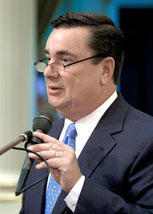
Photo of Joel Anderson
R California Senate · District 38

Sen. Joel Anderson

Compare
Total votes
26,170
all sessions
Attendance
96%
801 missed
Near the chamber average
With party
94%
of cast votes
Lower than 93% of chamber peers
Bipartisan score
4%
crosses aisle rarely
Higher than 92% of chamber peers
Sponsored
925
bills & resolutions
Near the chamber average
Committees
0
assignments
925 bills and resolutions

Sponsored bills

Total
925
Primary
226
Co-sponsor
699
This page
925
matching current filters
Co-sponsor AB 355
Signed into law · California Assembly · Co-sponsor
Unclaimed property: safe deposit boxes.

Existing law, the Unclaimed Property Law, governs the disposition of unclaimed property, including the escheat of certain property to the state. Existing law provides for the escheat to the state of the contents of, or proceeds of sale of the contents of, any safe deposit box or any other safekeeping repository held in the state by a business association, as specified. In cases where the contents of a safe deposit box or other safekeeping repository escheat to the state, existing law requires the business association to report to the Controller certain information regarding the property and owner, including a description of the property and the place where it is held and may be inspected by the Controller. Within 165 days after the final date for filing the report, existing law requires the Controller to mail a notice to each person having an address listed in the report who appears to be entitled to property escheated, as specified. This bill would additionally authorize the Controller to mail a separate notice to an apparent owner of a United States savings bond, war bond, or military award inside a safe deposit box or other safekeeping repository whose name is shown on or can be associated with the contents of a safe deposit box or other safekeeping repository and is different from the name of the reported owner.

Signed into law Sep 21, 2015 1 co-sponsor
Co-sponsor SB 9
died · California Senate · Co-sponsor
Department of Transportation.

(1) Existing law creates the Department of Transportation with various powers and duties relative to the state highway system and other transportation programs. This bill would prohibit the department from using any nonrecurring funds, including, but not limited to, loan repayments, bond funds, or grant funds, to pay the salaries or benefits of any permanent civil service position within the department. (2) Article XXII of the California Constitution grants to the State of California and all other governmental entities the choice and authority to contract with qualified private entities for architectural and engineering services for all public works of improvement. This bill would require the Department of Transportation to contract with qualified private entities for architectural and engineering services with respect to public works of improvement undertaken by the department, with a minimum of 15% of the total annual value of these services to be contracted to qualified private entities beginning on July 1, 2016, and increasing each year to a minimum of 50% by July 1, 2023.

died Sep 14, 2015 1 co-sponsor
Co-sponsor SB 3
died · California Senate · Co-sponsor
Transportation bonds: highway, street, and road projects.

Existing law, the Safe, Reliable High-Speed Passenger Train Bond Act for the 21st Century, approved by the voters as Proposition 1A at the November 4, 2008, general election, provides for the issuance of general obligation bonds in the amount of $9 billion for high-speed rail purposes and $950 million for other related rail purposes. Article XVI of the California Constitution requires measures authorizing general obligation bonds to specify the single object or work to be funded by the bonds and further requires a bond act to be approved by a 23 vote of each house of the Legislature and a majority of the voters. This bill would provide that no further bonds shall be sold for high-speed rail purposes pursuant to the Safe, Reliable High-Speed Passenger Train Bond Act for the 21st Century, except as specifically provided with respect to an existing appropriation for high-speed rail purposes for early improvement projects in the Phase 1 blended system. The bill, subject to the above exception, would require redirection of the unspent proceeds from outstanding bonds issued and sold for other high-speed rail purposes prior to the effective date of these provisions, upon appropriation, for use in retiring the debt incurred from the issuance and sale of those outstanding bonds. The bill, subject to the above exception, would also require the net proceeds of bonds subsequently issued and sold under the high-speed rail portion of the bond act, upon appropriation, to be made available to the Department of Transportation for repair and new construction projects on state highways and freeways, and for repair and new construction projects on local streets and roads, as specified. The bill would make no changes to the authorization under the bond act for the issuance of $950 million in bonds for rail purposes other than high-speed rail. These provisions would become effective only upon approval by the voters at the June 7, 2016, statewide primary election.

died Sep 14, 2015 1 co-sponsor
Co-sponsor ACR 7
Signed into law · California Assembly · Co-sponsor
Relative to National Night Out.

This measure would proclaim August 4, 2015, as National Night Out in California and would urge the people of California to observe and participate in National Night Out.

Signed into law Sep 10, 2015 1 co-sponsor
Co-sponsor ACR 63
Signed into law · California Assembly · Co-sponsor
Relative to the Tony Gwynn Memorial Freeway.

This measure would designate the portion of Interstate 15 from Camino Del Norte to Scripps Poway Parkway/Mercy Road in the County of San Diego as the Tony Gwynn Memorial Freeway. The measure would also request the Department of Transportation to determine the cost of appropriate signs showing this special designation and, upon receiving donations from nonstate sources covering that cost, to erect those signs.

Signed into law Sep 10, 2015 1 co-sponsor
Co-sponsor SB 10
In committee · California Senate · Co-sponsor
Regional transportation capital improvement funds.

Existing law establishes the state transportation improvement program process, pursuant to which the California Transportation Commission generally programs and allocates available state and federal funds for transportation capital improvement projects, other than state highway rehabilitation and repair projects, over a multiyear period based on estimates of funds expected to be available. Existing law provides funding for these interregional and regional transportation capital improvement projects through the state transportation improvement program process, with 25% of funds available for interregional projects selected by the Department of Transportation through preparation of an interregional transportation improvement program and 75% for regional projects selected by transportation planning agencies through preparation of a regional transportation improvement program. Existing law requires funds available for regional projects to be programmed by the commission pursuant to the county shares formula, under which a certain amount of funding is available for programming in each county, based on population and miles of state highway. Existing law specifies the various types of projects that may be funded with the regional share of funds to include state highways, local roads, transit, and others. This bill would revise the process for programming and allocating the 75% share of state and federal funds available for regional transportation improvement projects. The bill would require the department to annually apportion, by the existing formula, the county share for each county to the applicable metropolitan planning organization, transportation planning agency, or county transportation commission, as a block grant. These transportation capital improvement funds, along with an appropriate amount of capital outlay support funds, would be appropriated annually through the annual Budget Act to regional transportation agencies. The bill would require the regional transportation agencies, in their regional transportation improvement programs, to identify the transportation capital improvement projects to be funded with these moneys, and would require the California Transportation Commission to incorporate the regional transportation improvement programs into the state transportation improvement program. The bill would eliminate the role of the California Transportation Commission in programming and allocating funds to these regional projects, but would retain certain oversight roles of the commission with respect to expenditure of the funds. The bill would repeal provisions governing computation of county shares over multiple years and make various other conforming changes.


In committee Sep 9, 2015 1 co-sponsor
Co-sponsor SCA 1
In committee · California Senate · Co-sponsor
A resolution to propose to the people of the State of California an amendment to the Constitution of the State, by amending Sections 1, 5, 6, and 8 of, and adding Sections 11 and 12 to, Article XIX thereof, relating to transportation.

(1) Article XIX of the California Constitution restricts the expenditure of revenues from taxes imposed by the state on fuels used in motor vehicles upon public streets and highways to street and highway and certain mass transit purposes, and restricts the expenditure of revenues from fees and taxes imposed by the state upon vehicles or their use or operation to state administration and enforcement of laws regulating the use, operation, or registration of vehicles used upon the public streets and highways, as well as to street and highway and certain mass transit purposes. These restrictions do not apply to revenues from taxes or fees imposed under the Sales and Use Tax Law or the Vehicle License Fee Law. Article XIX prohibits the Legislature from borrowing revenues from taxes imposed by the state on fuels used in motor vehicles, and from using those revenues other than as specifically permitted by Article XIX. Article XIX provides that up to 25% of fuel tax revenues allocated to the state may be pledged or used for the payment of principal and interest on voter-approved transportation bonds issued for street and highway purposes on and after November 2, 2010, upon voter approval and appropriation by the Legislature. Article XIX provides that up to 25% of fuel tax revenues allocated to cities and counties may be pledged or used for the payment of principal and interest on voter-approved transportation bonds issued for street and highway purposes. However, in counties where voters have approved the use of fuel tax revenues for certain mass transit purposes, Article XIX provides that the Legislature may authorize any fuel tax revenues allocated to mass transit purposes to be pledged or used for payment of principal and interest on voter-approved bonds issued for those mass transit purposes. This measure would prohibit the Legislature from borrowing revenues from fees and taxes imposed by the state on vehicles or their use or operation, and from using those revenues other than as specifically permitted by Article XIX. The measure would also prohibit those revenues from being pledged or used for the payment of principal and interest on bonds or other indebtedness. The measure would delete the provision that provides for use of any fuel tax revenues allocated to mass transit purposes to be pledged or used for payment of principal and interest on voter-approved bonds issued for those mass transit purposes, and would instead subject those expenditures to the existing 25% limitation applicable to the use of fuel tax revenues for street and highway bond purposes. This measure would also restrict the expenditure of revenues from taxes imposed by the state on motor vehicle fuels used other than in motor vehicles upon public streets and highways, by requiring the use of those revenues for street and highway purposes, but only with respect to the portion of the affected revenues attributable to increases in tax rates that are effective on or after July 1, 2010. This restriction on expenditures would not apply if federal law requires another use of any portion of those revenues. The measure would also prohibit the Legislature from borrowing those revenues or pledging those revenues for debt service. (2) Article XI of the California Constitution requires the revenues derived under the Vehicle License Fee Law from a rate that does not exceed 0.65% of the market value of a vehicle to be allocated to cities and counties, and does not restrict expenditure of those revenues for a particular purpose. This measure would require revenues derived from that portion of the vehicle license fee rate that exceeds 0.65% of the market value of a vehicle to be used solely for street and highway purposes and would prohibit the Legislature from borrowing those revenues. The measure would also prohibit those revenues from being pledged or used for the payment of principal and interest on bonds or other indebtedness. (3) This measure would make other conforming changes.

In committee Sep 9, 2015 1 co-sponsor
Co-sponsor SCR 78
Signed into law · California Senate · Co-sponsor
Veterans: Team AMVETS.

This measure would commend AMVETS Department of California, also known as Team AMVETS, for providing benefits and services to veterans, and for playing an important role in the community for 70 years.

Signed into law Sep 8, 2015 1 co-sponsor
Showing 311 to 320 of 925 bills
Previous 1 … 31 32 33 … 93 Next