

Existing law requires the Department of Housing and Community Development to submit an annual report to the Governor and both houses of the Legislature on the operations and accomplishments during the previous fiscal year of the housing programs administered by the department. Existing law requires the report to include, among other things, an evaluation, in collaboration with the Department of Veterans Affairs, of any program established by the department pursuant to the Veterans Housing and Homeless Prevention Act of 2014. This bill would additionally require the evaluation to include information relating to the effectiveness of assisted projects in helping veterans occupying any supportive housing or transitional housing development that was issued funds pursuant to that act, as specified. This bill would incorporate changes to Section 50408 of the Health and Safety Code proposed by both this bill and AB 90, which would become operative only if both bills are enacted and become effective on or before January 1, 2016, and this bill is chaptered last.
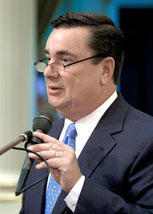
Sponsored bills
Existing law makes it a crime to manufacture, assemble, sell, advertise for sale, possess, transport, import, or furnish to another a device that is primarily or exclusively designed or intended for eavesdropping upon the communication of another, or any device that is primarily or exclusively designed or intended for the unauthorized interception of reception of communications between a cellular radio telephone, as defined, and a landline telephone or other cellular radio telephone. Existing law additionally makes it a crime to purchase, sell, offer to purchase or sell, or conspire to purchase or sell, any telephone calling pattern record or list, without the written consent of the subscriber, or to procure, obtain, attempt to obtain, or conspire to obtain, any calling pattern record or list through fraud or deceit. Existing law contains certain exemptions from these crimes for law enforcement agencies. This bill would require every local agency that operates cellular communications interception technology, as defined, to maintain reasonable operational, administrative, technical, and physical safeguards to protect information gathered through use of the technology from unauthorized access, destruction, use, modification, or disclosure and implement a usage and privacy policy, as specified, to ensure that the collection, use, maintenance, sharing, and dissemination of information gathered through use of the technology complies with applicable law and is consistent with respect for an individual's privacy and civil liberties. The bill would, except as provided, prohibit a local agency from acquiring cellular communications interception technology unless that acquisition is approved by a resolution or ordinance adopted by its legislative body at a regularly scheduled public meeting of the legislative body held pursuant to a specified open meetings law. The bill would require that the resolution or ordinance set forth the policies of the local agency. The bill would require that the local agency make the usage and privacy policy available in writing to the public and if the local agency maintains an Internet Web site, to conspicuously post the usage and privacy policies on that site. The bill would, in addition to any other sanctions, penalties, or remedies provided by law, authorize an individual who has been harmed by a violation of these provisions to bring a civil action in any court of competent jurisdiction against a person who knowingly caused that violation.
Existing law, the California Retail Food Code, establishes uniform health and sanitation standards for, and provides for regulation by the State Department of Public Health of, retail food facilities and various types of food. Among other things, the code requires nonpermanent food facilities that handle nonprepackaged food to protect the food from contamination and limit the display and handling of nonprepackaged food. The code also establishes specified food safety and sanitation requirements for certified farmers' markets governing food preparation, storage, and sampling, among other things. Under existing law, local health agencies are primarily responsible for enforcing the code. A person who violates any provision of the code is guilty of a misdemeanor, except as otherwise provided. This bill would create a new type of nonpermanent food facility, defined as a "fishermen's market," that would be a food facility operated by a licensed commercial fisherman or an entity representing two or more California-licensed commercial fishermen or California-licensed commercial fishermen and California-registered aquaculturists, that sells only raw edible aquatic plants, raw fresh fish, or fresh frozen fish, caught by California-licensed commercial fishermen or harvested by California-registered aquaculturists, directly to consumers. The bill would establish and impose food safety and sanitation requirements upon a fishermen's market. The bill would authorize only a licensed commercial fisherman or an entity representing two or more California-licensed commercial fishermen or California-licensed commercial fishermen and California-registered aquaculturists to act as the responsible person and sole permitholder for a fishermen's market, and would require that fisherman or entity to submit a permit application and site plan, including specified information, to the enforcement agency at least 2 weeks prior to the operation of the fishermen's market. The bill would define terms for its purposes and make conforming changes. This bill would incorporate additional changes to Section 113789 of the Health and Safety Code, proposed by AB 143 and AB 234, that would become operative only if this bill and either or both of those bills are chaptered and become effective January 1, 2016, and this bill is chaptered last. By imposing new enforcement requirements on local health agencies, and by creating a new crime, the bill would impose a state-mandated local program. The California Constitution requires the state to reimburse local agencies and school districts for certain costs mandated by the state. Statutory provisions establish procedures for making that reimbursement. This bill would provide that with regard to certain mandates no reimbursement is required by this act for a specified reason. With regard to any other mandates, this bill would provide that, if the Commission on State Mandates determines that the bill contains costs so mandated by the state, reimbursement for those costs shall be made pursuant to the statutory provisions noted above.
(1) Existing law provides that a search warrant may only be issued upon probable cause, supported by affidavit, naming or describing the person to be searched or searched for, and particularly describing the property, thing, or things and the place to be searched. Existing law also states the grounds upon which a search warrant may be issued, including, among other grounds, when the property or things to be seized consist of any item or constitute any evidence that tends to show a felony has been committed, or tends to show that a particular person has committed a felony, or when there is a warrant to arrest a person. This bill would prohibit a government entity from compelling the production of or access to electronic communication information or electronic device information, as defined, without a search warrant, wiretap order, order for electronic reader records, or subpoena issued pursuant under specified conditions, except for emergency situations, as defined. The bill would also specify the conditions under which a government entity may access electronic device information by means of physical interaction or electronic communication with the device, such as pursuant to a search warrant, wiretap order, or consent of the owner of the device. The bill would define a number of terms for those purposes, including, among others, "electronic communication information" and "electronic device information," which the bill defines collectively as "electronic information." The bill would require a search warrant for electronic information to describe with particularity the information to be seized and would impose other conditions on the use of the search warrant or wiretap order and the information obtained, including retention, sealing, and disclosure. The bill would require a warrant directed to a service provider to be accompanied by an order requiring the service provider to verify by affidavit the authenticity of electronic information that it produces, as specified. The bill would authorize a service provider to voluntarily disclose, when not otherwise prohibited by state or federal law, electronic communication information or subscriber information, and would require a government entity to destroy information so provided within 90 days, subject to specified exceptions. The bill would, subject to exceptions, require a government entity that executes a search warrant pursuant to these provisions to contemporaneously provide notice, as specified, to the identified target, that informs the recipient that information about the recipient has been compelled or requested, and that states the nature of the government investigation under which the information is sought. The bill would authorize a delay of 90 days, subject to renewal, for providing the notice under specified conditions that constitute an emergency. The bill would require the notice to include a copy of the warrant or statement describing the emergency under which the notice was delayed. The bill would provide that any person in a trial, hearing, or proceeding may move to suppress any electronic information obtained or retained in violation of its provisions, according to specified procedures. The bill would provide that a California or foreign corporation, and its officers, employees, and agents, are not subject to any cause of action for providing records, information, facilities, or assistance in accordance with the terms of a warrant, wiretap order, or other order issued pursuant to these provisions. (2) The California Constitution provides for the Right to Truth in Evidence, which requires a 23 vote of the Legislature to exclude any relevant evidence from any criminal proceeding, as specified. Because this bill would exclude evidence obtained or retained in violation of its provisions in a criminal proceeding, it requires a 23 vote of the Legislature.
Existing law provides for the construction and operation of various toll bridges by the state, the Golden Gate Bridge, Highway and Transportation District, and private entities that have entered into a franchise agreement with the state. This bill would, until January 1, 2021, prohibit a toll from being imposed on the passage of a pedestrian or bicycle over these various toll bridges.
Existing law requires specified categories of law enforcement officers to meet training standards pursuant to courses of training certified by the Commission on Peace Officer Standards and Training (POST) . Existing law requires POST to include in its basic training course adequate instruction in the handling of persons with developmental disabilities or mental illness, or both. Existing law also requires POST to establish and keep updated a continuing education classroom training course relating to law enforcement interaction with developmentally disabled and mentally ill persons. This bill would require POST to review the training module relating to persons with a mental illness, intellectual disability, or substance abuse disorder in its basic training course, and develop additional training to better prepare law enforcement officers to recognize, deescalate, and appropriately respond to persons with mental illness, intellectual disability, or substance use disorders. The bill would require that this training be at least 15 hours, address issues relating to stigma, be culturally relevant and appropriate, include training scenarios and facilitated learning activities, and be included in the current hour requirement of the regular basic course. The bill would also require POST to establish and keep updated a classroom-based continuing training course that includes instructor-led active learning relating to behavioral health and law enforcement interaction with persons with mental illness, intellectual disabilities, and substance use disorders. The bill would require that this continuing training course be at least 3 consecutive hours. The bill would require this course be made available to each law enforcement officer with a rank of supervisor or below and who is assigned to patrol duties or to supervise officers who are assigned to patrol duties. This bill would require implementation of the training module and continuing training course no later than August 1, 2016.
Existing law requires specified categories of law enforcement officers to meet training standards pursuant to courses of training certified by the Commission on Peace Officer Standards and Training (POST) . Existing law requires POST to include in its basic training course adequate instruction in the handling of persons with developmental disabilities or mental illness, or both. Existing law also requires POST to establish and keep updated a continuing education classroom training course relating to law enforcement interaction with developmentally disabled and mentally ill persons. This bill would require POST to require field training officers who are instructors for the field training program to have at least 8 hours of crisis intervention behavioral health training, as specified. The bill would also require POST to require as part of its existing field training officer course, at least 4 hours of training relating to competencies of the field training program and police training program that addresses how to interact with persons with mental illness or intellectual disability, to be completed as specified. By requiring local law enforcement field training officers to have at least 8 additional hours of training and imposing additional training costs on local law enforcement agencies, the bill would impose a state-mandated local program. The California Constitution requires the state to reimburse local agencies and school districts for certain costs mandated by the state. Statutory provisions establish procedures for making that reimbursement. This bill would provide that, if the Commission on State Mandates determines that the bill contains costs mandated by the state, reimbursement for those costs shall be made pursuant to these statutory provisions.
Under existing law, the California Child Day Care Facilities Act, the State Department of Social Services licenses and regulates child day care facilities, as defined. The act requires that, as a condition of licensure and in addition to any other required training, at least one director or teacher at each day care center, and each family day care home licensee who provides care, have at least 15 hours of health and safety training, covering specified components, including preventative health practices courses, that may include identification and reporting of signs and symptoms of child abuse. A willful or repeated violation of the act is a misdemeanor punishable by a fine not to exceed $1,000 or by imprisonment in county jail for a period not to exceed 180 days, or by both the fine and imprisonment, and a serious violation of the act is subject to daily civil penalties, as specified. The Child Abuse and Neglect Reporting Act requires a mandated reporter, including a licensee, an administrator, or an employee of a licensed child day care facility, to report whenever he or she, in his or her professional capacity, has knowledge of or observed a child whom the mandated reporter knows or reasonably suspects has been the victim of child abuse or neglect. This bill would, beginning January 1, 2018, require the department to develop and disseminate information to providers, administrators, and employees of licensed child day care facilities regarding detecting and reporting child abuse, and to provide training including statewide guidance on the responsibilities of those persons as mandated reporters, as provided. Beginning January 1, 2018, the bill would require those persons, as a condition of licensure, to complete that training provided by the department, as specified. Under the bill, a violation of its provisions would not be a misdemeanor or subject to civil fines as a serious violation under the California Child Day Care Facilities Act. Instead, the bill would authorize the department to revoke a facility's license if the facility fails to correct a violation of the bill's provisions within 90 days of receipt of a notice of deficiency from the department, as provided. The bill would make conforming changes.
Existing law provides that a person who (1) has been convicted of a felony and imprisoned in the state prison or incarcerated in a county jail for that conviction, (2) is granted a pardon by the Governor for specified reasons, and (3) has served the term or any part thereof for which he or she was imprisoned, may present a claim against the state to the California Victim Compensation and Government Claims Board for the pecuniary injury sustained by him or her through the erroneous conviction and imprisonment, as specified. Existing law provides an opportunity for the Attorney General to respond to a claim, and for a hearing on the claim, as specified. Existing law provides that if the evidence shows that the crime with which the claimant was charged was either not committed at all, or, if committed, was not committed by the claimant, and that the claimant has sustained pecuniary injury through his or her erroneous conviction and imprisonment, the California Victim Compensation and Government Claims Board shall report the facts of the case and its conclusions to the Legislature, with a recommendation that an appropriation be made by the Legislature for the purpose of indemnifying the claimant for the pecuniary injury. Existing law provides that the amount of the recommended appropriation shall be a sum equivalent to $100 per day of incarceration served after the claimant was convicted. This bill would expand the scope of a compensable injury to include nonpecuniary injuries. The bill would increase the amount of the recommended appropriation to $140 per day of incarceration served after the claimant was convicted, as specified. This bill would make other technical, nonsubstantive changes.
This measure would proclaim April 12 through April 19, 2015, as California Holocaust Memorial Week and would urge Californians to observe these days of remembrance for the victims of the Holocaust in an appropriate manner.