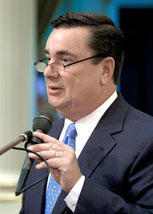
Photo of Joel Anderson
R California Senate · District 38

Sen. Joel Anderson

Compare
Total votes
26,170
all sessions
Attendance
96%
801 missed
Near the chamber average
With party
94%
of cast votes
Lower than 93% of chamber peers
Bipartisan score
4%
crosses aisle rarely
Higher than 92% of chamber peers
Sponsored
925
bills & resolutions
Near the chamber average
Committees
0
assignments
925 bills and resolutions

Sponsored bills

Total
925
Primary
226
Co-sponsor
699
This page
925
matching current filters
Co-sponsor SB 1012
Signed into law · California Senate · Co-sponsor
Flags: purchase.

Existing law requires the Flag of the United States and the Flag of the State of California to be prominently displayed during business hours upon or in front of the buildings or grounds of each public building belonging to the state, a county, or a municipality, among other places. This bill would, on and after January 1, 2017, require any Flag of the United States or the Flag of the State of California purchased by the state or any local government agency be made in the United States.

Signed into law Sep 27, 2016 1 co-sponsor
Co-sponsor AB 1708
Vetoed · California Assembly · Co-sponsor
Disorderly conduct: prostitution.

Existing law provides that a person who solicits or agrees to engage in or engages in any act of prostitution is guilty of disorderly conduct, a misdemeanor, punishable by imprisonment in the county jail for no more than 6 months or by a fine not exceeding $1,000, or by both that fine and imprisonment. Existing law also imposes increased minimum terms of imprisonment for a violation of that provision if a person has previously been convicted of soliciting or agreeing to engage in or engaging in any act of prostitution. Existing law defines "prostitution" to include any lewd act between persons for money or other consideration. Existing law additionally makes prostitution involving soliciting a minor punishable by imprisonment of not less than 2 days and not more than one year and a fine not exceeding $10,000. Existing law allows a court to, when the interests of justice are best served, reduce or eliminate the mandatory 2 days in the county jail. This bill would recast these provisions to distinguish between the different individuals who are guilty of disorderly conduct by soliciting, agreeing to engage in, or engaging in, any act of prostitution based on whether the person is soliciting or agreeing to receive compensation, money, or anything of value for an act of prostitution, as specified, or the person is soliciting or agreeing to provide compensation, money, or anything of value for an act of prostitution with a minor or with an adult, as specified. The bill would provide that committing disorderly conduct by soliciting or agreeing to provide compensation is punishable by a fine of not less than $250 but not exceeding $1,000, and imprisonment in a county jail for not less than 72 hours, or if probation is granted, not less than 48 hours, as specified, and not exceeding 6 months. The bill would provide that committing disorderly conduct by soliciting or agreeing to provide compensation when the defendant knew or should have known that the person solicited was a minor or the person was posing as a minor, is punishable by a fine of not less than $1,000 but not exceeding $10,000, and imprisonment in a county jail for not less than 72 hours, or if probation is granted, not less than 48 hours, as specified, and not exceeding one year. By imposing those mandatory terms of incarceration, this bill would impose a state-mandated local program. This bill would incorporate additional changes to Section 647 of the Penal Code, proposed by SB 1129 and SB 1322, that would become operative only if this bill and one or more of those other bills are enacted and become effective on or before January 1, 2017, and this bill is chaptered last. The California Constitution requires the state to reimburse local agencies and school districts for certain costs mandated by the state. Statutory provisions establish procedures for making that reimbursement. The bill would provide that no reimbursement is required by this act for a specified reason.

Vetoed Sep 27, 2016 1 co-sponsor
Co-sponsor SB 1064
Signed into law · California Senate · Co-sponsor
Sexually exploited minors.

Existing law, until January 1, 2017, authorizes the Counties of Alameda and Los Angeles, respectively, to create a pilot project, contingent upon local funding, for the purposes of developing a comprehensive, replicative, multidisciplinary model to address the needs and effective treatment of commercially sexually exploited minors, as specified. This bill would extend the operation of this program indefinitely in the County of Alameda. The bill would also expand the definition of a "commercially sexually exploited minor" to include, among others, a minor who has been adjudged a dependent of the juvenile court because he or she is a commercially sexually exploited child, and would create a presumption that, if a minor has been arrested for engaging in prostitution, or is the subject of a petition to adjudge him or her a dependent of the juvenile court because he or she is a commercially sexually exploited child, he or she is a commercially sexually exploited minor for the purposes of that definition. This bill would make legislative findings and declarations as to the necessity of a special statute for the County of Alameda.

Signed into law Sep 26, 2016 1 co-sponsor
Co-sponsor AB 1276
Signed into law · California Assembly · Co-sponsor
Child witnesses: human trafficking.

Existing law authorizes a court in a criminal proceeding, upon written notice by the prosecutor made at least 3 days prior to the date of the preliminary hearing or trial date on which the testimony of the minor is scheduled or during the course of the proceeding on the court's own motion, to order that the testimony of a minor 13 years of age or younger at the time of the motion be taken by contemporaneous examination and cross-examination in another place and out of the presence of the judge, jury, defendant or defendants, and attorneys, and communicated to the courtroom by means of closed-circuit television, if the court makes specified findings. One of the findings required by existing law requires is that the minor's testimony will involve a recitation of the facts of specified crimes, including an alleged violent felony of which the minor is a victim. This bill would authorize, under specified conditions, a minor 15 years of age or younger to testify by contemporaneous examination and cross-examination in another place and out of the presence of the judge, jury, defendant or defendants, and attorneys if the testimony will involve the recitation of the facts of an alleged offense of human trafficking.

Signed into law Sep 26, 2016 1 co-sponsor
Co-sponsor AB 33
Signed into law · California Assembly · Co-sponsor
Electrical corporations: energy storage systems: long duration bulk energy storage resources.

Under existing law, the Public Utilities Commission has regulatory authority over public utilities, including electrical corporations, as defined. Existing law requires the commission to open a proceeding to determine appropriate targets, if any, for each load-serving entity, as defined, to procure viable and cost-effective energy storage systems to be achieved by December 31, 2020. This bill would require the commission to evaluate and analyze the potential for all types of long duration bulk energy storage resources to help integrate renewable generation into the electrical grid, as specified.

Signed into law Sep 26, 2016 1 co-sponsor
Co-sponsor AB 492
Vetoed · California Assembly · Co-sponsor
CalWORKs: welfare-to-work: supportive services.

Existing law provides for the California Work Opportunity and Responsibility to Kids (CalWORKs) program, under which each county provides cash assistance and other benefits to qualified low-income families and individuals. Existing law generally requires a recipient of CalWORKs benefits to participate in welfare-to-work activities as a condition of eligibility for aid. Existing law requires that necessary supportive services be available to participants in welfare-to-work activities, including child care. This bill would provide that, commencing October 1, 2020, necessary supportive services also include a diaper benefit in the amount of $50 per month for diapers for every child 2 years of age or younger enrolled in child care pursuant to the above-mentioned provisions. The bill would require that the diaper benefit be issued to participants through an electronic benefits transfer system. The bill would specify that the diaper benefit is not income for purposes of determining CalWORKs eligibility or benefits, and that it may be used by a participant only to purchase diapers. By increasing the duties of counties administering these services, the bill would impose a state-mandated local program. The California Constitution requires the state to reimburse local agencies and school districts for certain costs mandated by the state. Statutory provisions establish procedures for making that reimbursement. This bill would provide that, if the Commission on State Mandates determines that the bill contains costs mandated by the state, reimbursement for those costs shall be made pursuant to these statutory provisions.

Vetoed Sep 25, 2016 1 co-sponsor
Co-sponsor AB 1299
Signed into law · California Assembly · Co-sponsor
Medi-Cal: specialty mental health services: foster children.

Existing law provides for the Medi-Cal program, which is administered by the State Department of Health Care Services, under which qualified low-income individuals receive health care services. The Medi-Cal program is, in part, governed and funded by federal Medicaid Program provisions. Existing law provides that specialty mental health services and Early and Periodic Screening, Diagnosis, and Treatment (EPSDT) for any individual under 21 years of age are covered under Medi-Cal, consistent with the requirements of federal law. Federal law defines EPSDT to include screening services, vision services, dental services, hearing services, and other necessary services to correct or ameliorate defects and physical and mental illnesses and conditions discovered by the screening services, whether or not the services are covered under the state plan. Existing law provides that specialty mental health services include EPSDT services provided to eligible Medi-Cal beneficiaries under 21 years of age. Existing law requires each local mental health plan to establish a procedure to ensure access to outpatient specialty mental health services, as required by the EPSDT program standards, for children in foster care who have been placed outside their county of adjudication. Existing law includes standardized contracts, procedures, documents, and forms, to facilitate the receipt of medically necessary specialty mental health services by a foster child who is placed outside his or her county of original jurisdiction. This bill would declare the intent of the Legislature to ensure that foster children who are placed outside of their county of original jurisdiction, are able to access mental health services in a timely manner consistent with their individualized strengths and needs and the requirements of EPSDT program standards and requirements. The bill would require the department to issue policy guidance that establishes the conditions for and exceptions to presumptive transfer of responsibility for providing or arranging for mental health services to a foster child from the county of original jurisdiction to the county in which the foster child resides, as prescribed. The bill would define presumptive transfer for these purposes. The bill would authorize any interested party who owes a legal duty to the child involving the child's health or welfare to seek a waiver of presumptive transfer and would provide that the county probation agency or child welfare services agency with responsibility for the care and placement of the child is responsible for determining whether presumptive transfer is appropriate under specified conditions, including when a determination is made that the transfer of mental health services would disrupt continuity of care or timely access to services, as specified. The bill would require the mental health plan in the host county to assume responsibility for the authorization and provision of mental health services, and payments for services, upon the presumptive transfer. By increasing the responsibilities of county probation agencies or child welfare services agencies with respect to determining whether presumptive transfer is appropriate, the bill would impose a state-mandated local program. This bill would require the department to seek approval from the United States Department of Health and Human Services, federal Centers for Medicare and Medicaid Services (CMS) prior to implementing these provisions if the department determines that approval is necessary. The bill would authorize the department and the State Department of Social Services to adopt regulations to implement these provisions by July 1, 2019, as specified. The California Constitution requires the state to reimburse local agencies and school districts for certain costs mandated by the state. Statutory provisions establish procedures for making that reimbursement. This bill would provide that, if the Commission on State Mandates determines that the bill contains costs mandated by the state, reimbursement for those costs shall be made pursuant to these statutory provisions.

Signed into law Sep 25, 2016 1 co-sponsor
Co-sponsor AB 797
Signed into law · California Assembly · Co-sponsor
Motor vehicles: rescue or provision of care for animal: civil and criminal liability.

Existing law authorizes a peace officer, humane officer, or animal control officer to take all steps reasonably necessary to remove an animal from a motor vehicle because the animal's safety appears to be in immediate danger of specified harm. Existing law requires those persons who remove an animal from a vehicle to take the animal to an animal shelter or other place of safekeeping or, if deemed necessary, to a veterinary hospital for treatment, and to leave a notice in the vehicle that notifies the owner of, among other things, the location where the animal may be claimed. Existing law authorizes the owner to claim the animal only after paying all charges that have accrued for the maintenance, care, medical treatment, or impoundment of the animal. This bill would expand the authorization and requirements applicable to a peace officer, humane officer, or animal control officer described above to include a firefighter or other emergency responder. The bill would additionally provide that a person may be required to pay for charges that have accrued for the maintenance, care, medical treatment, or impoundment of the animal removed from the vehicle. The bill would exempt a person from criminal liability for actions taken reasonably and in good faith to remove an animal from a vehicle under the circumstances described above if the person satisfies specified conditions, including immediately turning the animal over to a representative from law enforcement, animal control, or other emergency responder who responds to the scene. The bill would exempt a person from civil liability for property damage or trespass to a motor vehicle if the property damage or trespass occurred while the person was rescuing an animal pursuant to these provisions.

Signed into law Sep 24, 2016 1 co-sponsor
Co-sponsor AB 1719
Signed into law · California Assembly · Co-sponsor
Pupil instruction: cardiopulmonary resuscitation.

(1) Existing law authorizes a school district or school to provide a comprehensive program in first aid or cardiopulmonary resuscitation training, or both, to pupils and employees in accordance with specified guidelines. Existing law requires each pupil completing grade 12 to satisfy certain requirements as a condition of receiving a diploma of graduation from high school. These requirements include the completion of designated coursework in grades 9 to 12, inclusive. Existing law authorizes a governing board of a school district to adopt other coursework requirements. This bill would require, commencing with the 2018–19 school year, the governing board of a school district or the governing body of a charter school that requires a course in health education for graduation from high school to include instruction in performing compression-only cardiopulmonary resuscitation, as provided. The bill would encourage those entities to provide to pupils general information on the use and importance of an automated external defibrillator. The bill would require the State Department of Education to provide guidance on how to implement these provisions, including, but not limited to, who may provide instruction. (2) Existing law provides that no local agency, entity of state or local government, or other public or private organization that sponsors, authorizes, supports, finances, or supervises the training of citizens in cardiopulmonary resuscitation shall be liable for any civil damages alleged to result from such training programs. Existing law provides that no person who is certified to instruct in cardiopulmonary resuscitation by either the American Heart Association or the American Red Cross shall be liable for any civil damages alleged to result from the acts or omissions of an individual who received instruction on cardiopulmonary resuscitation by that certified instructor. This bill would provide that a local agency, entity of state or local government, or other public or private organization that sponsors, authorizes, supports, finances, or supervises, and a public employee who provides or facilitates, the instruction of pupils in compression-only cardiopulmonary resuscitation or the use of an automated external defibrillator pursuant to the bill shall not be liable for any civil damages alleged to result from the acts or omissions of an individual who received such instruction, except as provided.

Signed into law Sep 24, 2016 1 co-sponsor
Co-sponsor AB 2844
Signed into law · California Assembly · Co-sponsor
Public contracts: discrimination.

Existing law governs the procurement process for contracts of specified public entities. Existing law, the Unruh Civil Rights Act, states that all persons within this state are free and equal and, no matter what their sex, race, color, religion, ancestry, national origin, disability, medical condition, genetic information, marital status, sexual orientation, citizenship, primary language, or immigration status, are entitled to full and equal accommodations, advantages, facilities, privileges, or services in all business establishments. Existing law, the California Fair Employment and Housing Act, protects and safeguards the right and opportunity of all persons to seek, obtain, and hold employment without discrimination, abridgment, or harassment on account of race, religious creed, color, national origin, ancestry, physical disability, mental disability, medical condition, genetic information, marital status, sex, gender, gender identity, gender expression, age, sexual orientation, or military and veteran status. This bill would, with certain exceptions, require a person that submits a bid or proposal to, or otherwise proposes to enter into or renew a contract with, a state agency with respect to any contract in the amount of $100,000 or more to certify, under penalty of perjury, at the time the bid or proposal is submitted or the contract is renewed that they are in compliance with the Unruh Civil Rights Act and the California Fair Employment and Housing Act, and that any policy that they have adopted against any sovereign nation or peoples recognized by the government of the United States, including, but not limited to, the nation and people of Israel, is not used to discriminate in violation of the Unruh Civil Rights Act or the California Fair Employment and Housing Act. By requiring a person to certify under penalty of perjury, this bill would expand the definition of a crime, thereby imposing a state-mandated local program. The California Constitution requires the state to reimburse local agencies and school districts for certain costs mandated by the state. Statutory provisions establish procedures for making that reimbursement. This bill would provide that no reimbursement is required by this act for a specified reason.


Signed into law Sep 24, 2016 1 co-sponsor
Showing 151 to 160 of 925 bills
Previous 1 … 15 16 17 … 93 Next