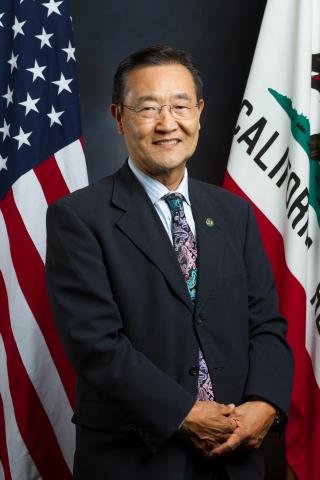
Photo of Steve Choi
R California Senate · District 37

Sen. Steve Choi

Compare
Total votes
16,057
all sessions
Attendance
84%
2,232 missed
Lower than 85% of chamber peers
With party
98%
of cast votes
Lower than 80% of chamber peers
Bipartisan score
1%
crosses aisle rarely
Higher than 95% of chamber peers
Sponsored
1,211
bills & resolutions
Near the chamber average
Committees
5
assignments
1,211 bills and resolutions

Sponsored bills

Total
1,211
Primary
190
Co-sponsor
1,021
This page
1,211
matching current filters
Co-sponsor ACR 98
Passed · California Assembly · Co-sponsor
Relative to mental health and substance use treatment.

This measure would urge specified state departments and the Attorney General to use their authority to ensure that health care service plans and health insurers subject to their authority comply with the federal Paul Wellstone and Pete Domenici Mental Health Parity and Addiction Equity Act of 2008.

Passed Jan 9, 2020 1 co-sponsor
Co-sponsor AB 128
Signed into law · California Assembly · Co-sponsor
Equines: protection.

(1) Proposition 6, an initiative measure approved by the electors at the November 3, 1998, general election, enacted the Prohibition of Horse Slaughter and Sale of Horsemeat for Human Consumption Act of 1998. The act makes it unlawful, and punishable as a felony, for any person to possess, to import into or export from the state, or to sell, buy, give away, hold, or accept any horse with the intent of killing, or having another kill, that horse, if that person knows or should have known that any part of that horse will be used for human consumption. The act also makes it unlawful to offer horsemeat for sale for human consumption. The Equine Protection Act of 1991 creates a program of equine protection and identification in the Department of Food and Agriculture. The act prohibits any person from purchasing, consigning, selling, or accepting the donation of an animal, defined as a horse, pony, mule, or burro, that is destined for slaughter unless a written bill of sale or any written instrument containing specified information is provided, as prescribed. The act makes it a misdemeanor if any person does not keep the necessary written records with respect to these transactions and other transactions subject to the act, refuses to show the records to a peace officer or to allow copies to be made of the record, or destroys the record within a specified period of time. This bill would instead require a written bill of sale or written instrument to be provided when any person purchases, consigns, sells, or accepts the donation of an animal, as defined in the act, at a public or private auction, as prescribed. The bill would require a person who purchases an animal in these circumstances to sign a sworn statement, under penalty of perjury, acknowledging and agreeing to comply with Proposition 6. The bill would require, before any animal could be sold at an auction, the operator of the auction yard to determine whether the animal has an implanted microchip or has been tattooed or branded with an identifying mark. If the animal has an implanted microchip, a tattoo, or a brand, the bill would require the operator of the auction yard to post, on its internet website and through any active social media in which the operator of the auction yard participates, all identifying information, as provided, for at least 24 hours. The bill would also require, for a minimum of one year following the date of sale of each animal sold at auction, the operator of the auction yard to maintain specified records that document compliance with the above provisions. The bill would require the operator of the auction yard to provide access to these records upon the request of the Department of Food and Agriculture, a law enforcement officer, an animal control agency, or a humane officer, as provided. Because a violation of these provisions would be a crime, and by expanding the scope of the crime of perjury, the bill would impose a state-mandated local program. The bill would require, in addition to any other penalties available under law, a person who violates these provisions to be subject to a civil penalty of $1,000 for the first offense and $2,000 for the 2nd and each subsequent offense. (2) Existing law requires that, at any public auction or sale where equines are sold, a specified notice be posted conspicuously or inserted into the consignment agreement, as specified, by the management of the auction or sale warning buyers and sellers that horses sold there may be purchased for slaughter and that, as a possible safeguard, the seller can set the minimum bid above current slaughter prices. Existing law requires the management of the auction or sale to post current slaughter prices or to make them available to sellers upon request. This bill would instead require that notice or agreement to warn buyers that the sale of horses in California for slaughter for human consumption is a felony and would make a conforming change. (3) The California Constitution requires the state to reimburse local agencies and school districts for certain costs mandated by the state. Statutory provisions establish procedures for making that reimbursement. This bill would provide that no reimbursement is required by this act for a specified reason.


Signed into law Oct 12, 2019 1 co-sponsor
Primary AB 677
Signed into law · California Assembly · Lead sponsor
Intercountry adoption finalized in a foreign country.

Existing law generally provides for the adoption of a child native to a foreign country by a prospective adoptive parent or parents who are California residents that is either finalized in another country or this state. Existing law requires a licensed adoption agency facilitating an intercountry adoption that will be finalized in a foreign country to provide specific services that include certification to the federal government as to whether this state's intercountry adoption requirements have been met. Existing law requires a resident of the state who adopts a child through an intercountry adoption that is finalized in a foreign country to readopt the child in this state if it is required by the United States Department of Homeland Security, and requires this readoption to include at least one postplacement in-home visit, a home study report, and final adoption order. Existing law also authorizes a resident of the state who adopts a child through an intercountry adoption that is finalized in a foreign country to readopt the child in this state. This bill would repeal those readoption provisions and would instead require an adoptive parent, or if an adoptive parent fails to do so, then the adoption agency that facilitated the adoption, to file a petition to readopt within specified deadlines to establish a record by which an adoptee can prove the facts of the foreign adoption. The bill would require the petition to include, among other things, a report from at least one postplacement home visit by an intercountry adoption agency or a contractor of that agency licensed to provide intercountry adoption services in the state. The bill would require the clerk of the court to submit an order granting the petition to the State Registrar, would require the State Registrar to issue a delayed registration of birth, as specified, and would authorize an adoptive parent to obtain a California birth certificate for that child. The bill would require an adoption agency to report the arrival of an adoptee whose adoption was finalized in a foreign country to the department within 14 calendar days, and would authorize the department to take disciplinary action if the adoption agency fails to report the arrival or fails to file a petition to readopt. This bill would require a court that finds a child may be the subject of human trafficking or specified types of abuse to notify all appropriate authorities. This bill would, if a licensed adoption agency has a written agreement for which postadoption services have been paid, require the licensed adoption agency to provide those services, and would also make technical, nonsubstantive changes to the other services a licensed adoption agency facilitating an intercountry adoption is required to provide.

Signed into law Oct 12, 2019 0 co-sponsors
Co-sponsor SB 8
Signed into law · California Senate · Co-sponsor
State parks: state beaches: smoking ban.

Existing law makes it an infraction punishable by a fine of $250 for a person to smoke a cigarette, cigar, or other tobacco product within 25 feet of a playground or tot lot sandbox area. This bill would make it an infraction punishable by a fine of up to $25 for a person to smoke, as defined, on a state beach, as defined, or in a unit of the state park system, as defined, except as provided, or to dispose of used cigar or cigarette waste on a state beach or in a unit of the state park system unless the disposal is made in an appropriate waste receptacle. The bill would establish a state-mandated local program by creating a new crime. The bill would require the Department of Parks and Recreation to develop and post signs at strategic locations, as determined by the Director of Parks and Recreation, of state beaches and units of the state park system operated by the department to provide notice of the smoking prohibition. The bill would require an entity operating, pursuant to an agreement with the department, a state beach or unit of the state park system that is not operated by the department to post signs approved by the department at strategic locations, as determined by the operating entity and approved by the department, to provide notice of the smoking prohibition. The bill would require the smoking prohibition to be enforced at a state beach or unit of the state park system only after appropriate signs have been posted pursuant to these provisions. The California Constitution requires the state to reimburse local agencies and school districts for certain costs mandated by the state. Statutory provisions establish procedures for making that reimbursement. This bill would provide that no reimbursement is required by this act for a specified reason.
Signed into law Oct 11, 2019 1 co-sponsor
Co-sponsor AB 415
Signed into law · California Assembly · Co-sponsor
Victim compensation: relocation: pets.

Existing law generally provides for the compensation of victims and derivative victims of specified types of crimes by the California Victim Compensation and Government Claims Board from the Restitution Fund, a continuously appropriated fund, for specified losses suffered as a result of those crimes. Existing law requires a victim or derivative victim seeking compensation to have sustained one or more specified physical or emotional injuries, or pecuniary losses, as a direct result of the crime. Existing law authorizes the board to grant compensation for pecuniary loss, if it determines it will best aid the person seeking compensation, by authorizing a cash payment or reimbursement to a victim for expenses incurred in relocating, including a security deposit, if the expenses are determined by law enforcement to be necessary for the personal safety of the victim or by a mental health treatment provider to be necessary for the emotional well-being of the victim. Existing law specifies that if a security deposit is required for relocation, the board shall be named as the recipient, and receive the funds, upon expiration of the victim's rental agreement. This bill would specify, for purposes of these provisions, that "expenses incurred in relocating" may include the costs of temporary housing for any pets belonging to the victim upon immediate relocation. The bill would also authorize the cash payment or grant to reimburse a victim for a security deposit, pet deposit, or both, for which the board would be named as the recipient, and would receive the funds, upon expiration of the victim's rental agreement. By expanding the authorizations for use of moneys in the Restitution Fund, a continuously appropriated fund, this bill would make an appropriation. This bill would incorporate additional changes to Section 13957 of the Government Code proposed by AB 629 to be operative only if this bill and AB 629 are enacted and this bill is enacted last.

Signed into law Oct 8, 2019 1 co-sponsor
Co-sponsor AB 169
Signed into law · California Assembly · Co-sponsor
Guide, signal, and service dogs: injury or death.

Under existing law, it is an infraction or a misdemeanor for a person to permit a dog that is owned, harbored, or controlled by the person to cause injury to, or the death of, a guide, signal, or service dog, as defined, while the guide, signal, or service dog is in discharge of its duties. Existing law makes a person who intentionally causes injury to, or the death of, a guide, signal, or service dog, while the dog is in discharge of its duties, guilty of a misdemeanor. This bill would delete, from both crimes, the requirement that the guide, signal, or service dog be in discharge of its duties when the injury or death occurs and would make these crimes applicable to the injury or death of dogs that are enrolled in a training school or program for guide, signal, or service dogs, as specified. Under existing law, if a defendant is convicted of either of the above crimes, the defendant is required to make restitution to the person with a disability who has custody or ownership of the dog for any veterinary bills and replacement costs of the dog if it is disabled or killed, or other reasonable costs deemed appropriate by the court. The bill would require the defendant, convicted of either crime, to also make restitution to the person for medical or medical-related expenses, or for loss of wages or income, as defined, incurred by the person with a disability. The bill would also include in the definition of "replacement costs" for this purpose the training costs for a new dog, if needed, the cost of keeping the now-disabled dog in a kennel while the handler travels to receive the new dog, and, if needed, the cost of the travel required for the handler to receive the new dog. Because this bill would expand the scope and penalties of existing crimes, it would impose a state-mandated local program. The California Constitution requires the state to reimburse local agencies and school districts for certain costs mandated by the state. Statutory provisions establish procedures for making that reimbursement. This bill would provide that no reimbursement is required by this act for a specified reason.

Signed into law Oct 8, 2019 1 co-sponsor
Co-sponsor AB 629
Signed into law · California Assembly · Co-sponsor
Crime victims: the California Victim Compensation Board.

Existing law governs the procedure by which crime victims may obtain compensation from the Restitution Fund, a continuously appropriated fund. Existing law establishes eligibility for compensation when prescribed requirements are met and authorizes the California Victim Compensation Board to grant compensation from the fund for pecuniary loss when the board determines it will best aid the person seeking compensation. Existing law authorizes the board to provide compensation equal to the loss of income or loss of support, or both, that a victim or derivative victim incurs as a direct result of the victim's or derivative victim's injury or the victim's death. Under existing law, as amended by Proposition 35, the Californians Against Sexual Exploitation Act, an initiative measure approved by the voters at the November 6, 2012, statewide general election, a person who deprives or violates another person's personal liberty with the intent to obtain forced labor or services or who deprives or violates another person's personal liberty for the purpose of prostitution or sexual exploitation is guilty of human trafficking, a felony. This bill would authorize the board to provide compensation equal to loss of income or support that a victim incurs as a direct result of the victim's deprivation of liberty during the crime, if the qualifying crime is human trafficking, in an amount not exceeding the value of the victim's labor as guaranteed under California law for up to 40 hours per week, as specified. The bill would require the board to adopt guidelines on or before July 1, 2020, that allow the board to rely on evidence other than official employment documentation in considering and approving an application for loss of income or support, including any reliable corroborating information approved by the board. The bill would prohibit compensation for loss of income paid by the board if the qualifying crime is human trafficking from exceeding $10,000 per year that the services were performed, for a maximum of 2 years. By expanding the authorizations for use of moneys in the Restitution Fund, a continuously appropriated fund, this bill would make an appropriation. This bill would incorporate additional changes to Section 13957 of the Government Code proposed by AB 415 to be operative only if this bill and AB 415 are enacted and this bill is enacted last.

Signed into law Oct 8, 2019 1 co-sponsor
Co-sponsor AB 651
Signed into law · California Assembly · Co-sponsor
Air ambulance services.

(1) Existing law, the Knox-Keene Health Care Service Plan Act of 1975, provides for the licensure and regulation of health care service plans by the Department of Managed Health Care and makes a willful violation of the act a crime. Existing law also provides for the regulation of health insurers by the Department of Insurance. Existing law requires that health care service plan contracts and health insurance policies provide coverage for certain services and treatments, including emergency medical transportation services. This bill would require a health care service plan contract or a health insurance policy issued, amended, or renewed on or after January 1, 2020, to provide that if an enrollee, insured, or subscriber (individual) receives covered services from a noncontracting air ambulance provider, the individual shall pay no more than the same cost sharing that the individual would pay for the same covered services received from a contracting air ambulance provider, referred to as the in-network cost-sharing amount. The bill would provide that an individual would not owe the noncontracting provider more than the in-network cost-sharing amount for services. The bill would authorize a noncontracting provider to advance to collections only the in-network cost-sharing amount that the individual has failed to pay. The bill would authorize a health care service plan, health insurer, or provider to seek relief in any court for the purpose of resolving a payment dispute, and would not prohibit a provider from using a health care service plan's or health insurer's existing dispute resolution processes. Because a willful violation of the bill's requirements relative to health care service plans would be a crime, the bill would impose a state-mandated local program. (2) Existing law, the Emergency Medical Air Transportation Act, effective until January 1, 2022, imposes a penalty of $4 until January 1, 2020, upon every conviction for a violation of the Vehicle Code or a local ordinance adopted pursuant to the Vehicle Code, other than a parking offense. The act requires the county or the court that imposed the fine to transfer the moneys collected pursuant to that act to the Treasurer for deposit into the Emergency Medical Air Transportation and Children's Coverage Fund. Under the act, moneys in the fund are made available, upon appropriation by the Legislature, to the State Department of Health Care Services for children's health care coverage and administrative costs relating to emergency medical air transportation provider payments. Existing law requires the assessed penalty to continue to be collected, administered, and distributed until exhausted or until June 30, 2021, whichever occurs first, and requires any remaining unexpended and unencumbered moneys in the fund to be transferred to the General Fund, to be available, upon appropriation by the Legislature, for specified purposes, including funding children's health care coverage. This bill would impose the penalty until July 1, 2020, and would extend the above-specified dates by six months. (3) The California Constitution requires the state to reimburse local agencies and school districts for certain costs mandated by the state. Statutory provisions establish procedures for making that reimbursement. This bill would provide that no reimbursement is required by this act for a specified reason.

Signed into law Oct 7, 2019 1 co-sponsor
Co-sponsor ACR 109
Signed into law · California Assembly · Co-sponsor
Relative to Hangul Day.

This measure would declare October 9, 2019, and each October 9 thereafter, as Hangul Day.

Signed into law Sep 26, 2019 1 co-sponsor
Showing 721 to 730 of 1,211 bills
Previous 1 … 72 73 74 … 122 Next