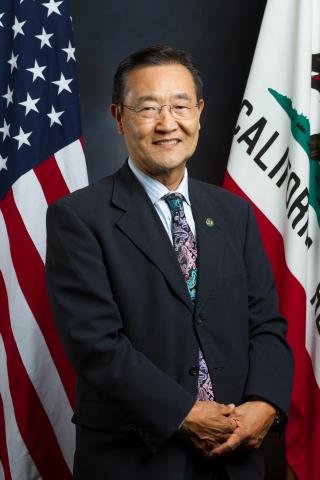
Photo of Steve Choi
R California Senate · District 37

Sen. Steve Choi

Compare
Total votes
16,057
all sessions
Attendance
84%
2,232 missed
Near the chamber average
With party
98%
of cast votes
Near the chamber average
Bipartisan score
1%
crosses aisle rarely
Near the chamber average
Sponsored
1,211
bills & resolutions
Near the chamber average
Committees
5
assignments
1,211 bills and resolutions

Sponsored bills

Total
1,211
Primary
190
Co-sponsor
1,021
This page
1,211
matching current filters
Primary SR 73
Passed · California Senate · Lead sponsor
Relative to school governance.

Maddy summaryThis Senate Resolution recognizes and celebrates school board members across California for their work in public education. It declares January 2026 as School Board Recognition Month to honor the dedication of nearly 5,000 locally elected school board members who serve on over 1,000 school districts and county offices of education. The resolution urges community members to support local school boards and work together to improve the education system for all children. This is a commemorative measure rather than a policy change, as it does not alter existing laws or regulations.

Passed Feb 13, 2026 0 co-sponsors
Primary SCR 106
Signed into law · California Senate · Lead sponsor
Relative to Korean American Day.

Maddy summarySCR 106 designates January 13, 2026, as Korean American Day within the state. This ceremonial resolution officially recognizes the contributions of Korean Americans to the state's cultural and social fabric. It affects state records and calendar designations, adding a specific date for commemoration. The bill became law on February 3, 2026, as Chapter 2 of the Statutes of 2026.

Signed into law Feb 3, 2026 0 co-sponsors
Co-sponsor AB 496
Failed · California Assembly · Co-sponsor
Unemployment and disability insurance: quality of services: reporting.

Existing law, for purposes of unemployment insurance provisions, requires employers to make contributions with respect to unemployment insurance and disability insurance from the wages paid to their employees. Existing law establishes, within the state disability insurance program administered by the Employment Development Department, a family temporary disability insurance program, also known as the paid family leave program, for the provision of wage replacement benefits to workers who take time off work to care for a seriously ill family member or to bond with a minor child within one year of birth or placement, as specified. This bill would require the Legislative Analyst's Office, on or before January 1, 2027, and annually thereafter, to prepare and submit a report to the Legislature that evaluates the quality of services provided by the department to the public with regard to unemployment and disability insurance. The bill would repeal these provisions on January 1, 2031.

Failed Feb 2, 2026 1 co-sponsor
Co-sponsor AB 505
Failed · California Assembly · Co-sponsor
Multifamily Housing Program: Homekey: report.

Existing law establishes the Multifamily Housing Program administered by the Department of Housing and Community Development. Existing law requires that specified funds appropriated to provide housing for individuals and families who are experiencing homelessness or who are at risk of homelessness and who are inherently impacted by or at increased risk for medical diseases or conditions due to the COVID-19 pandemic or other communicable diseases be disbursed in accordance with the Multifamily Housing Program for specified uses. This disbursement program is referred to as Homekey. This bill would require the Legislative Analyst's Office to conduct an evaluation of the Homekey disbursement program described above to review the effectiveness of the program in relation to sustaining people experiencing homelessness, including, among other things, the number of housing units and projects funded since the program's inception, and the timeliness of the allocation of program funds provided to localities participating in the program, including, among other things, the average time between application submission and fund disbursement. The bill would require the office, on or before July 1, 2027, to submit a report to the Legislature, subject to specified requirements, with the results of the above-described evaluation described that includes policy recommendations to address any issues identified during the evaluation. The bill would repeal its provisions on January 1, 2031, pursuant to specified provisions.

Failed Feb 2, 2026 1 co-sponsor
Co-sponsor AB 513
Failed · California Assembly · Co-sponsor
California Global Warming Solutions Act of 2006: scoping plan.

The California Global Warming Solutions Act of 2006 designates the State Air Resources Board as the state agency charged with monitoring and regulating sources of emissions of greenhouse gases. The state board is required to adopt rules and regulations to achieve the maximum technologically feasible and cost-effective greenhouse gas emissions reductions to ensure that the statewide greenhouse gas emissions are reduced to at least 40% below the statewide greenhouse gas emissions limit, as defined, no later than December 31, 2030. The act requires the state board to prepare and approve a scoping plan for achieving the maximum technologically feasible and cost-effective reductions in greenhouse gas emissions and to update the scoping plan at least once every 5 years. This bill would require the state board to include greenhouse gas emissions from wildlands and forest fires in the scoping plan.

Failed Feb 2, 2026 1 co-sponsor
Co-sponsor AB 1058
Failed · California Assembly · Co-sponsor
Motor Vehicle Fuel Tax Law: suspension of tax.

Existing law, the Motor Vehicle Fuel Tax Law, imposes a tax upon each gallon of motor vehicle fuel removed from a refinery or terminal rack in this state, entered into this state, or sold in this state, at a specified rate per gallon. Existing unfair competition laws establish a statutory cause of action for unfair competition, including any unlawful, unfair, or fraudulent business act or practice and unfair, deceptive, untrue, or misleading advertising and acts prohibited by false advertisement laws. This bill would suspend the imposition of the tax on motor vehicle fuels for one year. The bill would require that all savings realized based on the suspension of the motor vehicle fuels tax by a person other than an end consumer, as defined, be passed on to the end consumer, and would make the violation of this requirement an unfair business practice, in violation of unfair competition laws, as provided. The bill would require a seller of motor vehicle fuels to provide a receipt to a purchaser that indicates the amount of tax that would have otherwise applied to the transaction. This bill would also direct the Controller to transfer a specified amount from the General Fund to the Motor Vehicle Fuel Account in the Transportation Tax Fund. By transferring General Fund moneys to a continuously appropriated account, this bill would make an appropriation. This bill would declare that it is to take effect immediately as an urgency statute.

Failed Feb 2, 2026 1 co-sponsor
Co-sponsor AB 921
Failed · California Assembly · Co-sponsor
Generators: air pollution regulations: sales and use taxes: exemptions.

(1) Existing law, the California Emergency Services Act, sets forth the emergency powers of the Governor under its provisions and empowers the Governor to proclaim a state of emergency for certain conditions, including fire, flood, and severe energy shortage. Existing law requires the State Air Resources Board to adopt cost-effective and technologically feasible regulations to prohibit engine exhaust and evaporative emissions from new small off-road engines produced on or after a specified date. This bill would exempt from those regulations and other regulations adopted by the state board the sale and purchase of portable or emergency backup generators during the period of time for which the Governor has proclaimed a state of emergency based on an emergency resulting in a loss of electrical service to any part of the state. (2) Existing state sales and use tax laws impose a tax on retailers measured by the gross receipts from the sale of tangible personal property sold at retail in this state or on the storage, use, or other consumption in this state of tangible personal property purchased from a retailer for storage, use, or other consumption in this state. The Sales and Use Tax Law provides various exemptions from those taxes. This bill would, on and after January 1, 2027, and before January 1, 2032, provide an exemption from the taxes imposed by the Sales and Use Tax Law for the gross receipts of a qualified backup electricity generator, as defined, during the month of May, as specified. The bill would restrict the exemption to apply only to those generators with a cost not exceeding $7,000 and purchased for noncommercial purposes. The Bradley-Burns Uniform Local Sales and Use Tax Law authorizes counties and cities to impose local sales and use taxes in conformity with the Sales and Use Tax Law, and existing laws authorize districts, as specified, to impose transactions and use taxes in accordance with the Transactions and Use Tax Law, which generally conforms to the Sales and Use Tax Law. Amendments to the Sales and Use Tax Law are automatically incorporated into the local tax laws. This bill would provide that the exemption created by the bill does not apply to local sales and use taxes or transactions and use taxes. Existing law imposes or dedicates certain state sales and use tax rates for local funding, including through the Local Revenue Fund 2011. This bill would provide that the exemption created by the bill does not apply to those state sales and use tax rates imposed or dedicated for local government funding, including those rates for which revenues are deposited into the Local Revenue Fund 2011. Existing law requires any bill authorizing a new tax expenditure to contain, among other things, specific goals the tax expenditure will achieve, detailed performance indicators, and data collection requirements. This bill would include additional information required for any bill authorizing a new tax expenditure.


Failed Feb 2, 2026 1 co-sponsor
Primary SB 817
Failed · California Senate · Lead sponsor
Political Reform Act of 1974.

The Political Reform Act of 1974 imposes various requirements and limitations with respect to the conduct of public officials, campaign expenditures and disclosures, political advertisements, lobbying, the ballot pamphlet, and other aspects of political reform. This bill would declare the intent of the Legislature to enact future legislation relating to the Political Reform Act of 1974.

Failed Feb 2, 2026 0 co-sponsors
Primary SB 405
Failed · California Senate · Lead sponsor
Elections: voter identification.

Existing law prohibits local governments from enacting or enforcing any charter provision, ordinance, or regulation requiring a person to present identification for the purpose of voting or submitting a ballot at any polling place, vote center, or other location where ballots are cast or submitted. This bill would repeal that prohibition.

Failed Feb 2, 2026 0 co-sponsors
Primary SB 406
Failed · California Senate · Lead sponsor
Elections: ballot submission deadline.

Under existing law, a vote-by-mail ballot is timely cast if it is postmarked or otherwise time-stamped on or before election day and received in the mail no later than 7 days after election day. This bill would instead require a vote-by-mail ballot to be returned to the applicable elections official no later than the close of the polls on election day, except that the bill would require a vote-by-mail ballot cast by a military or overseas voter to be counted if it is postmarked on or before election day and received no later than 7 days after election day.

Failed Feb 2, 2026 0 co-sponsors
Showing 91 to 100 of 1,211 bills
Previous 1 … 9 10 11 … 122 Next