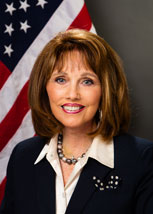
Photo of Patricia C. Bates
R California Senate · District 36

Sen. Patricia C. Bates

Compare
Total votes
46,261
all sessions
Attendance
93%
1,864 missed
Lower than 78% of chamber peers
With party
98%
of cast votes
Near the chamber average
Bipartisan score
2%
crosses aisle rarely
Higher than 81% of chamber peers
Sponsored
1,957
bills & resolutions
Near the chamber average
Committees
0
assignments
1,957 bills and resolutions

Sponsored bills

Total
1,957
Primary
271
Co-sponsor
1,686
This page
1,957
matching current filters
Co-sponsor SCR 77
Signed into law · California Senate · Co-sponsor
Relative to Child Passenger Safety Week.

This measure would recognize the 3rd week of September 2017 and the 3rd week of September every year thereafter, as Child Passenger Safety Week.

Signed into law Sep 22, 2017 1 co-sponsor
Primary SCR 68
Signed into law · California Senate · Lead sponsor
Relative to drug abuse.

This measure would designate the month of September 2017 as Opioid, Heroin, Fentanyl, and Prescription Drug Abuse Awareness Month, as specified.

Signed into law Sep 19, 2017 0 co-sponsors
Primary SCR 71
Signed into law · California Senate · Lead sponsor
Relative to Ocean Institute Day.

This measure would proclaim September 9, 2017, as Ocean Institute Day, in honor of the Ocean Institute's 40th anniversary, urge all Californians to join in celebrating Ocean Institute Day, and commend the Ocean Institute for its years of service and contributions to the community.

Signed into law Sep 19, 2017 0 co-sponsors
Co-sponsor SCR 53
Signed into law · California Senate · Co-sponsor
Relative to National Military Appreciation Month.

This measure would honor the men and women who have served and are serving in our nation's military, and would recognize the month of May 2017 as National Military Appreciation Month.

Signed into law Sep 14, 2017 1 co-sponsor
Co-sponsor SB 410
Signed into law · California Senate · Co-sponsor
Civil service: veterans' hiring preference: active duty members.

The State Civil Service Act prescribes a comprehensive civil service personnel system for the state and specifically provides certain preferences for veterans. The act grants to a person retired from the United States military, honorably discharged from active military duty with a service-connected disability, or honorably discharged from active duty eligibility for civil service examinations for which they meet the minimum qualifications for the classification. The act requires that, in evaluating minimum qualifications, related military experience be considered state civil service experience in a comparable class, based on the duties and responsibilities assigned. The act also requires that request for and proof of eligibility for the veterans' preference be submitted by the veteran to the Department of Human Resources or the designated appointing authority conducting the employment examination, subject to rules promulgated by the Department of Human Resources in consultation with the Department of Veterans Affairs. This bill would authorize the Department of Human Resources or the designated appointing authority, in order to facilitate a request for veterans' preference from a currently serving active duty member of the United States Armed Forces, to use a signed document by the applicant's commanding officer of the military to verify that applicant's military service. The bill would require the department or designated authority, before the applicant enters state service with the benefit of veterans' preference, to otherwise require the same proof of eligibility for veterans' preference generally used.

Signed into law Sep 11, 2017 1 co-sponsor
Primary SB 684
Signed into law · California Senate · Lead sponsor
Incompetence to stand trial: conservatorship: treatment.

(1) Existing law prohibits a person from being tried or adjudged to punishment while that person is mentally incompetent. Existing law establishes a process by which a defendant's mental competency is evaluated and by which the defendant receives treatment with the goal of returning the defendant to competency. Existing law allows a mentally incompetent defendant to be committed to the State Department of State Hospitals or other public or private treatment facility for a period of 3 years or to a period of commitment equal to the maximum term of imprisonment provided by law for the most serious offense charged, whichever is shorter, and requires the defendant to be returned to the committing court after his or her maximum period of commitment. If the defendant is gravely disabled upon his or her return to the committing court, existing law requires the court to order the conservatorship investigator of the county to initiate conservatorship proceedings on the basis that the indictment or information pending against the person charges a felony involving death, great bodily harm, or a serious threat to the physical well-being of another person. This bill would also allow the initiation of conservatorship proceedings on the basis that person is gravely disabled due to a condition in which the person, as a result of a mental health disorder, is unable to provide for his or her basic personal needs for food, clothing, or shelter. (2) Existing law requires, if the action is on a complaint charging a felony, that a proceeding to determine mental competence be held prior to the filing of an information unless counsel for the defendant requests a preliminary examination. Existing law requires an indictment or information to be pending against the defendant at the time a conservatorship is initiated. This bill would allow, if the action is on a complaint charging a felony involving death, great bodily harm, or a serious threat to the physical well-being of another person, the prosecuting attorney, at any time before or after a defendant is determined incompetent to stand trial, to request a determination of probable cause to believe the defendant committed the offense or offenses alleged in the complaint, solely for the purpose of establishing that the defendant is gravely disabled, and would grant the defendant a preliminary hearing after restoration of competency. The bill would define "gravely disabled" for these purposes as a condition where the person has been found mentally incompetent by specified procedures, and certain other facts exist, including, among others, that the person is charged with a felony involving death, great bodily harm, or a serious threat to the physical well-being of another person. The bill would allow for the initiation of a conservatorship upon a criminal complaint if there has been a finding of probable cause on the complaint. The bill would provide that a proceeding to determine mental competence, or in the alternative, a request for a preliminary examination, as described above, would not preclude a determination of probable cause as described above, and vice versa.

Signed into law Sep 11, 2017 0 co-sponsors
Co-sponsor AB 182
Passed · California Assembly · Co-sponsor
Heroin and Opioid Public Education (HOPE) Act.

Existing law tasks the State Department of Public Health with certain specified duties related to health information and strategic planning, including opioid misuse and overdose prevention. Among other duties, existing law directs the department, upon appropriation by the Legislature, to award naloxone grant funding to local health departments, local government agencies, or other entities, as specified, in order to reduce the rate of fatal overdose from opioid drugs including heroin and prescription opioids. This bill would require the department, in consultation with stakeholders, to develop, coordinate, implement, and oversee a comprehensive multicultural public awareness campaign, to be known as "Heroin and Opioid Public Education (HOPE) ," upon appropriation by the Legislature or receipt of state or federal grant funding, until January 1, 2023. The bill would require the HOPE program to provide for the coordinated and widespread public dissemination of individual case stories and other generalized information that focuses on, among other things, describing the effects and warning signs of heroin use and opioid medication and identifying available pathways for individuals seeking help. The bill would require the HOPE program to effectuate the dissemination of information by using appropriate types of media, as specified, employing a variety of complementary educational themes and messages that are tailored to appeal to different target audiences, and using culturally and linguistically appropriate means. The bill would require the department to submit a report to the Governor and Legislature on at least an annual basis, that summarizes the actions that have been undertaken by the department to implement the bill and includes an assessment of the effectiveness of the HOPE program, as specified.

Passed Sep 1, 2017 1 co-sponsor
Co-sponsor AB 702
Passed · California Assembly · Co-sponsor
Driving under the influence: chemical tests.

(1) When a person is convicted of violating specified driving-under-the-influence (DUI) provisions, and at the time of the arrest leading to that conviction the person willfully refused a peace officer's request to submit to, or willfully failed to complete, a specified chemical test, existing law requires a court to impose additional penalties, as specified. This bill would make it a crime for a person to willfully refuse to submit to, or willfully fail to complete, a breath test after being lawfully arrested for a violation of specified offenses. The bill would specify that this crime does not apply to a person who has submitted to and completed a blood test, as specified. By creating a new crime, this bill would impose a state-mandated local program. (2) When a person is convicted of violating specified DUI provisions, existing law requires a court to consider a concentration of alcohol in a person's blood of 0.15% or more, by weight, or the refusal of the person to take a chemical test as a special factor that may justify enhancing the penalties in sentencing, in determining whether to grant probation, and, if probation is granted, in determining additional or enhanced terms and conditions of probation. This bill would change the provision described above to no longer require a court to consider a person's refusal to take a chemical test as a special factor. (3) Existing law provides that a person who drives a motor vehicle is deemed to have given his or her consent to chemical testing of his or her blood or breath for the purpose of determining the alcoholic or drug content of his or her blood if lawfully arrested for driving under the influence of alcohol or drugs. Existing law requires a person to be told that his or her failure to submit to, or the failure to complete, the required chemical test will result in a fine, mandatory imprisonment if convicted of specified DUI offenses, and suspension or revocation of his or her driving privilege, as specified. Existing law exempts a person afflicted with hemophilia or a heart condition, as specified, from this blood test requirement and instead requires him or her to submit to, and complete, a urine test. This bill would repeal the presumption that a person consents to submit to chemical testing of his or her blood or breath and would instead require a motor vehicle driver who is lawfully arrested for a specified DUI offense to submit to chemical testing of his or her blood or breath for the purpose of determining the alcoholic or drug content of his or her blood. The bill would require a peace officer to advise the person that he or she is entitled to a number of constitutional protections as to the manner in which the testing will occur, but that failure to take a blood or urine test may result in suspension or revocation of his or her driving privilege, and refusal to take a breath test may result in the same penalty and a fine or mandatory imprisonment if the person is convicted of a specified DUI offense. The bill would require a person exempted from the blood test requirement because of hemophilia or a heart condition, as specified, to submit to, and complete, a breath test or a urine test, as specified. Because this bill would impose new requirements on peace officers, it would impose a state-mandated local program. (4) The bill would also make legislative findings and declarations about the privilege of driving on public streets and highways in California and reasonable conditions imposed on that privilege. The California Constitution requires the state to reimburse local agencies and school districts for certain costs mandated by the state. Statutory provisions establish procedures for making that reimbursement. This bill would provide that with regard to certain mandates no reimbursement is required by this act for a specified reason. With regard to any other mandates, this bill would provide that, if the Commission on State Mandates determines that the bill contains costs so mandated by the state, reimbursement for those costs shall be made pursuant to the statutory provisions noted above.


Passed Sep 1, 2017 1 co-sponsor
Showing 421 to 430 of 1,957 bills
Previous 1 … 42 43 44 … 196 Next