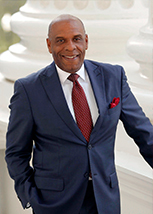
Photo of Steve Bradford
D California Senate · District 35 · Former member

Sen. Steve Bradford

Contact Email
Compare
Total votes
40,542
all sessions
Attendance
98%
526 missed
Higher than 82% of chamber peers
With party
99%
of cast votes
Higher than 84% of chamber peers
Bipartisan score
0%
crosses aisle rarely
Lower than 87% of chamber peers
Sponsored
1,013
bills & resolutions
Lower than 80% of chamber peers
Committees
0
assignments
1,013 bills and resolutions

Sponsored bills

Total
1,013
Primary
298
Co-sponsor
715
This page
1,013
matching current filters
Co-sponsor AB 403
Signed into law · California Assembly · Co-sponsor
Legislature: Legislative Employee Whistleblower Protection Act.

Existing law generally protects employees who disclose illegal or improper workplace activities by prohibiting interference with, and retaliation for, making such disclosures. Existing law provides procedures for a person to file a complaint alleging violations of legislative ethics. Existing law also authorizes each house of the Legislature to adopt rules for its proceedings and to select committees necessary for the conduct of its business. This bill would impose criminal and civil liability on a Member of the Legislature or legislative employee, as defined, who interferes with, or retaliates against, a legislative employee's exercise of the right to make a protected disclosure, which is defined as a good faith allegation made by a legislative employee to specified entities that a Member of the Legislature or a legislative employee has engaged in, or will engage in, activity that may constitute a violation of law, including sexual harassment, or a violation of a legislative standard of conduct. The bill would also impose civil liability on an entity that interferes with, or retaliates against, a legislative employee's exercise of the right to make a protected disclosure, as specified. By creating new crimes, the bill would impose a state-mandated local program. The California Constitution requires the state to reimburse local agencies and school districts for certain costs mandated by the state. Statutory provisions establish procedures for making that reimbursement. This bill would provide that no reimbursement is required by this act for a specified reason. This bill would declare that it is to take effect immediately as an urgency statute.

Signed into law Feb 5, 2018 1 co-sponsor
Co-sponsor AB 176
Failed · California Assembly · Co-sponsor
Water project: Friant-Kern Canal.

Existing law requires the Department of Water Resources, upon appropriation by the Legislature, to provide funding for a project that substantially conforms to the project description for the Reverse Flow Pump-back Facilities on the Friant-Kern Canal Restoration Project, as specified, provided that certain conditions are met. Existing law requires that the appropriation be no more than $7,000,000. This bill would appropriate $7,000,000 from the General Fund to the department for this project. This bill would make legislative findings and declarations as to the necessity of a special statute for the Friant-Kern Canal.

Failed Feb 1, 2018 1 co-sponsor
Primary SB 619
In committee · California Senate · Lead sponsor
Lottery tickets: ticket messenger service.

The California State Lottery Act of 1984, enacted by initiative, authorizes a California State Lottery and provides for its operation and administration by the California State Lottery Commission and the Director of the California State Lottery, with certain limitations. The act defines a "lottery game retailer" as a person or organization with whom the California State Lottery Commission may contract for the purpose of selling tickets or shares in lottery games to the public and prohibits lottery tickets from being sold by a lottery game retailer unless the retailer has a certificate of authority issued by the lottery. The act directs the commission to promulgate regulations specifying the terms and conditions for contracting with lottery game retailers so as to provide adequate and convenient availability of tickets or shares to prospective buyers of lottery games. The act specifies that none of its provisions may be changed except to further its purpose by a bill passed by a 23 vote of each house of the Legislature. This bill would allow a business that is not a lottery game retailer to purchase lottery tickets from an authorized lottery retailer on behalf of individuals or groups of individuals who order those tickets through an Internet Web site or mobile application operated by that business. The bill would allow the business to charge the lottery retailer a percentage of its lottery compensation. By permitting the facilitation of lottery ticket sales through 3rd-party transactions, and the sharing of the retailer's lottery compensation with a 3rd party, the bill would amend the act. The bill would declare that its provisions further the purposes of the act.

In committee Feb 1, 2018 0 co-sponsors
Co-sponsor AB 252
Failed · California Assembly · Co-sponsor
Local government: taxation: prohibition: video streaming services.

Existing law authorizes counties, cities, and other local agencies to impose various taxes and fees in connection with activity or property within those jurisdictions. The California Constitution also authorizes a charter city to levy local taxes to raise revenues for local purposes, subject to restrictions imposed by that city's charter or preemption in matters of statewide concern. This bill, until January 1, 2023, would prohibit the imposition by a city, city and county, or county, including a chartered city, city and county, or county, of a tax on video streaming services, including, but not limited to, any tax on the sale or use of video streaming services or any utility user tax on video streaming services. This bill would make a legislative finding and declaration regarding the statewide concern of the promotion of uniformity in access throughout the state to video streaming services.

Failed Feb 1, 2018 1 co-sponsor
Primary SB 375
In committee · California Senate · Lead sponsor
Income taxation: timeliness penalty: abatement.

Existing law imposes penalties when a taxpayer fails to timely file an income tax return or fails to timely pay the tax due as shown on, or as required to be shown on, the tax return, unless it is shown that the failure is due to reasonable cause and not due to willful neglect. This bill, for taxable years beginning on and after January 1, 2018, would require the Franchise Tax Board, upon request by an individual taxpayer, to abate a failure-to-file or failure-to-pay timeliness penalty if the taxpayer was not previously required to file a California personal income tax return or the Franchise Tax Board has not imposed a timeliness penalty in the year of the request or prior 4 years, the taxpayer has filed all required returns as of the date of the request for abatement, and the taxpayer has paid, or is in a current arrangement to pay, all tax currently due.

In committee Feb 1, 2018 0 co-sponsors
Primary SB 163
In committee · California Senate · Lead sponsor
Elections: residence: domicile.

Existing law defines "residence" for voting purposes as a person's domicile. Existing law describes the domicile of a person as that place in which his or her habitation is fixed, wherein the person has the intention of remaining, and to which, whenever he or she is absent, the person has the intention of returning. Existing law describes the residence of a person as that place in which the person's habitation is fixed for some period of time, but wherein he or she does not have the intention of remaining. Existing law provides that a person may have only one domicile at a given time, but may have more than one residence. Existing law also provides that, for purposes of determining the domicile of a Member of the Legislature or a Representative in the Congress of the United States, the residence address indicated on that person's currently filed affidavit of voter registration is conclusively presumed to be that person's domicile. This bill would clarify that the domicile of a Member of the Legislature or a Representative in Congress is to be determined solely by the operation of this conclusive presumption and not by the above-described factual criteria otherwise used to determine a person's domicile.

In committee Feb 1, 2018 0 co-sponsors
Co-sponsor AB 1081
Failed · California Assembly · Co-sponsor
Sales and use taxes: exclusion: low-emission motor vehicle: trade-in.

Existing sales and use tax laws impose taxes on retailers measured by gross receipts from the sale of tangible personal property sold at retail in this state, or on the storage, use, or other consumption in this state of tangible personal property purchased from a retailer for storage, use, or other consumption in this state, measured by sales price. The Sales and Use Tax Law defines the terms "gross receipts" and "sales price." This bill, before January 1, 2023, would exclude from the terms "gross receipts" and "sales price" the value of a motor vehicle traded in for a qualified motor vehicle, as defined, if the value of the trade-in motor vehicle is separately stated on the invoice or bill of sale or similar document provided to the purchaser. The Bradley-Burns Uniform Local Sales and Use Tax Law authorizes counties and cities to impose local sales and use taxes in conformity with the Sales and Use Tax Law, and existing laws authorize districts, as specified, to impose transactions and use taxes in accordance with the Transactions and Use Tax Law, which generally conforms to the Sales and Use Tax Law. Amendments to the Sales and Use Tax Law are automatically incorporated into the local tax laws. This bill would specify that this exclusion would not apply to local sales and use taxes, transactions and use taxes, and specified state taxes from which revenues are deposited into the Local Public Safety Fund, the Local Revenue Fund, or the Local Revenue Fund 2011. This bill would take effect immediately as a tax levy, but its operative date would depend on its effective date.

Failed Feb 1, 2018 1 co-sponsor
Primary SB 636
In committee · California Senate · Lead sponsor
Addiction treatment: advertising: payment.

Existing law makes it a crime to operate a group advertising and referral service for specified licensed professionals, except as provided. This bill would prohibit a person, firm, partnership, association, or corporation, or an agent or employee thereof, from making payments for services that recommend any form of medical care or treatment that is provided by an alcohol-related or narcotic-related program, or an alcoholism or drug abuse recovery or treatment program, facility, or dispensary. The bill would also prohibit a person, firm, partnership, association, or corporation, or an agent or employee thereof, from using runners, cappers, steerers, or other persons to procure clients, patients, or customers for any form of medical care or treatment provided by an alcohol-related or narcotic-related program, facility, or dispensary. Existing law provides for the licensure and regulation by the State Department of Health Care Services of adult alcoholism and drug abuse recovery and treatment facilities. The department also requires that an individual providing counseling services working within an alcohol and drug abuse recovery and treatment program be registered with or certified by a certifying organization approved by the department to register and certify counselors. This bill would prohibit certain persons, programs, or entities, including a substance use disorder treatment program and persons employed by that program, from giving or receiving remuneration or anything of value for the referral of a person who is seeking substance use disorder treatment services and would authorize the department to investigate and take specified disciplinary action against those persons or programs for violating those prohibitions. The bill would make a person who violates these provisions subject to a civil penalty not to exceed $10,000 for the first violation, and not more than $100,000 for each subsequent violation, as specified. The bill would also make a person who commits a knowing and willful violation of these provisions subject to a civil penalty in an amount not to exceed $50,000 for the first violation, and not more than $250,000 for each subsequent knowing and willful violation, as specified. The bill would also include a statement of legislative intent.


In committee Feb 1, 2018 0 co-sponsors
Showing 371 to 380 of 1,013 bills
Previous 1 … 37 38 39 … 102 Next