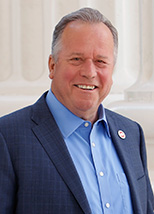
Photo of Bill Dodd
D California Senate · District 3

Sen. Bill Dodd

Contact Email
Compare
Total votes
20,491
all sessions
Attendance
97%
423 missed
Lower than 97% of chamber peers
With party
99%
of cast votes
Bipartisan score
0%
crosses aisle rarely
Sponsored
1,151
bills & resolutions
Near the chamber average
Committees
0
assignments
1,151 bills and resolutions

Sponsored bills

Total
1,151
Primary
250
Co-sponsor
901
This page
1,151
matching current filters
Co-sponsor SB 31
Signed into law · California Senate · Co-sponsor
California Religious Freedom Act: state agencies: disclosure of religious affiliation information.

Existing law prohibits a state agency from including a question regarding an applicant's race, sex, marital status, or religion in any application form for employment. This bill would prohibit a state or local agency or a public employee acting under color of law from providing or disclosing to the federal government personal information regarding a person's religious beliefs, practices, or affiliation, as specified, when the information is sought for compiling a database of individuals based on religious belief, practice, or affiliation, national origin, or ethnicity for law enforcement or immigration purposes. The bill would also prohibit a state agency from using agency resources to assist with any government program compiling such a database, or from making state databases available in connection with an investigation or enforcement under such a program. The bill would prohibit state and local law enforcement agencies and their employees from collecting personal information on the religious beliefs, practices, or affiliation of any individual, except as part of a targeted investigation, as provided, or where necessary to provide religious accommodations. The bill would also prohibit law enforcement agencies from using agency or department moneys, facilities, property, equipment, or personnel to investigate, enforce, or assist in the investigation or enforcement of any criminal, civil, or administrative violation, or warrant for a violation, of any requirement that individuals register with the federal government or any federal agency based on religion, national origin, or ethnicity. The bill would also terminate, to the extent of any conflict, any existing agreements that make any agency or department information or database available in conflict with these provisions. The bill would not prevent the collection, retention, or disclosure of personal information or documents as required by Federal law or a court order. The bill would provide that an agency or employee would only be deemed to be in violation of its provisions if the agency or employee acted with actual knowledge that the information shared would be used for purposes prohibited by these provisions. This bill would declare that it is to take effect immediately as an urgency statute.

Signed into law Oct 15, 2017 1 co-sponsor
Primary SB 334
Signed into law · California Senate · Lead sponsor
Enhanced industrial disability leave.

Existing law generally grants to state officers and employees who are members of the Public Employees' Retirement System or the State Teachers' Retirement System, among others, a right to industrial disability leave, as defined. Existing law defines an excluded employee to include managerial employees and supervisors, among others. Existing law provides an enhanced industrial disability leave benefit to an excluded employee who is temporarily disabled for more than 22 consecutive working days by an injury or type of injury designated by the Director of the Department of Human Resources as qualifying for these purposes. This bill would provide an employee who is a member of State Bargaining Unit 8 and is temporarily disabled in the course of state employment for more than 22 days an extended industrial disability leave benefit based on his or her net salary, as defined. The bill would authorize the employee to receive this benefit for a period not to exceed 52 weeks after the date of injury or until the date the injury is declared permanent, whichever is earlier. The bill would additionally authorize an eligible employee whose injuries are burn-related to receive the benefit for up to 156 weeks.

Signed into law Oct 15, 2017 0 co-sponsors
Co-sponsor SB 5
Signed into law · California Senate · Co-sponsor
California Drought, Water, Parks, Climate, Coastal Protection, and Outdoor Access For All Act of 2018.

Under existing law, programs have been established pursuant to bond acts for, among other things, the development and enhancement of state and local parks and recreational facilities. Existing law, the Water Quality, Supply, and Infrastructure Improvement Act of 2014, approved by the voters as Proposition 1 at the November 4, 2014, statewide general election, authorizes the issuance of general obligation bonds in the amount of $7,545,000,000 to finance a water quality, supply, and infrastructure improvement program. Existing law, the Safe Drinking Water, Water Quality and Supply, Flood Control, River and Coastal Protection Bond Act of 2006, an initiative measure approved by the voters as Proposition 84 at the November 7, 2006, statewide general election, authorizes the issuance of bonds in the amount of $5,388,000,000 for the purposes of financing safe drinking water, water quality and supply, flood control, natural resource protection, and park improvements. Existing law, the California Clean Water, Clean Air, Safe Neighborhood Parks, and Coastal Protection Act of 2002, approved by the voters as Proposition 40 at the March 5, 2002, statewide primary election, authorizes the issuance of bonds in the amount of $2,600,000,000, for the purpose of financing a program for the acquisition, development, restoration, protection, rehabilitation, stabilization, reconstruction, preservation, and interpretation of park, coastal, agricultural land, air, and historical resources. This bill would enact the California Drought, Water, Parks, Climate, Coastal Protection, and Outdoor Access For All Act of 2018, which, if approved by the voters, would authorize the issuance of bonds in an amount of $4,000,000,000 pursuant to the State General Obligation Bond Law to finance a drought, water, parks, climate, coastal protection, and outdoor access for all program. The bill, upon voter approval, would reallocate $100,000,000 of the unissued bonds authorized for the purposes of Propositions 1, 40, and 84 to finance the purposes of a drought, water, parks, climate, coastal protection, and outdoor access for all program. The bill would provide for the submission of these provisions to the voters at the June 5, 2018, statewide primary direct election. This bill would declare that it is to take effect immediately as an urgency statute.


Signed into law Oct 15, 2017 1 co-sponsor
Primary SB 173
Signed into law · California Senate · Lead sponsor
Real estate: Bureau of Real Estate.

Existing law establishes in state government the Business, Consumer Services, and Housing Agency, which is comprised of various departments including the Department of Consumer Affairs. Existing law establishes the Bureau of Real Estate within the Department of Consumer Affairs to license and regulate real estate brokers and real estate salespersons. This bill would, as of July 1, 2018, remove the bureau from the Department of Consumer Affairs and instead make it a department within the Business, Consumer Services, and Housing Agency and rename the bureau to the Department of Real Estate. The bill would also make other conforming and technical changes. This bill would incorporate additional changes to Section 30 of the Business and Professions Code proposed by SB 244 to be operative only if this bill and SB 244 are enacted, as specified.

Signed into law Oct 15, 2017 0 co-sponsors
Co-sponsor AB 616
Signed into law · California Assembly · Co-sponsor
Pupil instruction: California State Summer School for Mathematics and Science: funding: tuition.

Existing law establishes the California State Summer School for Mathematics and Science to provide academic development to enable pupils with demonstrated academic excellence in mathematics and science to receive intensive educational enrichment in these subjects and an opportunity for pupils who wish to study mathematics or science or to pursue careers that require a high degree of skills in and knowledge of mathematics and science. Existing law requests the Regents of the University of California to operate the summer school. Existing law, until January 1, 2018, requests the regents to set a tuition fee for the summer school within a range that corresponds to actual program costs, up to but not exceeding $2,810 per session in the year 2012 and to increase this fee by an amount of up to 5% each year thereafter. Existing law, after January 1, 2018, requests the regents to set a tuition fee within a range that corresponds to actual program costs, up to but not exceeding $1,000 per session in the year 2000, and to increase this fee by an amount of up to 5% each year thereafter. This bill would no longer request the regents after January 1, 2018, to set a tuition fee within a range that corresponds to actual program costs, up to but not exceeding $1,000 per session in the year 2000, and to increase this fee by an amount of up to 5% each year thereafter. The bill would extend the current tuition fee provisions to January 1, 2023.

Signed into law Oct 14, 2017 1 co-sponsor
Co-sponsor SB 368
Signed into law · California Senate · Co-sponsor
Horse racing: fairs: funding.

(1) The Horse Racing Law provides that any unallocated balance from the total revenue received by the Department of Food and Agriculture pursuant to that law, except as specified, is hereby appropriated without regard to fiscal years for allocation by the Secretary of Food and Agriculture for capital outlay to California fairs for, among other things, fair projects involving public health and safety and projects that are required to protect fair property. That law also provides that a portion of these funds may be allocated to California fairs for general support. This bill would revise these provisions to include revenue deposited into the Fair and Exposition Fund pursuant to a specified provision and funding appropriated by the Legislature or otherwise designated for California fairs pursuant to the Horse Racing Law or any other law that is to be appropriated without regard to fiscal years for allocation by the secretary for those capital outlay purposes. (2) Existing law provides that all funds appropriated for California fairs and expositions pursuant to specified provisions of law shall not be utilized for the purposes specified in those provisions but shall instead be utilized for the construction or operation of recreational and cultural facilities of general public interest and may be allocated by the Secretary of Food and Agriculture to all state-designated fairs for those purposes. This bill would delete these provisions and instead require that all funds appropriated or designated for California fairs and expositions pursuant to specified law or any other law be deposited into the Fair and Exposition Fund and be continuously appropriated as provided in specified provisions of the Horse Racing Law. (3) By increasing the amounts to be deposited into the Fair and Exposition Fund, which is continuously appropriated, and by appropriating these amounts for new purposes, the bill would make an appropriation.

Signed into law Oct 14, 2017 1 co-sponsor
Primary SB 147
Signed into law · California Senate · Lead sponsor
Mobilehome parks: residency.

The Mobilehome Residency Law governs residency in mobilehome parks and includes provisions that are applicable to those who have an ownership interest in a subdivision, cooperative, or condominium for mobilehomes, or a resident-owned mobilehome park, as specified. Among other things, these provisions set forth the rights of residents and homeowners regarding the use of the property. Existing law authorizes a homeowner who lives alone to share his or her mobilehome with one guest at a time whose stay does not exceed specified time limits without being required to register with the management and without the imposition of a fee by management for that person, and requires that person to comply with the rules and regulations of the mobilehome park. This bill would authorize any homeowner who lives alone to designate one other person per calendar year to share his or her mobilehome on an ongoing basis, except as specified, and would prohibit the imposition of a fee by management for that person. Existing law authorizes a homeowner to share the mobilehome with a person over 18 years of age if that person provides live-in health care or live-in supportive care to the homeowner pursuant to a written treatment plan prepared by the homeowner's physician. Existing law also authorizes a senior homeowner in an age limited mobilehome park to share the mobilehome with specified persons if the senior homeowner requires live-in health care, live-in supportive care, or supervision pursuant to a written treatment plan prepared by a physician and surgeon. A person staying in the mobilehome of a homeowner under these provisions has no rights of tenancy in the mobilehome park and is required to comply with the rules and regulations of the park. This bill would permit park management to require written confirmation from a licensed health care professional of the homeowner's need for the care or supervision, if the need is not readily apparent or already known to management. The bill would provide that these provisions do not grant any guest, companion, live-in caregiver, or family member under the care of a senior homeowner, rights of tenancy in the park and would make any violation of the rules and regulations of the park by any of these persons subject to enforcement by park management, as specified. The bill would also provide that these provisions do not create a duty on the part of park management to manage, supervise, or provide care for a homeowner's guest, companion, live-in caregiver, or family member under the care of a senior homeowner, during that person's stay in the mobilehome park.

Signed into law Oct 13, 2017 0 co-sponsors
Co-sponsor AB 1598
Signed into law · California Assembly · Co-sponsor
Affordable housing authorities.

Existing law authorizes certain local agencies to form a community revitalization authority (authority) within a community revitalization and investment area, as defined, to carry out provisions of the Community Redevelopment Law in that area for purposes related to, among other things, infrastructure, affordable housing, and economic revitalization. Existing law provides for the financing of these activities by, among other things, the issuance of bonds serviced by property tax increment revenues, and requires the authority to adopt a community revitalization and investment plan for the community revitalization and investment area that includes elements describing and governing revitalization activities. Existing law requires a community revitalization and investment plan to include a 30-year limit for establishing loans, advances, and indebtedness by the authority. This bill would authorize a city, county, or city and county to adopt a resolution creating an affordable housing authority with power limited to providing low- and moderate-income housing and affordable workforce housing, as defined, funded through a low- and moderate-income housing fund, as specified. The bill would prohibit certain local government entities from participating in the authority. The bill would authorize an authority created pursuant to those provisions to have boundaries that are identical to the boundaries of the city, county, or city and county that created the authority. The bill would require the authority to adopt, after holding a noticed public hearing, an affordable housing investment plan that includes, among other things, an affordable housing program. The bill would require an authority created pursuant to these provisions to include a 45-year limit for establishing loans, advances, and indebtedness by the authority. The bill would authorize specified local entities to adopt a resolution to provide property tax increment revenues to the authority. The bill would also authorize specified local entities to adopt a resolution allocating other tax revenues to the authority, subject to certain requirements. The bill would provide for the financing of the activities of the authority by, among other things, the issuance of bonds serviced by funds received pursuant to those property tax increment revenues or other tax revenues allocated to the authority.

Signed into law Oct 13, 2017 1 co-sponsor
Co-sponsor SB 145
Signed into law · California Senate · Co-sponsor
Autonomous vehicles: testing on public roads.

Existing law authorizes the operation of an autonomous vehicle on public roads for testing purposes by a driver who possesses the proper class of license for the type of vehicle operated if specified requirements are satisfied. Existing law prohibits the operation of an autonomous vehicle on public roads until the manufacturer submits an application to the Department of Motor Vehicles, as specified, and that application is approved. Existing law requires the department to notify the Legislature if it receives an application from a manufacturer seeking approval to operate an autonomous vehicle capable of operating without the presence of a driver inside the vehicle. Existing law prohibits such an application from becoming effective any sooner than 180 days after that application is submitted. Existing law requires the department to adopt regulations no later than January 1, 2015, setting forth requirements for submitting evidence of insurance, surety bond, or self-insurance, and for submitting and approving an application to operate an autonomous vehicle. Existing law requires the department to approve an application submitted by a manufacturer if it finds, among other information, that the applicant has completing testing necessary to satisfy the department that the autonomous vehicles are safe to operate on the public roads. Existing law prohibits the limitation or expansion of existing authority to operate autonomous vehicles on public roads, until 120 days after the department adopts those regulations. This bill would repeal the requirement that the department notify the Legislature of receipt of an application seeking approval to operate an autonomous vehicle capable of operating without the presence of a driver inside the vehicle. The bill would also repeal the requirement that the approval of such an application not be effective any sooner that 180 days after the date the application is submitted. The bill would require the department to provide public notice when it adopts the autonomous vehicle regulations, would repeal the 120 day prohibition against limiting or expanding the authority to operate autonomous vehicles, and instead would prohibit the department from approving an application submitted pursuant to the regulations until 30 days after public notice of the adopted regulations is provided. This bill would declare that it is to take effect immediately as an urgency statute.
Signed into law Oct 12, 2017 1 co-sponsor
Showing 671 to 680 of 1,151 bills
Previous 1 … 67 68 69 … 116 Next