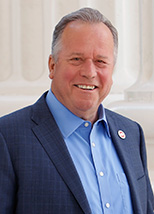
Photo of Bill Dodd
D California Senate · District 3

Sen. Bill Dodd

Contact Email
Compare
Total votes
20,491
all sessions
Attendance
97%
423 missed
Lower than 97% of chamber peers
With party
99%
of cast votes
Bipartisan score
0%
crosses aisle rarely
Sponsored
1,151
bills & resolutions
Near the chamber average
Committees
0
assignments
1,151 bills and resolutions

Sponsored bills

Total
1,151
Primary
250
Co-sponsor
901
This page
1,151
matching current filters
Co-sponsor AB 2543
Signed into law · California Assembly · Co-sponsor
State agencies: infrastructure project budget and schedule: Internet Web site information.

Existing law, on order of the Governor, requires the head of each state agency to make a report to the Governor giving an account of all matters pertaining to the agency during the period specified by the Governor. This bill would require each state agency or department authorized to undertake any infrastructure project costing $100,000,000 or more to publicly post on its Internet Web site any change in the cost or schedule of the project that would result in the project exceeding its established budget by 10 percent or more or being delayed by 12 months or longer. The bill would require that the posted information describe how much the project is expected to exceed its established budget or delay its construction schedule.

Signed into law Sep 29, 2018 1 co-sponsor
Primary SB 981
Signed into law · California Senate · Lead sponsor
Home solicitation contract or offer: water treatment devices: rescission.

Existing law authorizes a buyer to rescind a home solicitation contract or offer, as defined, within a limited period of time if specified requirements are met. Under existing law, a contract or offer, subject to approval, for the sale, lease, or rental of a water treatment device is deemed a home solicitation contract or offer. Existing law prohibits a water treatment device or any other materials that are the subject of a home solicitation contract or offer from being delivered or installed, or other services performed, until the expiration of the rescission period, as provided. Existing law makes a violation of these provisions a crime. Existing law prescribes additional requirements on a home improvement contract if obtaining a loan is a condition precedent to the contract or if the contractor provides financing or assists the buyer in obtaining a loan. Existing law renders the home improvement contract unenforceable if the additional requirements are not met, including, among others, if the buyer rescinds the loan or financing transaction within the 3-day period prescribed for rescission pursuant to the federal Truth in Lending Act. Under existing law, a contractor is prohibited from delivering any property or performing any services in relation to the home improvement project until the additional requirements are met. This bill would authorize the delivery and installation of a water treatment device or any other materials during the home solicitation contract rescission period, subject to the above-described additional rescission requirements for a home improvement contract. The bill would make the seller responsible for all costs in removing the installed water treatment device or other materials, and would require that removal to occur within 20 days if the buyer rescinds the contract before the expiration of the rescission period. The bill would also require the seller to restore the property to substantially as good condition as it was at the time the services were rendered if the seller's services result in the alteration of property of the buyer. Because a violation of the bill's requirements would be a crime, the bill would impose a state-mandated local program. The California Constitution requires the state to reimburse local agencies and school districts for certain costs mandated by the state. Statutory provisions establish procedures for making that reimbursement. This bill would provide that no reimbursement is required by this act for a specified reason.

Signed into law Sep 29, 2018 0 co-sponsors
Primary SB 998
Signed into law · California Senate · Lead sponsor
Discontinuation of residential water service: urban and community water systems.

Existing law, the California Safe Drinking Water Act, requires the State Water Resources Control Board to administer provisions relating to the regulation of drinking water to protect public health. Existing law declares it to be the established policy of the state that every human being has the right to safe, clean, affordable, and accessible water adequate for human consumption, cooking, and sanitary purposes. Under existing law, the Public Utilities Commission has regulatory authority over public utilities, including water corporations. Existing law requires certain notice to be given before a water corporation, public utility district, municipal utility district, or a municipally owned or operated public utility furnishing water may terminate residential service for nonpayment of a delinquent account, as prescribed. This bill would require an urban and community water system, defined as a public water system that supplies water to more than 200 service connections, to have a written policy on discontinuation of water service to certain types of residences for nonpayment available in prescribed languages. The bill would require the policy to include certain components, be available on the system's Internet Web site, and be provided to customers in writing, upon request. The bill would provide for enforcement of these provisions, including making a violation of these provisions punishable by a civil penalty issued by the board in an amount not to exceed $1,000 for each day in which the violation occurs, and would require the enforcement moneys collected by the board to be deposited in the Safe Drinking Water Account. The bill would prohibit an urban and community water system from discontinuing residential service for nonpayment until a payment by a customer has been delinquent for at least 60 days. The bill would require an urban and community water system to contact the customer named on the account and provide the customer with the urban and community water system's policy on discontinuation of residential service for nonpayment no less than 7 business days before discontinuation of residential service, as prescribed. This bill would prohibit residential service from being discontinued under specified circumstances. The bill would require an urban and community water system that discontinues residential service to provide the customer with information on how to restore service. The bill would require an urban and community water system to waive interest charges on delinquent bills for, and would limit the amount of a reconnection of service fee imposed on, a residential customer who demonstrates, as prescribed, to the urban and community water system household income below 200% of the federal poverty line. The bill would require an urban and community water system that furnishes individually metered residential service to residential occupants of a detached single-family dwelling, a multiunit structure, mobilehome park, or permanent residential structure in a labor camp, and that the owner, manager, or operator of the dwelling, structure, or park is the customer of record, to make every good faith effort to inform the residential occupants by written notice that service will be terminated and that the residential occupants have the right to become customers, as specified. The bill would require an urban and community water system to report the number of annual discontinuations of residential service for inability to pay on its Internet Web site and to the board, and the bill would require the board to post on its Internet Web site the information reported. The bill would require an urban water supplier, as defined, or an urban and community water system regulated by the commission, to comply with the bill's provisions on and after February 1, 2020, and any other urban and community water system to comply with the bill's provisions on and after April 1, 2020. The bill would provide that the provisions of the bill are in addition to the provisions in existing law duplicative of the bill and that where the provisions are inconsistent, the provisions described in the bill apply.


Signed into law Sep 28, 2018 0 co-sponsors
Co-sponsor SB 175
Signed into law · California Senate · Co-sponsor
Developmental services: Canyon Springs Community Facility.

Existing law authorizes a court, if the court finds that a person has a developmental disability, and is a danger to himself, herself, or to others, to make an order that the person be committed to the State Department of Developmental Services for suitable treatment and habilitation services, as specified. This bill would authorize a court to order, until June 30, 2021, the commitment of an individual who meets specified criteria for admission due to an acute crisis, as defined, to a separate and distinct unit of Canyon Springs Community Facility. The bill would make other conforming changes. This bill would incorporate additional changes to Section 6500 of the Welfare and Institutions Code proposed by SB 1494 to be operative only if this bill and SB 1494 are enacted and this bill is enacted last. This bill would declare that it is to take effect immediately as an urgency statute.

Signed into law Sep 28, 2018 1 co-sponsor
Co-sponsor SB 1301
Vetoed · California Senate · Co-sponsor
State permitting: environment: processing procedures: dam safety or flood risk reduction project.

Existing law requires the Department of Water Resources to supervise the maintenance and operation of dams and reservoirs as necessary to safeguard life and property. Existing law requires the department to perform various flood control activities throughout the state. Existing law establishes the Central Valley Flood Protection Board and authorizes the board to engage in various flood control activities along the Sacramento River, the San Joaquin River, their tributaries, and related areas. Existing law also authorizes the board of supervisors of a county to appropriate and spend money from the general fund of the county for specified flood control purposes in connection with streams or rivers in the county. This bill would require the Office of Planning and Research to develop a joint multiagency preapplication for supplemental consultation and a model fee-for-service agreement, in consultation with a state agency with the power to issue a permit that would authorize a dam safety project or authorize a flood risk reduction project and any interested potential project applicants. The bill would authorize a project applicant to complete a joint multiagency preapplication and submit the preapplication to each state agency named in the preapplication at any time. The bill would require the submission to cause, as appropriate for the proposed project and as specified in the preapplication, a state agency to identify how the requested supplemental consultation will be provided. The bill would require supplemental consultation to occur at least once per quarter, except that supplemental consultation would not occur until a written fee-for-service agreement is entered into. The bill would authorize the establishment and collection of fees payable by a project applicant submitting a preapplication as reimbursement to cover specified reasonable costs, thereby making an appropriation. The bill would authorize and encourage certain federal agencies to provide supplemental consultation for those projects.

Vetoed Sep 28, 2018 1 co-sponsor
Primary SB 1144
Signed into law · California Senate · Lead sponsor
Enhanced industrial disability leave: State Bargaining Unit 8.

Existing law generally grants to state officers and employees who are members of the Public Employees' Retirement System or the State Teachers' Retirement System, among others, a right to industrial disability leave, as defined. Existing law also grants an employee who is a member of State Bargaining Unit 8 and is temporarily disabled in the course of state employment for more than 22 days an extended industrial disability leave benefit based on his or her net salary, as defined. Existing law authorizes the employee to receive this benefit for a period not to exceed 52 weeks after the date of injury or until the date the injury is declared permanent, whichever is earlier. Existing law also authorizes an eligible employee whose injuries are burn-related to receive that benefit for up to 156 weeks. This bill would delete the above requirement that an employee of State Bargaining Unit 8 be temporarily disabled for a period that exceeds 22 consecutive days to be entitled to the enhanced industrial disability leave benefit. The bill would also include within this benefit any salary increases that the employee would have received during his or her leave. The bill would revise the above condition concerning an injury or illness being declared permanent to include that it also be declared stationary.

Signed into law Sep 28, 2018 0 co-sponsors
Co-sponsor SB 1130
Signed into law · California Senate · Co-sponsor
Property tax postponement: residential dwelling: manufactured homes.

Existing law authorizes a claimant to file a claim with the Controller to postpone the payment of property taxes that are due on the residential dwelling of the claimant pursuant to the Senior Citizens and Disabled Citizens Property Tax Postponement Law, the Senior Citizens Tenant-Stockholder Property Tax Postponement Law, and the Senior Citizens Possessory Interest Holder Property Tax Postponement Law. Existing law, for purposes of these laws, defines a "residential dwelling" to mean a dwelling occupied as the principal place of residence of the claimant and owned by the claimant, the claimant and spouse, or by the claimant and another individual, as specified, including condominiums that are assessed as realty for local property tax purposes. Existing law continuously appropriates revenues in the Senior Citizens and Disabled Citizens Property Tax Postponement Fund for, among other things, disbursements relating to the postponement of property taxes pursuant to these laws. Existing law authorizes the postponement of the payment of property taxes of a claimant who is the owner of a mobilehome for loans established prior to February 20, 2009, pursuant to the Senior Citizens Mobilehome Property Tax Postponement Law. This bill would expand the definition of a "residential dwelling" to include a manufactured home, thereby authorizing a claimant who is the owner of a manufactured home to postpone the payment of property taxes. The bill, on July 1, 2019, and on July 1 each year thereafter, would require up to 1% of the amount available in the Senior Citizens and Disabled Citizens Property Tax Postponement Fund for disbursements relating to postponement of property taxes to be available for residential dwellings that are manufactured homes. Because this bill would provide for an additional category of expenditures from the Senior Citizens and Disabled Citizens Property Tax Postponement Fund, a continuously appropriated fund, it would make an appropriation. The bill would repeal the Senior Citizens Mobilehome Property Tax Postponement Law and would, instead, enact the Senior Citizens Manufactured Home Property Tax Postponement Law, which would, commencing July 1, 2019, establish a procedure for the postponement of the payment of property taxes of a claimant who is the owner of a manufactured home, as defined. The bill would require a claimant applying for postponement under this law to file a claim under penalty of perjury, as provided. The bill would also make related conforming changes. By requiring a claim for postponement to be filed under penalty of perjury, the bill would expand the crime of perjury, thereby imposing a state-mandated local program. Existing law requires all sums paid by the Controller to be secured by a lien in favor of the state when funds are transferred to the county by the Controller upon the real property for which property taxes have been postponed. Existing law also requires the Controller to maintain a record of all properties against which a notice of lien for postponed property taxes has been recorded. This bill would additionally require all sums paid by the Controller to be secured by a lien in favor of the state when funds are transferred to the county by the Controller upon a manufactured home situated on real property owned by the claimant for which property taxes have been postponed, as provided. The bill, in the case of a manufactured home situated on real property not owned by the claimant, would require the state's interest to be secured by a security agreement in favor of the State of California, as provided. The bill would also require the Controller to maintain a record of all properties against which the Department of Housing and Community Development has been notified to withhold the transfer of title or permit for transport. The bill would require the Controller, or authorized delegate of the Controller, if at any time the amount of the obligation secured by the lien or security agreement for postponed property taxes is paid in full or otherwise discharged in the case of a manufactured home, to direct certain local tax officials to remove specified information from the secured roll or assessment records, as provided. By imposing new duties upon local tax officials with respect to the removal of information from the secured roll and assessment records, this bill would impose a state-mandated local program. The California Constitution requires the state to reimburse local agencies and school districts for certain costs mandated by the state. Statutory provisions establish procedures for making that reimbursement. This bill would provide that with regard to certain mandates no reimbursement is required by this act for a specified reason. With regard to any other mandates, this bill would provide that, if the Commission on State Mandates determines that the bill contains costs so mandated by the state, reimbursement for those costs shall be made pursuant to the statutory provisions noted above.

Signed into law Sep 28, 2018 1 co-sponsor
Co-sponsor SB 970
Signed into law · California Senate · Co-sponsor
Employment: human trafficking awareness.

Existing law requires specified businesses and other establishments to post a notice, as developed by the Department of Justice, that contains information relating to slavery and human trafficking, including information regarding specified nonprofit organizations that a person can call for services or support in the elimination of slavery and human trafficking. The California Fair Employment and Housing Act (FEHA) makes specified employment practices unlawful, including the harassment of an employee directly by the employer or indirectly by agents of the employer with the employer's knowledge. FEHA requires employers with 50 or more employees to provide at least 2 hours of prescribed training and education regarding sexual harassment to all supervisory employees within 6 months of their assumption of a supervisory position and once every 2 years, as specified. This bill would amend FEHA to require specified employers to provide at least 20 minutes of prescribed training and education regarding human trafficking awareness to employees who are likely to interact or come into contact with victims of human trafficking, as defined. The bill would establish a schedule for compliance commencing January 1, 2020. The bill would authorize the Department of Fair Employment and Housing, in the case of an employer violation of the bill's requirements, to seek an order requiring compliance.

Signed into law Sep 27, 2018 1 co-sponsor
Co-sponsor SB 1104
Signed into law · California Senate · Co-sponsor
Pupil safety: human trafficking prevention resources.

Existing law authorizes a school district to provide sexual abuse and sex trafficking prevention education, as defined, encourages school districts to collaborate with outside consultants, including law enforcement, with expertise in sexual abuse and sex trafficking prevention education in order to create school safety plans to address those threats, and authorizes in-service training of school district personnel relating to understanding sexual abuse and sex trafficking to be conducted periodically, as provided. This bill would require the governing board of a school district and the governing body of a charter school to work with their schools that maintain any of grades 6 to 12, inclusive, to identify the most appropriate methods of informing parents and guardians of pupils in those grades of human trafficking prevention resources and to implement the identified methods in those schools by January 1, 2020. By imposing additional requirements on school districts and charter schools, the bill would impose a state-mandated local program. The California Constitution requires the state to reimburse local agencies and school districts for certain costs mandated by the state. Statutory provisions establish procedures for making that reimbursement. This bill would provide that, if the Commission on State Mandates determines that the bill contains costs mandated by the state, reimbursement for those costs shall be made pursuant to the statutory provisions noted above.

Signed into law Sep 27, 2018 1 co-sponsor
Primary SB 1051
Signed into law · California Senate · Lead sponsor
Tribal gaming: compact ratification.

The existing federal Indian Gaming Regulatory Act of 1988 provides for the negotiation and execution of tribal-state gaming compacts for the purpose of authorizing certain types of gaming on Indian lands within a state. The California Constitution authorizes the Governor to negotiate and conclude tribal-state gaming compacts, subject to ratification by the Legislature. Existing law expressly ratifies a number of tribal-state gaming compacts, and amendments of tribal-state gaming compacts, between the State of California and specified Indian tribes. The California Environmental Quality Act (CEQA) requires a lead agency to prepare, or cause to be prepared, and certify the completion of, an environmental impact report on a project, as defined, that it proposes to carry out or approve that may have a significant effect on the environment, as defined, or to adopt a negative declaration if it finds that the project will not have that effect. This bill would ratify the tribal-state gaming compacts entered into between the State of California and the following Indian tribes: the La Jolla Band of Luiseño Indians, the Mechoopda Indian Tribe of Chico Rancheria, the San Pasqual Band of Mission Indians, the Torres-Martinez Desert Cahuilla Indians, and the Twenty-Nine Palms Band of Mission Indians. The bill would also ratify the amendment to the tribal-state gaming compact between the State of California and the Dry Creek Rancheria Band of Pomo Indians, executed on August 1, 2018, and the amendment to the tribal-state gaming compact between the State of California and the Karuk Tribe, executed on August 1, 2018. The bill would provide that, in deference to tribal sovereignty, certain actions related to these compacts and amended compacts are not projects for purposes of CEQA. This bill would declare that it is to take effect immediately as an urgency statute.

Signed into law Sep 27, 2018 0 co-sponsors
Showing 541 to 550 of 1,151 bills
Previous 1 … 54 55 56 … 116 Next