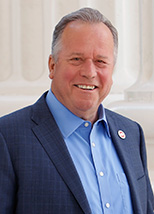
Photo of Bill Dodd
D California Senate · District 3

Sen. Bill Dodd

Contact Email
Compare
Total votes
20,491
all sessions
Attendance
97%
423 missed
Lower than 97% of chamber peers
With party
99%
of cast votes
Bipartisan score
0%
crosses aisle rarely
Sponsored
1,151
bills & resolutions
Near the chamber average
Committees
0
assignments
1,151 bills and resolutions

Sponsored bills

Total
1,151
Primary
250
Co-sponsor
901
This page
1,151
matching current filters
Co-sponsor SCR 8
Signed into law · California Senate · Co-sponsor
Relative to the State Capitol Building.

This measure would recognize the 150th anniversary of the Legislature first convening session in the State Capitol Building in Sacramento.

Signed into law May 10, 2019 1 co-sponsor
Co-sponsor SCR 23
Signed into law · California Senate · Co-sponsor
Relative to California Wines: Down to Earth Month.

This measure would proclaim the month of April 2019 as California Wines: Down to Earth Month, to celebrate the sustainable leadership of California wineries and winegrape growers throughout the month of April.

Signed into law May 2, 2019 1 co-sponsor
Co-sponsor ACR 25
Signed into law · California Assembly · Co-sponsor
Relative to California Attractions and Parks Day.

This measure would recognize March 14, 2019, as California Attractions and Parks Day, and would declare that the Legislature intends to take actions to commemorate the 15th anniversary of the California Attractions and Parks Association and celebrate the organization's important role and many contributions to California's tourism industry through its promotion, support, and sponsorship of a wide variety of activities and programs at attractions and parks throughout the state.

Signed into law Apr 9, 2019 1 co-sponsor
Co-sponsor SB 1272
Vetoed · California Senate · Co-sponsor
Tax Recovery and Criminal Enforcement (TRaCE) Task Force.

Existing law, until January 1, 2019, establishes the Revenue Recovery and Collaborative Enforcement Team as a pilot program consisting of a team of agencies charged with specified duties that include developing a plan to document, review, and evaluate data and complaints, evaluating the benefits of a processing center to receive and analyze data, share complaints, and research leads, and providing agencies with investigative leads, as specified, to combat criminal tax evasion associated with the underground economy. This bill would establish the Tax Recovery and Criminal Enforcement (TRaCE) Task Force in the Department of Justice to combat underground economic activities through a multiagency collaboration to, among other things, pool resources, collaborate and share data, including confidential tax and fee information, prosecute violations, and recover state revenue lost to the underground economy, as specified. This bill would require TRaCE Task Force investigative teams to be located in Sacramento, Los Angeles, San Diego, the San Francisco Bay area, and Fresno, under the direct oversight of the Department of Justice. The bill would establish a TRaCE Task Force executive board and TRaCE Task Force investigative team committees to ensure multiagency collaboration. The bill would require that information exchanged pursuant to these provisions retain its confidential status, as specified. The bill would require the TRaCE Task Force to develop a data analytics system that enhances the efficiency and effectiveness of the multiagency collaboration to the extent the Legislature appropriates funds for these purposes. The bill would require the Department of Justice, in consultation with the executive board of the TRaCE Task Force, to submit an annual report to the Legislature that includes specified information.

Vetoed Sep 30, 2018 1 co-sponsor
Co-sponsor SB 822
Signed into law · California Senate · Co-sponsor
Communications: broadband Internet access service.

Existing law imposes certain obligations in the context of particular transactions, and provides mechanisms to enforce those obligations. This bill would enact the California Internet Consumer Protection and Net Neutrality Act of 2018. This act would prohibit fixed and mobile Internet service providers, as defined, that provide broadband Internet access service, as defined, from engaging in specified actions concerning the treatment of Internet traffic. The act would prohibit, among other things, blocking lawful content, applications, services, or nonharmful devices, impairing or degrading lawful Internet traffic on the basis of Internet content, application, or service, or use of a nonharmful device, and specified practices relating to zero-rating, as defined. It would also prohibit fixed and mobile Internet service providers from offering or providing services other than broadband Internet access service that are delivered over the same last-mile connection as the broadband Internet access service, if those services have the purpose or effect of evading the above-described prohibitions or negatively affect the performance of broadband Internet access service.

Signed into law Sep 30, 2018 1 co-sponsor
Co-sponsor SB 419
Signed into law · California Senate · Co-sponsor
Legislature: Whistleblower protection and retaliation prevention.

Existing law, the Legislative Employee Whistleblower Protection Act, imposes criminal and civil liability on a Member of the Legislature or legislative employee, as defined, who interferes with, or retaliates against, a legislative employee's exercise of the right to make a protected disclosure, which is defined as a good faith allegation made by a legislative employee to specified entities that a Member of the Legislature or a legislative employee has engaged in, or will engage in, activity that may constitute a violation of law or a violation of a legislative standard of conduct. This bill would define "protected disclosure" for purposes of that act to also include a complaint made at the request of a legislative employee and a complaint made against a nonemployee in specified circumstances. Existing law, the California Fair Employment and Housing Act (FEHA) , protects and safeguards the right and opportunity of all persons to generally seek, obtain, and hold employment without discrimination, abridgment, or harassment on account of enumerated protected categories. Existing law also precludes an employer, labor organization, employment agency, or person from discharging, expelling, or otherwise discriminating against any person because the person has opposed any practices forbidden under FEHA or because the person has filed a complaint, testified, or assisted in any FEHA proceeding. Existing law, the Unruh Civil Rights Act, states that all people in California are entitled to the full and equal accommodations, advantages, facilities, privileges, or services in all business establishments, no matter their sex, race, color, religion, ancestry, national origin, disability, medical condition, genetic information, marital status, sexual orientation, citizenship, primary language, or immigration status. Existing law establishes a cause of action for violations of that act. Existing law also separately establishes liability for sexual harassment if a plaintiff proves specified elements, including, among other things, that there is a business, service, or professional relationship between the plaintiff and defendant. This bill would declare that neither house of the Legislature may retaliate against a legislative advocate or employee, as defined, because that person has opposed any practices forbidden under the above provisions, or filed a complaint, testified, or assisted in any proceeding relating to a complaint of harassment under those provisions. This bill would impose civil liability for a violation of that prohibition. This bill would also require each house of the Legislature to maintain a record of each harassment complaint made to that house for a period of at least 12 years after the complaint is made. This bill would declare that it is to take effect immediately as an urgency statute.


Signed into law Sep 30, 2018 1 co-sponsor
Co-sponsor AB 237
Signed into law · California Assembly · Co-sponsor
Pilot Program for Increased Access to Responsible Small Dollar Loans.

(1) Existing law, the California Financing Law, generally provides for the licensure and regulation of finance lenders, brokers, and, beginning on January 1, 2019, program administrators, by the Commissioner of Business Oversight. The CFL makes a willful violation of specified provisions a crime. The CFL, until January 1, 2023, establishes the Pilot Program for Increased Access to Responsible Small Dollar Loans (pilot program) , which requires licensees and other entities that wish to participate in the pilot program to file an application and pay a specified fee to the commissioner to participate in the pilot program. The pilot program authorizes a licensee approved by the commissioner to participate in the pilot program to impose specified alternative interest rates and charges, including an administrative fee and delinquency fees, on unsecured loans of at least $300 and less than $2,500, subject to certain requirements. This bill would increase the upper limit on the amount of a permissible loan under the pilot program from $2,500 to $7,500 and make corresponding changes. (2) Under the pilot program, a licensee is prohibited from making a loan if that licensee determines, through its underwriting, that the borrower's total monthly debt service payments exceed 50% of the borrower's monthly gross income. This bill would instead prohibit a licensee from making a loan under these circumstances if the borrower's total monthly debt service payments exceed 50% of the borrower's gross monthly income for a loan of no more than $2,500, or exceed 36% of the borrower's gross monthly income for a loan in excess of $2,500. (3) The pilot program establishes that a loan with a principal balance, upon origination, of at least $1,500 is required to have a term of not less than 180 days. As an alternative to other authorized charges, a licensee approved by the commissioner to participate in the pilot program may contract for and receive charges at an annual simple interest rate not exceeding specified amounts. This bill would additionally require a loan under the pilot program that has a principal balance exceeding $2,500 to have a minimum term of one year and a maximum term of 5 years. The bill would also require licensees to reduce the interest rates on each subsequent loan to the same borrower by a minimum of one percentage point and subject to additional reductions, if specified conditions are satisfied. (4) Under the pilot program, licensees are required to develop and implement policies and procedures designed to respond to questions raised by applicants and borrowers regarding their loans, including those involving finders. Existing law describes a finder as an entity that brings a licensee and a prospective borrower together for the purpose of negotiating a loan contract. This bill would also require licensees to perform reasonable background checks on any finders associated with a licensee's participation in the pilot program. (5) The pilot program authorizes a licensee who is approved to participate in the program to use the services of one or more finders. Existing law defines a "finder" for these purposes as an entity that, at the finder's physical location for business, brings a licensee and a prospective borrower together for the purpose of negotiating a loan contract. This bill would authorize the commissioner to charge a licensee participating in the program an additional fee to offset the commissioner's costs to oversee and examine the activities of that licensee's finder or finders. (6) Existing law requires the Commissioner of Business Oversight to examine each licensee that is accepted into the program at least once every 24 months. This bill would require the commissioner also to examine each finder whose services were used by the licensee at least once every 24 months. (7) Existing law requires the Commissioner of Business Oversight to post reports containing specified information on his or her Internet Web site that summarize utilization of the Pilot Program for Increased Access to Responsible Small Dollar Loans. If more than one licensee is approved to participate in the program, existing law requires that information in the report to be stated in aggregate to avoid identifying data by specific licensee. This bill would require that these reports also contain specified information for each finder whose services were used by a licensee in connection with the loans or loan applications, along with the finder's identity. By increasing the scope of the program, the bill would expand the definition of a crime, thereby imposing a state-mandated local program. (8) The California Constitution requires the state to reimburse local agencies and school districts for certain costs mandated by the state. Statutory provisions establish procedures for making that reimbursement. This bill would provide that no reimbursement is required by this act for a specified reason.

Signed into law Sep 30, 2018 1 co-sponsor
Showing 531 to 540 of 1,151 bills
Previous 1 … 53 54 55 … 116 Next