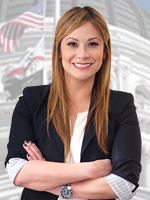
Photo of Ling Ling Chang
R California Senate · District 29

Sen. Ling Ling Chang

Compare
Total votes
10,779
all sessions
Attendance
92%
576 missed
Lower than 89% of chamber peers
With party
95%
of cast votes
Lower than 99% of chamber peers
Bipartisan score
3%
crosses aisle rarely
Higher than 96% of chamber peers
Sponsored
511
bills & resolutions
Near the chamber average
Committees
0
assignments
511 bills and resolutions

Sponsored bills

Total
511
Primary
69
Co-sponsor
442
This page
511
matching current filters
Primary AB 971
Failed · California Assembly · Lead sponsor
Payment of expenses.

Existing law requires all expenses authorized and necessarily incurred to prepare for and conduct an election to be paid from the county treasuries, except as otherwise provided. This bill would require expenses authorized and necessarily incurred to prepare for and conduct certain vacancy elections to be paid by the state, as specified.

Failed Feb 1, 2016 0 co-sponsors
Primary AB 756
Failed · California Assembly · Lead sponsor
Small businesses: civil fines and penalties. penalties: waiver.

Existing law imposes various taxes and fees that are administered by the State Board of Equalization, the Franchise Tax Board, and the Employment Development Department. Existing law authorizes these state agencies to impose fines and penalties for violations of those laws imposing the tax or fee. Under existing law, if the Director of Employment Development finds that any employer, in submitting facts concerning the termination of a specified claimant's employment concerning unemployment compensation, among other things, willfully makes a false statement or representation, the director is required to assess a penalty against the employer of that claimant in a specified amount. This bill would authorize the State Board of Equalization, the Franchise Tax Board, and the Employment Development Department to waive any fine or penalty for violations of the laws that impose a tax or fee, assessed against a small business, as defined, within its first 120 days of operation if certain requirements are met.

Failed Feb 1, 2016 0 co-sponsors
Primary AB 889
Failed · California Assembly · Lead sponsor
Concurrent enrollment in secondary school and community college.

(1) Existing law authorizes the governing board of a school district to allow pupils whom the district has determined would benefit from advanced scholastic or vocational work to attend community college as special part-time or full-time students, subject to recommendation by the school principal and parental permission. This bill would authorize the governing board of a school district to authorize a pupil, upon recommendation of the principal of the pupil's school of attendance, and with parental consent, to attend a community college during any session or term as a special part-time or full-time student and to undertake one or more STEM courses, as defined to mean courses in science, technology, engineering, or mathematics, offered at the community college if that pupil has exhausted all opportunities to enroll in an equivalent course at the high school of attendance, or at an adult education program, continuation school, regional occupational center or program, or any other program offered by that school district. The bill also would authorize the governing board of a community college district to enter into a formal partnership with a school district or school districts located within its immediate service area to allow secondary school pupils to attend a community college if those pupils have exhausted all opportunities to enroll in an equivalent STEM course at the high school of attendance, adult education program, continuation school, regional occupational center or program, or any other program offered by that school district. The bill would require the partnership agreement to outline the terms of the partnership, as specified. The bill would require a community college district and a school district, as a condition of, and before adopting, a partnership agreement, to present the adoption of the partnership agreement as an information item at regularly scheduled open meetings of their respective governing boards, and to take testimony from the public and approve or disapprove the proposed partnership agreement at subsequent regularly scheduled open public hearings of their respective governing boards. The bill would require, for each partnership entered into under the bill, the affected community college district and school district to file an annual report, containing specified data, with the Office of the Chancellor of the California Community Colleges, which would transmit this annual report to the Legislature, the Director of Finance, the Superintendent of Public Instruction, and the governing boards of the participating school districts and community college districts, as specified. (2) Existing law requires the governing board of a community college district to assign a low enrollment priority to a pupil attending community college pursuant to a recommendation from his or her principal or school district or a petition from his or her parents, in order to ensure that these pupils, admitted as special part-time or full-time students, do not displace regularly admitted students. This bill would authorize the governing board of a community college district to assign an enrollment priority to pupils attending community college pursuant to a partnership agreement established under the bill. The bill would require community college districts, in assigning an enrollment priority under this provision, to ensure that these pupils do not displace regularly admitted community college students. The bill would prohibit a community college district from receiving an allowance or apportionment for an instructional activity for which a school district has been, or will be, paid. (3) This bill would also make various nonsubstantive changes, and delete obsolete provisions.


Failed Feb 1, 2016 0 co-sponsors
Co-sponsor SCR 88
Signed into law · California Senate · Co-sponsor
Relative to Human Trafficking Awareness Month.

This measure would proclaim the month of January 2016 as Human Trafficking Awareness Month, encourage all Californians to become educated about human trafficking and work to eradicate these criminal practices within and beyond our borders, and encourage Members of the Legislature, as well as organizations, businesses, and individuals, to host or sponsor and attend community events in order to bring visibility and support to efforts made by nongovernmental organizations to recognize and combat human trafficking.

Signed into law Feb 1, 2016 1 co-sponsor
Co-sponsor AB 1123
died · California Assembly · Co-sponsor
Dispute resolution programs: court administration.

Existing law authorizes a county to establish a program of grants to public entities and nonprofit organizations for the provision of dispute resolution services and prescribes a variety of eligibility requirements and duties in this regard. Existing law requires the Administrative Office of the Courts to make monthly distributions from superior court filing fees for the support of dispute resolution programs in each county that has acted to establish a program, as specified. This bill would permit a county that has established and is operating a dispute resolution program as described above to contract with the superior court of the county to transfer operation of the program to the court. The court would be required to operate the program in compliance with all requirements, rules, and regulations associated with the program. The bill would provide that a court that contracts to operate a dispute resolution program assumes the relevant rights and responsibilities connected with the program and would require the county to transfer, within a reasonable time, any funds received for administration of the program, with future program funding to be provided directly to the court.

died Feb 1, 2016 1 co-sponsor
Co-sponsor AB 239
Failed · California Assembly · Co-sponsor
Greenhouse gases: regulations.

The California Global Warming Solutions Act of 2006 authorizes the State Air Resources Board to adopt greenhouse gas emissions limits and emission reduction measures by regulation to achieve the maximum technologically feasible and cost-effective reduction in greenhouse gas emissions in furtherance of achieving the statewide greenhouse gas emissions limit. The act authorizes the board, in the regulations adopted, to include the use of market-based compliance mechanisms. This bill would prohibit the board, on and after January 1, 2016, from adopting or amending regulations pursuant to the act. The bill would authorize the board to submit to the Legislature recommendations on how to achieve the goals of the act.

Failed Feb 1, 2016 1 co-sponsor
Co-sponsor AB 1038
Failed · California Assembly · Co-sponsor
Employment: flexible work schedules.

Existing law, with certain exceptions, establishes 8 hours as a day's work and a 40-hour workweek, and requires payment of prescribed overtime compensation for additional hours worked. Existing law authorizes the adoption by 23 of employees in a work unit of alternative workweek schedules providing for workdays no longer than 10 hours within a 40-hour workweek. This bill would permit an individual nonexempt employee to request an employee-selected flexible work schedule providing for workdays up to 10 hours per day within a 40-hour workweek, and would allow an employer to implement this schedule without the obligation to pay overtime compensation for those additional hours in a workday, except as specified. The bill would require that the flexible work schedule contain specified information and the employer's and the employee's original signature. The bill would also require the Division of Labor Standards Enforcement in the Department of Industrial Relations to enforce this provision and adopt regulations.

Failed Feb 1, 2016 1 co-sponsor
Co-sponsor AB 483
Vetoed · California Assembly · Co-sponsor
Healing arts: license fees: proration.

Existing law provides for the regulation and licensure of various professions and vocations by boards within the Department of Consumer Affairs. Existing law establishes fees for initial licenses, initial temporary and permanent licenses, and original licenses for those various professions and vocations. Existing law requires that licenses issued to certain licensees, including, among others, architects, acupuncturists, dental hygienists, dentists, occupational therapists, osteopathic physicians and surgeons, registered veterinary technicians, and veterinarians, expire at 12 a.m. on either the last day of the birth month of the licensee or at 12 a.m. of the legal birth date of the licensee during the 2nd year of a 2-year term, if not renewed. This bill would, commencing July 1, 2017, require that the fees imposed on these licensees for an initial license or an original license be prorated on a monthly basis. The bill would, commencing July 1, 2017, require that the fee assessed an osteopathic physician and surgeon for license renewal be prorated on a monthly basis. This bill would incorporate additional changes in Section 1724 of the Business and Professions Code, proposed by Assembly Bill 179, that would become operative only if this bill and Assembly Bill 179 are chaptered and become effective January 1, 2016, and this bill is chaptered last. This bill would incorporate additional changes in Section 1944 of the Business and Professions Code, proposed by Senate Bill 800, that would become operative only if this bill and Senate Bill 800 are chaptered and become effective January 1, 2016, and this bill is chaptered last.

Vetoed Jan 15, 2016 1 co-sponsor
Co-sponsor SCA 7
In committee · California Senate · Co-sponsor
A resolution to propose to the people of the State of California an amendment to the Constitution of the State, by amending Sections 1, 5, 6, and 8 of, and adding Sections 11 and 12 to, Article XIX thereof, relating to transportation.

(1) Article XIX of the California Constitution restricts the expenditure of revenues from taxes imposed by the state on fuels used in motor vehicles upon public streets and highways to street and highway and certain mass transit purposes, and restricts the expenditure of revenues from fees and taxes imposed by the state upon vehicles or their use or operation to state administration and enforcement of laws regulating the use, operation, or registration of vehicles used upon the public streets and highways, as well as to street and highway and certain mass transit purposes. These restrictions do not apply to revenues from taxes or fees imposed under the Sales and Use Tax Law or the Vehicle License Fee Law. Article XIX prohibits the Legislature from borrowing revenues from taxes imposed by the state on fuels used in motor vehicles, and from using those revenues other than as specifically permitted by Article XIX. Article XIX provides that up to 25% of fuel tax revenues allocated to the state may be pledged or used for the payment of principal and interest on voter-approved transportation bonds issued for street and highway purposes on and after November 2, 2010, upon voter approval and appropriation by the Legislature. Article XIX provides that up to 25% of fuel tax revenues allocated to cities and counties may be pledged or used for the payment of principal and interest on voter-approved transportation bonds issued for street and highway purposes. However, in counties where voters have approved the use of fuel tax revenues for certain mass transit purposes, Article XIX provides that the Legislature may authorize any fuel tax revenues allocated to mass transit purposes to be pledged or used for payment of principal and interest on voter-approved bonds issued for those mass transit purposes. This measure would prohibit the Legislature from borrowing revenues from fees and taxes imposed by the state on vehicles or their use or operation, and from using those revenues other than as specifically permitted by Article XIX. The measure would also provide that none of those revenues may be pledged or used for the payment of principal and interest on bonds or other indebtedness. The measure would delete the provision that provides for use of any fuel tax revenues allocated to mass transit purposes to be pledged or used for payment of principal and interest on voter-approved bonds issued for those mass transit purposes, and would instead subject those expenditures to the existing 25% limitation applicable to the use of fuel tax revenues for street and highway bond purposes. This measure would also restrict the expenditure of revenues from taxes imposed by the state on motor vehicle fuels used in propelling water-borne vessels solely to purposes relating to boating facilities, safety, and boating-related activities, as specified, and would prohibit the Legislature from borrowing those revenues. (2) Article XI of the California Constitution requires the revenues derived under the Vehicle License Fee Law from a rate that does not exceed 0.65% of the market value of a vehicle to be allocated to cities and counties, and does not restrict expenditure of those revenues for a particular purpose. This measure would require revenues derived from that portion of the vehicle license fee rate that exceeds 0.65% of the market value of a vehicle to be used solely for street and highway purposes and would prohibit the Legislature from borrowing those revenues. The measure would also prohibit those revenues from being pledged or used for the payment of principal and interest on bonds or other indebtedness. (3) This measure would make other conforming changes.

In committee Jan 12, 2016 1 co-sponsor
Showing 351 to 360 of 511 bills
Previous 1 … 35 36 37 … 52 Next