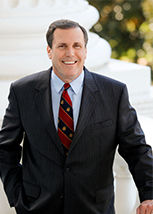
Photo of Scott Wilk
R California Senate · District 21

Sen. Scott Wilk

Contact Email
Compare
Total votes
25,318
all sessions
Attendance
96%
859 missed
Near the chamber average
With party
95%
of cast votes
Near the chamber average
Bipartisan score
3%
crosses aisle rarely
Near the chamber average
Sponsored
1,250
bills & resolutions
Near the chamber average
Committees
0
assignments
1,250 bills and resolutions

Sponsored bills

Total
1,250
Primary
196
Co-sponsor
1,054
This page
1,250
matching current filters
Primary SB 466
In committee · California Senate · Lead sponsor
Agriculture: environmental farming program.

Existing law, the Cannella Environmental Farming Act of 1995, requires the Department of Food and Agriculture to establish and oversee an environmental farming program to provide incentives to farmers whose practices promote the well-being of ecosystems, air quality, and wildlife and their habitat. The act states the intent of the Legislature, among other things, that environmental laws should be based on the best scientific evidence gathered from public and private sources and that the best scientific evidence should include the net environmental impact provided by agriculture. This bill would make a nonsubstantive change to these provisions.

In committee Feb 3, 2020 0 co-sponsors
Co-sponsor AB 505
Failed · California Assembly · Co-sponsor
Student financial aid: Cal Grant B, Cal Grant C, and federal Pell Grant awards: financial aid book advance program.

Existing federal law establishes the federal Pell Grant Program under Title IV of the federal Higher Education Act of 1965 to provide need-based grant awards to low-income students in order to promote access to postsecondary education. Existing law, known as the Ortiz-Pacheco-Poochigian-Vasconcellos Cal Grant Program, establishes, among other programs, the Cal Grant B program and the Cal Grant C program under the administration of the Student Aid Commission and establishes eligibility requirements for awards under those programs. This bill, beginning with the 2020–21 academic year, would require an institution of higher education, as a condition of its participation in the Cal Grant Program, to implement a financial aid book advance program that would provide a line of credit for the purchase of books and educational materials at bookstores owned by or located on the campus of the institution to each student who is owed a credit balance for certain financial aid awards and who has not opted out of the program. The bill would provide for a reduction in the amount of the award moneys disbursed to the student based upon the amount of credit expended by the student at the institution's bookstores and would provide for reimbursement to the institution's bookstores for that amount. The bill would exempt from these requirements an institution that does not have a bookstore and an institution that provides its students with all of their financial aid award moneys that the institution disburses on or before the 7th day of the academic semester or term.

Failed Feb 3, 2020 1 co-sponsor
Primary SB 624
In committee · California Senate · Lead sponsor
Qualified medical supplies providers: sales taxes: repayment.

Existing state sales and use tax laws impose a tax on retailers measured by gross receipts on the sale of tangible personal property sold at retail in this state, or on the storage, use, or other consumption in this state of tangible personal property purchased from a retailer for storage, use, or other consumption in this state. This bill would provide a procedure for a qualified medical supplies provider to submit a claim for qualified repayments, as defined, with the California Department of Tax and Fee Administration, as provided. The bill would define a qualified medical supplies provider to mean a pharmacy or durable medical equipment provider enrolled in Medi-Cal who, among other things, paid sales taxes imposed under the Sales and Use Tax Law and the California Constitution for sales of medical supplies or equipment furnished to Medi-Cal beneficiaries occurring during the period beginning June 1, 2011, and before November 1, 2013, for which a portion of payments from Medi-Cal for those sales, which included applicable sales tax reimbursement, was paid back to the State Department of Health Care Services by the pharmacy or durable medical equipment provider due to the reduction of Medi-Cal payment by specified law. This bill would, on or before March 1, 2021, require the California Department of Tax and Fee Administration to pay the amount of qualified repayments to each qualified medical supplies provider, and would appropriate $1,000,000 from the General Fund to the department to make the payments of qualified repayments. The bill would provide that the total amount of money available to make qualified repayments shall not exceed the aggregate amount paid to the State Department of Health Care Services, as described above. This bill would make findings regarding the public purpose served by the bill. This bill would declare that it is to take effect immediately as an urgency statute.

In committee Feb 3, 2020 0 co-sponsors
Co-sponsor AB 192
Failed · California Assembly · Co-sponsor
California Integrated Community Living Program.

Existing law, the Lanterman Developmental Disabilities Services Act (Lanterman Act) , establishes the State Department of Developmental Services, which is responsible for providing various services and supports to persons with developmental disabilities, and for ensuring the appropriateness and quality of those services and supports. The Lanterman Act requires the department to enter into contracts with private nonprofit corporations to operate regional centers, which are required to provide, or arrange for the provision of, services and supports for persons with developmental disabilities. Under existing law, the state is responsible for developing and implementing a statewide program encouraging the establishment of sufficient numbers and types of living arrangements, both in communities and state hospitals, as necessary, to meet the needs of persons with disabilities. Existing law establishes the Department of Housing and Community Development (DHCD) in the Business, Consumer Services, and Housing Agency. The DHCD is responsible for administering various housing and home loan programs throughout the state. This bill would establish the California Integrated Community Living Program in the State Department of Developmental Services. The program would provide deferred payment loans to finance capital and other specified costs for permanent supportive housing for individuals who are regional center clients in order to maximize affordable integrated community living opportunities within communities for people with intellectual and developmental disabilities. The bill would require the department and the DHCD to enter into an interagency agreement to administer the Integrated Community Living Program Fund, which would be created by, and continuously appropriated to the department for the purposes described in, the bill. The bill would prescribe the moneys to be deposited into the fund, including all moneys received by the department through the sale, lease, or other revenue-generating agreement for any state developmental center property, except as specified. The bill would prohibit moneys in the fund from being used to supplant or backfill any existing program budget within either department. By creating a continuously appropriated fund, the bill would make an appropriation. The bill would require the department to convene an advisory committee to advise and assist in establishing funding priorities, with an emphasis on funding priorities for this program, as specified. This bill would require the department, in consultation with the DHCD, to develop and administer a competitive application process to award funding for loans under the bill, as specified. The bill would require the department, in consultation with the DHCD, to distribute funds in a manner that maximizes access to low-income housing tax credit program projects for the target population, and that also incentivizes development of creative permanent supportive housing projects outside of that program, as specified. The bill also would require the department, in consultation with the DHCD, to adopt guidelines establishing income and rent standards for potential residents of properties funded under the program, including standards based solely on federal Supplemental Security Income. The bill would require the department and the DHCD to develop community integration criteria to set the maximum percentage of apartment units reserved for persons with intellectual or developmental disabilities within specified program projects, and to stipulate community integration standards for small projects.


Failed Feb 3, 2020 1 co-sponsor
Co-sponsor AB 536
Failed · California Assembly · Co-sponsor
Developmental services.

Existing law, the Lanterman Developmental Disabilities Services Act, requires the State Department of Developmental Services to contract with regional centers to provide services and supports to individuals with developmental disabilities and their families, and requires regional centers to identify and pursue all possible sources of funding for consumers receiving those services. Existing law defines a "developmental disability" as a disability that originates before an individual attains 18 years of age, continues, or can be expected to continue, indefinitely, and constitutes a substantial disability for the individual. This bill would modify that definition to mean a disability that originates before an individual attains 22 years of age, continues, or can be expected to continue, indefinitely, and constitutes a substantial disability for the individual. The bill would make various technical and nonsubstantive changes.

Failed Feb 3, 2020 1 co-sponsor
Co-sponsor AB 55
Failed · California Assembly · Co-sponsor
Department of Veterans Affairs: veterans' services.

Existing law requires the Department of Veterans Affairs to disburse funds, appropriated to the department for the purpose of supporting county veterans service officers pursuant to the annual Budget Act, on a pro rata basis, to counties that have established and maintain a county veterans service officer in accordance with the staffing level and workload of each county veterans service officer under a formula based upon performance developed by the department. This bill would define a workload unit for purposes of these provisions to mean a specific claim activity that is used to allocate subvention funds to counties, which is approved by the department, and performed by county veterans service officers. The bill would appropriate on an annual basis the sum of $11,000,000 from the General Fund to the Department of Veterans Affairs to be available for allocation to counties to fund the activities of county veterans service officers, as specified. The bill would also delete obsolete provisions and would make conforming changes. This bill would declare that it is to take effect immediately as an urgency statute.

Failed Feb 3, 2020 1 co-sponsor
Co-sponsor AB 461
Failed · California Assembly · Co-sponsor
Vehicles: renewal of registration.

Existing law authorizes the Department of Motor Vehicles to renew the registration of a vehicle upon the application of the owner and the payment of applicable fees. Existing law imposes penalties for a late registration renewal application and the late payment of registration fees. This bill would require the department to provide an indigent person, as defined, with a payment plan option that allows the person to apply for renewal of registration any time after enrolling in the payment plan and pay any outstanding fees in monthly installments. For persons enrolled in a payment plan, the bill would waive specified late penalties and suspend wage garnishments, bank levies, or offsets for the collection of delinquent registration fees and would allow a person who becomes delinquent on a payment plan one 45-day extension to resume payments. The bill would require the department to develop options for submitting an application for the payment plan, including online or by mail. Existing law requires an owner who does not wish to renew the registration of a vehicle to certify that the vehicle will not be operated, moved, or left standing upon a highway unless the owner first applies for registration of the vehicle and pays the applicable fees, except as provided, and imposes penalties for the late filing of this certification. This bill would require the department to allow an indigent person, whether or not enrolled in the payment plan described above, to file this certification regardless of any fees or late penalties owed for the vehicle. Existing law authorizes peace officers or specified public employees engaged in directing traffic or enforcing parking laws to remove a vehicle in various circumstances, including if the vehicle is found or operated upon a highway, public land, or an offstreet parking facility with a registration expiration date in excess of 6 months before the date it is found or operated, and to impound the vehicle until the owner or person in control of the vehicle provides proof of current registration and other specified information. This bill would prohibit a parked vehicle from being removed due to an expired registration, as described above, unless a notice containing specified information is affixed to the vehicle at least 7 days before the vehicle is removed. By requiring local authorities to provide notice before removing a vehicle due to an expired registration, the bill would impose a state-mandated local program. The California Constitution requires the state to reimburse local agencies and school districts for certain costs mandated by the state. Statutory provisions establish procedures for making that reimbursement. This bill would provide that, if the Commission on State Mandates determines that the bill contains costs mandated by the state, reimbursement for those costs shall be made pursuant to the statutory provisions noted above.

Failed Feb 3, 2020 1 co-sponsor
Co-sponsor AB 200
Failed · California Assembly · Co-sponsor
State veterans cemeteries: Hmong veterans.

Existing law authorizes the Department of Veterans Affairs to design, develop, and construct state-owned and state-operated veterans cemeteries, as specified, in northern, southern, and central California. Existing law makes honorably discharged veterans, their spouses, and dependent children eligible for internment in those cemeteries, as specified. This bill would additionally authorize the remains of a person to be buried in those cemeteries if the person was naturalized pursuant to the federal Hmong Veterans' Naturalization Act of 2000, as specified, and resided in the State of California at the time of the person's death.

Failed Feb 3, 2020 1 co-sponsor
Co-sponsor AB 154
Failed · California Assembly · Co-sponsor
Public postsecondary education: income share agreement: pilot program.

The Donahoe Higher Education Act provides for a public postsecondary education system in this state. This system consists of the University of California, the California State University, and the California Community Colleges. The act applies to the University of California only to the extent that the Regents of the University of California act by resolution to make it applicable. This bill would require the California State University and, as a condition of receipt of funds appropriated for purposes of the bill's provisions, the University of California to each select a campus of their respective system to establish, commencing with the 2021–22 academic year, a pilot program for participating students to enter into an income share agreement with the campus. These agreements would specify that moneys for the pilot program would be provided to students for costs of attendance, with students agreeing to pay a portion of their future incomes in exchange. The bill would provide that the period of repayment shall not exceed 10 years, unless extended by up to 60 months under specified circumstances, and shall commence 6 months after the student is no longer enrolled full-time in an accredited college program. The bill would require the income share agreement to be subject to specified requirements, including, among others, that the agreement provide for monthly payments to be based on a specified percentage of the student's annual income. The bill would require the pilot program to be open to students in their sophomore, junior, or senior year, and would authorize the campus to impose other eligibility requirements and cap the number of participants based on the amount of moneys appropriated for the pilot program. The bill would require that implementation of the pilot program be contingent upon the appropriation of funds for this purpose in the annual Budget Act or another statute. The bill would require each participating campus to submit a report no later than November 1, 2023, and a 2nd report no later than November 1, 2026, to the appropriate policy and fiscal committees of the Legislature containing specified information about the pilot program.

Failed Feb 3, 2020 1 co-sponsor
Primary SB 437
In committee · California Senate · Lead sponsor
Personal income taxes: qualified commuter credit.

The Personal Income Tax Law allows various credits against the taxes imposed by that law. This bill, for each taxable year beginning on or after January 1, 2020, would allow a credit against those taxes to qualified commuters in an amount equal to $500 for spouses filing joint returns, if both spouses are qualified commuters, as defined, and $250 for other specified taxpayers who are qualified commuters. The bill would restrict eligibility for the credit to taxpayers with specified incomes. The bill would require, for a taxpayer with an allowable credit in excess of tax liability, a payment from the Tax Relief and Refund Account, a continuously appropriated account, to the taxpayer equal to the amount of the allowable credit that is in excess of tax liability, as provided. By authorizing additional payments from this account, the bill would make an appropriation.

In committee Feb 3, 2020 0 co-sponsors
Showing 321 to 330 of 1,250 bills
Previous 1 … 32 33 34 … 125 Next