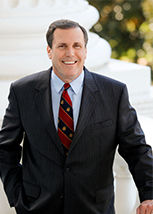
Photo of Scott Wilk
R California Senate · District 21

Sen. Scott Wilk

Contact Email
Compare
Total votes
25,318
all sessions
Attendance
96%
859 missed
Near the chamber average
With party
95%
of cast votes
Near the chamber average
Bipartisan score
3%
crosses aisle rarely
Near the chamber average
Sponsored
1,250
bills & resolutions
Near the chamber average
Committees
0
assignments
1,250 bills and resolutions

Sponsored bills

Total
1,250
Primary
196
Co-sponsor
1,054
This page
1,250
matching current filters
Primary SB 901
In committee · California Senate · Lead sponsor
Hospitals: seismic safety.

Existing law, the Alfred E. Alquist Hospital Facilities Seismic Safety Act of 1983, establishes a program of seismic safety building standards for certain hospitals. Existing law requires hospitals with buildings subject to a seismic compliance deadline of January 1, 2020, and that are seeking an extension for their buildings to submit an application to the Office of Statewide Health Planning and Development by April 1, 2019, subject to certain exceptions. Existing law requires final seismic compliance be achieved by July 1, 2022, if the compliance is based on a replacement or retrofit plan, or by January 1, 2025, if the compliance is based on a rebuild plan. This bill would make technical, nonsubstantive changes to those provisions.

In committee Feb 12, 2020 0 co-sponsors
Co-sponsor SB 925
In committee · California Senate · Co-sponsor
Mobile telephony service base transceiver station towers: performance reliability standards.

Under existing law, the Public Utilities Commission has regulatory authority over public utilities, including telephone corporations. Existing law requires the commission to develop and implement performance reliability standards for backup power systems installed on the property of residential and small commercial customers by a facilities-based provider of telephony services upon determining that the benefits of the standards exceed the costs. This bill would require the commission, in consultation with the Office of Emergency Services, to develop and implement performance reliability standards, as specified, for all mobile telephony service base transceiver station towers, commonly known as "cell towers." Under existing law, a violation of the Public Utilities Act or any order, decision, rule, direction, demand, or requirement of the commission is a crime. Because the provisions of this bill would be a part of the act and because a violation of an order or decision of the commission implementing its requirements would be a crime, the bill would impose a state-mandated local program by creating a new crime. The California Constitution requires the state to reimburse local agencies and school districts for certain costs mandated by the state. Statutory provisions establish procedures for making that reimbursement. This bill would provide that no reimbursement is required by this act for a specified reason.

In committee Feb 12, 2020 1 co-sponsor
Co-sponsor SCA 7
Introduced · California Senate · Co-sponsor
A resolution to propose to the people of the State of California an amendment to the Constitution of the State, by amending Section 14 of Article II, Section 8 of Article III, Section 18 of Article IV, Section 14 of Article V, Section 10 of Article VII, Section 1 of Article XII, and Sections 1 and 2 of Article XXI, thereof, relating to the Public Utilities Commission.

The California Constitution establishes the Public Utilities Commission, with jurisdiction over all public utilities. Under the California Constitution, the commission consists of 5 members appointed by the Governor and approved by the Senate, a majority of the membership concurring, for staggered 6-year terms. This measure would provide that the commission instead consists of 4 members elected from distinct Public Utilities Commission districts for staggered 4-year terms. The measure would subject members of the commission to certain provisions of the California Constitution that are applicable to other state officers, including those provisions related to recall, compensation, impeachment, conflicts of interest, elections, and redistricting.

Introduced Feb 12, 2020 1 co-sponsor
Primary SB 887
In committee · California Senate · Lead sponsor
School districts: governing boards.

Existing law establishes the system of public elementary and secondary schools in this state, and provides for their funding and governance. Existing law establishes school districts throughout the state to administer the public elementary and secondary schools within their respective jurisdictions. Existing law requires that every school district be under the control of a board of school trustees or a board of education and requires the governing board of each school district to prescribe and enforce rules not inconsistent with the law, or with the rules prescribed by the State Board of Education, for its own government. This bill would make nonsubstantive changes to the latter provision.

In committee Feb 6, 2020 0 co-sponsors
Co-sponsor SB 881
In committee · California Senate · Co-sponsor
Worker status: independent contractors: musicians and music industry professionals.

Existing law, as established in the case of Dynamex Operations W. v. Superior Court (2018) 4 Cal.5th 903 (Dynamex) , creates a presumption that a worker who performs services for a hirer is an employee for purposes of claims for wages and benefits arising under wage orders issued by the Industrial Welfare Commission. Existing law requires a 3-part test, commonly known as the "ABC" test, to determine if workers are employees or independent contractors for purposes of specified wage orders. Existing law establishes that, for purposes of the Labor Code, the Unemployment Insurance Code, and the wage orders of the Industrial Welfare Commission, a person providing labor or services for remuneration is considered an employee rather than an independent contractor unless the hiring entity demonstrates that the person is free from the control and direction of the hiring entity in connection with the performance of the work, the person performs work that is outside the usual course of the hiring entity's business, and the person is customarily engaged in an independently established trade, occupation, or business. This test is commonly known as the "ABC" test. Existing law charges the Labor Commissioner with the enforcement of labor laws, including worker classification. Existing law exempts specified occupations and business relationships from the application of Dynamex and these provisions. Existing law instead provides that these exempt relationships are governed by the test adopted in S. G. Borello & Sons, Inc. v. Department of Industrial Relations (1989) 48 Cal.3d 341. This bill would expand the above-described exemptions to also include a musician or music industry professional, except as specified.


In committee Feb 6, 2020 1 co-sponsor
Co-sponsor SB 238
died · California Senate · Co-sponsor
Worker status: factors for determination of employee status.

Existing law, as established in the case of Dynamex Operations W. v. Superior Court (2018) 4 Cal.5th 903 (Dynamex) , creates a presumption that a worker who performs services for a hirer is an employee. Existing law requires a 3-part test, commonly known as the "ABC" test, to establish that a worker is an independent contractor for purposes of claims for wages and benefits arising under wage orders issued by the Industrial Welfare Commission. This bill would instead, for purposes of claims for wages and benefits arising under wage orders, analyze whether the worker is economically dependent upon the hiring entity to determine whether that worker is an employee based upon the economic reality of the relationship with the hiring entity. The bill would require this analysis to be based solely upon enumerated factors that are similar to those used as a part of the Economic Realities Test in the federal Fair Labor Standards Act of 1938. This bill would provide legislative findings and declarations in support of these provisions, and would state in the findings and declarations that it is the intent of the Legislature that the test under these provisions be applied retroactively to claims filed on and after April 30, 2018.

died Feb 4, 2020 1 co-sponsor
Primary SB 553
died · California Senate · Lead sponsor
Public contracts: bid preference: ESOPs.

The State Contract Act governs state contracts for public works projects and generally requires that a contract be rewarded to the lowest responsible bidder. Under the act, projects not under the jurisdiction of the Department of Water Resources, the Department of Parks and Recreation, the Department of Corrections and Rehabilitation, the Department of Transportation, the High-Speed Rail Authority, or the Military Department are under the sole charge and direct control of the Department of General Services. This bill would require an entity awarding a contract pursuant to the act to provide a 3% bid preference to a qualified ESOP bidder, as defined.

died Feb 3, 2020 0 co-sponsors
Primary SB 170
In committee · California Senate · Lead sponsor
School districts: governing boards.

Existing law establishes the system of public elementary and secondary schools in this state, and provides for their funding and governance. Existing law establishes school districts throughout the state to administer the public elementary and secondary schools within their respective jurisdictions. Existing law requires that every school district be under the control of a board of school trustees or a board of education and requires the governing board of each school district to prescribe and enforce rules not inconsistent with the law, or with the rules prescribed by the State Board of Education, for its own government. This bill would make nonsubstantive changes to the latter provision.

In committee Feb 3, 2020 0 co-sponsors
Primary SB 186
In committee · California Senate · Lead sponsor
California State University: terms of employment.

Existing law establishes the California State University and provides for its administration by the Trustees of the California State University. Existing law requires the trustees to provide by rule for the government of their appointees and employees. This bill would make nonsubstantive changes to that requirement.

In committee Feb 3, 2020 0 co-sponsors
Primary SB 261
In committee · California Senate · Lead sponsor
Office of Emergency Services.

The California Emergency Services Act, among other things, establishes the Office of Emergency Services for the purpose of mitigating the effects of natural, manmade, or war-caused emergencies and makes findings and declarations relating to ensuring that preparation within the state will be adequate to deal with those emergencies. This bill would make nonsubstantive changes to these provisions.

In committee Feb 3, 2020 0 co-sponsors
Showing 311 to 320 of 1,250 bills
Previous 1 … 31 32 33 … 125 Next