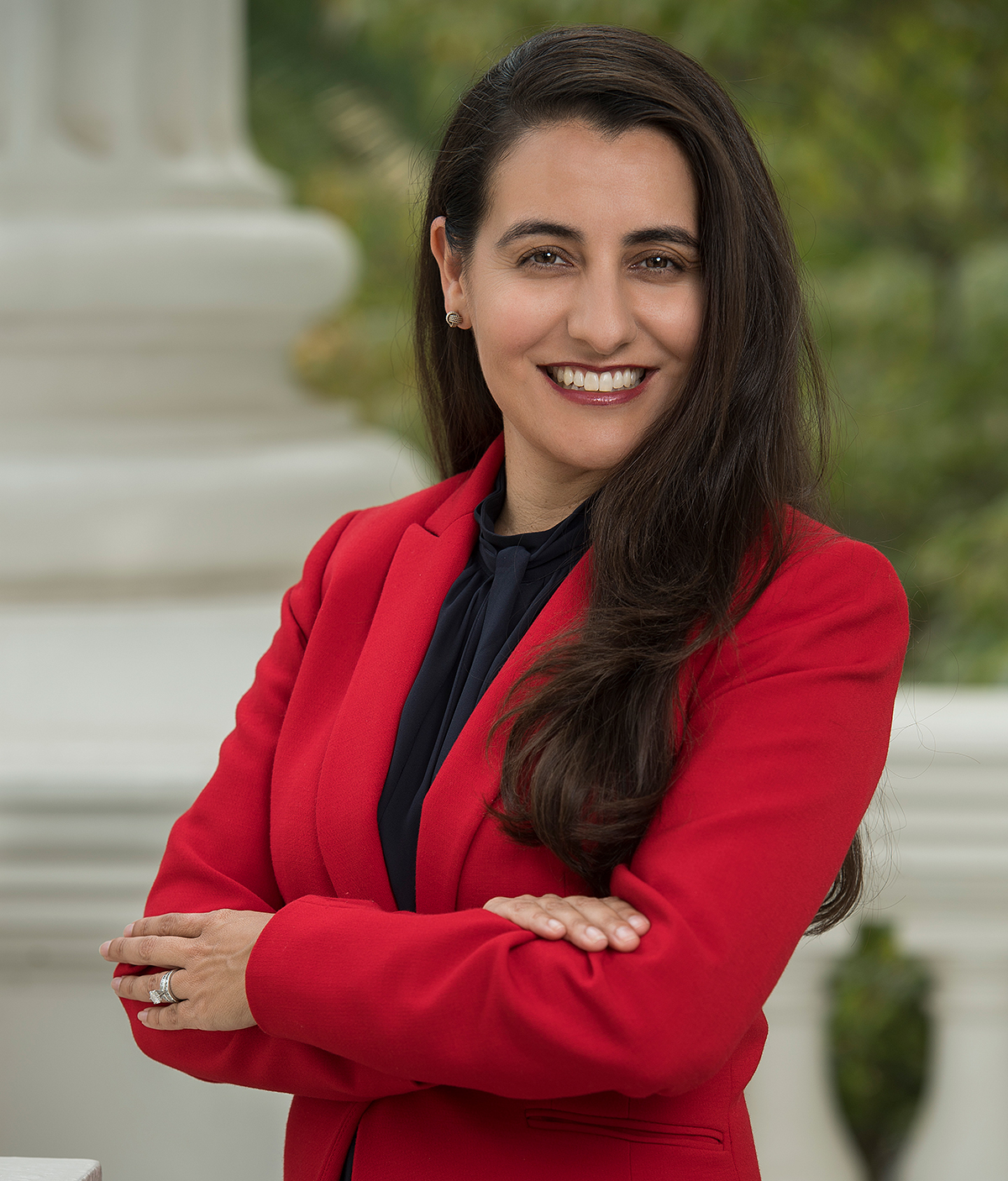
Photo of Monique Limón
D California Senate · District 21

Sen. Monique Limón

Compare
Total votes
20,781
all sessions
Attendance
92%
1,339 missed
Near the chamber average
With party
99%
of cast votes
Near the chamber average
Bipartisan score
0%
crosses aisle rarely
Near the chamber average
Sponsored
1,106
bills & resolutions
Near the chamber average
Committees
4
assignments
1,106 bills and resolutions

Sponsored bills

Total
1,106
Primary
238
Co-sponsor
868
This page
1,106
matching current filters
Co-sponsor SR 114
Passed · California Senate · Co-sponsor
Relative to President Joseph Biden.

Maddy summarySenate Resolution 114 is a non-binding tribute from the California State Senate honoring President Joseph Biden for his extensive public service career. The resolution details his background, legislative achievements, and leadership roles as a senator, vice president, and president, specifically highlighting his work on infrastructure, climate action, and pandemic response. It concludes by formally thanking the President for stepping down to allow new leaders to take office and directs the Senate Secretary to distribute copies of the resolution.

Passed Aug 15, 2024 1 co-sponsor
Primary SB 1433
Passed · California Senate · Lead sponsor
Gravity-Based Energy Storage Well Pilot Program.

Existing law requires the State Oil and Gas Supervisor to supervise the drilling, operation, maintenance, and abandonment of wells so as to prevent damage to life, health, property, and natural resources, damage to underground oil and gas deposits from infiltrating water and other causes, loss of oil, gas, or reservoir of energy, and damage to underground and surface waters suitable for irrigation or domestic purposes by the infiltration of, or the addition of, detrimental substances. Existing law defines "wells" to mean oil or gas wells or other wells related to oil or gas production. Under existing law, a person who fails to comply with the requirements relating to the regulation of wells is guilty of a misdemeanor. This bill would, until January 1, 2034, establish the Gravity-Based Energy Storage Well Pilot Program and would authorize the supervisor to authorize the conversion of not more than 1,000 wells for use as gravity-based energy storage wells, as defined, to evaluate their use, including the establishment of appropriate operating conditions and physical parameters to safely generate energy. The bill would require idle wells that are authorized for use as gravity-based energy storage wells to be identified as gravity-based energy storage wells in a plan or updates to the plan required to be filed with the supervisor. The bill would require the mechanical integrity of gravity-based energy storage wells to be assessed by the Geologic Energy Management Division not less than annually. The bill would require an operator of a gravity-based energy storage well, in the event of a loss of mechanical integrity of the well or a leak to the environment, to notify the division, the State Air Resources Board, the appropriate regional water quality control board, and schools and community members within 3,200 feet of the well. The bill would require gravity-based energy storage wells to be continuously monitored for fluid leaks. The bill would specify that the authorization for wells to be used as gravity-based energy storage wells end at the termination of the pilot program. The bill would, by January 1, 2032, require the Secretary for Environmental Protection, in consultation with certain entities, to evaluate the pilot program and make recommendations to the Legislature for a framework to implement an ongoing Gravity-Based Energy Storage Well Program to regulate the operation of gravity-based energy storage wells. Because a violation of the requirements of the Gravity-Based Energy Storage Well Pilot Program would be a crime, this bill would impose a state-mandated local program. This bill would prohibit the supervisor from authorizing or allowing the use of a well or hydrocarbon reservoir for any purpose other than provided for in law. The California Constitution requires the state to reimburse local agencies and school districts for certain costs mandated by the state. Statutory provisions establish procedures for making that reimbursement. This bill would provide that no reimbursement is required by this act for a specified reason.

Passed Aug 15, 2024 0 co-sponsors
Co-sponsor SB 980
Passed · California Senate · Co-sponsor
The Smile Act.

Existing law establishes the Medi-Cal program, which is administered by the State Department of Health Care Services and under which qualified low-income individuals receive health care services, including certain dental services. The Medi-Cal program is, in part, governed and funded by federal Medicaid program provisions. Under existing law, early and periodic screening, diagnostic, and treatment (EPSDT) services are covered under Medi-Cal for an individual under 21 years of age in accordance with certain federal provisions. Under existing law, for persons 21 years of age or older, laboratory-processed crowns on posterior teeth are a covered benefit when medically necessary to restore a posterior tooth back to normal function based on the criteria specified in the Medi-Cal Dental Manual of Criteria. This bill, The Smile Act, for purposes of the above-described Medi-Cal coverage for laboratory-processed crowns, would remove the condition that the tooth be posterior and would apply the coverage to persons 13 years of age or older. The bill would also add, as a covered Medi-Cal benefit for persons of any age, subject to prior authorization, a dental implant if tooth extraction or removal is medically necessary or if the corresponding tooth is missing. The bill would condition this coverage on there being no other covered functional alternatives for prosthetic replacement to correct the person's dental condition, as specified, on the person being without medical conditions for which dental implant surgery would be contraindicated, on receipt of any necessary federal approvals, and on the availability of federal financial participation. Under the bill, the above-described provisions would not be construed to exclude Medi-Cal coverage for laboratory-processed crowns on teeth or dental implants if otherwise required under EPSDT services.

Passed Aug 15, 2024 1 co-sponsor
Co-sponsor SCR 160
Signed into law · California Senate · Co-sponsor
Relative to California Wine Month.

Maddy summaryThis bill officially designates September 2024 as California Wine Month to honor the state's wine industry. It directly affects wineries, grape growers, and related businesses by celebrating their economic and cultural contributions. The measure uses a formal resolution to proclaim the month, highlighting the industry's role in jobs, tourism, and sustainability. No new laws or regulations are created; the change is purely symbolic and commemorative.

Signed into law Aug 13, 2024 1 co-sponsor
Primary SB 380
Passed · California Senate · Lead sponsor
California state preschool programs: age of eligibility.

Existing law, the Early Education Act, among other things, requires the Superintendent of Public Instruction to administer all California state preschool programs, including, but not limited to, part-day and full-day age and developmentally appropriate programs for 3- and 4-year-old children. Existing law requires the State Department of Education, in collaboration with the State Department of Social Services, to implement a reimbursement system plan that establishes reasonable standards and assigned reimbursement rates, which vary with the length of the program year and the hours of service, for California state preschool program contractors, as provided. Existing law requires each applicant or contracting agency to give priority for part-day and full-day California state preschool programs according to a specified priority order. Existing law establishes adjustment factors applicable to the reimbursement a contractor receives in order to reflect the additional expense of serving full-day and part-day preschool children who meet certain criteria and requires the adjustment factor for children who are 47 months or younger to be 1.8, as provided. This bill, until July 1, 2027, would authorize, but not require, a California state preschool contractor operating a part-day, full-day, or both part- and full-day California state preschool program to enroll interested eligible 2-year-old children, as defined, and would make conforming changes. The bill, on or after July 1, 2027, would prohibit a contractor from serving any 2-year-old children, unless the contractor was serving those 2-year-old children before July 1, 2027. The bill, until July 1, 2027, would instead require the adjustment factor for 2-year-old and 3-year-old children to be 1.8 and would require the State Department of Education to ensure that the rate that contractors receive for 2-year-old children in each county for each setting and time base type is no less than the rate provided for children of the same age served in general child care and development programs, as provided.

Passed Aug 7, 2024 0 co-sponsors
Primary SB 1189
Signed into law · California Senate · Lead sponsor
County Employees Retirement Law of 1937: county board of retirement.

The County Employees Retirement Law of 1937 (CERL) authorizes counties to establish retirement systems pursuant to its provisions in order to provide pension benefits to their employees. CERL authorizes the board of retirement to appoint a retirement administrator, chief financial officer, chief operations officer, chief investment officer, and general counsel. This bill would also authorize the board to appoint a chief technology officer.

Signed into law Jul 15, 2024 0 co-sponsors
Primary SB 948
Signed into law · California Senate · Lead sponsor
Political Reform Act of 1974: contribution limitations.

(1) The Political Reform Act of 1974 authorizes a candidate for elective state, county, or city office to raise contributions for a general election before the primary election, and for a special general election before a special primary election, for the same office under specified conditions. If the candidate is defeated in the primary election or special primary election, or otherwise withdraws from the general election or special general election, the act requires the candidate to refund the general election or special general election funds, as specified. This bill would clarify that a candidate who does not file a declaration of candidacy to qualify for a primary election or special primary election is not subject to these requirements to refund the general election or special general election contributions, and that such a candidate may transfer these funds to a committee for the same or a different office as specified. (2) The act authorizes a candidate to transfer campaign funds from one controlled committee to a controlled committee for elective state, county, or city office of the same candidate, provided that the contributions transferred are attributed to specific contributors. Notwithstanding that provision, the act authorizes a candidate for elective state, county, or city office to carry over contributions raised in connection with one election to pay campaign expenditures incurred in connection with a subsequent election for the same elective office. This bill would permit a candidate who receives a majority of the votes cast for an office at a primary election, such that the candidate is elected to the office without advancing to the general election, to carry over funds raised for the primary election to a committee for any subsequent election to the same office without attributing funds to specific contributors. The bill would also specify that, in that same scenario, a candidate who raises funds for the general election may transfer those funds to a committee for any subsequent election, but that the candidate must attribute those funds to specific contributors pursuant to the requirements of existing law. (3) The Political Reform Act of 1974, an initiative measure, provides that the Legislature may amend the act to further the act's purposes upon a 23 vote of each house of the Legislature and compliance with specified procedural requirements. This bill would declare that it furthers the purposes of the act.

Signed into law Jul 15, 2024 0 co-sponsors
Co-sponsor AB 2608
Signed into law · California Assembly · Co-sponsor
Postsecondary education: sexual violence and sexual harassment: training.

Existing law requires the governing boards of community college districts and the Trustees of the California State University, and requests the Regents of the University of California, to provide, as part of established campus orientations, educational and preventive information on sexual violence and sexual harassment. Existing law, beginning on September 1, 2024, and annually thereafter, requires the California Community Colleges, the California State University, and independent institutions of higher education and private postsecondary educational institutions that receive state financial assistance, and requests the University of California, to annually train students on sexual violence and sexual harassment, and requires that training to include certain topics, including common facts and myths about the causes of sexual violence and sexual harassment. This bill would require the California Community Colleges, the California State University, and independent institutions of higher education and private postsecondary educational institutions that receive state financial assistance, and request the University of California, on or before September 1, 2026, and biennially thereafter, to consider updating the annual sexual violence and sexual harassment training for students. The bill would also require the annual sexual violence and sexual harassment training, beginning on September 1, 2026, to include additional topics, including how to recognize if someone is at risk of alcohol- and drug-facilitated sexual assault. By imposing new duties on community college districts, the bill would impose a state-mandated local program. The California Constitution requires the state to reimburse local agencies and school districts for certain costs mandated by the state. Statutory provisions establish procedures for making that reimbursement. This bill would provide that, if the Commission on State Mandates determines that the bill contains costs mandated by the state, reimbursement for those costs shall be made pursuant to the statutory provisions noted above.

Signed into law Jul 15, 2024 1 co-sponsor
Co-sponsor SB 867
Signed into law · California Senate · Co-sponsor
Safe Drinking Water, Wildfire Prevention, Drought Preparedness, and Clean Air Bond Act of 2024.

The California Drought, Water, Parks, Climate, Coastal Protection, and Outdoor Access For All Act of 2018, approved by the voters as Proposition 68 at the June 5, 2018, statewide primary election, authorizes the issuance of bonds in the amount of $4,100,000,000 pursuant to the State General Obligation Bond Law to finance a drought, water, parks, climate, coastal protection, and outdoor access for all program. Article XVI of the California Constitution requires measures authorizing general obligation bonds to specify the single object or work to be funded by the bonds and further requires a bond act to be approved by a 23 vote of each house of the Legislature and a majority of the voters. This bill would enact the Safe Drinking Water, Wildfire Prevention, Drought Preparedness, and Clean Air Bond Act of 2024, which, if approved by the voters, would authorize the issuance of bonds in the amount of $10,000,000,000 pursuant to the State General Obligation Bond Law to finance projects for safe drinking water, drought, flood, and water resilience, wildfire and forest resilience, coastal resilience, extreme heat mitigation, biodiversity and nature-based climate solutions, climate-smart, sustainable, and resilient farms, ranches, and working lands, park creation and outdoor access, and clean air programs. This bill would declare that it is to take effect immediately as an urgency statute.


Signed into law Jul 3, 2024 1 co-sponsor
Co-sponsor SR 99
Passed · California Senate · Co-sponsor
Relative to the Fourth of July.

Maddy summaryThis Senate Resolution formally recognizes July 4 as Independence Day and encourages Californians to celebrate the occasion with reverence and gratitude. The document highlights the historical significance of the date, noting its role in commemorating American independence and the principles of liberty and democracy. It serves as a symbolic gesture to honor the sacrifices of military service members and the contributions of citizens to the nation. The resolution does not create new laws or change existing policies but rather expresses the Senate's collective sentiment regarding the holiday.

Passed Jul 3, 2024 1 co-sponsor
Showing 141 to 150 of 1,106 bills
Previous 1 … 14 15 16 … 111 Next