

Existing law establishes the Multifamily Housing Program administered by the Department of Housing and Community Development. Existing law requires assistance for projects under the program to be provided in the form of deferred payment loans to pay for eligible costs of specified types of development, as provided. Existing law requires that specified funds appropriated to provide housing for individuals and families who are experiencing homelessness or who are at risk of homelessness and who are inherently impacted by or at increased risk for medical diseases or conditions due to the COVID-19 pandemic or other communicable diseases be disbursed in accordance with the Multifamily Housing Program for specified uses. Existing law exempts these specified funds from the deferred payment loan requirement, as specified. Existing law also requires at least 8 percent of these specified funds to be available for projects serving homeless youth, or youth at risk of homelessness, as defined. This bill would, instead, require that at least 8 percent of the specified funds be available for units, rather than projects, serving homeless youth, or youth at risk of homelessness. The bill would also require that at least one-half of these funds be prioritized for units to house current foster youth between 18 to 21 years of age, inclusive. The bill would prohibit units that house current or former foster youth between 18 to 21 years of age, inclusive, from requiring a referral through the coordinated entry system for a person under juvenile court jurisdiction, as specified. This bill would specify that nonprofit corporations that provide emergency shelter or transitional housing and submit to the department a letter of support from a county, city, or other local public entity, as specified, are eligible to receive grants disbursed for housing projects solely serving homeless youth, youth at risk of experiencing homelessness, or current or former foster youth and would require the department to give preference to applications from those nonprofit corporations, and partner organizations, that have experience providing those direct services.
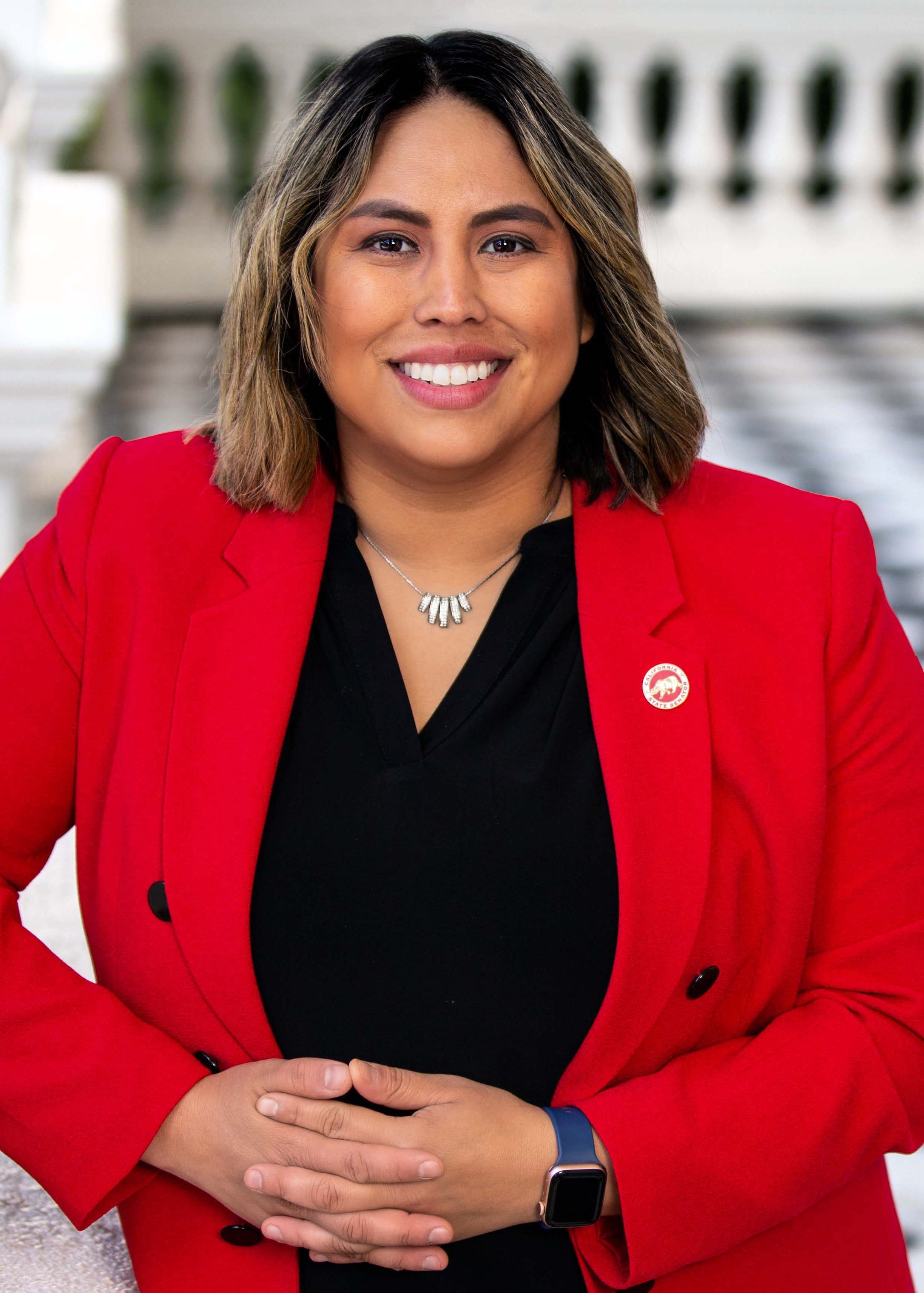
Sen. Caroline Menjivar
Sponsored bills
Existing law, the California Child Day Care Facilities Act, provides for the licensure and regulation of child daycare facilities, daycare centers, and family daycare homes by the State Department of Social Services. The act exempts from its provisions certain types of these facilities and certain programs, including, among others, a California state preschool program operated by a local educational agency under contract with the State Department of Education and that meets specified conditions and operates in a school building. Existing law requires the governing board of any school district to, among other things, repair its school property. This bill, the School Extreme Heat Action Plan Act of 2023, would, among other things, require all schoolsites, as defined, the next time outdoor surfaces are resurfaced or replaced at the schoolsite, to replace low specific heat surfaces, such as cement, asphalt, brick, pebbles, sand, aggregates, rubber, and synthetic turf, with high specific heat surfaces, such as cool pavement technologies, natural grass, shrubs, trees, wood chips, or other natural systems that mitigate heat and pollution, as provided. The bill would require all schoolsite decisionmaking personnel involved in the replacement or resurfacing of outdoor surfaces at a schoolsite to be trained in extreme heat mitigation measures. By imposing additional duties on local educational entities, the bill would impose a state-mandated local program. This bill would require the State Department of Education, in consultation with the State Department of Social Services, as appropriate, to develop a template for an extreme heat action plan to be used by schoolsites, and to make a model program guidebook available to schoolsites and establish a process for systematically updating the guidebook and supporting documentation. The bill would require the State Department of Social Services to identify a liaison for child daycare facilities, as defined, for these purposes. This bill would, on or before January 1, 2025, require all schoolsites, as defined, to develop an extreme heat action plan, as specified. The bill would require the plan to address the installation or planting of (1) shade trees or mini-forests, positioned on schoolsites where pupils can access them when in attendance, (2) school garden infrastructure and plantings, and (3) green barriers between the schoolsite and any adjacent high-polluting streets or commercial projects. By imposing additional duties on local educational entities, the bill would impose a state-mandated local program. This bill would also require, on or before January 1, 2027, schoolsites to begin implementation of their extreme heat action plan. The bill would make implementation of the plan contingent upon appropriation by the Legislature. By imposing additional duties on local educational entities, the bill would impose a state-mandated local program. The California Constitution requires the state to reimburse local agencies and school districts for certain costs mandated by the state. Statutory provisions establish procedures for making that reimbursement. This bill would provide that, if the Commission on State Mandates determines that the bill contains costs mandated by the state, reimbursement for those costs shall be made pursuant to the statutory provisions noted above.
Existing law authorizes a minor 15 years of age or older to consent to the minor's medical care or dental care, if the minor is living separate and apart from the minor's parents or guardian and the minor is managing their own financial affairs, as specified. Existing law authorizes a physician and surgeon or dentist, with or without the minor's consent, to advise the minor's parent or guardian of the treatment given or needed if the physician and surgeon has reason to know the parent's or guardian's whereabouts, based on information given by the minor. Under existing law, a parent or guardian is not liable for care provided according to these provisions. This bill additionally would authorize minors to consent to their own vision care, and would authorize an optometrist to advise a minor's parent or guardian of the care given or needed, under the same conditions applicable to the provision of medical care and dental care. The bill would define "vision care" as the diagnosis, prevention, treatment, and management of disorders, diseases, and dysfunctions of the visual system and the provision of habilitative or rehabilitative optometric services by a licensed optometrist, as specified.
The California Urban Forestry Act of 1978 has a purpose of, among other things, promoting the use of urban forest resources for purposes of increasing integrated projects with multiple benefits in urban communities. The act requires the Department of Forestry and Fire Protection to implement a program in urban forestry to encourage better tree management and planting in urban areas to increase integrated, multiple-benefit projects by assisting urban areas with innovative solutions to problems, as provided. The act authorizes the Director of Forestry and Fire Protection to make grants to provide assistance of 25% to 90% of costs for projects, as provided. This bill would require funds appropriated or allocated to the department for the bill's purposes to be administered to support school greening, as defined, by providing grants to eligible local educational agencies, as defined, nonprofit organizations, cities, counties, and districts, including special districts, through a competitive grant process that the bill would require the department to develop, including guidelines and selection criteria, as specified, on or before July 1, 2024. The bill would require the department, before developing the grant process, to hold at least 2 public hearings to gather public input on the grant process development. The bill would, upon appropriation in the annual Budget Act, require funding for these purposes to be transferred to the School Greening and Resiliency Fund, which the bill would establish in the State Treasury.
Existing federal law provides for allocation of federal funds through the federal Temporary Assistance for Needy Families (TANF) block grant program to eligible states. Existing law provides for the California Work Opportunity and Responsibility to Kids (CalWORKs) program under which, through a combination of state and county funds and federal funds received through the TANF program, each county provides cash assistance and other benefits, including allowances for other purposes such as pregnancy, homeless assistance, and recurring special needs, to qualified low-income families. This bill would, beginning April 1, 2025, make a menstruating person who is qualified for aid under the CalWORKs program and between 10 and 55 years of age, inclusive, entitled to $20 per month to assist with menstrual product costs. The bill would require the State Department of Social Services to work with the County Welfare Directors Association of California and the California Statewide Automated Welfare System (CalSAWS) to develop and implement the necessary system changes on or before April 1, 2025. By increasing the duties of counties administering the CalWORKs program, the bill would impose a state-mandated local program. Existing law continuously appropriates moneys from the General Fund to defray a portion of county costs under the CalWORKs program. This bill would instead provide that the continuous appropriation would not be made for purposes of implementing the bill. The California Constitution requires the state to reimburse local agencies and school districts for certain costs mandated by the state. Statutory provisions establish procedures for making that reimbursement. This bill would provide that, if the Commission on State Mandates determines that the bill contains costs mandated by the state, reimbursement for those costs shall be made pursuant to the statutory provisions noted above.
This measure would condemn Azerbaijan's blockade of the Republic of Artsakh and urge the United States government and the international community to take action to protect and assist the Armenians of Artsakh.
Existing law establishes the California State University, under the administration of the Trustees of the California State University, as one of the segments of public postsecondary education in the state. The California State University comprises 23 institutions of higher education located throughout the state. This bill would require the trustees to comply with various requirements on mental health counseling at CSU, including having one full-time equivalent California-licensed mental health counselor per 1,500 students enrolled at each CSU campus. The bill, contingent upon appropriation by the Legislature, would establish the CSU Mental Health Professionals Act to provide one-time grants to certain CSU students to become mental health counselors in the state. The bill, contingent upon appropriation by the Legislature, would establish the Mental Health Professionals Fund as the depository of moneys appropriated or otherwise received for the program, and upon appropriation by the Legislature, would require the Department of Health Care Access and Information to disburse moneys in the fund under the act. The bill would define "mental health counselor" for purposes of these provisions.
The California Constitution provides that only a marriage between a man and a woman is valid or recognized in California, and federal law permanently enjoins the state from enforcing this constitutional provision. This measure would repeal this unenforceable constitutional provision and would instead provide that the right to marry is a fundamental right, as specified.
This measure would proclaim June 24, 2023, as Play Day and encourage all Californians to go out and play on that day.