

Existing law requires the State Department of Education to develop resources or, as appropriate, update existing resources for in-service training on schoolsite and community resources for the support of lesbian, gay, bisexual, transgender, queer, and questioning (LGBTQ) pupils, and strategies to increase support for LGBTQ pupils and thereby improve overall school climate. Existing law requires those resources to be designed for use in schools operated by a school district or county office of education and charter schools serving pupils in grades 7 to 12, inclusive. This bill would require the Superintendent of Public Instruction, on or before July 1, 2024, to convene an advisory task force to identify the needs of lesbian, gay, bisexual, transgender, queer, questioning, and plus (LGBTQ+) pupils and to make recommendations to assist in implementing supportive policies and initiatives to address LGBTQ+ pupil education and well-being, as provided. The bill would require advisory task force members to be selected by the Superintendent, as provided. The bill would require the advisory task force to, on or before January 1, 2026, report their findings and recommendations to the Legislature, the Superintendent, and the Governor.
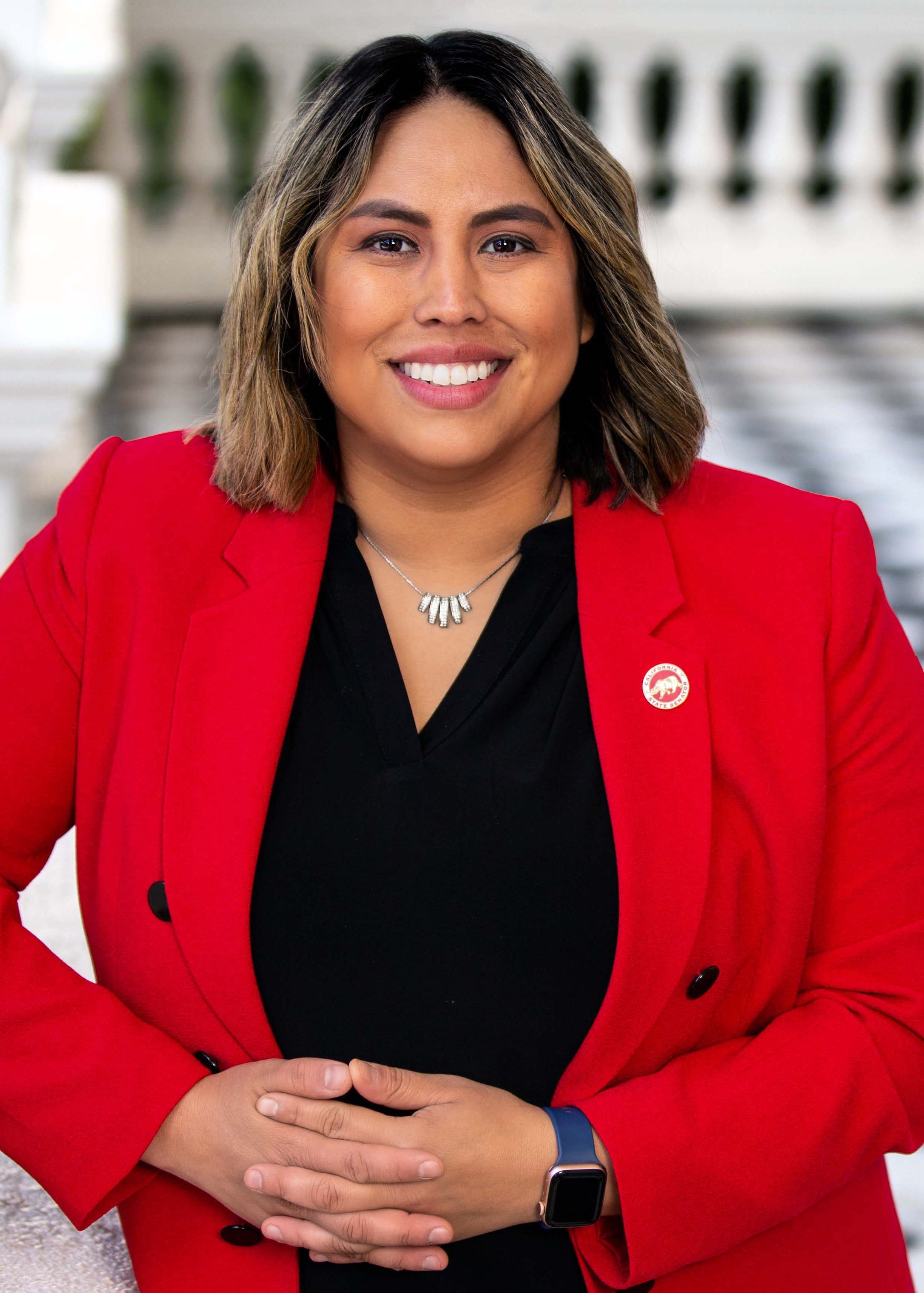
Sen. Caroline Menjivar
Sponsored bills
Existing law requires every restroom of every public and private school maintaining any combination of classes from kindergarten to grade 12, inclusive, to be maintained and cleaned regularly, fully operational, and stocked at all times with toilet paper, soap, and paper towels or functional hand dryers, and kept open during school hours when pupils are not in classes. Existing law requires that a sufficient number of restrooms be kept open during school hours when pupils are in classes. Existing law authorizes a school to temporarily close a restroom as necessary for pupil safety or as necessary to repair the facility. This bill would revise the conditions under which a restroom is authorized to be temporarily closed to instead be as necessary (1) for a documented pupil safety concern, (2) for an immediate threat to pupil safety, or (3) to repair the facility. The bill would require, on or before July 1, 2026, each school district, county office of education, and charter school, including charter schools operating in a school district facility, maintaining any combination of classes from grades 1 to 12, inclusive, to provide and maintain at least one all-gender restroom for voluntary pupil use at each of its schoolsites that meet specified criteria. The bill would require the all-gender restroom to meet certain requirements, including, among other things, that it has signage identifying the bathroom facility as being open to all genders and is unlocked, unobstructed, and easily accessible by any pupil. The bill would require the local educational agency to designate a staff member to serve as a point of contact for these purposes and to post a notice regarding these requirements in a prominent and conspicuous location outside at least one all-gender restroom. The bill would require these requirements to be subject to compliance review, as specified. By imposing additional requirements on local educational agencies, the bill would impose a state-mandated local program. The bill would authorize a local educational agency to use an existing restroom to satisfy these requirements, as provided. The bill would require the State Department of Education to post on its internet website guidance for implementation of these provisions. Existing law, the Leroy F. Greene School Facilities Act of 1998 (the Greene Act) , requires the State Allocation Board to allocate to applicant school districts prescribed per-unhoused-pupil state funding for the construction and modernization of school facilities, including hardship funding, and supplemental funding for site development and acquisition. This bill would require the governing board of a school district, a county board of education, or the governing body of a charter school that applies for state funding pursuant to the Greene Act for a school modernization project to include, as part of the modernization project, an all-gender restroom designed exclusively for pupil use for specified schoolsites, as provided. The bill would provide that these provisions apply only to those projects that are submitted for approval on or after July 1, 2026. The California Constitution requires the state to reimburse local agencies and school districts for certain costs mandated by the state. Statutory provisions establish procedures for making that reimbursement. This bill would provide that, if the Commission on State Mandates determines that the bill contains costs mandated by the state, reimbursement for those costs shall be made pursuant to the statutory provisions noted above.
Existing law establishes the system of public elementary and secondary schools in this state and provides for the establishment of local educational agencies to operate these schools and provide instruction to pupils. Existing law states the policy of the State of California to afford all persons in public schools, regardless of their disability, gender, gender identity, gender expression, nationality, race or ethnicity, religion, sexual orientation, or any other specified characteristic, equal rights and opportunities in the educational institutions of the state. Existing law requires, no later than July 1, 2021, the State Department of Education to develop resources or, as appropriate, update existing resources for in-service training on schoolsite and community resources for the support of lesbian, gay, bisexual, transgender, queer, and questioning (LGBTQ) pupils, and strategies to increase support for LGBTQ pupils, as specified. Existing law encourages schools operated by a school district or county office of education and charter schools to use those resources to provide training at least once every 2 years to teachers and other certificated employees of those schools that serve pupils in grades 7 to 12, inclusive. This bill would require the State Department of Education, on or before July 1, 2025, to finalize the development of an online training delivery platform and an online training curriculum to support LGBTQ cultural competency training for teachers and other certificated employees, as specified. The bill would delete the above-described encouragement and instead would require, commencing with the 2025–26 school year and ending with the completion of the 2029–30 school year, each local educational agency, as defined, serving pupils in grades 7 to 12, inclusive, to use the online training delivery platform and curriculum, or an in-service alternative, to provide at least one hour of required training annually to teachers and other certificated employees at those schools, as provided. The bill would require each local educational agency to maintain records documenting the training, as provided. The bill would require the department to monitor compliance with the training requirement as part of the department's annual compliance monitoring of state and federal programs. The bill would require the department, within 9 months of the completion of the 5-year training period, to report data from that compliance monitoring to the Legislature, and post the report on the department's internet website, as provided. By imposing additional duties on local educational agencies, the bill would impose a state-mandated local program. The bill would require these provisions to be known as the Safe and Supportive Schools Act. This bill would make these requirements inoperative on July 1, 2031, and would repeal them as of January 1, 2032. The California Constitution requires the state to reimburse local agencies and school districts for certain costs mandated by the state. Statutory provisions establish procedures for making that reimbursement. This bill would provide that, if the Commission on State Mandates determines that the bill contains costs mandated by the state, reimbursement for those costs shall be made pursuant to the statutory provisions noted above.
Existing law establishes in the Business, Consumer Services, and Housing Agency the Department of Consumer Affairs. Existing law establishes various boards within the department for the licensure, regulation, and discipline of various professions and vocations. Existing law defines "board" for purposes of the Business and Professions Code to include bureau, commission, committee, department, division, examining committee, program, and agency, unless otherwise expressly provided. This bill would require a board within the Department of Consumer Affairs to update a licensee's or registrant's license or registration by replacing references to the former name or gender on the license or registration, as specified, if the board receives documentation, as described, from the licensee or registrant demonstrating that the licensee or registrant's legal name or gender has been changed. If the board operates an online license verification system, the bill would require the board to replace references to the licensee's or registrant's former name or gender with the individual's current name or gender, as applicable, on the publicly viewable information displayed on the internet. The bill would prohibit a board from publishing the licensee's or registrant's former name or gender online. Instead, the bill would require the board to post an online statement directing the public to contact the board for more information. For specified licensees or registrants, the board would be prohibited from posting enforcement records online, but would be required to post an online statement stating that the individual was previously subject to an enforcement action and directing the public to contact the board, as prescribed. This bill would provide that all records related to a request to update an individual's license or registration under these provisions are confidential and not subject to public inspection or disclosure. The bill would require the board, if requested by a licensee or registrant, to reissue any license created by the board and conferred upon the licensee or registrant. The bill would prohibit a board from charging a higher fee for reissuing a license with an updated legal name or gender than the fee it charges for reissuing a license with other updated information. Existing constitutional provisions require that a statute that limits the right of access to the meetings of public bodies or the writings of public officials and agencies be adopted with findings demonstrating the interest protected by the limitation and the need for protecting that interest. This bill would make legislative findings to that effect.
The measure would apply to the United States Congress to call a constitutional convention under Article V of the Constitution of the United States for the purpose of proposing a constitutional amendment relating to firearms, as specified.
Existing law authorizes a peace officer to make an arrest pursuant to a warrant or without a warrant if, among other circumstances, the officer has probable cause to believe that the person has committed a public offense in the officer's presence. Under existing law, it is unlawful to disobey the lawful order, signal, or direction of a uniformed peace officer performing any duties pursuant to the Vehicle Code or to refuse to submit to any lawful vehicular inspection authorized by the Vehicle Code. Existing case law deems a temporary detention of a person during an automobile stop by the police, even if only for a brief period and for a limited purpose, a seizure, under the Fourth Amendment of the Constitution of the United States, and as such, requires the actions to be reasonable. Under existing case law, the decision to stop an automobile is reasonable if the police have probable cause to believe that a traffic violation has occurred. Existing case law holds that constitutional reasonableness of traffic stops does not depend on the actual motivations of the individual officers involved and that ulterior motives do not invalidate police conduct that is justifiable on the basis of probable cause to believe that a violation of law has occurred. This bill would prohibit a peace officer from stopping or detaining the operator of a motor vehicle or bicycle for a low-level infraction, as defined, unless a separate, independent basis for a stop exists or more than one low-level infraction is observed. The bill would state that a violation of these provisions is not grounds for a defendant to move for return of property or to suppress evidence. The bill would authorize a peace officer who does not have grounds to stop a vehicle or bicycle, but can determine the identity of the owner, to send a citation or warning letter to the owner. The bill would authorize local authorities to enforce a nonmoving or equipment violation of the Vehicle Code through government employees who are not peace officers. This bill would incorporate additional changes to Section 21100 of the Vehicle Code proposed by AB 436 and AB 825 to be operative only if this bill and AB 436, this bill and AB 825, or this bill, AB 436, and AB 825 are enacted and this bill is enacted last.
This measure would proclaim the month of October 2023 as California Firefighter Appreciation Month and October 14, 2023, as California Firefighters Memorial Day.
Existing law requires the Commission on Teacher Credentialing to, among other duties, establish standards for the issuance and renewal of credentials, certificates, and permits. Under existing law, the services credential with a specialization in pupil personnel services authorizes the holder to perform, at all grade levels, the pupil personnel service approved by the commission as designated on the credential, including, among others, in child welfare and attendance services, as provided. Existing law establishes the minimum requirements for the services credential with a specialization in pupil personnel services, which include, among others, completion of a commission-approved program of supervised field experience that includes direct classroom contact, jointly sponsored by a school district and a college or university. This bill would instead require, for a services credential with a specialization in pupil personnel services in the area of child welfare and attendance services, the completion of (1) the above-described college- or university-sponsored supervised field experience requirement or (2) a commission-approved program of professional preparation offered by a local educational agency, as provided.
(1) Existing law imposes ballot layout specifications, including, among other things, the content of the ballot label, defined as that portion of the ballot containing the names of the candidates or the statement of a measure. Existing law requires the ballot label to include, among other things, a condensed version of the ballot title and summary and a list of the names of supporters and opponents, as specified. Existing law defines the ballot title and summary and requires that it include a summary of the chief purpose and points, including the fiscal impact, of any measure that appears in the state voter information guide. Existing law requires the ballots used when voting on a statute referred to the voters as a referendum measure to use words asking the voter whether the statute that is the subject to referendum should be adopted, followed by the choices "Yes" and "No." This bill would revise the ballot title and summary and ballot label requirements for statewide referendum measures by instead requiring that the ballot title and summary be posed in the form of a question asking whether the state should keep or overturn the law that is proposed to be overturned, followed by a summary of the chief purposes and points of the law. The bill would require this question and a condensed version of the summary to be included on the ballot label. The bill would require the ballot title and summary that appears in the state voter information guide for a statewide referendum measure to be followed by the measure's top funders, as specified. Commencing January 1, 2025, the bill would additionally require the names of supporters and opponents in the ballot arguments printed in the state voter information guide to be listed on the ballot label, as specified. The bill would require the ballot label for statewide referendum measures to be followed by the choices "Keep the law" and "Overturn the law." (2) Existing law requires the Secretary of State, upon receipt of a referendum measure petition certified to have been signed by the requisite number of qualified voters to issue a certificate of qualification certifying that the referendum measure is qualified for the ballot, notify the proponents of the referendum measure and the elections official of each county that the measure is qualified for the ballot, and include the referendum measure in a list of all statewide referendum measures that have qualified for the ballot, as specified. This bill would, for a referendum measure, require the Secretary of State to identify the date of the next statewide general election or the next special statewide election that will occur not less than 31 days after the date the Secretary of State receives a petition certified to have been signed by the requisite number of qualified voters. The bill would, on the 131st day prior to the date of the identified election, or upon receipt of a certified petition described above, require the Secretary of State to take the steps described above. The bill would void a certificate of qualification for a referendum measure pending on the effective date of this bill and would require the Secretary of State to reissue a new certificate pursuant to these provisions, and permit the proponents of the measure to withdraw the measure, as specified. The bill would, upon the Secretary of State's transmission of notification to the proponents and elections officials, provide that the statute that is the subject of the referendum measure ceases to have effect unless and until the Secretary of State or a court of competent jurisdiction concludes that the petition was not signed by the requisite number of qualified voters, the proponents of the referendum measure withdraw the measure, or the voters vote to keep the statute that is the subject of the referendum at the statewide election in which the referendum measure appears on the ballot. This bill would require any judicial action or proceeding to challenge, review, set aside, void, or annul this bill or any portion of this bill to be commenced within 45 days after the date this bill would become effective, and would prohibit relief granted by the court from interfering with the November 5, 2024, statewide general election or any special election held after the date this bill would become effective. (3) Existing law requires the state voter information guide to contain, as to each state measure to be voted upon, the official summary prepared by the Attorney General, among other things. This bill would require, in the state voter information guide for a statewide referendum measure, that the official summary prepared by the Attorney General be followed by a blank horizontal line and a listing of the top funders of the petition to overturn the law, as specified. The bill would require the Secretary of State to determine the list of top funders no later than the date a referendum qualifies for the ballot. The Political Reform Act of 1974, an initiative measure, authorizes the Legislature, without following the procedures required for amending the act absent voter approval, to add to the ballot pamphlet information regarding candidates or other information. This bill would declare that it permits or requires the inclusion of additional information in the ballot pamphlet in accordance with the above-described authority. (4) Because this bill would impose new requirements on local elections officials, it would impose a state-mandated local program. The California Constitution requires the state to reimburse local agencies and school districts for certain costs mandated by the state. Statutory provisions establish procedures for making that reimbursement. This bill would provide that, if the Commission on State Mandates determines that the bill contains costs mandated by the state, reimbursement for those costs shall be made pursuant to the statutory provisions noted above. (5) This bill would declare that it is to take effect immediately as an urgency statute.
This measure would proclaim the week of August 6, 2023, to August 12, 2023, inclusive, as National Health Center Week, and would encourage Californians to take part in this week by visiting their local community health center and celebrating the important partnership between California's community health centers and the communities they serve.