

Existing law establishes the University of California, administered by the Regents of the University of California, the California State University administered by the Trustees of the California State University, and the California Community Colleges, administered by the Board of Governors of the California Community Colleges, as the 3 segments of public postsecondary education in the state. The Donahoe Higher Education Act prohibits the campuses of those segments from charging mandatory systemwide tuition or fees to specified students who apply for a waiver, including a child of any veteran of the United States military who has a service-connected disability, has been killed in service, or has died of a service-connected disability, an undergraduate student who is a recipient of a Medal of Honor, or an undergraduate student who is a child of a recipient of a Medal of Honor and who is no more than 27 years of age, if certain requirements are satisfied. This bill would additionally prohibit the campuses of the University of California and California State University from charging tuition or fees for specified students who enroll in an extended education course if certain requirements are satisfied and the extended education course is being used to meet the requirements of an undergraduate degree program. The bill would apply to the campuses of the University of California only to the extent that the Regents of the University of California, by appropriate resolution, make it apply.
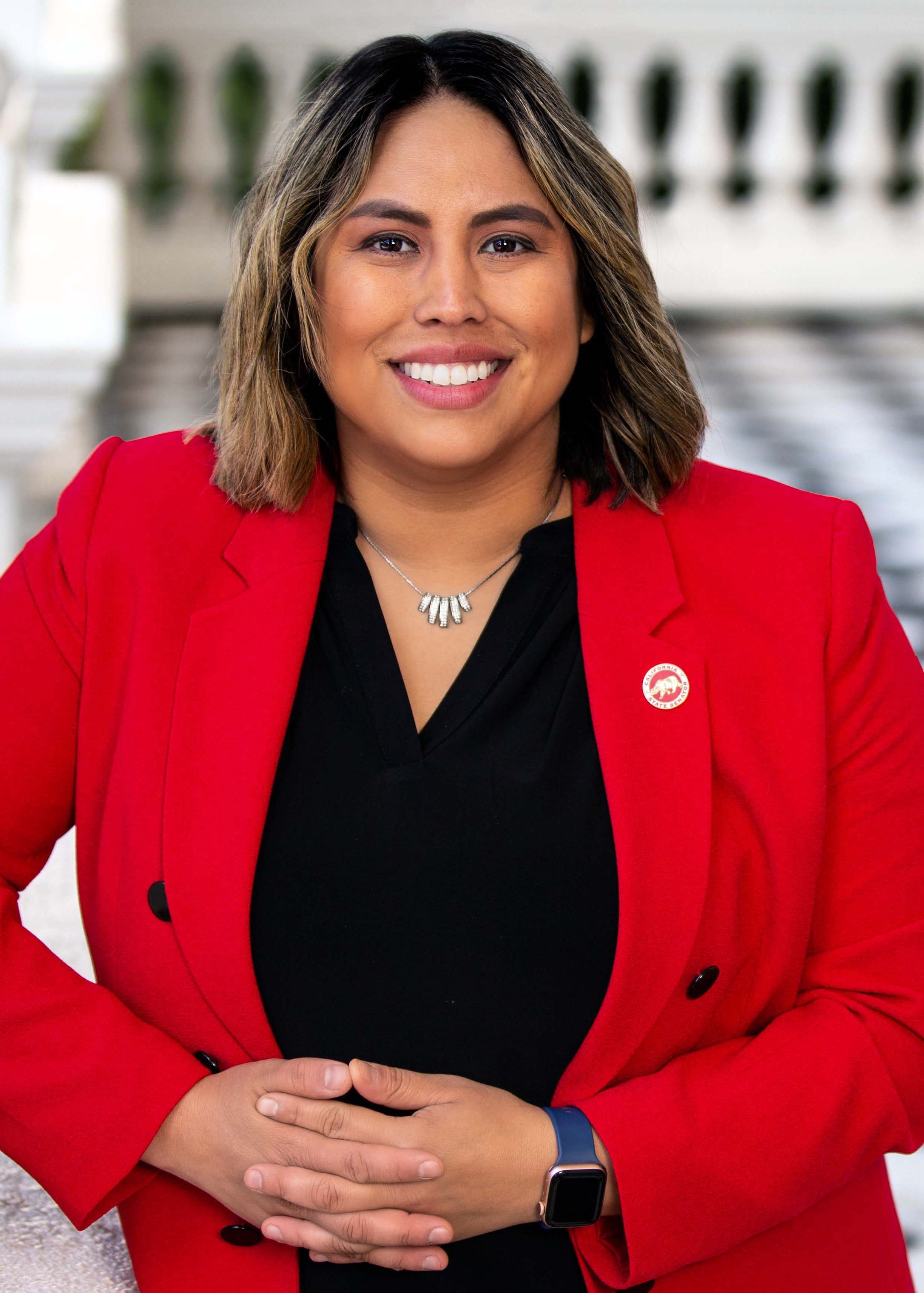
Sen. Caroline Menjivar
Sponsored bills
Under existing law, there is established in each county treasury a Supplemental Law Enforcement Services Account (SLESA) to receive all amounts allocated to a county for specified purposes. Existing law requires the moneys to be allocated in specified amounts, including, but not limited to, 50% to a county or city and county to implement a comprehensive multiagency juvenile justice plan, as specified. Existing law requires the juvenile justice plan to be developed by the local juvenile justice coordinating council in each county and city and county. Existing law requires a juvenile justice coordinating council to consist of certain members, including, but not limited to, the chief probation officer, as chair, and a representative from the district attorney's office, the public defender's office, and the sheriff's department, among others. This bill would revise and recast those membership provisions, and instead require each county juvenile justice coordinating council to, at a minimum, consist of at least 50% community representatives with the remainder of the seats allocated as specified. The bill would require the council to include an at-promise youth, as defined, and either a person with experience in the juvenile court system or a system-impacted family member. The bill would require a council to meet no less than 3 times per year and announce its meetings at least 10 days in advance of a meeting.
(1) Existing law allows a defendant to be released under their own recognizance pending trial if a defendant files with the clerk of the court, or other person authorized to accept bail, a signed release agreement that includes various stipulations by the defendant. The bill would, for a defendant released from custody under a court's order for pretrial supervision, prohibit a defendant from being charged a fee for pretrial supervision, maintain information obtained in pretrial supervision services apart from law enforcement and criminal justice records, and make confidential information in the course of performing pretrial supervision subject to specified exceptions, including that the court may order the disclosure of information if the information is material, exonerating on the issue of guilt, and would not otherwise be available. The bill would authorize the disclosure of information to specified entities, including to the court to determine bail, release, and conditions of release, detention, compliance with release conditions, or sentencing, and to a law enforcement agency upon a reasonable belief that the information is necessary to assist in apprehending an individual. The bill would prohibit the admissibility of this information on the issue of guilt in a criminal proceeding except when the crime was committed while on pretrial supervision or a defendant failed to appear in a criminal proceeding while on pretrial supervision, or if that information is relevant evidence that is admissible under specified standards in the California Constitution. (2) Existing law allows a court to employ an investigative staff to make a recommendation on whether a defendant should be released on their own recognizance pending trial. Existing law requires an investigative report be prepared in all cases involving specified felonies with a recommendation on whether a defendant should be released on their own recognizance. Existing law requires the report to be submitted to the court prior to a specified hearing. The bill would authorize an investigative report for every investigation by a court-employed investigative staff or a county pretrial agency staff from specified counties. If a report is issued, the bill would require the staff only to include information relevant to the release of a defendant and would prohibit the staff from soliciting from a defendant information regarding the circumstances of the alleged offense and information likely to reveal circumstances of any potential offenses. The bill would require the report to be kept confidential, as specified. (3) Existing law requires the Department of Justice to maintain state summary criminal history information, as defined, and to furnish this information to various state and local government officers, officials, and agencies, a public utility, or any other entity, if needed in the course of their duties, including the courts, district attorneys, and probation and parole officers. Existing law allows the department to furnish federal-level criminal history information upon a showing, as specified, to various state and local government officers, officials, and agencies, a public utility, and any other entity. Under existing law, the disclosure of state summary criminal history information to an unauthorized person is a crime. The bill would also require the Attorney General to furnish state summary criminal history information to county staff performing pretrial investigation and release services, as specified, and if needed in the course of their duties, and allow the Attorney General to furnish federal-level criminal history information to a treatment or services provider, community health worker, or case manager, as specified, with the consent of the subject of the state summary criminal history and for purposes of furthering the subject's treatment needs and ability to comply with pretrial release or diversion. By expanding the scope of an existing crime, this bill would impose a state-mandated local program. (4) Existing law requires a local criminal justice agency to furnish local summary criminal history information, as defined, to various state and local government officers, officials, and agencies, a public utility, or any entity, when the information is needed in the course of their duties. Under existing law, the disclosure of local summary criminal history information to an unauthorized person is a crime. The bill would also require a local criminal justice agency to furnish local summary criminal history information to a county staff performing pretrial investigation and release services, as defined, and would allow a local criminal justice agency to furnish local summary criminal history information to a treatment or services provider, community health worker, or case manager, as specified, with the consent of the subject of the local summary criminal history and for purposes of furthering the subject's compliance with pretrial release or diversion. By expanding the scope of an existing crime, the bill would impose a state-mandated local program. (5) Existing law defines "criminal justice agencies" as agencies that perform activities that relate to the apprehension, prosecution, adjudication, incarceration, or correction of criminal offenders. Under existing law, a criminal justice agency, among other things, compiles records and data for the purpose of identifying criminal offenders and maintaining specified information pertaining to each offender, including a summary of arrests and pretrial proceedings. The bill would include pretrial investigation and release within the definition of an activity of a criminal justice agency. By imposing a new duty on local government, the bill would create a state-mandated local program. (6) Existing constitutional provisions require that a statute that limits the right of access to the meetings of public bodies or the writings of public officials and agencies be adopted with findings demonstrating the interest protected by the limitation and the need for protecting that interest. This bill would make legislative findings to that effect. (7) The California Constitution requires the state to reimburse local agencies and school districts for certain costs mandated by the state. Statutory provisions establish procedures for making that reimbursement. This bill would provide that with regard to certain mandates no reimbursement is required by this act for a specified reason. With regard to any other mandates, this bill would provide that, if the Commission on State Mandates determines that the bill contains costs so mandated by the state, reimbursement for those costs shall be made pursuant to the statutory provisions noted above.
Maddy summaryThis legislative resolution designates September 1, 2024, as Salvadoran American Day to honor the history and contributions of Salvadorans in California. The measure recognizes the community's significant cultural impact and acknowledges the nation's independence from Spain, which occurred 203 years prior to the declaration. Passed by the California Senate, the bill serves as a formal commemoration rather than establishing new laws or funding.
The Personal Income Tax Law imposes a tax on individual taxpayers measured by the taxpayer's taxable income for the taxable year, but excludes certain items of income from the computation of tax, including an exclusion for combat-related special compensation. This bill, for taxable years beginning on or after January 1, 2024, and before January 1, 2034, would exclude from gross income retirement pay received by a taxpayer from the federal government for service performed in the uniformed services, as defined, during the taxable year. The bill, for taxable years beginning on or after January 1, 2024, and before January 1, 2034, would also exclude from gross income annuity payments received by a qualified taxpayer, as defined, pursuant to a United States Department of Defense Survivor Benefit Plan during the taxable year. The bill would make related findings and declarations. Existing law requires any bill authorizing a new tax expenditure to contain, among other things, specific goals, purposes, and objectives that the tax expenditure will achieve, detailed performance indicators, and data collection requirements. This bill also would include additional information required for any bill authorizing a new tax expenditure. The bill would require the Franchise Tax Board and the Department of Veterans Affairs to provide any data requested by the Legislative Analyst to write the report, as provided, and would make taxpayer information received by the Legislative Analyst subject to limitation on the collection and use of that information. By expanding the scope of a crime, this bill would impose a state-mandated local program. The California Constitution requires the state to reimburse local agencies and school districts for certain costs mandated by the state. Statutory provisions establish procedures for making that reimbursement. This bill would provide that no reimbursement is required by this act for a specified reason. This bill would take effect immediately as a tax levy.
Maddy summaryThis Senate Resolution recognizes Dr. Claudia Sheinbaum as the first female president of Mexico, highlighting her historic election and background in science and public service. The measure celebrates her achievements, including her work on climate change and transportation, and notes her status as the first female president elected in North America. It expresses the California Senate's support for her leadership and looks forward to strengthening ties between California and Mexico. The resolution is a formal acknowledgment rather than a law that changes policy or imposes new requirements.
Maddy summarySenate Resolution 114 is a non-binding tribute from the California State Senate honoring President Joseph Biden for his extensive public service career. The resolution details his background, legislative achievements, and leadership roles as a senator, vice president, and president, specifically highlighting his work on infrastructure, climate action, and pandemic response. It concludes by formally thanking the President for stepping down to allow new leaders to take office and directs the Senate Secretary to distribute copies of the resolution.
Maddy summaryThis bill designates Thursday, July 25, 2024, as Hire a Veteran Day in California to honor veterans and encourage their employment. The measure is a commemorative resolution that does not create new laws, regulations, or funding but serves as an official state recognition of the date. By acknowledging this day, the Legislature aims to highlight the skills veterans bring to the workforce and support efforts to reduce veteran unemployment. The resolution requires no action from businesses or individuals other than observing the designated date.
Maddy summaryThis bill establishes Transgender History Month in California to recognize the state's significant contributions to transgender history and activism. The resolution highlights key historical figures and events, such as early Indigenous gender variance, the Cooper Do-nuts and Compton's Cafeteria riots, and the founding of major support organizations. By formally acknowledging these milestones, the measure aims to educate the public about the long-standing presence and struggles of transgender people in California.
Maddy summaryThis bill designates October 2024 as National Domestic Violence Awareness Month to highlight the issue and encourage community support. It does not change any laws or allocate funding but serves as a symbolic recognition of the problem's impact on survivors across all demographics. The measure aims to raise public awareness about domestic violence statistics and the importance of prevention programs.