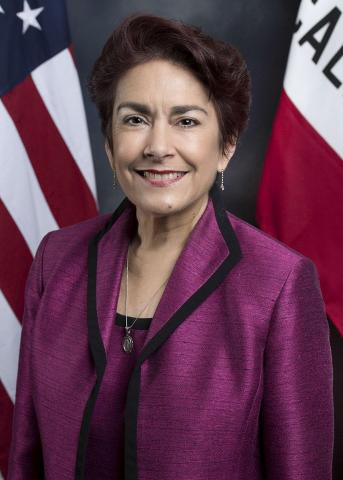
Photo of Anna Caballero
D California Senate · District 14

Sen. Anna Caballero

Compare
Total votes
35,964
all sessions
Attendance
93%
1,819 missed
Near the chamber average
With party
99%
of cast votes
Near the chamber average
Bipartisan score
1%
crosses aisle rarely
Near the chamber average
Sponsored
645
bills & resolutions
Near the chamber average
Committees
14
assignments
645 bills and resolutions

Sponsored bills

Total
645
Primary
181
Co-sponsor
464
This page
645
matching current filters
Co-sponsor SCR 84
Passed · California Senate · Co-sponsor
Relative to California Rail Month.

Maddy summarySCR 84 designates May 2025 as "California Rail Month" through a symbolic recognition. It does not create new laws, allocate funding, or change existing policies. The bill directly affects the state legislature and public awareness efforts related to rail transportation. This is a purely ceremonial measure with no concrete policy changes or direct impact on residents or rail services.

Passed Jul 2, 2026 1 co-sponsor
Primary SB 1143
Signed into law · California Senate · Lead sponsor
Children's advocacy centers: recordings.

Existing law authorizes a county to use a children's advocacy center to implement a coordinated multidisciplinary response to investigate reports involving child physical or sexual abuse, exploitation, or maltreatment. Existing law requires a county that utilizes a child advocacy center to meet specified standards, including, among other things, that the children's advocacy center must verify that interviews conducted in the course of investigations are conducted in a forensically sound manner and occur in a child-focused setting designed to provide a safe, comfortable, and dedicated place for children and families. Existing law requires the children's advocacy center or other identified multidisciplinary team member custodian to ensure that all recordings of child forensic interviews be released only in response to a court order, or, upon request, to law enforcement agencies authorized to investigate child abuse or agencies authorized to prosecute juvenile or criminal conduct described in the forensic interview, or to county counsel evaluating an allegation of child abuse. Existing law requires files, reports, records, communications, and working papers used or developed in providing services through a children's advocacy center to be confidential and not public records. Existing law authorizes the members of a multidisciplinary team associated with a children's advocacy center to share with other multidisciplinary team members any information or records concerning the child and family and the person who is the subject of the investigation of suspected child abuse or neglect for the sole purpose of facilitating a forensic interview, case discussion, or providing services to the child or family, as specified. This bill would additionally authorize the members of a multidisciplinary team associated with a children's advocacy center to share with child welfare agencies authorized to investigate child abuse and neglect any information or records, as specified, for the purposes mentioned above.

Signed into law Jun 30, 2026 0 co-sponsors
Co-sponsor SR 113
Passed · California Senate · Co-sponsor
Relative to the International Day of Peace.

Maddy summaryThis Senate resolution commemorates the United Nations International Day of Peace and honors the late Chancellor Young-Seek Choue for proposing the concept that led to its creation. The bill encourages all Californians to observe the day by reaffirming their commitment to peace, nonviolence, mutual understanding, and respect for human dignity. It does not create new laws or change existing policies but serves as a symbolic gesture to promote global peace and recognize the role of education in fostering international cooperation.

Passed Jun 29, 2026 1 co-sponsor
Co-sponsor SB 1350
Signed into law · California Senate · Co-sponsor
Energy: renewable electrical generation facilities: definition.

Existing law defines a "renewable electrical generation facility" as a facility that uses biomass, solar thermal, photovoltaic, wind, geothermal, fuel cells or linear generators that use specified fuels, small hydroelectric generation of 30 megawatts or less, digester gas, municipal solid waste conversion, landfill gas, ocean wave, ocean thermal, or tidal current, and that meets other specified requirements. Existing law incorporates that definition into various programs, including the California Renewables Portfolio Standard Program, which requires the Public Utilities Commission to establish a renewables portfolio standard requiring all retail sellers, as defined, to procure a minimum quantity of electricity products from electrical generating facilities that meet that definition of "renewable electrical generation facility," and the net energy metering program, in which residential customers, small commercial customers, and commercial, industrial, or agricultural customers of an electrical utility, who use renewable electrical generation facilities, are eligible to participate, as specified. This bill would expand the definition of "renewable electrical generation facility" to include a facility that converts hydrogen gas to electricity in a turbine and meets specified criteria, including that the hydrogen used in the turbine is solely derived from an eligible renewable resource, as specified, or through the electrolysis of water, and exclusively uses electricity generated from another renewable electrical generation facility, and that the manufacturing of the hydrogen does not result in resource shuffling or use unbundled renewable energy credits, as specified. Under existing law, a violation of any order, decision, rule, direction, demand, or requirement of the commission is a crime. Because a violation of a commission action implementing this bill's requirements would be a crime, the bill would impose a state-mandated local program. The California Constitution requires the state to reimburse local agencies and school districts for certain costs mandated by the state. Statutory provisions establish procedures for making that reimbursement. This bill would provide that no reimbursement is required by this act for a specified reason. This bill would declare that it is to take effect immediately as an urgency statute.

Signed into law Jun 29, 2026 1 co-sponsor
Co-sponsor SB 417
Signed into law · California Senate · Co-sponsor
The Veterans and Affordable Housing Bond Act of 2026.

Under existing law, there are programs providing assistance for, among other things, emergency housing, multifamily housing, farmworker housing, home ownership for very low and low-income households, and downpayment assistance for first-time home buyers. Existing law also authorizes the issuance of bonds in specified amounts pursuant to the State General Obligation Bond Law and requires that proceeds from the sale of these bonds be used to finance various existing housing programs, capital outlay related to infill development, brownfield cleanup that promotes infill development, and housing-related parks. Existing law, the Veterans and Affordable Housing Bond Act of 2018, authorized, the issuance of bonds in the amount of $4,000,000,000 to finance various existing housing programs, as well as infill infrastructure financing and affordable housing matching grant programs, as well as financing for a specified program for farm, home, and mobilehome purchase assistance for veterans, pursuant to the State General Obligation Bond Law. This bill would enact the Veterans and Affordable Housing Bond Act of 2026, which, if adopted, would authorize the issuance of bonds in the amount of $11,250,000,000, pursuant to the State General Obligation Bond Law. Of the proceeds from the sale of these bonds, $10,000,000,000 would be used to finance programs to fund affordable rental housing and home ownership programs, including, among others, the Multifamily Housing Program, the CalHome Program, and the Joe Serna, Jr. Farmworker Housing Grant Program, and $1,250,000,000 would be used to provide additional funding for the above-described program for farm, home, and mobilehome purchase assistance for veterans, as provided. This bill would provide for submission of the bond act to the voters at the November 3, 2026, statewide general election, in accordance with specified law. This bill would declare that it is to take effect immediately as an urgency statute.


Signed into law Jun 25, 2026 1 co-sponsor
Primary SB 555
Passed · California Senate · Lead sponsor
Workers' compensation: average annual earnings.

Existing law establishes a workers' compensation system, administered by the Administrative Director of the Division of Workers' Compensation, to compensate an employee for injuries sustained in the course of employment. Existing law provides for temporary disability, permanent total disability, or permanent partial disability benefits, among other benefits, for an injured employee and requires the computation of an injured employee's average annual earnings and average weekly earnings for purposes of determining those disability benefits. Existing law requires, for computing average annual earnings for purposes of permanent partial disability indemnity, that average weekly earnings be taken at various amounts, including between $240 and $435 for injuries occurring on or after January 1, 2014, except as specified. This bill would require, for computing average annual earnings for purposes of permanent partial disability indemnity, that average weekly earnings be taken at between $363 and $658 for injuries occurring on or after January 1, 2027.

Passed Jun 24, 2026 0 co-sponsors
Co-sponsor SB 1422
In committee · California Senate · Co-sponsor
Medi-Cal: eligibility: immigration status.

Existing law establishes the Medi-Cal program, which is administered by the State Department of Health Care Services and under which qualified low-income individuals receive health care services. The Medi-Cal program is, in part, governed and funded by federal Medicaid program provisions. Existing law sets a schedule of benefits that are covered by the Medi-Cal program. The federal Medicaid program prohibits payment to a state for medical assistance furnished to an alien who is not lawfully admitted for permanent residence or otherwise permanently residing in the United States under color of law. Existing state law extends Medi-Cal eligibility for the full scope of Medi-Cal benefits to individuals who do not have satisfactory immigration status if they are otherwise eligible for those benefits, with the exception of specified dental benefits for individuals who are 19 years of age or older. Existing law makes an individual who is 19 years of age or older, who does not have satisfactory immigration status, and who applies for Medi-Cal on or after January 1, 2026, or loses eligibility for eligibility for full-scope Medi-Cal on or after January 1, 2026, eligible only for pregnancy-related services and emergency medical treatment. Existing law, beginning no sooner than July 1, 2027, as specified, requires individuals who do not have satisfactory immigration status, who are not pregnant, and who are 19 to 59 years of age, inclusive, to pay a monthly premium of $30, subject to certain exceptions. This bill would require the Director of the Department of Finance to determine and report to the Legislature and the Governor the cost of implementing eligibility for the full scope of Medi-Cal benefits for individuals who do not have satisfactory immigration status if they are otherwise eligible, and whether including those costs the General Fund would be in a deficit, as defined. The bill would then, on January 1 of the year following such a determination, end the above-described limitations on services for those who apply for Medi-Cal after January 1, 2026, or who lose eligibility for the full-scope of Medi-Cal benefits on or after January 1, 2026, thereby making an individual who is 19 years of age or older, who does not have satisfactory immigration status, eligible for the full scope of Medi-Cal benefits subject to certain limitations, such as the payment of premiums and certain dental benefits. The bill would require that the implementation of eligibility for the full-scope of Medi-Cal benefits be done by groups categorized by age, beginning with individuals over 49 years of age. Because counties are required to make Medi-Cal eligibility determinations and this bill would alter Medi-Cal eligibility, the bill would impose a state-mandated local program. The California Constitution requires the state to reimburse local agencies and school districts for certain costs mandated by the state. Statutory provisions establish procedures for making that reimbursement. This bill would provide that, if the Commission on State Mandates determines that the bill contains costs mandated by the state, reimbursement for those costs shall be made pursuant to the statutory provisions noted above.

In committee Jun 8, 2026 1 co-sponsor
Co-sponsor SCR 156
Signed into law · California Senate · Co-sponsor
Relative to National Stroke Awareness Month.

Maddy summaryThis bill designates the month of May 2026 as National Stroke Awareness Month. The primary effect is to officially recognize this time period for public education and awareness campaigns regarding stroke prevention and treatment. It does not alter laws, allocate funding, or impose new requirements on individuals or organizations. The measure serves as a symbolic gesture to highlight the importance of stroke awareness during the specified month.

Signed into law Jun 5, 2026 1 co-sponsor
Co-sponsor SCR 163
Signed into law · California Senate · Co-sponsor
Relative to California Tourism Month.

This measure would proclaim the month of May 2026 as California Tourism Month and would urge the citizens of this great state to support tourism and local businesses by traveling in the state as an act of civic pride.

Signed into law Jun 5, 2026 1 co-sponsor
Showing 61 to 70 of 645 bills
Previous 1 … 6 7 8 … 65 Next