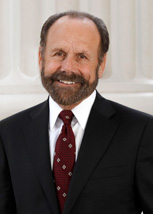
Photo of Jerry Hill
D California Senate · District 13 · Former member

Sen. Jerry Hill

Compare
Total votes
34,484
all sessions
Attendance
99%
121 missed
Higher than 94% of chamber peers
With party
99%
of cast votes
Near the chamber average
Bipartisan score
0%
crosses aisle rarely
Near the chamber average
Sponsored
1,209
bills & resolutions
Near the chamber average
Committees
0
assignments
1,209 bills and resolutions

Sponsored bills

Total
1,209
Primary
295
Co-sponsor
914
This page
1,209
matching current filters
Co-sponsor AB 559
Failed · California Assembly · Co-sponsor
Residential care facilities for the elderly.

Existing law, the California Residential Care Facilities for the Elderly Act, provides for the licensure of residential care facilities for the elderly by the State Department of Social Services. Existing law exempts from these provisions specified facilities, including general acute care hospitals, clinics, and recovery houses for individuals with drug or alcohol addiction. This bill would add to the list of facilities that are exempt from regulation as a residential care facility for the elderly a home or facility approved and annually reviewed by the United States Department of Veterans Affairs as a medical foster home, as defined, in which care is provided exclusively to three or fewer veterans.

Failed Feb 3, 2014 1 co-sponsor
Co-sponsor SB 640
In committee · California Senate · Co-sponsor
Medi-Cal: reimbursement: provider payments.

The Medi-Cal Act establishes the Medi-Cal program, which is administered by the State Department of Health Care Services, under which qualified low-income individuals receive health care services. The Medi-Cal program is, in part, governed and funded by federal Medicaid Program provisions. Existing law requires, except as otherwise provided, Medi-Cal provider payments to be reduced by 1% or 5%, and provider payments for specified non-Medi-Cal programs to be reduced by 1%, for dates of service on and after March 1, 2009, and until June 1, 2011. Existing law requires, except as otherwise provided, Medi-Cal provider payments and payments for specified non-Medi-Cal programs to be reduced by 10% for dates of service on and after June 1, 2011. This bill would instead require that, to the extent permitted by federal law, this payment reduction not apply to skilled nursing facilities or subacute care units that are a distinct part of a general acute care hospital, intermediate care or other specified facilities serving developmentally disabled individuals, or specified Medi-Cal provider payments for fee-for-service benefits, including payments to pharmacies, for dates of service on or after June 1, 2011. The bill would also provide that this payment reduction shall not apply to managed health care plans for dates of service after the effective date of the bill. This bill would declare that it is to take effect immediately as an urgency statute.

In committee Feb 3, 2014 1 co-sponsor
Co-sponsor AB 158
died · California Assembly · Co-sponsor
Solid waste: single-use carryout bags.

Existing law, until January 1, 2020, requires an operator of a store, as defined, to establish an at-store recycling program that provides to customers the opportunity to return clean plastic carryout bags to that store. With specified exceptions, this bill, as of January 1, 2015, would prohibit stores that have a specified amount of dollar sales or retail floor space from providing a single-use carryout bag to a customer. The bill would require these stores to meet other specified requirements regarding providing recycled paper bags and compostable bags to customers. The bill would require these stores to make reusable grocery bags available to customers. The bill would, on and after July 1, 2016, additionally impose these prohibitions and requirements on convenience food stores, foodmarts, and certain other specified stores. The bill, beginning January 1, 2016, would require reusable grocery bags that are sold or provided to a store by a reusable grocery bag producer meet specified requirements, and would require a producer to provide an independent certification to the Department of Resources Recycling and Recovery that the bags meet the requirements, and to pay a specified fee. The bill would require the department to deposit all penalties collected for violations of these requirements into the Reusable Bag Account, which would be established by the bill in the Integrated Waste Management Fund. The bill would require that moneys in the account be expended by the department, upon appropriation by the Legislature, to implement these requirements. The bill would allow a city, county, or city and county, or the state to impose civil penalties for a violation of the bill's requirements, except for the certification requirements. The bill would require these civil penalties to be paid to the office of the city attorney, city prosecutor, district attorney, or Attorney General, whichever office brought the action, and would allow the penalties collected by the Attorney General to be expended by the Attorney General, upon appropriation by the Legislature, to enforce the bill's provisions. The bill would provide that these remedies are not exclusive, as specified. This bill would prohibit enforcement and implementation of local ordinances and other local regulations on this subject that were enacted on or after January 1, 2014, as specified.

died Feb 3, 2014 1 co-sponsor
Primary SB 661
died · California Senate · Lead sponsor
False advertising.

Existing law makes it unlawful for any person, firm, corporation, or association to sell, or offer for sale, merchandise that advertises itself as being made in the United States when any article, unit, or part of the merchandise has been entirely or substantially made, manufactured, or produced outside of the United States. This bill would establish an exception to these provisions by authorizing a person, firm, corporation, or association to sell or offer for sale in this state any merchandise labeled as being made in the United States if the merchandise is made, manufactured, or produced in the United States and has an article, unit, or part from outside of the United States that cannot be obtained within the United States, as specified, and constitutes only a negligible part of the final manufactured product.

died Feb 3, 2014 0 co-sponsors
Co-sponsor SB 376
In committee · California Senate · Co-sponsor
Sales and use taxes: exemption: manufacturing: research and development.

(1) Existing laws impose state sales and use taxes on retailers measured by the gross receipts from the sale of tangible personal property sold at retail in this state, or on the storage, use, or other consumption in this state of tangible personal property purchased from a retailer for storage, use, or other consumption in this state, at the cumulative state rate of 6.5%, and provides various exemptions from those taxes. This bill would exempt from those state taxes, on and after January 1, 2017, and before January 1, 2022, the gross receipts from the sale of, and the storage, use, or other consumption of, qualified tangible personal property purchased for use by a qualified person for use primarily in any stage of manufacturing, processing, refining, fabricating, or recycling of tangible personal property, as specified, or for use primarily in research and development, as specified, or to maintain, repair, measure, or test that tangible personal property. The bill would also exempt from those taxes the gross receipts from the sale of, and the storage, use, or other consumption of, tangible personal property purchased for use by a contractor, as specified, for a qualified person. The bill would require the purchaser to furnish the retailer with an exemption certificate, as specified. This bill would also require the Legislative Analyst's Office to conduct a study, by January 1, 2019, using information provided by the State Board of Equalization, to measure the effects of the exemption, as specified. The Bradley-Burns Uniform Local Sales and Use Tax Law authorizes counties and cities to impose local sales and use taxes in conformity with the Sales and Use Tax Law, and existing law authorizes districts, as specified, to impose transactions and use taxes in accordance with the Transactions and Use Tax Law, which conforms to the Sales and Use Tax Law. Exemptions from state sales and use taxes are incorporated into these laws. This bill would specify that this exemption does not apply to local sales and use taxes and transactions and use taxes. (2) This bill would take effect immediately as a tax levy.

In committee Feb 3, 2014 1 co-sponsor
Primary SB 594
Signed into law · California Senate · Lead sponsor
Use of public resources.

(1) Existing law prohibits the use of public funds for campaign activities. This bill would prohibit a nonprofit organization or an officer, employee, or agent of a nonprofit organization from using, or permitting another to use public resources received from a local agency for campaign activity, as defined, and not authorized by law. This bill would define, among other terms, "public resources" to mean any property or asset owned by a local agency and funds received by a nonprofit organization which have been generated from any activities related to conduit bond financing by those entities subject to specified conduit financing and transparency and accountability provisions, and "nonprofit organization" to mean an entity incorporated under the Nonprofit Corporation Law or a nonprofit organization that qualifies for exempt status under the federal Internal Revenue Code of 1986, except as specified. This bill would authorize a civil cause of action for a violation of these prohibitions and damages that include, but are not limited to, 3 times the value of the unlawful use of the public resources. This bill would authorize the Attorney General, a district attorney, and a city attorney of a city having a population in excess of 750,000 to seek these civil remedies. (2) Existing law requires qualifying individuals and political organizations to report specified information, including, but not limited to, political contributions, in statements filed with the Fair Political Practices Commission. This bill would require a reporting nonprofit organization that engages in campaign activity to deposit into a separate bank account all "specific source or sources of funds" it receives and to pay for all campaign activity from that separate bank account. This bill would define, among other terms, "reporting nonprofit organization" to mean a nonprofit organization for which public resources from one or more local agencies account for more than 20% of the organization's annual gross revenue, as specified, and "specific source or sources of funds" to mean any funds received by the reporting nonprofit organization that have been designated for campaign activity use or any other funds received by the nonprofit organization, as specified. This bill would further require a reporting nonprofit organization that engages in campaign activity of specified amounts or more to periodically disclose to the Franchise Tax Board, and post on its Internet Web site in a certain manner, the identity and amount of each specific source or sources of funds it receives for campaign activity, a description of the campaign activity, and the identity and amount of payments the organization makes from the required separate bank account, as specified. This bill would authorize the Franchise Tax Board to conduct an audit of any reporting nonprofit organization, require the board to conduct an audit of any reporting nonprofit organization that engages in campaign activity in excess of $500,000 in a calendar year, issue a written audit report, and transmit the report to the Attorney General and the district attorney for the county in which the reporting nonprofit organization is domiciled. This bill would authorize the Attorney General or the district attorney for the county in which the reporting nonprofit organization is domiciled to assess a monetary civil penalty of up to $10,000 against a reporting nonprofit organization for each violation of these disclosure requirements, as specified.

Signed into law Oct 12, 2013 0 co-sponsors
Co-sponsor AB 532
Signed into law · California Assembly · Co-sponsor
Local Housing Trust Fund.

Existing law establishes the Local Housing Trust Fund Matching Grant Program for the purpose of supporting local housing trust funds dedicated to the creation or preservation of affordable housing. Existing law requires the Department of Housing and Community Development to make available the amount of $35,000,000 for the Local Housing Trust Fund Matching Grant Program, from the continuously appropriated Housing and Emergency Shelter Trust Fund of 2006. Under the grant program, the department is authorized to make matching grants available to cities, counties, cities and counties, and existing charitable nonprofit organizations that have created, funded, and operated housing trust funds. The minimum allocation to a program applicant is $1,000,000 for existing trust funds, or $500,000 for newly established housing trust funds. The maximum allocation for any applicant is $2,000,000. Under existing law, all funds provided under the grant program are to be matched on a dollar-for-dollar basis with moneys that are not required by any state or federal law to be spent on housing. This bill would revise the law applicable to the above grant program, including (1) reducing the maximum allocation to $1,000,000 per notice of funding availability for a trust that has previously received a grant through the program, (2) revising funding priorities for certain types of local housing trust funds, and (3) revising requirements relative to deed restrictions and equity sharing agreements applicable to for-sale housing projects or units within for-sale housing projects. Under existing law, an applicant is required to continue funding the local housing trust fund from identified local sources, and continue the trust in operation for a period of no less than 5 years from the date of award. This bill would extend any award to a local housing trust that was under contract on January 1, 2013, by 12 months. Existing law requires 50% of the funds allocated to the Local Housing Trust Fund Matching Grant Program to be made available exclusively for newly established housing trust funds. Existing law requires funds set aside for newly established housing trust funds to be available for encumbrance for 42 months and, after that time, to revert to another specified housing fund. This bill would remove the above restrictions, making the funds continuously available for purposes of the program and not reverting to another fund, thus making an appropriation. The bill also would authorize funding for a housing trust fund that had previously received a grant under the program. Under existing law, the department awards funds under the grant program through the issuance of a Notice of Funding Availability (NOFA) , as specified. This bill would require the department to issue a new NOFA for new trusts, as defined, by June 30, 2014. This bill would declare that it is to take effect immediately as an urgency statute.

Signed into law Oct 12, 2013 1 co-sponsor
Co-sponsor AB 260
Signed into law · California Assembly · Co-sponsor
Individualized county child care subsidy plans.

Existing law authorizes the City and County of San Francisco and the County of San Mateo, as pilot projects, to develop and implement individualized county child care subsidy plans for the purpose of ensuring that child care subsidies received in those counties are used to address local needs, conditions, and priorities of working families. The provisions authorizing those pilot projects are similar, but not identical. Existing law repeals the provisions relating to the City and County of San Francisco on January 1, 2018, and repeals the provisions relating to the County of San Mateo pilot project on January 1, 2017. This bill would require the City and County of San Francisco to terminate the individualized county child care subsidy plan on July 1, 2016, and would require the city and county from July 1, 2016, to July 1, 2018, inclusive, to phase out the plan, and, beginning July 1, 2018, implement the state's requirements for child care subsidies. The bill would require the City and County of San Francisco to submit a specified report on the pilot project's operation between the 2011–12 and 2013–14 fiscal years to the Legislature, the State Department of Social Services, and the State Department of Education on or before December 31, 2014. The bill would make those provisions relating to the City and County of San Francisco's individualized county child care subsidy plan inoperative on July 1, 2018, and would repeal those provisions on January 1, 2019. The bill would make those provisions relating to the County of San Mateo inoperative on July 1, 2014, and as of that date, would authorize the County of San Mateo's individualized county child care subsidy plan to continue in accordance with specified requirements until July 1, 2018. The bill would require the Child Development Division of the State Department of Education to review and approve or disapprove modifications to the plan. The bill would require the County of San Mateo to annually prepare and submit to the Legislature, the State Department of Social Services, and the State Department of Education a report that contains specified information relating to the success of the county's plan. The bill would also make conforming and related changes and nonsubstantive changes.

Signed into law Oct 11, 2013 1 co-sponsor
Primary SB 472
Signed into law · California Senate · Lead sponsor
Gaming: licenses.

The Gambling Control Act provides for the licensure of certain individuals and establishments involved in various gambling activities, and for the regulation of those activities, by the California Gambling Control Commission. The act makes any person who willfully violates any of the provisions of the act for which a penalty is not expressly provided guilty of a misdemeanor. The act requires every person who is required to hold a state license to obtain the license prior to engaging in the activity or occupying the position with respect to which the license is required, except as specified. Existing law requires every person who, by order of the commission, is required to apply for a gambling license or a finding of suitability to file an application within 30 calendar days after receipt of the order. This bill would instead require the application described above to be filed within 45 calendar days after receipt of an order of the commission. The act also provides that, if the owner of a gambling enterprise is not a person, the owner is not eligible for a gambling license unless specified persons involved in the enterprise obtain a gambling license. Existing law authorizes the commission to exempt specified limited partners in limited partnerships from the licensing requirements described above solely for the purpose of the licensure of a card club located on the grounds of a racetrack that is owned by a limited partnership that also owns the racetrack. This bill would instead authorize the commission to exempt specified limited partners in limited partnerships from the licensing requirements described above solely for the purpose of the licensure of a card club located on any portion of, or contiguous to, the grounds upon which a racetrack is or had been previously located and horse race meetings were authorized to be conducted by the California Horse Racing Board on or before January 1, 2012, that is owned by a limited partnership that also owns or owned the racetrack. Existing law provides that a person is deemed unsuitable to hold a state gambling license to own a gambling establishment if the person, or any partner, officer, director, or shareholder of the person, has any financial interest in any business or organization that is engaged in a prohibited form of gambling, whether within or without this state, except as specified. This bill would exempt from these provisions a person who is licensed or had an application to be licensed on file with the commission on or before February 1, 2013, has a financial interest in a business or organization engaged in gambling prohibited by state law that was closed and was not engaged in prohibited gambling at the time the person was either licensed or had filed an application to be licensed with the commission, and has a financial interest in a gambling establishment that is located on any portion of, or contiguous to, the grounds on which a racetrack is or had been previously located and horse race meetings were authorized to be conducted by the California Horse Racing Board on or before January 1, 2012, that is directly or indirectly owned by a racetrack limited partnership owner, as defined. The bill would require an exempted person described above, within 3 years of the date the closed business or organization reopens and becomes engaged in any form of prohibited gambling, as specified, to either divest that person's interest in the business or organization, or divest that person's interest in the gambling enterprise or gambling establishment for which the person is licensed or had applied to be licensed by the commission. The bill would also require an exempted person to inform the commission within 30 days of the date on which a business or organization in which the person has a financial interest begins to engage in any form of prohibited gambling, as specified. The bill would also make it unlawful, during the 3-year divestment period, for any cross-promotion or marketing, as defined, to occur between the business or organization that is engaged in any form of prohibited gambling, as specified, and a gambling enterprise or gambling establishment, as described. By creating a new crime, the bill would impose a state-mandated local program. The bill would prohibit, during that 3-year divestment period, any funds used in connection with the capital improvement of the gambling enterprise or gambling establishment from being provided from the gaming revenues of either the business or organization engaged in prohibited forms of gaming. The bill would also provide that if, at the end of the 3-year divestment period, a person has not divested his or her interest in either the gambling enterprise or gambling establishment or the business or organization that is engaged in the form of prohibited gaming, the exemption would not apply to that person and that person shall be deemed to be unsuitable to hold a state gambling license to own a gambling establishment if the person, or any partner, officer, director, or shareholder of the person, has any financial interest in any business or organization that is engaged in any form of prohibited gaming, whether within or without this state, as specified. The California Constitution requires the state to reimburse local agencies and school districts for certain costs mandated by the state. Statutory provisions establish procedures for making that reimbursement. This bill would provide that no reimbursement is required by this act for a specified reason.


Signed into law Oct 11, 2013 0 co-sponsors
Co-sponsor AB 394
Signed into law · California Assembly · Co-sponsor
Personal income tax: voluntary contributions: Alzheimer's disease.

The Personal Income Tax Law allows taxpayers, until January 1, 2015, to contribute amounts in excess of their tax liability for the support of the California Alzheimer's Disease and Related Disorders Research Fund, unless earlier repealed for failure to meet annual minimum contribution amounts. This bill would instead make these provisions effective for taxable years beginning before January 1, 2020.

Signed into law Oct 10, 2013 1 co-sponsor
Showing 501 to 510 of 1,209 bills
Previous 1 … 50 51 52 … 121 Next