

Existing law, the Administrative Procedure Act, sets forth the requirements for the adoption, publication, review, and implementation of regulations by state agencies. The Safe Drinking Water, Wildfire Prevention, Drought Preparedness, and Clean Air Bond Act of 2024 (act) , approved by the voters as Proposition 4 at the November 5, 2024, statewide general election, authorized the issuance of bonds in the amount of $10,000,000,000 pursuant to the State General Obligation Bond Law to finance projects for safe drinking water, drought, flood, and water resilience, wildfire and forest resilience, coastal resilience, extreme heat mitigation, biodiversity and nature-based climate solutions, climate-smart, sustainable, and resilient farms, ranches, and working lands, park creation and outdoor access, and clean air programs. Existing law authorizes certain regulations needed to effectuate or implement programs of the act to be adopted as emergency regulations in accordance with the Administrative Procedure Act, as provided. Existing law requires the emergency regulations to be filed with the Office of Administrative Law and requires the emergency regulations to remain in effect until repealed or amended by the adopting state agency. This bill, notwithstanding the above, would exempt the adoption of regulations for purposes of developing and adopting program guidelines and selection criteria needed to effectuate or implement programs of the act from the requirements of the Administrative Procedure Act, as provided. The bill would require a state entity that receives funding to administer a competitive grant program established using the Administrative Procedure Act exemption to do certain things, including, among other things, to develop draft project solicitation and evaluation guidelines, to transmit copies of the draft guidelines to the fiscal committees and to the appropriate policy committees of the Legislature, to hold a noticed public meeting on the draft guidelines, and to submit the final guidelines to the Secretary of the Natural Resources Agency, except as provided. The bill would require the Secretary of the Natural Resources Agency to post an electronic form of the guidelines submitted by a state entity and the subsequent verifications on the Natural Resources Agency's internet website. The bill would authorize the use of certain previously developed program guidelines and selection criteria for these purposes, as provided. This bill would declare that it is to take effect immediately as an urgency statute.
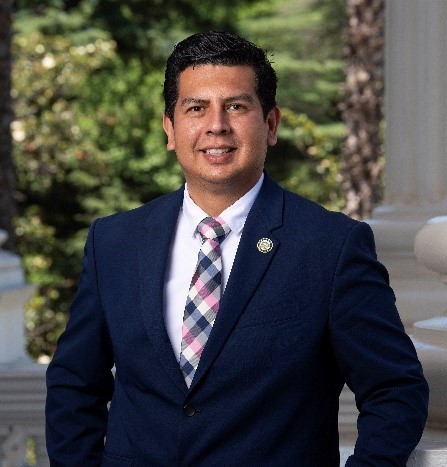
Rep. David Alvarez
Sponsored bills
This measure would extend an invitation to the people and government of the Province of Gauteng in South Africa to enter into a sister state relationship with California, would encourage the strengthening of existing partnerships, and would call upon California's universities, research institutions, and public agencies to explore new memoranda of understanding with Gauteng-based counterparts in areas of mutual interest.
Existing law requires the California Law Revision Commission to study, and limits the commission to studying, topics approved by resolution of the Legislature or by statute. This measure would grant approval to the commission to continue its study of designated topics that the Legislature previously authorized or directed the commission to study and two new topics of study, as specified. The measure would require the commission, before commencing work on any project within its authorized calendar of topics, to submit a detailed description of the scope of work to the Chairs and Vice Chairs of the Assembly Committee on Judiciary and the Senate Committee on Judiciary, and any other policy committee that has jurisdiction, as specified. If a major change to the scope of work occurs during the course of the project, the measure would require the commission to submit a description of the change.
Maddy summaryAB 181 is a procedural bill that expresses the Legislature's intent to enact future statutory changes related to the Budget Act of 2025. It does not specify any concrete policy changes or affect any particular group, as it merely sets the stage for upcoming budget-related legislation. The bill itself contains no new provisions or mechanisms; it serves only as a formal declaration of intent. Since no specific statutory changes are detailed in the abstract, this summary cannot describe key mechanisms or direct impacts.
This measure would designate a specified overcrossing on State Route 15 in the County of San Diego as the United States Navy Sailor Noah Tobin Memorial Overcrossing. The measure would request the Department of Transportation to determine the cost of appropriate signs showing this special designation and, upon receiving donations from nonstate sources covering that cost, to erect those signs.
(1) Existing law establishes the State Board of Education to adopt policies, and to establish rules and regulations, not inconsistent with the laws of the state, to govern the public elementary and secondary schools of the state. Existing law provides that the state board consists of 11 members, including 10 members who are appointed by the Governor to 4-year terms with the advice and consent of 23 of the Senate and a student member appointed by the Governor to a one-year term with the advice and consent of 23 of the Senate. This bill, commencing January 15, 2027, would add the Superintendent of Public Instruction to the state board by replacing one of the nonstudent positions that expires on January 15, 2027, with the Superintendent, thereby maintaining the state board's 11-member composition. The bill also would, commencing January 15, 2027, replace 4 of the existing positions that are appointed by the Governor with the advice and consent of 23 of the Senate with 2 members who are appointed by the President pro Tempore of the Senate and 2 members who are appointed by the Speaker of the Assembly, as provided. (2) Existing law requires the State Department of Education to be administered through the state board, which is the governing and policy determining body of the department, and the Director of Education, in whom all executive and administrative functions of the department are vested and who is the executive officer of the state board and the department. Existing law provides that the Superintendent is the ex officio Director of Education, and requires the department to be conducted under the control of the Director of Education. Existing law assigns to the Superintendent numerous duties related to the state board and the department. This bill would revise and recast those provisions by, among other things, (A) deleting the provision in existing law that establishes the Superintendent as the ex officio Director of Education, (B) vesting all executive and administrative functions of the department in an Education Commissioner to be appointed by, and serve at the pleasure of, the Governor and confirmed by the Senate after January 1, 2027, (C) transferring various duties of the Superintendent and the Director of Education relating to, among other things, the state board and the department, to the Education Commissioner, and (D) providing for the transfer, as specified, of certain employees (i) of the state board to the department, (ii) of the Superintendent to the department, and (iii) of the department to the Office of the Superintendent of Public Instruction, which the bill would establish, as specified. The bill would delay to July 1, 2027, the operative date of some of these provisions. This bill would require the Education Commissioner to create a plan no later than June 30, 2027, to transition the functions and operations of the department and other related activities from the Superintendent to the Education Commissioner, as provided. The bill would require the Superintendent to serve as an independent evaluator and cross-sector coordinator for public education, covering preschool through higher education, with specified duties. The bill would require the Superintendent to conduct independent evaluations of specified education initiatives and authorize the Superintendent to conduct independent evaluations of other education initiatives. This bill would prohibit the Superintendent and the Education Commissioner from holding positions of outside employment and would require all philanthropic foundations of the department to be dissolved no later than June 30, 2028. (3) Existing law establishes the California Community Colleges, under the administration of the Board of Governors of the California Community Colleges, as one of the segments of public postsecondary education in this state. The board of governors consists of 18 voting members, as provided. This bill, commencing July 1, 2027, would add the Superintendent to the board of governors as a 19th voting member.
Maddy summaryThis House Resolution recognizes the 250th anniversary of the Declaration of Independence in 2026 and encourages communities across California to participate in related celebrations and educational events. The measure honors the contributions of all individuals who have helped build the nation, with specific attention to those whose stories have historically been overlooked. It calls for reflection on both the achievements and shortcomings of American democracy while reaffirming a commitment to creating a more inclusive union. The resolution does not create new laws or funding but serves as a formal statement of the legislature's values and intent.
Maddy summaryThis bill designates June 2026 as Congenital Cytomegalovirus Awareness Month to highlight information about the virus. It directly affects public health officials, healthcare providers, and community organizations who may organize events or distribute educational materials during this time. The primary mechanism is a formal declaration that establishes the specific month for this awareness campaign. The measure does not alter laws or funding but serves to recognize the importance of the issue through official state recognition.
Maddy summaryThis bill designates May 2026 as Behavioral Health Awareness Month in California. It directs state agencies to acknowledge this month, likely through proclamations or public awareness campaigns. The measure does not change funding, laws, or services but serves to highlight the importance of mental and behavioral health.
This measure would proclaim the month of October 2026 as Italian American Heritage Month, and, among other things, encourage all citizens, schools, public institutions, and community organizations in California to observe Italian American Heritage Month with appropriate ceremonies, activities, and educational programs, as specified.