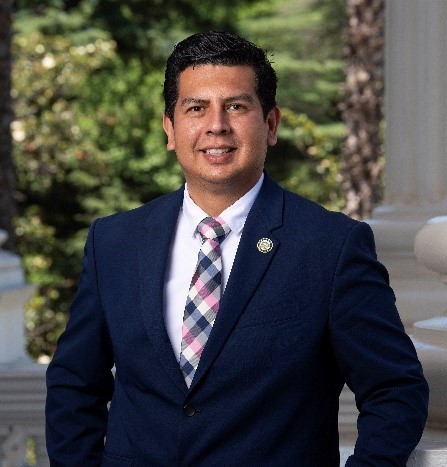
Photo of David Alvarez
D California Assembly · District 80 On the 2026 ballot

Asm. David Alvarez

Compare
Total votes
10,279
all sessions
Attendance
92%
785 missed
Lower than 85% of chamber peers
With party
99%
of cast votes
Near the chamber average
Bipartisan score
0%
crosses aisle rarely
Near the chamber average
Sponsored
858
bills & resolutions
Near the chamber average
Committees
10
assignments
858 bills and resolutions

Sponsored bills

Total
858
Primary
90
Co-sponsor
768
This page
858
matching current filters
Co-sponsor HR 100
Passed · California Assembly · Co-sponsor
Relative to Bike to School Day.

Maddy summaryThis bill designates May 17, 2024, as Bike to School Day in California to encourage students to ride bicycles or electric bikes to their schools. The resolution highlights the environmental, health, and recreational benefits of cycling while acknowledging the state's existing bike-friendly infrastructure and recent cycling events. It serves as a commemorative measure rather than a law that changes regulations or funding, and it directs the Assembly's Chief Clerk to distribute copies of the text for public awareness.

Passed May 20, 2024 1 co-sponsor
Co-sponsor HR 97
Passed · California Assembly · Co-sponsor
Relative to Harvey Milk Day.

Maddy summaryThis bill establishes April 27 as Harvey Milk Day to honor the first openly gay man elected to public office in a major U.S. city. The resolution recognizes Milk's legacy as a civil rights leader who fought against discrimination and advocated for LGBTQ+ visibility and unity among minority communities. It recounts key events in his life, including his assassination in 1978 and the subsequent legal proceedings against his killer. The measure serves as a commemorative acknowledgment of Milk's impact on California and national history rather than creating new laws or policies.

Passed May 20, 2024 1 co-sponsor
Co-sponsor AB 2140
In committee · California Assembly · Co-sponsor
Housing: Building Home Ownership for All Program.

Existing law defines the duties of the Treasurer, which includes, but is not limited to, keeping an account of all money received and disbursed. Existing law required the Treasurer to, as soon as April 1, 2022, but no later than specified, in consultation with the California Housing Finance Agency and other specified state agencies, develop a framework for the California Dream For All Program in accordance with the goals and intent of the program, including, among other things, making home ownership more affordable by reducing the cost of home ownership by up to 45 percent for lower and moderate-income Californians, and submit a report, as specified, outlining the program framework to the Legislature. This bill would require the Treasurer, on or before December 31, 2025, and in consultation with the California Housing Finance Agency, the Department of Housing and Community Development, and other stakeholders deemed relevant by those state bodies, to develop a framework for the Building Home Ownership for All Program in accordance with the goals and elements of the program, including, among other things, expanding access to homeownership by making it affordable for lower and moderate-income Californians, and submit a report, as specified, outlining the program framework to the Legislature. The bill would also make findings and declarations related to the program.

In committee May 16, 2024 1 co-sponsor
Primary AB 1811
In committee · California Assembly · Lead sponsor
Jury duty: eligibility.

Existing law makes all persons eligible and qualified to be prospective trial jurors, except persons who, among other things, are not citizens of the United States. The California Constitution vests the judicial power of the state in the Supreme Court, courts of appeal, and superior courts, and establishes the Judicial Council to, among other things, adopt rules of court and perform functions prescribed by statute. Existing law authorizes the Judicial Council to publish and distribute manuals, guides, checklists, and other materials designed to assist the judiciary. This bill would, beginning January 1, 2026, and until January 1, 2031, make a person eligible and qualified to be a prospective juror if they are a lawful permanent resident. The bill would require the Judicial Council to develop a program by January 1, 2026, to allow lawful permanent residents to participate in jury duty and would require the program to include specific requirements, including a notice stating that lawful permanent residents are eligible, but not required, to participate in jury duty, and procedures for courts to limit the sharing and disclosure of program and participant information. The bill would also make conforming changes.

In committee May 16, 2024 0 co-sponsors
Primary AB 3099
In committee · California Assembly · Lead sponsor
California Commission on the United States Semiquincentennial.

Existing law establishes various commissions within state government. This bill would establish the California Commission on the United States Semiquincentennial in the state government, with membership as prescribed, to plan and coordinate commemorations and observances and encourage celebrations throughout the state related to the 250th anniversary of the signing of the Declaration of Independence. This bill would require the commission to be solely supported by private or federal funds made available for the purpose of supporting the commission. Under the bill, these funds would be deposited in the Semiquincentennial Fund, which the bill would create in the State Treasury. Those funds would be available, upon appropriation by the Legislature, to support the activities of the commission in accordance with the bill. The bill would require the records, files, and other memoranda of the commission, other than any private possessions, to be deposited and filed with the State Archives before January 1, 2029, and would require the State Archives to receive those materials. The provisions of the bill would become operative only if the Treasurer determines that sufficient private or federal funds have been made available. The provisions of the bill would be repealed on January 1, 2029.

In committee May 16, 2024 0 co-sponsors
Primary AB 2241
In committee · California Assembly · Lead sponsor
Public social services: reporting and verification.

Existing law provides for various public social services programs administered by the State Department of Social Services, State Department of Health Care Services, and counties, including, among others, the California Work Opportunity and Responsibility to Kids (CalWORKs) program, under which each county provides cash assistance and other benefits to qualified low-income families and individuals, CalFresh, under which supplemental nutrition assistance benefits allocated to the state by the federal government are distributed to eligible individuals by each county, and the Medi-Cal program, under which qualified low-income individuals receive health care service. Existing law imposes various reporting and verification requirements on applicants and recipients of these public social services programs relating to identity, income, and assets, among other things. This bill would, to the extent permitted under federal law, require state and county agencies to accept the reporting by an applicant or recipient of public social services of any lawfully required information, changes, and verification required by law that affect eligibility and benefit amounts, reported in person, by telephone, through facsimile, or by secure electronic means, as specified. The bill would require a state or county agency that receives information in an unsecure manner to immediately inform the applicant or recipient of the privacy concern and provide a reasonable alternative method for resubmitting the information. The bill would require the State Department of Social Services and the State Department of Health Care Services to implement these provisions through all-county letters, provider bulletins or notices, policy letters, or similar instructions from the director of each department issued no later than July 1, 2025. To the extent this bill expands eligibility for county administered programs and by imposing additional duties on counties, this bill would impose a state-mandated local program. Existing law continuously appropriates moneys from the General Fund to defray a portion of county costs under the CalWORKs program. This bill would instead provide that the continuous appropriation would not be made for purposes of implementing the bill. The California Constitution requires the state to reimburse local agencies and school districts for certain costs mandated by the state. Statutory provisions establish procedures for making that reimbursement. This bill would provide that with regard to certain mandates no reimbursement is required by this act for a specified reason. With regard to any other mandates, this bill would provide that, if the Commission on State Mandates determines that the bill contains costs so mandated by the state, reimbursement for those costs shall be made pursuant to the statutory provisions noted above.


In committee May 16, 2024 0 co-sponsors
Co-sponsor HR 83
Passed · California Assembly · Co-sponsor
Relative to Menopause Awareness Month.

Maddy summaryThis bill designates October 2024 as Menopause Awareness Month in California to highlight the health and societal impacts of menopause on women. It acknowledges that millions of women face symptoms that can affect their daily lives and work, noting that women of color are at higher risk for complications like premature menopause and heart disease. The resolution encourages the state to provide better health information and services to support women's well-being before, during, and after this transition. While the text outlines these goals, the bill itself is a formal recognition rather than a law that creates new funding or mandates specific programs.

Passed May 16, 2024 1 co-sponsor
Co-sponsor AB 1786
In committee · California Assembly · Co-sponsor
California Individual Assistance Act: California Local Assistance Act.

Existing law, the California Emergency Services Act, empowers the Governor to proclaim a state of emergency under certain circumstances. Existing law defines a state of emergency to mean the duly proclaimed existence of conditions of disaster or of extreme peril to the safety of persons and property within the state caused by conditions such as, among others, air pollution, fire, flood, and storm. Existing law defines a local emergency to mean the duly proclaimed existence of conditions of disaster or of extreme peril to the safety of persons and property within the territorial limits of a county, city and county, or city, caused by conditions such as, among others, air pollution, fire, flood, and storm. This bill would add climate change and climate change exacerbated conditions to the list of conditions for which a state of emergency or local emergency may be proclaimed. Existing law, the California Disaster Assistance Act, requires the Director of Emergency Services to provide financial assistance to local agencies for their personnel costs, equipment costs, and the cost of supplies and materials used during disaster response activities, incurred as a result of a state of emergency proclaimed by the Governor, subject to specified criteria. The act continuously appropriates moneys in the Disaster Assistance Fund and its subsidiary account, the Earthquake Emergency Investigations Account, without regard to fiscal year, for purposes of the act. Existing law, the California Global Warming Solutions Act of 2006, establishes the State Air Resources Board as the state agency responsible for monitoring and regulating sources emitting greenhouse gases. The act authorizes the state board to include the use of market-based compliance mechanisms. Existing law requires all moneys, except for fines and penalties, collected by the state board from the auction or sale of allowances as part of a market-based compliance mechanism to be deposited in the Greenhouse Gas Reduction Fund and to be available upon appropriation by the Legislature. This bill would enact the California Individual Assistance Act to establish a grant program to provide funds to community-based organizations for specified costs related to a disaster, as prescribed. The bill would require the Director of Social Services to allocate moneys from the California Individual Assistance Act Account, which the bill would establish as a special account within the Disaster Assistance Fund, for purposes of the program. The bill would authorize the Director of Social Services to adopt regulations, as determined to be necessary, to govern the administration of the program. The bill would require the Controller to transfer $100,000,000 of the moneys in the Greenhouse Gas Reduction Fund to the California Individual Assistance Act Account for purposes of the act. By transferring moneys into a continuously appropriated fund, and by authorizing increased expenditure of moneys from a continuously appropriated fund for a new purpose, the bill would make an appropriation. This bill would additionally enact the California Local Assistance Act to establish a grant program to provide funds to local and tribal governments, transportation systems, and communities for specified costs related to a disaster, as prescribed. The bill would require the Strategic Growth Council to allocate moneys from the California Local Assistance Act Account, which the bill would establish as a special account within the Disaster Assistance Fund, for purposes of the program. The bill would authorize the Strategic Growth Council to adopt regulations, as determined to be necessary, to govern the administration of the program. The bill would require the Controller to transfer $400,000,000 of the moneys in the Greenhouse Gas Reduction Fund to the California Local Assistance Act Account for purposes of the act. By transferring moneys into a continuously appropriated fund, and by authorizing increased expenditure of moneys from a continuously appropriated fund for a new purpose, the bill would make an appropriation.

In committee May 16, 2024 1 co-sponsor
Primary AB 2945
In committee · California Assembly · Lead sponsor
Reconnecting Communities Redevelopment Act.

The California Constitution, with respect to any taxes levied on taxable property in a redevelopment project established under the Community Redevelopment Law, as it then read or may be amended, authorizes the Legislature to provide for the division of those taxes under a redevelopment plan between the taxing agencies and the redevelopment agency, as provided. Existing law dissolved redevelopment agencies as of February 1, 2012, and designates successor agencies to act as successor entities to the dissolved redevelopment agencies. This bill, the Reconnecting Communities Redevelopment Act, would authorize a city or county, or two or more cities acting jointly, to propose the formation of a reconnecting communities investment agency by adoption of a resolution of intention that meets specified requirements, including that the resolution of intention include a passthrough provision and an override passthrough provision, as defined. The bill would require the city or county to submit that resolution to each affected taxing entity and would authorize an entity that receives that resolution to elect to not receive a passthrough payment, as provided. The bill would require the city or county that adopted that resolution to hold a public hearing on the proposal to consider all written and oral objections to the formation, as well as any recommendations of the affected taxing entities, and would authorize that city or county to adopt a resolution of formation at the conclusion of that hearing. The bill would then require that city or county to submit the resolution of intention to the Strategic Growth Council for a determination as to whether the agency would promote statewide greenhouse gas reduction goals. The bill would require the council to approve formation of the agency if it determines that formation of the agency would promote statewide greenhouse gas reduction goals. The bill would deem an agency to be in existence as of the date of the council's approval. The bill would require the council to establish a program to provide technical assistance to a city or county desiring to form an agency pursuant to these provisions. The bill would provide for a governing board of the agency consisting of one member appointed by the legislative body or the legislative bodies, as applicable, that adopted the resolution of intention, one member appointed by each affected taxing entity, and 2 public members. The bill would authorize an agency formed pursuant to these provisions to finance specified infrastructure projects, and to carry out related powers, such as the power to purchase and lease property within the redevelopment project area, that are similar to the powers previously granted to redevelopment agencies. The bill would require an agency to adopt an annual budget and to maintain detailed records of every action taken by that agency for a specified period of time, and would provide that any person who violates this requirement be subject to a fine of $10,000 per violation. The bill would require the agency to submit an annual report containing specified information, and a final report of any audit undertaken by any other local, state, or federal governmental entity, to its governing body within specified time periods. The bill would also require the agency to submit a copy of the annual report with the Controller and a copy of any audit report with the Department of Housing and Community Development. The bill would establish procedures under which the Controller would identify major audit violations and the Attorney General would bring an action to compel compliance. The bill would require the governing board of an agency to designate an appropriate official to prepare a proposed redevelopment project plan, in accordance with specified procedures. The bill would require the agency to hold a public hearing on the proposed redevelopment project plan, and would authorize the governing board to either adopt the redevelopment project plan or abandon proceedings, in which case the agency would cease to exist. The bill would authorize the redevelopment project plan to provide for the division of taxes levied upon taxable property, if any, between an affected taxing entity and the agency, as provided. The bill would declare that this authorization fulfills the intent of constitutional redevelopment provisions. The bill would also require that not less than 30% of all taxes allocated to the agency from an affected taxing entity be deposited into a separate fund, established by the agency, and used for the purposes of increasing, improving, and preserving the community's supply of low- and moderate-income housing available at an affordable housing cost, as provided. The bill would authorize the agency to issue bonds to finance infrastructure projects, in accordance with specified requirements and procedures, including that the resolution proposing the bonds include a description of the facilities or developments to be financed and the estimated cost of those facilities or developments, and that the resolution adopting the bonds provide for specified matters such as the principal amount of bonds. The bill would also authorize a city, county, or special district that contains territory within the boundaries of an agency to loan moneys to the agency to fund activities described in the redevelopment project plan. The bill would require the agency to contract for an independent financial and performance audit every 2 years after the issuance of debt. By imposing additional duties on the county auditor with respect to the allocation of tax increment revenues, and the review of information submitted to the county auditor by an agency pursuant to these provisions, this bill would impose a state-mandated local program. The California Constitution requires the state to reimburse local agencies and school districts for certain costs mandated by the state. Statutory provisions establish procedures for making that reimbursement. This bill would provide that, if the Commission on State Mandates determines that the bill contains costs mandated by the state, reimbursement for those costs shall be made pursuant to the statutory provisions noted above.
In committee May 16, 2024 0 co-sponsors
Co-sponsor ACR 137
Signed into law · California Assembly · Co-sponsor
Relative to Cities Week.

This measure would proclaim the week of April 14, 2024 to April 20, 2024, to be Cities Week, and would encourage all Californians to be involved in their communities and be civically engaged with their local government.

Signed into law May 14, 2024 1 co-sponsor
Showing 451 to 460 of 858 bills
Previous 1 … 45 46 47 … 86 Next