

The Personal Income Tax Law, in modified conformity with federal income tax laws, allows various deductions from gross income in calculating adjusted gross income. This bill, for taxable years beginning on or after January 1, 2026, and before January 1, 2031, would allow a deduction from adjusted gross income for an amount equal to the interest paid on a qualified motor vehicle loan, as defined. The bill would limit this deduction to one qualified motor vehicle loan per taxpayer. Existing law requires any bill authorizing a new tax expenditure to contain, among other things, specific goals that the tax expenditure will achieve, detailed performance indicators, and data collection requirements. This bill also would include additional information required for any bill authorizing a new tax expenditure. This bill would take effect immediately as a tax levy.
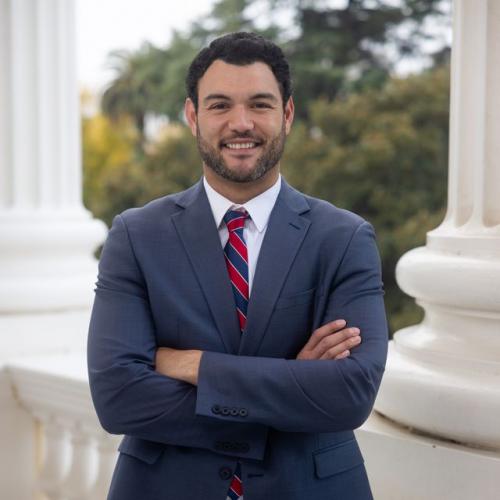
Asm. David Tangipa
Sponsored bills
The Personal Income Tax Law allows various credits against the taxes imposed by that law. This bill, for taxable years beginning on or after January 1, 2026, and before January 1, 2031, would allow a credit against the taxes imposed by that law to a qualified taxpayer, as defined, in a specified amount equal to the fee imposed to file a federal Petition for Alien Relative (I-130) form, not to exceed one credit per taxable year per qualified taxpayer, as specified. Existing law requires any bill authorizing a new tax expenditure, as defined, to include tax credits, to contain, among other things, specific goals, purposes, and objectives that the tax credit will achieve, detailed performance indicators, and data collection requirements. This bill would include additional information required for any bill authorizing a new tax expenditure. This bill would take effect immediately as a tax levy.
The Personal Income Tax Law allows various credits against the taxes imposed by that law. This bill would allow a credit against those taxes for each taxable year beginning on or after January 1, 2025, and before January 1, 2030, to a qualified taxpayer, as defined, in an amount equal to 40% of the taxpayer's qualified expenses, as defined, not to exceed $400 per taxable year, or $2,000 cumulatively. Existing law requires any bill authorizing a new tax credit to contain, among other things, specific goals, purposes, and objectives that the tax credit will achieve, detailed performance indicators, and data collection requirements. The bill would also include additional information required for any bill authorizing a new tax expenditure. This bill would take effect immediately as a tax levy.
The Personal Income Tax Law allows various credits against the taxes imposed by that law. This bill, for taxable years beginning on or after January 1, 2026, and before January 1, 2031, would allow a credit against the taxes imposed by that law to a qualified taxpayer in an amount equal to the qualified income earned by the qualified taxpayer for medical services, as defined, performed in a rural area in the state, not to exceed $5,000 per taxable year, as specified. Existing law requires any bill authorizing a new tax expenditure to contain, among other things, specific goals, purposes, and objectives that the tax expenditure will achieve, detailed performance indicators, and data collection requirements. This bill would include additional information required for any bill authorizing a new tax expenditure. This bill would take effect immediately as a tax levy.
Existing law establishes the California State University and the University of California as 2 of the segments of public postsecondary education in this state. Existing law requires the California State University, and requests the University of California, to publicly provide labor market outcome information relating to the graduates of their undergraduate programs. This bill would require the California State University, and would request the University of California, to include in admission notifications (1) a hyperlink to the university's internet website that contains the labor market outcome information described above, and (2) information on student loans, as specified.
Existing law establishes the California State Library, which includes the California Research Bureau, under the control of an executive known as the "State Librarian." Existing law authorizes the California State Library to serve as the central reference and research library for the departments of state government and to, among other things, maintain adequate legislative reference and research library services for the Legislature. Existing law declares as legislative policy that all of the territory of the state shall be included within a community college district, except that territory located within a county where the county residents accounted for fewer than 350 units of average daily attendance in the state's community colleges during the preceding fiscal year, and that territory located within such a county may be included within a community college district pursuant to prescribed procedures. This bill instead would declare as legislative policy that all of the territory of the state shall be included within a community college district or otherwise provided with equivalent opportunities for residents to participate in both in-person and online community college programs and courses. This bill would require the California Research Bureau to conduct a study and prepare a report evaluating the provision of community college services and opportunities to residents of the underserved Counties of Amador, Alpine, Mariposa, Modoc, and Sierra that are not fully included within the territory of a community college district, and would require the report to include policy recommendations regarding how the state can ensure that residents of those 5 counties have opportunities to participate in both in-person and online community college programs and courses equivalent to those of similarly sized communities that are fully included within the territory of a community college district, as provided. To assist with and inform the development of the report and recommendations, the bill would require the California Research bureau to convene and consult a working group that includes specified voluntary representatives, and would authorize the bureau to request and receive information from specified entities. The bill would require the California Research bureau to submit the report and recommendations to the Assembly Committee on Higher Education, the Senate Committee on Education, and the Governor on or before December 31, 2027. The bill would repeal these provisions as of January 1, 2032. This bill would make legislative findings and declarations as to the necessity of a special statute for the Counties of Amador, Alpine, Mariposa, Modoc, and Sierra.
Existing law establishes the University of California, administered by the Regents of the University of California, the California State University, administered by the Trustees of the California State University, and the California Community Colleges, administered by the Board of Governors of the California Community Colleges, as the 3 segments of public postsecondary education in the state. The Donahoe Higher Education Act prohibits the campuses of those segments from charging mandatory systemwide tuition or fees to specified students who apply for a waiver, including a child of any veteran of the United States military who has a service-connected disability, has been killed in service, or has died of a service-connected disability, an undergraduate student who is a recipient of a Medal of Honor, or an undergraduate student who is a child of a recipient of a Medal of Honor and who is no more than 27 years old, if certain requirements are satisfied. This bill would additionally prohibit the campuses of the 3 segments of public postsecondary education from charging those students any mandatory campus-based fees, as provided. To the extent the bill would add additional duties on community college districts, the bill would impose a state-mandated local program. The bill would apply to the campuses of the University of California only to the extent that the regents, by appropriate resolution, make it apply. The California Constitution requires the state to reimburse local agencies and school districts for certain costs mandated by the state. Statutory provisions establish procedures for making that reimbursement. This bill would provide that, if the Commission on State Mandates determines that the bill contains costs mandated by the state, reimbursement for those costs shall be made pursuant to the statutory provisions noted above.
The Safe Drinking Water, Wildfire Prevention, Drought Preparedness, and Clean Air Bond Act of 2024, approved by the voters as Proposition 4 at the November 5, 2024, statewide general election, authorized the issuance of bonds in the amount of $10,000,000,000 pursuant to the State General Obligation Bond Law to finance projects for safe drinking water, drought, flood, and water resilience, wildfire and forest resilience, coastal resilience, extreme heat mitigation, biodiversity and nature-based climate solutions, climate-smart, sustainable, and resilient farms, ranches, and working lands, park creation and outdoor access, and clean air programs. The act makes $135,000,000 available, upon appropriation by the Legislature, to the Office of Emergency Services for a wildfire mitigation grant program to provide, among other things, loans, direct assistance, and matching funds for projects that prevent wildfires, increase resilience, maintain existing wildfire risk reduction projects, reduce the risk of wildfires to communities, or increase home or community hardening. The act provides that eligible projects include, but are not limited to, grants to local agencies, state agencies, joint powers authorities, tribes, resource conservation districts, fire safe councils, and nonprofit organizations for structure hardening of critical community infrastructure, wildfire smoke mitigation, evacuation centers, including community clean air centers, structure hardening projects that reduce the risk of wildfire for entire neighborhoods and communities, water delivery system improvements for fire suppression purposes for communities in very high or high fire hazard areas, wildfire buffers, and incentives to remove structures that significantly increase hazard risk. This bill would include in the list of eligible projects grants to the above-mentioned entities for improvements to public evacuation routes in very high and high fire hazard severity zones, mobile rigid dip tanks, as defined, to support firefighting efforts, prepositioned mobile rigid water storage, as defined, and improvements to the response and effectiveness of fire engines and helicopters. The bill would also include grants, in coordination with the Public Utilities Commission, to local agencies, state agencies, special districts, joint powers authorities, tribes, and nonprofit organizations for backup electrical generators for water reservoirs.
The Personal Income Tax Law allows various credits against the taxes imposed by that law. This bill, for each taxable year beginning on or after January 1, 2026, and before January 1, 2031, would allow a credit against the taxes imposed under that law to a qualified taxpayer, as defined, for the qualified expenses of in vitro fertilization, as defined, not to exceed $5,000 paid or incurred during the taxable year. Existing law requires any bill authorizing a new tax expenditure to contain, among other things, specific goals that the tax expenditure will achieve, detailed performance indicators, and data collection requirements. This bill also would include additional information required for any bill authorizing a new tax expenditure. This bill would take effect immediately as a tax levy.
Existing law requires a person engaged in the production of human whole blood or human whole blood derivatives to be licensed by the state, and requires licensed blood banks and blood transfusion services to meet specified standards. Existing law authorizes the State Department of Public Health to establish and require compliance with additional requirements, as specified. This bill, the California Source Plasma Donation Centers Act, would authorize a person to operate a source plasma donation center for the purpose of collecting source plasma, as defined. The bill would, among other things, authorize a source plasma donation center to offer payment to a donor of money or other valuable consideration. The bill would require the operator of a source plasma donation center to obtain a license from the State Department of Public Health, as specified. The bill would authorize the department to regulate source plasma donation centers, including to inspect the property or records of the center and to suspend or revoke a license for violation of specified law or regulation. The bill would authorize the department to promulgate any regulations it deems necessary to implement the bill's provisions. The bill would make a violation of the bill's provisions a misdemeanor, and would authorize a district or city attorney to prosecute a violation of the bill's provisions. By creating a new crime, the bill would impose a state-mandated local program. This bill would require a local health officer, if they obtained records from a source plasma donation center of a plasma donor who had a reactive result to HIV antibody testing, upon completion of the officer's efforts to locate and notify the plasma donor, to expunge all of the individual's records. By imposing additional duties on local health officials, this bill would impose a state-mandated local program. Existing law establishes the Clinical Laboratory Improvement Fund and requires specified fees collected from the licensing and regulation of blood banks and blood transfusion services to be deposited in the fund, available upon appropriation, for the purpose of regulating blood banks and blood transfusion services. This bill would additionally require fees collected from the licensing and regulation of source plasma donation centers to be deposited in the fund for the purpose of regulating source plasma donation centers, upon appropriation by the Legislature. Existing law requires specified establishments that receive specified human whole blood and derivatives to be considered blood bank depositories and require specified procedures on blood for transfusion to be the sole responsibility of the blood bank depository. This bill would exempt source plasma donation centers from these provisions. The California Constitution requires the state to reimburse local agencies and school districts for certain costs mandated by the state. Statutory provisions establish procedures for making that reimbursement. This bill would provide that with regard to certain mandates no reimbursement is required by this act for a specified reason. With regard to any other mandates, this bill would provide that, if the Commission on State Mandates determines that the bill contains costs so mandated by the state, reimbursement for those costs shall be made pursuant to the statutory provisions noted above.