Maddy summaryThis bill designates the week of April 17 to April 23, 2026, as Cambodian Genocide Memorial Week in California. It aims to honor the survivors and descendants of the Cambodian people while remembering those who died during the Khmer Rouge regime between 1975 and 1979. The resolution calls on all Californians to observe this week by participating in appropriate activities and programs that recognize the tragedy and the resilience of the Cambodian community.
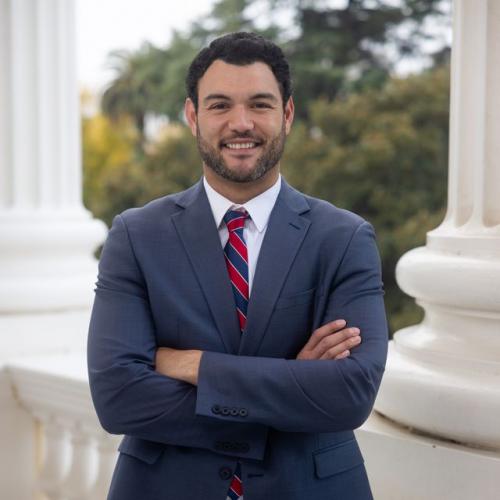
Asm. David Tangipa
Sponsored bills
Existing law, the California Community Care Facilities Act, provides for the licensure and regulation of community care facilities, including foster family homes and foster family agencies, by the State Department of Social Services. Existing law requires a criminal record check of applicants for a license, special permit, or certificate of approval for a foster family home or certified family home, and other persons, including nonclients who reside in those homes and staff and employees. Existing law requires the department to check the child abuse and neglect registry of a different state for a licensee of a community care facility, or any specified associated individual, who has lived in another state in the preceding 5 years. Existing law generally makes violations of these requirements a crime. This bill would authorize a licensee of a community care facility to approve an individual to care for children before the completion of another state's child abuse and neglect registry check if certain specified conditions are met, including that the community care facility has submitted a request for the out-of-state abuse and neglect registry check to the department. The bill would require a licensee to remove an applicant from the community care facility immediately upon receipt of information that would disqualify the applicant from approval and notify the department of the removal within 3 business days. By expanding the scope of a crime, this bill would impose a state-mandated local program. The California Constitution requires the state to reimburse local agencies and school districts for certain costs mandated by the state. Statutory provisions establish procedures for making that reimbursement. This bill would provide that no reimbursement is required by this act for a specified reason.

Existing law establishes the Department of Veterans Affairs, which administers various programs that provide benefits to veterans, as defined. Existing law additionally establishes a statewide system of veterans' homes to provide room, board, and other services to eligible veterans and their spouses or domestic partners. Existing law establishes the Department of Motor Vehicles in the Transportation Agency and sets forth various powers and duties for the department, including prescribing and providing suitable forms of applications, certificates of ownership, registration cards, driver's licenses, and all other forms that are deemed necessary. This bill would require the Department of Motor Vehicles, in coordination with the Department of Veterans Affairs, to provide mobile services to each resident at each California veterans' home at least once per calendar year. The bill would require the Department of Veterans Affairs to assist by coordinating the scheduling, space, and outreach to residents to facilitate the provision of those services. For the purposes of these provisions, the bill would define "mobile services" as, among other things, issuance or renewal of driver's licenses and identification and Real ID application processing.
Maddy summaryThis bill designates April 14, 2026, as California Holocaust Memorial Day to honor the victims of the Holocaust and promote awareness of the tragedy. It urges all Californians to observe this day with appropriate remembrance activities, such as educational events or moments of reflection. The resolution also highlights the importance of combating antisemitism and other forms of hatred by remembering the historical events and the heroism shown during that time.
Maddy summaryThis House Resolution officially recognizes Vaisakhi as a significant cultural and religious observance for Sikh, Hindu, and Buddhist communities in California. The bill formally acknowledges the festival's historical roots as a harvest celebration and its modern importance for Sikhs, who mark the day with religious ceremonies and the initiation of new members into the Khalsa faith. By designating April 14, 2026, as the date for this recognition, the resolution encourages Californians to participate in the festivities and expresses respect for the diverse traditions associated with the holiday.
This measure would designate an unspecified portion of State Route 41 in the County of Madera as the Buffalo Soldiers Madera County Trailhead. The measure would request that the Department of Transportation determine the cost of appropriate signs showing this special designation and, upon receiving donations from nonstate sources sufficient to cover the cost, to erect those signs.
Existing law, the Alcoholic Beverage Control Act, contains various provisions regulating the application for, the issuance of, and the suspension of alcoholic beverage licenses by the Department of Alcoholic Beverage Control. Existing law makes the sale of an alcoholic beverage to a person under 21 years of age a misdemeanor and authorizes a licensee to refuse to sell or serve alcoholic beverages to a person who is unable to produce adequate proof of age. Existing law makes it a crime to operate a vehicle while under the influence of alcohol or drugs, and sets forth the penalties for a violation of these provisions. Under existing law, if a person is convicted of a driving under the influence violation and the offense occurs within 10 years of 2 or more separate driving under the influence violations that resulted in convictions, the offense is subject to escalating fines, suspensions, and other sanctions. This bill would require a court, when sentencing an individual to a term of imprisonment to be served in state prison for a 3rd driving under the influence offense within a 10-year period to prohibit the individual from purchasing alcoholic beverages for life. The bill would require the Department of Motor Vehicles to issue an identification card or driver's license with an appropriate designation on the face upon the receipt of an abstract of the record of a court. The bill would authorize a licensee to refuse to sell alcoholic beverages to an individual who provides the licensee with an identification card or driver's license with such a designation. To the extent it would require a higher level of service from court staff who are county employees, the bill would impose a state-mandated local program. The California Constitution requires the state to reimburse local agencies and school districts for certain costs mandated by the state. Statutory provisions establish procedures for making that reimbursement. This bill would provide that, if the Commission on State Mandates determines that the bill contains costs mandated by the state, reimbursement for those costs shall be made pursuant to the statutory provisions noted above.
Existing law establishes the Medi-Cal program, which is administered by the State Department of Health Care Services and under which qualified low-income individuals receive health care services. The Medi-Cal program is in part governed by, and funded pursuant to, federal Medicaid program provisions. Under existing law, a critical access hospital is eligible for supplemental payments for Medi-Cal covered outpatient services rendered to Medi-Cal eligible persons, as specified. This bill would appropriate $5,500,000 from the General Fund to the department for the purpose of providing supplemental payments for services covered under the Medi-Cal program, with the stated intent that these payments facilitate the maintenance of operations of the health care system in the County of Inyo and thereby prevent the closure of hospitals within the county. The bill would require that, of the appropriated moneys, $2,500,000 be distributed to the Northern Inyo Healthcare District and $3,000,0000 be distributed to the Southern Inyo Healthcare District. Under the bill, these payments would be in addition to any supplemental payments received by a hospital within the county pursuant to the above-described provision regarding critical access hospitals. This bill would make legislative findings and declarations as to the necessity of a special statute for the County of Inyo.
Maddy summaryThis bill urges state and local education leaders to formally evaluate new reporting requirements by asking six specific questions about their purpose, audience, value, feasibility, duplication, and duration. It aims to reduce administrative burdens on school districts by ensuring that any new data collection efforts directly support student learning rather than diverting resources. The resolution calls on the Legislature, Governor, and various state agencies to adopt this structured analysis process before implementing additional planning or accountability mandates. By promoting a more coherent system, the bill seeks to help schools use public funds more effectively for classrooms and pupil well-being.
Maddy summaryThis legislative resolution honors Major League Baseball Opening Day 2026 and celebrates the sport's deep historical and cultural significance within California. It acknowledges the state's status as home to five MLB teams and recognizes the contributions of players, coaches, staff, and fans to the community. The text expresses gratitude to team owners and executives for their investment in the franchises while pledging continued support for baseball in the state. Ultimately, the bill serves as a commemorative statement rather than enacting new laws or policy changes.