

Existing law provides that libel is a false and unprivileged written publication that injures the reputation and that slander is a false and unprivileged publication, orally uttered, that injures the reputation, as specified. Existing law makes certain publications and communications privileged and therefore protected from civil action, including complaints of sexual harassment by an employee, without malice, to an employer based on credible evidence and communications between the employer and interested persons regarding a complaint of sexual harassment. This bill would include among those privileged communications a communication made by an individual, without malice, regarding an incident of sexual assault, harassment, or discrimination, as defined, and would specify the attorney's fees and damages available to a prevailing defendant in any defamation action brought against that defendant for making that communication.
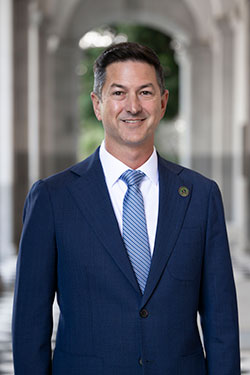
Asm. Chris Ward
Sponsored bills
Existing law establishes the California State University, under the administration of the Trustees of the California State University, and the University of California, under the administration of the Regents of the University of California, as 2 of the segments of public postsecondary education in this state. Existing law provides for the missions and functions of these segments, and states that the University of California has the sole authority in public higher education to award doctoral degrees in all fields of learning, except that it may agree with the California State University to award joint doctoral degrees in selected fields. However, existing law authorizes the California State University to offer doctoral programs in education, audiology, physical therapy, occupational therapy, and public health without that agreement. This bill would authorize the California State University to award professional or applied doctoral degrees statewide that do not duplicate University of California doctoral degrees and satisfy certain requirements. The bill would require a California State University campus seeking authorization to offer a professional or applied doctoral degree program pursuant to the bill to submit specified information on the proposed doctoral degree for review by the office of the Chancellor of the California State University, and approval by the trustees, as provided. The bill would authorize professional or applied doctoral degree programs that are approved for implementation by the trustees pursuant to the bill to be implemented at any California State University campus, but would limit the number of doctoral degree programs that may be offered at a California State University campus. The bill would prohibit the trustees from approving more than 10 new doctoral degree disciplines pursuant to the bill per academic year. The bill would require the Legislative Analyst's Office to conduct a systemwide evaluation of doctoral degree programs established pursuant to the bill and report the results of the evaluation to the Legislature and the Governor on or before December 31, 2028.
Existing law establishes the California Transportation Commission in the Transportation Agency. Existing law vests the California Transportation Commission with various powers and duties relative to the programming of transportation capital projects and allocation of funds to those projects pursuant to the state transportation improvement program and various other transportation funding programs. This bill would require the commission to convene relevant state agencies to assess the procurement and implementation of data, modeling, and analytic software tools to support the state's sustainable transportation, congestion management, affordable housing, efficient land use, air quality, economic, and climate change strategies and goals, as provided. On or before July 1, 2025, the bill would require the commission to develop a proposal to procure data, modeling, and analytic software tools and a process to grant access to the data it procures directly, or provide a process for direct allocation of funding to agencies for data procurement, or both of those, as provided.
Existing law authorizes a public transit operator, as defined, to enforce parking violations in specified transit-only traffic lanes through the use of video imaging and to install automated forward facing parking control devices on public transit vehicles for the purpose of video imaging parking violations occurring in transit-only traffic lanes, as specified. Existing law requires a designated employee of a city, county, city and county, or a contracted law enforcement agency for a special transit district, who is qualified by the city and county or the district to issue parking citations, to review video image recordings for the purpose of determining whether a parking violation occurred in a transit-only traffic lane and to issue a notice of violation to the registered owner of a vehicle within 15 calendar days, as specified. Existing law makes these video image records confidential, and provides that these records are available only to public agencies to enforce parking violations. Existing law requires an operator who implements an automated enforcement system described above to report to specified committees of the Legislature on the system's effectiveness and impact on traffic outcomes, among other things, as specified. This bill would, until January 1, 2030, authorize a local agency, as defined, to install automated forward facing parking control devices on city-owned or district-owned parking enforcement vehicles for the purpose of taking photographs of parking violations occurring in bicycle lanes. The bill would require a designated employee of a city, county, city and county, or a contracted law enforcement agency for a special transit district, who is qualified by the city and county or the district to issue parking citations, to review photographs for the purpose of determining whether a parking violation occurred in a bicycle lane and to issue a notice of violation to the registered owner of a vehicle within 15 calendar days, as specified. The bill would require these photographic records to be confidential and make these records available only to public agencies to enforce parking violations. The bill would require any local agency that implements this pilot program to report to specified committees of the Legislature on the system's effectiveness and impact on traffic outcomes, among other things, by December 31, 2028. Existing constitutional provisions require that a statute that limits the right of access to the meetings of public bodies or the writings of public officials and agencies be adopted with findings demonstrating the interest protected by the limitation and the need for protecting that interest. This bill would make legislative findings to that effect.
Existing law establishes the California Community Colleges, under the administration of the Board of Governors of the California Community Colleges, as one of the segments of public postsecondary education in this state. Existing law makes specified community college career development and college preparation courses and classes for which credit is not given, and that are offered in a sequence of courses leading to certain outcomes, eligible for state funding. This bill would instead make the same courses and classes for which credit is not given eligible for state funding if those courses are offered in both face-to-face and distance education instructional methods.
(1) Existing law requires the adopted course of study for grades 1 to 6, inclusive, and the adopted course of study for grades 7 to 12, inclusive, to include certain areas of study, including, among others, English, mathematics, social sciences, science, and visual and performing arts, as specified. This bill, with respect to both of the above-referenced adopted courses of study, would require the science area of study to include an emphasis on the causes and effects of climate change and methods to mitigate and adapt to climate change. The bill would require that appropriate coursework including this material be offered to pupils as soon as possible, commencing no later than the 2024–25 school year. Because the bill would impose new duties on school districts, it would constitute a state-mandated local program. (2) This bill would incorporate additional changes to Section 51210 of the Education Code proposed by AB 446 and SB 509 to be operative only if this bill and either or both of those bills are enacted and this bill is enacted last. (3) The California Constitution requires the state to reimburse local agencies and school districts for certain costs mandated by the state. Statutory provisions establish procedures for making that reimbursement. This bill would provide that, if the Commission on State Mandates determines that the bill contains costs mandated by the state, reimbursement for those costs shall be made pursuant to the statutory provisions noted above.
The California Global Warming Solutions Act of 2006 requires the State Air Resources Board to adopt regulations to require the reporting and verification of statewide greenhouse gas emissions and to monitor and enforce compliance with the act. The act requires the state board to make available, and update at least annually, on its internet website the emissions of greenhouse gases, criteria pollutants, and toxic air contaminants for each facility that reports to the state board, as provided. This bill would require, on or before January 1, 2026, and biennially thereafter, a covered entity, as defined, to prepare a climate-related financial risk report disclosing the entity's climate-related financial risk and measures adopted to reduce and adapt to climate-related financial risk. The bill would require the covered entity to make a copy of the report available to the public on its own internet website. The bill would require the state board to contract with a climate reporting organization, as defined, to biennially prepare a public report that contains specified information, including a review of the disclosure of climate-related financial risk contained in a subset of publicly available climate-related financial risk reports and an analysis of the systemic and sectorwide climate-related financial risks facing the state. The bill would require the state board to adopt regulations that authorize it to seek administrative penalties from covered entities for failing to make the report publicly available on its internet website or publishing an inadequate or insufficient report, as specified. The bill would require covered entities to pay an annual fee for the state board's actual and reasonable costs to administer and implement the bill. The bill would create the Climate-Related Financial Risk Disclosure Fund, require the proceeds of the fees to be deposited in the fund, and continuously appropriate the moneys in the fund to the state board for purposes of the bill. By creating a continuously appropriated fund, the bill would make an appropriation.
The California Global Warming Solutions Act of 2006 requires the State Air Resources Board to adopt regulations to require the reporting and verification of statewide greenhouse gas emissions and to monitor and enforce compliance with the act. The act requires the state board to make available, and update at least annually, on its internet website the emissions of greenhouse gases, criteria pollutants, and toxic air contaminants for each facility that reports to the state board, as provided. This bill would require the state board, on or before January 1, 2025, to develop and adopt regulations requiring specified partnerships, corporations, limited liability companies, and other business entities with total annual revenues in excess of $1,000,000,000 and that do business in California, defined as "reporting entities," to publicly disclose to the emissions reporting organization, as defined, and obtain an assurance engagement on, starting in 2026 on a date to be determined by the state board, and annually thereafter, their scope 1 and scope 2 greenhouse gas emissions, as defined, and, starting in 2027 and annually thereafter, their scope 3 greenhouse gas emissions, as defined, from the reporting entity's prior fiscal year, as provided. The bill would require the state board to review during 2029, and update as necessary on or before January 1, 2030, these deadlines to evaluate trends in scope 3 emissions reporting and to consider changes to the deadlines, as provided. The bill would require a reporting entity to obtain an assurance engagement, performed by an independent third-party assurance provider, of the entity's public disclosure as provided. The bill would require the state board, in developing these regulations, to consult with the Attorney General, other government stakeholders, investors, stakeholders representing consumer and environmental justice interests, and reporting entities that have demonstrated leadership in full-scope greenhouse gas emissions accounting and public disclosure and greenhouse gas emissions reductions. The bill would also require the state board to ensure that the assurance process minimizes the need for reporting entities to engage multiple assurance providers and ensures sufficient assurance provider capacity, as well as timely reporting implementation, as required. The bill would further require the state board to contract with an emissions reporting organization to develop a reporting program to receive and make publicly available the required disclosures. The bill would authorize the state board, starting in 2033 and every 5 years thereafter, to assess the global greenhouse gas accounting and reporting standards and to adopt an alternative standard if it determines that using the alternative standard would more effectively further the goals of the bill. This bill would require the state board, on or before July 1, 2027, to contract with the University of California, the California State University, a national laboratory, or another equivalent academic institution to prepare a report on the public disclosures made by reporting entities to the emissions reporting organization. The bill would require, in preparing the report, consideration to be given to, at a minimum, greenhouse gas emissions from reporting entities in the context of state greenhouse gas emissions reduction and climate goals. The bill would require the state board to provide the report to the emissions reporting organization to post on a digital platform that would be required to be created by the emissions reporting organization, and publicly accessible, to house the state board's report and the reporting entities' public disclosures. The bill would require the emissions reporting organization to provide the state board's report to the relevant policy committees of the Legislature. This bill would require a reporting entity, upon filing its disclosure, to pay to the state board an annual fee set by the state board, as provided. The bill would create the Climate Accountability and Emissions Disclosure Fund, require the proceeds of the fees to be deposited in the fund, and continuously appropriate the moneys in the fund to the state board for purposes of the bill. By creating a continuously appropriated fund, the bill would create an appropriation. The bill would require the state board to adopt regulations that authorize it to seek administrative penalties for violations of these provisions, as specified.
Existing law establishes the California Transportation Commission (CTC) to advise and assist the Secretary of Transportation and the Legislature in formulating and evaluating state policies and plans for transportation programs in the state. Existing law tasks the CTC with various transportation-related studies and reports to the Legislature. This bill would require the CTC to convene a task force to study the relationship between vehicle weight and injuries to vulnerable road users, such as pedestrians and cyclists, and degradation to roads, and to study the costs and benefits of imposing a passenger vehicle weight fee to include consideration of vehicle weight. The bill would require the CTC, by no later than January 1, 2026, to prepare and submit a report to the Legislature, as specified.
Existing law, the California Building Standards Law, establishes the California Building Standards Commission within the Department of General Services. Existing law requires the commission to approve and adopt building standards and to codify those standards in the California Building Standards Code. Existing law requires the State Fire Marshal to research and develop, and authorizes the State Fire Marshal to propose to the California Building Standards Commission, mandatory building standards for fire resistance based on occupancy risk categories in very high, high, and moderate California fire severity zones, as provided. This bill would require the State Fire Marshal to research standards for single-exit, single stairway apartment houses, with more than 2 dwelling units, in buildings above 3 stories and provide a report to specified legislative committees and to the California Building Standards Commission by January 1, 2026. The bill would require this report to address fire and life safety or emergency activities in single-exit, single stairway apartment houses, with more than 2 dwelling units, in buildings above 3 stories. The bill would repeal the above-mentioned provisions on January 1, 2028.