Maddy summaryACR 10 designates January 13, 2025, as Korean American Day in California. The resolution commemorates the arrival of the first Korean immigrants to the U.S. on January 13, 1903, and recognizes Korean Americans' historical contributions to California and the nation. It does not create new laws or policies, but serves as a ceremonial acknowledgment of this community's heritage and impact.
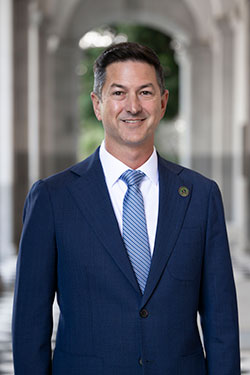
Asm. Chris Ward
Sponsored bills
Maddy summaryThis bill is a House Resolution that formally recognizes the work of school board members across California by designating January 2025 as School Board Recognition Month. It directly affects local school districts and county offices of education by honoring the nearly 5,000 elected school board members who serve in these roles. The resolution expresses appreciation for their dedication to public education and encourages community members to support these local officials in their efforts to serve students. This is a commemorative measure rather than a policy change, as it does not alter laws or regulations but instead highlights the importance of school governance.
The California Constitution prohibits the total annual appropriations subject to limitation of the State and of each local government from exceeding the appropriations limit of the entity of government for the prior year adjusted for the change in the cost of living and the change in population. The California Constitution defines "appropriations subject to limitation" of the State for these purposes. The California Constitution establishes the Budget Stabilization Account and requires, for every fiscal year and based on the Budget Act for that fiscal year, the Controller to transfer from the General Fund to the Budget Stabilization Account, no later than October 1, a sum equal to 1.5% of the estimated amount of General Fund revenues for that fiscal year. The California Constitution requires other transfers between the General Fund and the Budget Stabilization Account, as specified. The California Constitution prohibits the amount transferred pursuant to these provisions for any fiscal year from exceeding an amount that would result in a balance in the account that, when the transfer is made, exceeds 10% of the amount of the General Fund proceeds of taxes for the fiscal year estimate, as specified. This measure would change the 1.5% required transfer to an undetermined percentage of the estimated amount of General Fund revenues for that fiscal year. The measure would change the 10% limit on the balance in the Budget Stabilization Account to 20% of the amount of the General Fund proceeds of taxes for the fiscal year estimate, as specified. The measure would specify that funds transferred under these provisions to the Budget Stabilization Account do not constitute appropriations subject to the above-described annual appropriations limit.
Existing law, the Veterans Housing and Homeless Prevention Act of 2014 (the act) , requires the California Housing Finance Agency, the Department of Housing and Community Development, and the Department of Veterans Affairs (referred to collectively as "the departments") to establish and implement programs that focus on veterans at risk for homelessness or experiencing temporary or chronic homelessness, as specified. In this regard, existing law requires the departments to establish and implement programs that, among other things, prioritize projects that combine housing and supportive services. Existing law requires the departments to ensure at least 50% of funds awarded for capital development provide housing to veteran households with extremely low incomes. Existing law requires a determination of whether a potential tenant is eligible under those provisions to consider all of a household's income sources upon initial tenancy, as specified. Existing law, for purposes of supportive housing units that are restricted to extremely low income veterans pursuant to a regulatory agreement with the committee, authorizes an entity tasked with making referrals of those units targeted to extremely low income households that is unable to place a qualified tenant in a qualified unit, as specified, to match prospective secondary tenants to qualified units. For purposes of the act, existing law defines a "secondary tenant" as (1) a veteran who is homeless, has an income of up to 50% of the median income, and is receiving income as a result of service-connected disability benefits or (2) a veteran who is homeless and has an income of up to 60% of the area median income, but would otherwise have an income below 50% of the area median income if not for their income as a result of their service-connected disability. For purposes of supportive housing for veterans funded by tax credits and private activity bonds, existing law defines a "secondary tenant" as a veteran who is homeless, who has an income of up to 60% of the area median income, and who is receiving income as a result of service-connected disability benefits. This bill would instead, for both purposes described above, define a "secondary tenant" to mean a veteran who is homeless and has an income of up to 60% of the area median income. The bill would prohibit a determination of whether a potential tenant is eligible for supportive, affordable, or transitional housing under the act from considering a potential tenant's service-connected disability benefits. This bill would declare that it is to take effect immediately as an urgency statute.
Existing law requires the State Department of Education to establish a formal liaison with the United States Department of Defense and school districts and county offices of education that enroll military dependents to, among other things, create model memoranda of agreement between military bases and school districts or county offices of education regarding enabling schoolage military dependents to experience a smoother transition from one school to another school. Existing law authorizes a governing board of a school district and a county office of education to undertake certain activities to properly address the needs of military dependents. This bill would require the State Department of Education to establish a nonmonetary California Purple Star School Designation Program to reduce the burden on military-connected pupils and their families and to publicly recognize and designate public schools that meet certain requirements related to supporting military-connected pupils and their families' unique needs, as provided. The bill would require the department to develop an annual application process and adopt application criteria for the California Purple Star School Designation Program, as specified, and would provide that a Purple Star School designation is valid for 3 years, after which a schoolsite seeking to renew its designation is required to reapply.
Existing law, notwithstanding the requirement that each person between 6 and 18 years of age who is not otherwise exempted is subject to compulsory full-time education, requires a pupil to be excused from school for specified types of absences, including, among others, for purposes of spending time with a member of the pupil's immediate family who is an active duty member of the uniformed services, and has been called to duty for, is on leave from, or has immediately returned from, deployment to a combat zone or combat support position, as specified. This bill would remove the requirement that the deployment be to a combat zone or combat support position, thereby expanding the scope of that excused absence to encompass all deployments. The bill also would make nonsubstantive changes. To the extent the bill would impose additional duties on school officials, the bill would impose a state-mandated local program. This bill would incorporate additional changes to Section 48205 of the Education Code proposed by SB 1138 and AB 2499 to be operative only if this bill and either or both of those bills are enacted and this bill is enacted last. The California Constitution requires the state to reimburse local agencies and school districts for certain costs mandated by the state. Statutory provisions establish procedures for making that reimbursement. This bill would provide that, if the Commission on State Mandates determines that the bill contains costs mandated by the state, reimbursement for those costs shall be made pursuant to the statutory provisions noted above.

Existing law establishes a public library system, including school libraries, unified school district and union high school district public libraries, municipal libraries, county free libraries, the California State Library, and library districts. Under existing law, the Legislature declares that the public library is, among other things, a source of information and inspiration to persons of all ages, cultural backgrounds, and economic statuses. This bill would require every public library jurisdiction, as defined, that directly receives any state funding to establish, adopt, and maintain a written and publicly accessible collection development policy for its libraries by January 1, 2026, as specified. The bill would require the collection development policy to, among other things, (1) guide the selection and deselection of library materials, as defined, and (2) establish a process for community members to share their concerns regarding library materials and request materials be reconsidered for inclusion in the library's collection. The bill would require the adopted policy to be sent to the State Librarian, and would authorize the State Librarian or their designee to provide technical assistance to public libraries in developing their collection development policy. The bill would prohibit the governing board or body of a public library, or any body or commission designated to review the procurement, retention, or circulation of, or access to, library materials, from (1) proscribing the circulation or procurement of, or access to, library materials in a public library because of the topic addressed by the library materials or because of the views, ideas, or opinions contained in materials or (2) creating policies or procedures that limit or restrict access to library materials offered by the public library, except as provided. The bill would also prohibit library materials in a public library from being excluded, and access to library materials from being limited, solely on the bases of (1) specified protected characteristics of a subject of the library materials, an author of the materials, the sources of the library materials, or the perceived or intended audience for the library materials, (2) that the materials contain inclusive and diverse perspectives, or (3) that the materials may include sexual content, except as provided. The bill would provide that a person's right to use a public library and its resources shall not be denied or abridged solely because of personal characteristics, age, background, or views. The bill would prohibit a librarian, library media specialist, other employee, or contractor at a public library from being subject to termination, demotion, discipline, or retaliation for (1) refusing to remove a library material before it has been reviewed in accordance with the public library's process for reconsideration of library materials or (2) making displays, acquisitions, or programming decisions that the employee believes, in good faith, are in accordance with the bill's provisions. The bill would provide that these provisions apply to a public library, as defined, including any public library operated on a contractual basis, or operated by a city, including a general law or charter city, county, special district, or joint powers authority, except that these provisions do not apply to any school library, as defined, or any library operated by the governing board of a school district, a county board of education, or the governing body of a charter school. To the extent these provisions impose additional duties on public libraries, the bill would create a state-mandated local program. The bill would include findings that changes proposed by this bill address a matter of statewide concern rather than a municipal affair and, therefore, apply to all cities, including charter cities. The California Constitution requires the state to reimburse local agencies and school districts for certain costs mandated by the state. Statutory provisions establish procedures for making that reimbursement. This bill would provide that, if the Commission on State Mandates determines that the bill contains costs mandated by the state, reimbursement for those costs shall be made pursuant to the statutory provisions noted above.

Existing law requires the State Department of Education to incorporate age-appropriate materials relating to, among other things, genocide and the Holocaust into publications that provide examples of curriculum resources for teacher use, consistent with the subject frameworks on history and social science. Under existing law, the Legislature encourages the incorporation of survivor, rescuer, liberator, and witness oral testimony into the teaching of genocide and the Holocaust. This bill would establish the California Teachers Collaborative for Holocaust and Genocide Education, to be responsible for establishing a statewide teacher professional development program on genocide, including the Holocaust, for school district, county office of education, and charter school teachers. The bill would require the collaborative to consist of leading genocide and Holocaust education organizations and institutions, genocide survivors, educators, and community leaders. The bill would provide that the collaborative's mission is to ensure that genocide, including Holocaust, education is taught consistent with, among other things, the content standards, curriculum frameworks, and instructional materials adopted by the State Board of Education, in ways that are interdisciplinary and age-appropriate to pupils of different grade levels. The bill would prescribe the duties of the collaborative, including, among others, developing and providing curriculum resources on genocide and Holocaust education. The bill would authorize other duties of the collaborative, subject to available funding, including, among others, providing, as determined by the department, annual verbal or written reports to the department and the Legislature on the collaborative's achievement of its mission. The bill would make the implementation of these provisions contingent upon an appropriation.
The Donahoe Higher Education Act sets forth, among other things, the missions and functions of California's public and independent segments of higher education and their respective institutions of higher education. A provision of the act applies to the University of California only to the extent that the Regents of the University of California, by appropriate resolution, act to make the provision applicable. A portion of the Donahoe Higher Education Act, known as the Equity in Higher Education Act, provides, among other things, that all students have the right to participate fully in the educational process, free from discrimination and harassment, and that California's postsecondary educational institutions have an affirmative obligation to combat racism, sexism, and other forms of bias, and a responsibility to provide equal educational opportunity. For purposes of the Equity in Higher Education Act, existing law defines "nationality" to include citizenship, country of origin, and national origin and defines "religion" to include all aspects of religious belief, observance, and practice, as provided. This bill would instead provide that California's postsecondary educational institutions have an affirmative obligation to combat discrimination on the basis of disability, gender, gender identity, gender expression, nationality or national identity, race or ethnicity, religion, sexual orientation, and other specified characteristics, and a responsibility to provide equal educational opportunity. For purposes of the Equity in Higher Education Act, the bill would instead define "nationality" or "national identity" to include a person's actual or perceived shared ancestry or ethnic characteristics, citizenship, or residency in a country with a dominant religion or distinct religious identity, as provided. For purposes of the Equity in Higher Education Act, the bill would define "discrimination on the basis of religion" to include, but not be limited to, anti-Semitism and Islamophobia. The bill would also state that it is the intent of the Legislature that each postsecondary educational institution undertake supportive measures to help students who have encountered discriminatory incidents, regardless of the location of the discriminatory incident, if the student feels the incident impairs their access to equal educational opportunities. This bill would require the California Community Colleges, the California State University, and independent institutions of higher education and private postsecondary educational institutions that receive state financial assistance, and would request the University of California, to include training to address discrimination against the 5 most targeted groups in the state, as provided, as part of any general antidiscrimination training or diversity, equity, and inclusion training that is offered by the institution, except as specified. By imposing new requirements on community college districts, the bill would impose a state-mandated local program. The California Constitution requires the state to reimburse local agencies and school districts for certain costs mandated by the state. Statutory provisions establish procedures for making that reimbursement. This bill would provide that, if the Commission on State Mandates determines that the bill contains costs mandated by the state, reimbursement for those costs shall be made pursuant to the statutory provisions noted above.
The existing federal Indian Gaming Regulatory Act of 1988 provides for the negotiation and execution of tribal-state gaming compacts for the purpose of authorizing certain types of gaming on Indian lands within a state. The California Constitution prohibits the Legislature from authorizing casinos of the type operating in Nevada and New Jersey and authorizes the Governor to negotiate and conclude tribal-state gaming compacts, subject to ratification by the Legislature. Existing law expressly ratifies a number of tribal-state gaming compacts between the State of California and specified Indian tribes. Existing law, the Gambling Control Act, provides for the regulation, oversight, and licensure of gambling establishments by the California Gambling Control Commission. Existing law prohibits a list of specified gambling games or any banking or percentage game played with cards, dice, or any device, for money, checks, credit, or any representative of value, and provides that any person who offers for play or participates in these games is guilty of a misdemeanor and is punishable as specified. Existing law authorizes gambling establishments to operate controlled games utilizing a player-dealer position, as defined, and to contract with a third party for the provision of proposition player services subject to specified conditions and regulatory requirements. Existing law generally specifies the persons or entities that may bring a civil action as prescribed for relief. Existing law authorizes a court to grant a preliminary injunction or temporary restraining order at any time prior to judgment, if the verified complaint or affidavits provide sufficient grounds to do so and the opposing party has been given notice. This bill would authorize a California Indian tribe, under certain conditions, to bring an action solely against licensed California card clubs and third-party proposition player services providers to seek a declaration as to whether a controlled game operated by a licensed California card club and banked by a third-party proposition player services provider constitutes a banking card game that violates state law, including tribal gaming rights under the constitutional provisions described above, and to request injunctive relief. The bill would require that any review of such a challenge be conducted de novo. The bill would prohibit a claim for money damages, penalties, or attorney's fees and would require that actions be filed no later than April 1, 2025, as specified. The bill would clarify that it does not intend to authorize an action, or otherwise impose any liability, against the state and would prohibit a court from issuing a preliminary injunction or temporary restraining order under certain circumstances. This bill would provide that its provisions are severable.