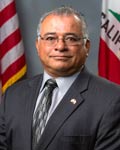
Photo of Rocky J. Chávez
R California Assembly · District 76

Asm. Rocky J. Chávez

Compare
Total votes
13,005
all sessions
Attendance
94%
681 missed
Near the chamber average
With party
94%
of cast votes
Lower than 94% of chamber peers
Bipartisan score
3%
crosses aisle rarely
Higher than 91% of chamber peers
Sponsored
1,052
bills & resolutions
Near the chamber average
Committees
0
assignments
1,052 bills and resolutions

Sponsored bills

Total
1,052
Primary
96
Co-sponsor
956
This page
1,052
matching current filters
Co-sponsor ACR 27
died · California Assembly · Co-sponsor
Relative to César Chávez.

This measure would call upon all Californians to observe César Chávez's birthday, March 31, as a day of public service, to recognize the hard work and self-sacrifice that farmworkers go through to feed all the families in our state, and to learn from César Chávez's life and his mission of nonviolence, social justice, and selfless service to others.

died Nov 30, 2014 1 co-sponsor
Primary AB 2092
Failed · California Assembly · Lead sponsor
Postsecondary education: Donahoe Higher Education Act: 4-year baccalaureate degree.

Existing law, known as the Donahoe Higher Education Act, sets forth, among other things, the missions and functions of California's public and independent segments of higher education, and their respective campuses. The public segments of higher education include the California State University, under the administration of the Trustees of the California State University, and the University of California, under the administration of the Regents of the University of California. This bill would require the Trustees of the California State University, and request the Regents of the University of California, to offer eligible students of their respective segments an agreement guaranteeing that a student who meets certain conditions may complete a baccalaureate degree within 4 academic years, with the exception of certain programs that may require up to 5 academic years to complete. The bill would specify that a student who scores in an unspecified percentile, or above, on a standardized college readiness assessment would be presumed to be eligible to enter into an agreement under the bill. The bill would require the agreement to outline a general pathway for the coursework that the student must complete in order to continue to be qualified for the guarantee and receive his or her baccalaureate within the agreed-upon time.

Failed Nov 30, 2014 0 co-sponsors
Co-sponsor AB 269
Failed · California Assembly · Co-sponsor
Vote by mail ballots: military or overseas voters.

Existing law requires that a vote by mail ballot be received by the issuing elections official or the precinct board no later than the close of polls on election day. This bill would make an exception for military or overseas voters, as defined, and would instead require that their vote by mail ballots be postmarked by the United States Postal Service or the Military Postal Service Agency on or before election day and received by their elections officials no later than 3 days after election day. Because the bill would impose additional duties on local elections officials, it would impose a state-mandated local program. The California Constitution requires the state to reimburse local agencies and school districts for certain costs mandated by the state. Statutory provisions establish procedures for making that reimbursement. This bill would provide that, if the Commission on State Mandates determines that the bill contains costs mandated by the state, reimbursement for those costs shall be made pursuant to these statutory provisions.

Failed Nov 30, 2014 1 co-sponsor
Primary AB 1631
Failed · California Assembly · Lead sponsor
Identity theft: unemployment insurance base wage file.

Existing law creates the Employment Development Department and requires that it pay unemployment compensation benefits to individuals who meet specified requirements, are unemployed, as defined, and file a valid claim for these benefits. Existing law requires employers to send the department specified information regarding their employees, including wage information and social security numbers. The department maintains a file of wage records of employees for the purpose of computing earnings in a base period to establish amounts for unemployment benefits. Existing law requires the director of the department to share information in its possession under specified circumstances. This bill would require the department to review, at least once each year, the information in its unemployment insurance base wage file, to identify if multiple names are associated with a single social security number. The bill would require the department, whenever it discovers that 5 or more names are associated with a single social security number, to inform the Department of Justice of this, along with relevant supporting information, as a potential incidence of identity theft.

Failed Nov 30, 2014 0 co-sponsors
Co-sponsor AB 2235
Failed · California Assembly · Co-sponsor
Education facilities: Kindergarten-University Public Education Facilities Bond Act of 2014.

(1) Existing law, the Leroy F. Greene School Facilities Act of 1998, requires the State Allocation Board to allocate to applicant school districts prescribed per-unhoused-pupil state funding for construction and modernization of school facilities, including hardship funding, and supplemental funding for site development and acquisition. The bill would revise the definition of modernization under the act to include the replacement of facilities on a site containing a permanent structure that is at least 25 years old or, in the case of a portable classroom, that is at least 20 years old, as specified. The bill would reduce the minimum amount that an applicant school district under the act must set aside for ongoing and major maintenance of school buildings from 3% to 2% of the total general fund expenditures of that district in a fiscal year. This bill would delete a provision requiring the State Allocation Board to conduct an evaluation of the cost of new construction and modernization of small high schools in conjunction with a specified pilot program. The bill would require each school district that elects to participate in a new construction or modernization program funded by the proceeds of any bond approved by the voters after November 1, 2014, to reestablish eligibility, as specified, and to conduct an inventory of existing facilities for purposes of maintaining a statewide school facilities inventory. The bill would authorize a grant for new construction or modernization under the act to be used for seismic mitigation purposes and for related design, study, and testing costs, and require the State Allocation Board, in the development of guidelines and regulations, to provide a school district with maximum flexibility in the design, modernization, and new construction of school facilities. The bill would require the Office of Public School Construction to recommend regulations to the board to provide school districts with flexibility in designing instruction facilities. The bill would require the State Department of Education, the Division of the State Architect, the Office of Public School Construction, and the Department of Toxic Substances Control to convene for the purposes of developing an interagency plan to streamline the school facility construction application, review, and audit processes in order to reduce the time and improve the efficiency of the school facility construction process. The bill would require that this interagency plan be submitted to the Legislature on or before July 1, 2015. (2) Existing law, the California Constitution, prohibits the Legislature from creating a debt or liability that singly or in the aggregate with any previous debts or liabilities exceeds the sum of $300,000, except by an act that (a) authorizes the debt for a single object or work specified in the act, (b) has been passed by a 23 vote of all the members elected to each house of the Legislature, (c) has been submitted to the people at a statewide general or primary election, and (d) has received a majority of all the votes cast for and against it at that election. This bill would enact the Kindergarten-University Public Education Facilities Bond Act of 2014 to authorize $4,300,000,000 of state general obligation bonds, as scheduled, to provide aid to school districts, county superintendents of schools, county boards of education, charter schools, the California Community Colleges, the University of California, the Hastings College of the Law, and the California State University to construct and modernize education facilities. The proceeds of these bonds would be deposited in the continuously appropriated 2014 State School Facilities Fund, which this bill would establish, thereby making an appropriation. The proposed bond act would become operative only if approved by the voters at the November 4, 2014, statewide general election, and the bill would provide for its submission to the voters at that election. The bill would require the Secretary of State to publish, and separately mail, a supplemental ballot pamphlet regarding the proposed bond act if it is not possible to include information regarding this proposed bond act in the ballot pamphlet for the November 4, 2014, statewide general election. The bill would provide for public examination of the translations of the ballot title and condensed statement of the ballot title of the proposed bond act, as specified. (3) This bill would specify that certain of its provisions would become operative only if the Kindergarten-University Public Education Facilities Bond Act of 2014 is approved by the voters at the November 4, 2014, statewide general election. (4) The bill would make conforming changes in related provisions of existing law. (5) This bill would declare that it is to take effect immediately as an urgency statute.

Failed Nov 30, 2014 1 co-sponsor
Co-sponsor SB 473
Vetoed · California Senate · Co-sponsor
Human trafficking.

Existing law, as amended by Proposition 21, as approved by the voters at the March 7, 2000, statewide primary election, provides that any person who actively participates in any criminal street gang with knowledge that its members engage in or have engaged in a pattern of criminal gang activity, and who willfully promotes, furthers, or assists in any felonious criminal conduct by members of that gang, shall be punished, as specified. Existing law defines "a pattern of criminal gang activity" as the commission of, attempted commission of, conspiracy to commit, or solicitation of, sustained juvenile petition for, or conviction of, 2 or more listed offenses. Proposition 21 may be amended by a statute passed by a 23 vote of the membership of each house of the Legislature. This bill would add human trafficking as an offense that may be used to establish a pattern of criminal gang activity. Because this bill would amend Proposition 21, the bill requires a 23 vote. Because this bill would change the definition of a crime and require a higher level of service from local prosecutors in pleading and proving the enhancement, it would impose a state-mandated local program. The bill would also correct cross-references and make conforming changes. The California Constitution requires the state to reimburse local agencies and school districts for certain costs mandated by the state. Statutory provisions establish procedures for making that reimbursement. This bill would provide that no reimbursement is required by this act for a specified reason.


Vetoed Nov 30, 2014 1 co-sponsor
Primary AB 2133
Failed · California Assembly · Lead sponsor
Special education: nonpublic, nonsectarian schools or agencies: certification.

Existing law sets forth a method for providing special education and related services to pupils with exceptional needs. Existing law also permits, under certain circumstances, contracts to be entered for the provision of those services by nonpublic, nonsectarian schools or agencies, as defined. Existing law authorizes a master contract for special education and related services provided by a nonpublic, nonsectarian school or agency only if the school or agency has been certified by the Superintendent of Public Instruction as meeting specified standards. Existing law authorizes a nonpublic, nonsectarian school or agency that seeks certification to file an application, including specified information, with the Superintendent. Existing law also requires the nonpublic, nonsectarian school or agency that is applying for certification to submit, on a form developed by the State Department of Education, a signed verification by local educational agency representatives that they have been notified of the intent to certify or renew certification. Existing law requires the State Department of Education to mail renewal application materials to certified nonpublic, nonsectarian schools and agencies at least 120 days before the expiration date of their current certification. This bill would require the local educational agency to send the applicant an acknowledgment, rather than a signed verification, as specified. The bill would delete the provision requiring the State Department of Education to mail renewal application materials, and instead require the department to provide electronic notification of the availability of these materials to certified nonpublic, nonsectarian schools and agencies at least 120 days before the date their current certification expires.

Failed Nov 30, 2014 0 co-sponsors
Co-sponsor AB 135
Failed · California Assembly · Co-sponsor
School employees: child abuse: reporting.

Existing law requires the State Office of Child Abuse Prevention to develop and disseminate information to all school districts and district school personnel regarding the detection of child abuse. Existing law, the Child Abuse and Neglect Reporting Act, designates certain persons, including teachers, as mandated reporters. Existing law requires a mandated reporter to make a report if the person has knowledge of or observes a child whom the person knows or reasonably suspects has been the victim of child abuse or neglect. Existing law also provides that the California School for the Blind and the California School for the Deaf are under the administration of the State Department of Education. This bill would require the governing board of each school district and county office of education, the governing body of each charter school, and, for purposes of the California School for the Blind and the California School for the Deaf, the department, to adopt a policy on the reporting of child abuse and the responsibilities of mandated reporters. The bill would require each school district, charter school, and county office of education, the California School for the Blind, and the California School for the Deaf to, at minimum, review the mandated reporting requirements of school employees with all school personnel within the first 6 weeks of each school year, at a regularly scheduled staff meeting. By expanding the duty of school districts, charter schools, and county offices of education, the bill would impose a state-mandated local program. The California Constitution requires the state to reimburse local agencies and school districts for certain costs mandated by the state. Statutory provisions establish procedures for making that reimbursement. This bill would provide that, if the Commission on State Mandates determines that the bill contains costs mandated by the state, reimbursement for those costs shall be made pursuant to these statutory provisions.

Failed Nov 30, 2014 1 co-sponsor
Primary AB 2201
Failed · California Assembly · Lead sponsor
Vehicles: driver's license: selective service.

Existing law establishes the practices and procedures for the issuance of an original or a renewal of a driver's license. The federal Military Selective Service Act (federal act) requires specified persons to register with the federal Selective Service System. This bill would require a person who is required to be registered under the federal act and who submits an application for an original or a renewal of a driver's license to be deemed to have consented to registration with the federal Selective Service System, as provided. The bill would require the Department of Motor Vehicles to include specified notices on an application for an original or renewal of a driver's license and would require the department to forward the necessary personal information required for registration to the federal Selective Service System in an electronic format. The bill would make its provisions operative on January 1, 2016.

Failed Nov 30, 2014 0 co-sponsors
Co-sponsor AB 1335
Failed · California Assembly · Co-sponsor
Sex offenses: disabled victims.

(1) Existing law, as amended by Proposition 83, the Sexual Predator Punishment and Control Act (Jessica's Law) , approved by the voters at the November 7, 2006, statewide general election, provides that a defendant shall be punished by imprisonment in the state prison for 25 years to life if convicted of certain crimes, including rape, sexual penetration, sodomy, oral copulation, continuous sexual abuse of a child, or rape, spousal rape, or sexual penetration in concert, if certain circumstances were present, including, among other things, in the commission of that offense, any person kidnapped the victim, tortured the victim, or committed the offense during the commission of a burglary, as specified. Existing law further provides that a defendant shall be punished by imprisonment in the state prison for 15 years to life if convicted of certain crimes, including rape, sexual penetration, sodomy, oral copulation, continuous sexual abuse of a child, or rape, spousal rape, or sexual penetration in concert, if certain circumstances were present, including, among other things, in the commission of that offense any person, except as specified in the provisions above, kidnapped the victim, committed the offense during the commission of a burglary, or used a dangerous or deadly weapon in the commission of the offense. Proposition 83 provides that the Legislature may amend the provisions of the act to expand the scope of their application or increase the punishment or penalties by a statute passed by a majority vote of each house. This bill would add the crimes of rape, sexual penetration, sodomy, and oral copulation, perpetrated against a person who is incapable, because of a mental disorder or developmental or physical disability, of giving legal consent, to the above provisions, if the victim is developmentally disabled, as defined. By applying the above enhancements to these crimes, this bill would impose a state-mandated local program. (2) Existing law provides that a defendant shall be punished by imprisonment in the state prison for 25 years to life if convicted of certain crimes, including rape, spousal rape or sexual penetration in concert, sexual penetration, sodomy, or oral copulation if certain circumstances were present, including, among other things, in the commission of that offense any person kidnapped the victim, committed the offense during the commission of a burglary, or used a dangerous or deadly weapon in the commission of the offense, or under other specified circumstances, and the crime was committed against a minor 14 years of age or older. This bill would add the crimes of rape, sexual penetration, sodomy, and oral copulation, perpetrated against a person who is incapable, because of a mental disorder or developmental or physical disability, of giving legal consent, to the above provisions, if the victim is developmentally disabled, as defined. By applying the above enhancements to these crimes, this bill would impose a state-mandated local program. (3) Existing law requires that a person who commits certain enumerated crimes, including rape, sodomy, oral copulation, and sexual penetration, against a person who is 65 years of age or older, or against a person who is blind, deaf, developmentally disabled, a paraplegic, or a quadriplegic, or against a person who is under 14 years of age, receive a one-year sentence enhancement and requires that any person having a prior conviction for any of the enumerated offenses receive a 2-year sentence enhancement. This bill would add to the enumerated list of crimes rape, sodomy, oral copulation, and sexual penetration, perpetrated against a person who is incapable, because of a mental disorder or developmental or physical disability, of giving legal consent. By applying the above enhancements to these crimes, this bill would impose a state-mandated local program. (4) The California Constitution requires the state to reimburse local agencies and school districts for certain costs mandated by the state. Statutory provisions establish procedures for making that reimbursement. This bill would provide that no reimbursement is required by this act for a specified reason.
Failed Nov 30, 2014 1 co-sponsor
Showing 821 to 830 of 1,052 bills
Previous 1 … 82 83 84 … 106 Next