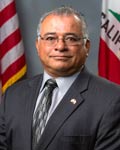
Photo of Rocky J. Chávez
R California Assembly · District 76 · Former member

Asm. Rocky J. Chávez

Compare
Total votes
13,005
all sessions
Attendance
94%
681 missed
Near the chamber average
With party
94%
of cast votes
Lower than 94% of chamber peers
Bipartisan score
3%
crosses aisle rarely
Higher than 91% of chamber peers
Sponsored
1,052
bills & resolutions
Near the chamber average
Committees
0
assignments
1,052 bills and resolutions

Sponsored bills

Total
1,052
Primary
96
Co-sponsor
956
This page
1,052
matching current filters
Primary AB 2677
In committee · California Assembly · Lead sponsor
Subsidized child care: limit on services.

The Child Care and Development Services Act, administered by the State Department of Education, provides that children from infancy to 13 years of age, inclusive, are eligible, with certain requirements, for child care and development services. The act authorizes the Superintendent of Public Instruction to enter into and execute local contractual agreements with any public or private entity or agency for the delivery of child care and development services. This bill would limit a family to a total of not more than 8 years of subsidized child care services under the act.

In committee Apr 13, 2016 0 co-sponsors
Co-sponsor AB 1912
In committee · California Assembly · Co-sponsor
Sex offenders.

Existing law requires every person convicted of certain offenses, for the rest of his or her life while residing in California, or while attending school or working in California, as specified, to register with the chief of police of the city in which he or she is residing, or the sheriff of the county if he or she is residing in an unincorporated area or city that has no police department, and, additionally, with the chief of police of a campus of the University of California, the California State University, or community college if he or she is residing upon the campus or in any of its facilities, within 5 working days of coming into, or changing his or her residence within, any city, county, or city and county, or campus in which he or she temporarily resides, and to register thereafter as specified. Existing law makes it a crime for a person who is required to register and fails to do so. Existing law requires the Department of Justice to make available to the public information concerning registered sex offenders on an Internet Web site, as specified. This bill would require a person convicted of soliciting a minor who the person knew, or reasonably should have known, was a victim of human trafficking to register as a sex offender for a period of 5 years after a first conviction, 10 years after a second conviction, and 20 years after a third or subsequent conviction. By requiring more people to register and therefore expanding the scope of a crime, the bill would create a state-mandated local program. The bill would additionally require the department to make available to the public specified information regarding the person on the Internet Web site, for the time that the person has to register. The California Constitution requires the state to reimburse local agencies and school districts for certain costs mandated by the state. Statutory provisions establish procedures for making that reimbursement. This bill would provide that no reimbursement is required by this act for a specified reason.

In committee Apr 12, 2016 1 co-sponsor
Co-sponsor AB 1565
In committee · California Assembly · Co-sponsor
Developmental services: funding.

The Lanterman Developmental Disabilities Services Act requires the State Department of Developmental Services to contract with regional centers to provide services and supports to individuals with developmental disabilities. Under existing law, the regional centers purchase needed services for individuals with developmental disabilities through approved service providers or arrange for those services through other publicly funded agencies. This bill would require the department to submit a plan to the Legislature by August 1, 2017, to ensure the sustainability, quality, and transparency of community-based services for individuals with developmental disabilities. The bill would require the department to regularly consult with stakeholders in developing the plan and would require the plan to address specified topics, including, among others, recommendations for a comprehensive approach to funding regional center operations in a sustainable and transparent manner that enables regional centers to deliver high-quality services to consumers. Existing law requires that contracts or agreements between regional centers and service providers in which the rates between the regional center and the service provider are determined through negotiations to ensure that not more than 15% of regional center funds be spent on administrative costs, as described. This bill would instead provide that the percentage of the funds that may be spent on administrative costs varies depending on the total value, annually, of the payments received by a service provider from all regional centers. Existing law establishes specified rates to be paid to certain service providers and the rates to be paid for certain developmental services. Existing law requires that rates to be paid to other developmental service providers either be set by the department or negotiated between the regional center and the service provider. Existing law prohibits certain provider rate increases, but authorizes increases to those rates as necessary to adjust employee wages to meet the state minimum wage law. This bill would increase the rates established by existing law, as specified, and would require an increase to the rates set by the department and the rates negotiated between regional centers and service providers, as specified. The bill would also require the department, when setting rates for community care facilities serving people with developmental disabilities, to ensure that the rates permit the viability of those facilities by establishing different rates for each facility size, as determined by the number of beds available, that reflect reasonable differences in the cost structure of facilities with differing numbers of beds. The bill would require the department to adopt emergency regulations implementing that provision. Existing law requires each regional center to submit, on or before August 1 of each year, to the department and the State Council on Developmental Disabilities a program budget plan for the subsequent budget year. Existing law provides that, to the extent feasible, all funds appropriated for developmental disabilities programs be allocated to those programs by August 1 of each year and designates the department as the agency responsible for the processing, audit, and payment of funds made available to regional centers. This bill would require the department to increase the funding paid to a regional center for the regional center's operating budget, beginning July 1, 2016, by 10% above the amount the regional center otherwise would have received under the department's core staffing formula, and, beginning July 1, 2017, by 10% above the amount the regional center otherwise would have received under the department's core staffing formula, plus a percentage equal to the percentage of any increase in the California Consumer Price Index since July 1, 2016. The bill would also require the department to increase the funding provided to a regional center to enable the regional center and the regional center's purchase-of-service vendors to fund certain costs related to minimum wage requirements. This bill would declare that it is to take effect immediately as an urgency statute.


In committee Apr 12, 2016 1 co-sponsor
Co-sponsor SCR 120
Signed into law · California Senate · Co-sponsor
Relative to Biotechnology Day.

This measure would declare April 7, 2016, and every April 7 thereafter, as Biotechnology Day in California.

Signed into law Apr 11, 2016 1 co-sponsor
Co-sponsor AB 1839
Failed · California Assembly · Co-sponsor
California Health Benefit Exchange: enrollment options.

Existing law establishes the California Health Benefit Exchange (Exchange) within state government, specifies the powers and duties of the board governing the Exchange, and requires the board to facilitate the purchase of qualified health plans through the Exchange by qualified individuals and small employers. Existing law requires the board, among other things, to determine the criteria and process for eligibility, enrollment, and disenrollment of enrollees and potential enrollees in the Exchange and coordinate that process with state and local government entities administering other specified health care coverage programs, as specified. The board membership is required to possess acknowledged expertise in information technology system management, among other areas, and to hire a chief technology and information officer. Existing law provides for the Medi-Cal program, which is administered by the State Department of Health Care Services, under which qualified low-income persons receive health care benefits. The Medi-Cal program is, in part, governed and funded by federal Medicaid program provisions. Under existing law, the department exercises a specified federal option to extend continuous Medi-Cal eligibility to children 19 years of age and younger. This bill would require the Exchange's enrollment system to be upgraded so an enrollee whose family income qualifies him or her for subsidized coverage, but only qualifies children in the household 19 years of age or younger for Medi-Cal, would be presented with the option of either enrolling in a plan with subsidized coverage for himself or herself and enrolling the eligible child or children in Medi-Cal, or enrolling in a single plan for the family that preserves the enrollee's subsidized coverage and purchasing unsubsidized coverage under the same plan for the child or children under 19 years of age. The bill would require the upgraded enrollment system to be operational no later than July 1, 2017, and would require the chief information and technology officer or his or her designee to oversee the upgrading process.

Failed Apr 5, 2016 1 co-sponsor
Primary AB 2338
In committee · California Assembly · Lead sponsor
Income taxes: returns: due dates.

The Personal Income Tax Law requires a partnership to file an informational return on the 15th day of the 4th month following the close of its taxable year, and a limited liability company to file a return of the taxes due and payable on the 15th day of the 4th month following the close of its taxable year. The Corporate Tax Law requires "C" corporation and "S" corporation taxpayers to file returns on the 15th day of the third month following the close of its taxable year. These tax return due dates conform to federal income tax return due dates for taxable years beginning before January 1, 2016. This bill would require, instead, for taxable years beginning on or after January 1, 2016, partnerships and limited liability companies to file a return on the 15th day of the 3rd month, and "C" Corporations to file a return on the 15th day of the 4th month of the year, except "C" corporations with fiscal years ending on June 30 would use the new filing date for taxable years beginning on or after January 1, 2026. These tax return due dates would conform to federal income tax return due dates for taxable years beginning on and after January 1, 2016.

In committee Apr 4, 2016 0 co-sponsors
Co-sponsor AB 1938
Failed · California Assembly · Co-sponsor
Toll facilities: Metropolitan Transportation Commission

Existing law designates the Metropolitan Transportation Commission as the regional transportation planning agency for the San Francisco Bay area. Existing law creates the Bay Area Toll Authority, governed by the same board as the commission, with specified powers and duties relative to the administration of toll revenues from state-owned toll bridges within the geographic jurisdiction of the commission. Existing law authorizes the authority to make direct contributions to the commission in furtherance of the exercise of the authority's powers, including contributions in the form of personnel services, office space, overhead, and other funding necessary to carry out the function of the authority, with those contributions not to exceed 1% of the gross annual bridge revenues. This bill would require this limitation to apply to any revenues derived from bridge tolls, fees, or taxes, regardless of classification.

Failed Apr 4, 2016 1 co-sponsor
Co-sponsor AB 1586
Failed · California Assembly · Co-sponsor
California Environmental Quality Act: Temperance Flat Reservoir.

The California Environmental Quality Act requires a lead agency, as defined, to prepare, or cause to be prepared, and certify the completion of, an environmental impact report on a project that it proposes to carry out or approve that may have a significant effect on the environment or to adopt a negative declaration if it finds that the project will not have that effect. The act also requires a lead agency to prepare a mitigated negative declaration for a project that may have a significant effect on the environment if revisions in the project would avoid or mitigate that effect and there is no substantial evidence that the project, as revised, would have a significant effect on the environment. The act establishes a procedure by which a person may seek judicial review of the decision of the lead agency made pursuant to the act. This bill would prohibit the court, in an action or proceeding alleging a violation of the act, from staying or enjoining the construction or operation of the Temperance Flat Reservoir unless the court makes certain findings. This bill would make legislative findings and declarations as to the necessity of a special statute for the Temperance Flat Reservoir.

Failed Apr 4, 2016 1 co-sponsor
Showing 551 to 560 of 1,052 bills
Previous 1 … 55 56 57 … 106 Next