

The Personal Income Tax Law, in conformity with federal income tax law, generally defines "gross income" as income from whatever source derived, except as specifically excluded, and provides various exclusions from gross income. Existing law, in modified conformity with federal income tax law, allows a deduction for specified investment interest, not to exceed the net investment income of the taxpayer for the taxable year, as provided. This bill, for taxable years beginning on or after January 1, 2026, would provide an exclusion from gross income for any amount of interest income that a taxpayer generates on an investment during the taxable year and, without the qualified taxpayer's consent and against the qualified taxpayer's will, is stolen, sold, or otherwise transferred, as specified. This bill would take effect immediately as a tax levy.
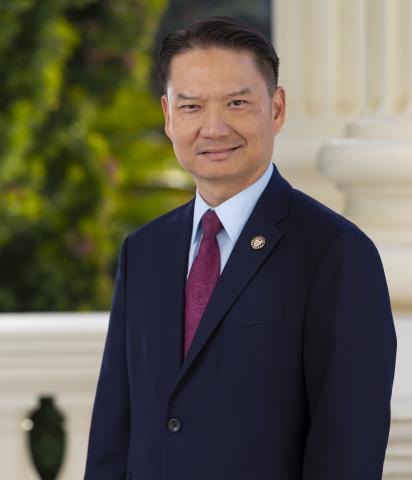
Asm. Tri Ta
Sponsored bills
The Personal Income Tax Law authorizes various credits against the taxes imposed by that law, including a credit for qualified renters in the amount of $120 for spouses filing joint returns, heads of household, and surviving spouses if adjusted gross income is $50,000, as adjusted, or less, and in the amount of $60 for other individuals if adjusted gross income is $25,000, as adjusted, or less. Existing law requires the Franchise Tax Board to annually adjust for inflation these adjusted gross income amounts. For 2024, the adjusted gross income limit is $52,421 and $104,842, respectively. Existing law establishes the continuously appropriated Tax Relief and Refund Account in the General Fund and provides that payments required to be made to taxpayers or other persons from the Personal Income Tax Fund are to be paid from that account. This bill, for taxable years beginning on or after January 1 of the taxable year that includes the date on which funding is first authorized for purposes of this bill and for the succeeding 4 taxable years, and only when specified in a bill relating to the Budget Act, would extend the above-described renter's credit to spouses filing joint returns, heads of household, and surviving spouses if adjusted gross income is $150,000, as adjusted, or less, and for other individuals if adjusted gross income is $75,000, as adjusted, or less. The bill would also increase the credit amount for those years to $2,000 for spouses filing joint returns, heads of households, and surviving spouses and $1,000 for other individuals. In the event the increased credit amount is not specified in a bill relating to the Budget Act, the existing credit amounts and adjusted gross income limits, as described above, would be the credit amounts and adjusted gross income limits for that taxable year. The bill would require the Franchise Tax Board to annually recompute the credit amount and the increased adjusted gross income limits for inflation for taxable years following the first year in which the increased credit is operative, except as provided. The bill, for credits allowable for taxable years in which the above-described increased credit is operative, would provide that the credit amount in excess of the qualified renter's liability would be refundable and paid from the Tax Relief and Refund Account to the qualified renter upon appropriation by the Legislature. Existing law requires any bill authorizing a new tax credit to contain, among other things, specific goals, purposes, and objectives that the tax credit will achieve, detailed performance indicators, and data collection requirements. The bill would provide findings and declarations relating to the goals, purposes, and objectives of this credit. This bill would take effect immediately as a tax levy.
The Personal Income Tax Law allows various credits against the taxes imposed by that law. This bill would allow a credit against those taxes for each taxable year beginning on or after January 1, 2025, and before January 1, 2030, to a qualified taxpayer, as defined, in an amount equal to 40% of the taxpayer's qualified expenses, as defined, not to exceed $400 per taxable year, or $2,000 cumulatively. Existing law requires any bill authorizing a new tax credit to contain, among other things, specific goals, purposes, and objectives that the tax credit will achieve, detailed performance indicators, and data collection requirements. The bill would also include additional information required for any bill authorizing a new tax expenditure. This bill would take effect immediately as a tax levy.
Existing law requires each state agency, each year, to make a review of all proprietary state lands over which it has jurisdiction to determine what land is in excess of its foreseeable needs and report thereon to the Department of General Services, including, among other things, land that is not currently being utilized, or is currently being underutilized by the state agency for any ongoing state program. This bill would require the report described above to include land that is not currently being utilized, or is currently being underutilized by the state agency for any ongoing state program regardless of whether the agency is currently prepared to dispose of the land by sale or otherwise. The bill would require the department to submit a report to the Legislature containing information regarding the land reported to it by a state agency as described in these provisions, on or before January 1, 2030.
Existing state law, Proposition 7, an initiative measure approved by the voters at the November 6, 2018, statewide general election, sets the standard time for California and sets daylight saving time to begin each March and end each November, as specified. Proposition 7 authorizes the Legislature to amend these provisions by a 23 vote to change the dates and times of the daylight saving time period, consistent with federal law, and authorizes the Legislature to amend these provisions by a 23 vote to provide for the application of year-round daylight saving time when authorized by federal law. This bill would repeal daylight saving time in the state and the provisions regarding the Legislature's authority to amend the above-described provisions by a 23 vote. The bill would instead require the state and all political subdivisions of the state to observe year-round standard time. The bill would exempt the state and all political subdivisions of the state from the provisions of federal law that establish the advancement of time. The bill would make related findings and declarations.
Existing law vests the Public Utilities Commission with regulatory authority over public utilities, including electrical corporations. Existing law authorizes the commission to fix the rates and charges for every public utility and requires that those rates and charges be just and reasonable. This bill would prohibit an electrical corporation from proposing a rate increase above the rate of inflation, as defined, as a systemwide average for any general rate case cycle, except the bill would expressly authorize the commission to approve a rate increase above the rate of inflation if the commission determines that the costs underlying the rate increase are directly related to safety enhancements and modernization or to higher commodity or fuel costs. Under existing law, a violation of the Public Utilities Act or any order, decision, rule, direction, demand, or requirement of the commission is a crime. Because the above prohibition would be a part of the act, and because a violation of a commission action implementing the above prohibition would be a crime, the bill would impose a state-mandated local program. The California Constitution requires the state to reimburse local agencies and school districts for certain costs mandated by the state. Statutory provisions establish procedures for making that reimbursement. This bill would provide that no reimbursement is required by this act for a specified reason.
The Personal Income Tax Law and the Corporation Tax Law allow various credits against the taxes imposed by those laws. This bill, for taxable years beginning on or after January 1, 2026, and before January 1, 2031, would allow a credit against those taxes to a qualified taxpayer in an amount equal to 40% of the qualified wages paid or incurred to a qualified employee employed during the taxable year. The bill would define a qualified employee for this purpose to mean an individual that, among other things, has been convicted of a felony, as provided, and has a hiring date not more than one year after the date the individual was convicted or was released from prison. Existing law requires any bill authorizing a new tax expenditure to contain, among other things, specific goals that the tax expenditure will achieve, detailed performance indicators, and data collection requirements. This bill would include additional information required for any bill authorizing a new income tax expenditure. This bill would take effect immediately as a tax levy.
Existing law establishes the Department of Veterans Affairs. The department, among other services, provides veterans and their dependents and survivors with assistance in processing service-related disability claims, assistance in obtaining affordable housing, and information about health ailments associated with military service. This bill would require the department to establish a program to fund, upon appropriation by the Legislature, an academic study of mental health among women veterans in California, as specified. The bill would require the department to submit a report that summarizes the findings and recommendations of the study to the Legislature no later than June 30, 2029. The bill would repeal these provisions on January 1, 2030.
Maddy summaryThis bill establishes January as National Human Trafficking Awareness Month in California to raise public awareness about human trafficking. The resolution recognizes the severity of human trafficking as a felony crime and highlights statistics showing its prevalence across the country and specific challenges with identifying male victims and labor trafficking cases. It aims to educate the public and encourage reporting and support for victims during this designated month.
Existing law, the Cal Grant Program, establishes the Cal Grant A Entitlement Awards, the Cal Grant B Entitlement Awards, the California Community College Expanded Entitlement Awards, the California Community College Transfer Entitlement Awards, the Competitive Cal Grant A and B Awards, the Cal Grant C Awards, and the Cal Grant T Awards under the administration of the Student Aid Commission. Existing law, the Cal Grant Reform Act, revises and recasts the provisions establishing and governing the existing Cal Grant Program into a new Cal Grant Program. Existing law specifies that the act becomes operative only if General Fund moneys over the multiyear forecasts beginning in the 2024–25 fiscal year are available to support ongoing augmentations and actions, and if funding is provided in the annual Budget Act to implement the act. Under either Cal Grant Program that is operative, existing law establishes eligibility requirements for awards under the program for participating students attending qualifying institutions, including, among others, California residency requirements, as provided. Existing law establishes the Middle Class Scholarship Program (MCSP) under the administration of the commission. Existing law makes an undergraduate student eligible for a scholarship award under the MCSP if the student is enrolled at the University of California or the California State University, or enrolled in upper division coursework in a community college baccalaureate program, and meets certain eligibility requirements, including, among others, that the applicant meets the eligibility requirements for a Cal Grant. This bill would extend Cal Grant and MCSP eligibility to a student who was not a resident of California at the time of high school graduation or its equivalent but meets all other applicable eligibility requirements and is a dependent natural or adopted child, stepchild, or spouse of a member of the Armed Forces of the United States stationed outside of California on active duty, if the member of the Armed Forces of the United States otherwise maintains California as their state of legal residence. The bill also would make conforming changes. This bill would incorporate additional changes to Section 70022 of the Education Code proposed by AB 148 and SB 148 to be operative only if this bill and either SB 148 or AB 148 are enacted, and this bill is enacted last.