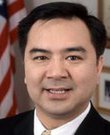
Photo of Van Tran
R California House · District 68

Rep. Van Tran

Compare
Total votes
9,477
all sessions
Attendance
92%
695 missed
Lower than 77% of chamber peers
With party
95%
of cast votes
Lower than 92% of chamber peers
Bipartisan score
3%
crosses aisle rarely
Higher than 89% of chamber peers
Sponsored
349
bills & resolutions
Near the chamber average
Committees
0
assignments
349 bills and resolutions

Sponsored bills

Total
349
Primary
67
Co-sponsor
282
This page
349
matching current filters
Primary AB 1731
Failed · California House · Lead sponsor
Vehicle rental agreements: waivers.

Existing law governs the contract terms of an agreement for the rental of a passenger vehicle. Existing law authorizes a rental company to sell a damage waiver subject to rate limitations that are determined by reference to the manufacturer's suggested retail price (MSRP) of the vehicle. This bill would revise the rate limitations on damage waivers sold by a rental company by deleting the reference to the vehicle's MSRP and instead imposing limits on the rate on the basis of the vehicle's class.

Failed Nov 30, 2010 0 co-sponsors
Co-sponsor AB 765
died · California House · Co-sponsor
Income tax: credit: purchase: principal residence.

The Personal Income Tax Law authorizes a credit against the taxes imposed by that law in an amount equal to the lesser of 5% of the purchase price or $10,000 in the case of the purchase of a qualified principal residence on and after March 1, 2009, and before March 1, 2010, but not to exceed an aggregate limitation of $100,000,000 for all credits allowable. Existing law requires a certification that the residence has never been occupied be provided to the Franchise Tax Board within one week of the sale of the qualified principal residence. This bill would limit the credit to taxpayers who purchased a qualified principal residence on and after March 1, 2009, and before July 3, 2009, and on and after the effective date of this bill and before March 1, 2010. This bill would also require the aggregate limitation of credits to be reduced by a specified amount per certification received by the Franchise Tax Board. (2) The bill would appropriate the sum of $44,000 from the General Fund to the Franchise Tax Board, in augmentation of a specified appropriation made in the 2009-10 Budget Act. (3) This bill would declare that it is to take effect immediately as an urgency statute.

died Nov 30, 2010 1 co-sponsor
Primary AB 2378
died · California House · Lead sponsor
Energy: renewable energy program.

Existing law establishes the renewable energy resources program that is administered by the State Energy Resources Conservation and Development Commission to increase the amount of electricity generated from eligible renewable energy resources per year. Existing law defines various terms, including "in-state renewable electricity generation facility," for the purposes of the program. "In-state renewable electricity generation facility" is defined as meeting certain criteria, including that the facility uses specified renewable resource technology. This bill would amend that definition to expressly specify that it includes a facility that uses a combination of those renewable resource technologies.

died Nov 30, 2010 0 co-sponsors
Primary AB 1769
Failed · California House · Lead sponsor
Elections: payment of expenses.

Existing law provides that all expenses authorized and necessarily incurred in the preparation for and conduct of elections are to be paid from the county treasuries. This bill would require that expenses incurred on or after January 1, 2009, and before December 31, 2010, for elections proclaimed by the Governor to fill a vacancy in the office of Senator or Member of the Assembly, or to fill a vacancy in the office of United States Senator or Representative in the Congress of the United States, be paid by the state. This bill would declare that it is to take effect immediately as an urgency statute.

Failed Nov 30, 2010 0 co-sponsors
Co-sponsor SB 330
Vetoed · California Senate · Co-sponsor
Public records: auxiliary organizations.

The California Public Records Act requires state and local agencies to make their records available for public inspection and to make copies available upon request and payment of a fee unless those records are exempt from disclosure. This bill would require specified entities to comply with the act, but would not require these entities to disclose information obtained in the process of soliciting potential donors that has actual or potential independent economic value because it is not generally known to the public or because the individuals can obtain economic value from its disclosure or use. This bill would specify that it is not the intent of the Legislature to designate specified organizations as state agencies by subjecting these organizations to the requirements of the act. The bill would exempt from disclosure under the act the names, addresses, and telephone numbers of persons who volunteer services or donate to specified entities if those persons request anonymity. However, the bill would provide that this exemption does not apply if a volunteer or donor meets specified conditions. This bill would also provide that it is the intent of the Legislature to reject the court's interpretation of state law regarding the application of the act to auxiliary organizations, such as the CSU Fresno Association, at issue in California State University, Fresno Assn., Inc. v. Superior Court (2001) 90 Cal.App.4th 810.

Vetoed Nov 30, 2010 1 co-sponsor
Primary AB 480
Failed · California House · Lead sponsor
Bond acts: auditing.

The existing State General Obligation Bond Law contains procedures for use in authorizing the issuance and sale and providing for the repayment of state general obligation bonds and requires any state general obligation bond measure to be subject to the making, at least annually, of a specified report, by the head of the lead state agency administering the bond proceeds, to the Legislature and the Department of Finance. This bill would require any state bond measure approved by the voters on or after January 1, 2010, to include auditing provisions with respect to the use of any bond moneys that would be spent for the purposes of the bond measure. The bill would authorize the Bureau of State Audits to conduct periodic audits to ensure that bond proceeds are awarded in a timely manner and that recipients of bond moneys use the funds in compliance with applicable provisions of law. The bill would require that the costs associated with the audit be reimbursed by the bond proceeds.

Failed Nov 30, 2010 0 co-sponsors
Primary AB 2303
Failed · California House · Lead sponsor
Vehicles: registration: installment payments.

Existing law prohibits a person from driving, moving, or leaving standing upon a highway, or in an offstreet public parking facility, any motor vehicle, trailer, semitrailer, pole or pipe dolly, or logging dolly, unless it is registered and the appropriate fees have been paid under the Vehicle Code. This bill would require the Department of Motor Vehicles, by regulation, by January 1, 2012, to implement a program that would allow certain persons to pay a vehicle registration fee in installments. The bill would specify that in order to qualify to participate in the program an individual shall be receiving unemployment compensation or meet state poverty guidelines.

Failed Nov 30, 2010 0 co-sponsors
Co-sponsor AB 79
Failed · California House · Co-sponsor
Disaster relief.

(1) Existing law authorizes a county board of supervisors to provide by ordinance for the reassessment of property that is damaged or destroyed, without fault on the part of the assessee, by a major misfortune or calamity, upon the application of the assessee or upon the action of the county assessor with the board's approval. With respect to certain counties that have adopted reassessment ordinances and have been declared by the Governor to be in a state of emergency as a result of certain events, existing law provides for state allocations of the estimated amounts of the reductions in property tax revenues resulting in certain fiscal years from reassessments under those ordinances. Existing law also continuously appropriates, without regard to fiscal years, moneys in the Special Fund for Economic Uncertainties for purposes of funding these state allocations. This bill would provide for similar state allocations with respect to property tax revenue reductions resulting from a reassessment for damages incurred within the Counties of Orange, Riverside, and San Bernardino, which were declared by the Governor to be in a state of emergency due to the wildfires that commenced in November 2008. By requiring moneys continuously appropriated from the Special Fund for Economic Uncertainties to be allocated for the new purpose of reimbursing the Counties of Orange, Riverside, and San Bernardino for these property tax revenue reductions, this bill would make an appropriation. (2) Existing property tax law provides, pursuant to a specified provision of the California Constitution, for a homeowners' property tax exemption in the amount of $7,000 of the full value of a "dwelling," as defined. This bill would also provide that any dwelling that qualified for the exemption prior to the commencement dates of the wildfires listed in the Governor's disaster proclamations of November 15, 2008, and November 17, 2008, that was damaged or destroyed by the wildfires in the Counties of Orange and Riverside, as declared by the Governor in November 2008, and that has not changed ownership since the commencement dates of these disasters as listed in the proclamations, may not be denied the exemption solely on the basis that the dwelling was temporarily damaged or destroyed or was being reconstructed by the owner, or was temporarily uninhabited as a result of restricted access to the property due to wildfires. The California Constitution requires the Legislature, in each fiscal year, to reimburse local governments for the revenue losses incurred by those governments in that fiscal year as a result of the homeowners' property tax exemption. This bill would state the intent of the Legislature to make this required reimbursement in the annual Budget Act. By requiring local tax officials to implement new exemption criteria, this bill would impose a state-mandated local program. The California Constitution requires the state to reimburse local agencies and school districts for certain costs mandated by the state. Statutory provisions establish procedures for making that reimbursement. This bill would provide that, if the Commission on State Mandates determines that the bill contains costs mandated by the state, reimbursement for those costs shall be made pursuant to these statutory provisions. (3) The Personal Income Tax Law and the Corporation Tax Law provide for the carryover to specified taxable years of specified losses sustained as a result of certain disasters occurring in California in an area determined by the President of the United States to warrant specified federal assistance, or proclaimed by the Governor to be in a state of emergency. This bill would extend these provisions to losses sustained in the Counties of Orange, Riverside, and San Bernardino as a result of the wildfires that commenced in November 2008. This bill would authorize a taxpayer to make an election to claim a deduction for those losses on the tax return for the preceding year. (4) This bill would declare that it is to take effect immediately as an urgency statute.


Failed Nov 30, 2010 1 co-sponsor
Showing 11 to 20 of 349 bills