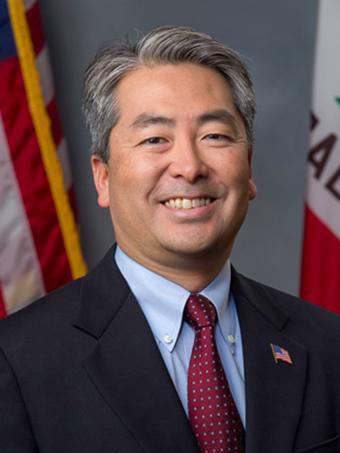
Photo of Al Muratsuchi
D California Assembly · District 66

Asm. Al Muratsuchi

Compare
Total votes
25,954
all sessions
Attendance
94%
1,387 missed
Near the chamber average
With party
98%
of cast votes
Near the chamber average
Bipartisan score
1%
crosses aisle rarely
Near the chamber average
Sponsored
2,045
bills & resolutions
Near the chamber average
Committees
4
assignments
2,045 bills and resolutions

Sponsored bills

Total
2,045
Primary
262
Co-sponsor
1,783
This page
2,045
matching current filters
Co-sponsor ACR 130
Signed into law · California Assembly · Co-sponsor
Relative to Sylvia Mendez Day.

Maddy summaryThis bill designates April 14 of every year as Sylvia Mendez Day to honor the civil rights activist who challenged school segregation in California. The measure is a commemorative resolution that does not change laws, allocate funding, or alter government operations. By establishing this annual observance, the state recognizes Mendez's historical contributions to education and civil rights.

Signed into law May 12, 2026 1 co-sponsor
Co-sponsor ACR 150
Signed into law · California Assembly · Co-sponsor
Relative to California Public Safety Telecommunicators Week.

Maddy summaryThis bill designates the week of April 12 to April 18, 2026, as California Public Safety Telecommunicators Week to honor the work of emergency call operators. The measure does not change laws or allocate funding; it simply establishes an official state observance. By creating this designated week, the legislation aims to bring public attention to the role of telecommunicators without altering their duties or compensation.

Signed into law May 12, 2026 1 co-sponsor
Co-sponsor ACR 172
Signed into law · California Assembly · Co-sponsor
Relative to World Irritable Bowel Syndrome Day.

Maddy summaryThis bill designates April 19, 2026, as World Irritable Bowel Syndrome Day within the state of California. It serves as a commemorative resolution intended to raise awareness about the condition on a specific date. The measure does not create new laws, funding, or administrative requirements but simply establishes an official day of recognition.

Signed into law May 12, 2026 1 co-sponsor
Co-sponsor HR 107
Passed · California Assembly · Co-sponsor
Relative to Asian and Pacific Islander American Heritage Month.

Maddy summaryThis bill is a House Resolution that formally recognizes May 2026 as Asian and Pacific Islander American Heritage Month in California. It commends the community for its historical contributions to the state and nation while acknowledging the hardships they have faced, such as discrimination and internment. The resolution serves as a symbolic gesture to celebrate the achievements and diverse cultures of over 7.3 million Asian and Pacific Islander Americans living in California. As a commemorative measure, it does not create new laws or change government operations but rather directs the Assembly to acknowledge this specific month of observance.

Passed May 11, 2026 1 co-sponsor
Co-sponsor HR 105
Passed · California Assembly · Co-sponsor
Relative to Amyotrophic Lateral Sclerosis Awareness Month.

Maddy summaryThis bill designates May 2026 as Amyotrophic Lateral Sclerosis Awareness Month in California to highlight the challenges faced by people living with this progressive neurodegenerative disease. The resolution calls on the public to support research, advocate for increased funding, and show solidarity with patients and their families. It does not create new laws or change government programs but serves as a symbolic gesture to raise awareness about ALS.

Passed May 11, 2026 1 co-sponsor
Co-sponsor HR 101
Passed · California Assembly · Co-sponsor
Relative to Star Wars Day.

Maddy summaryThis House Resolution officially designates May 4, 2026, as Star Wars Day in California. The bill honors the science fiction franchise created by George Lucas, highlighting his connection to Modesto and the series' cultural impact. It serves as a commemorative measure to recognize the fan celebration that began with the pun "May the Fourth be with you."

Passed May 4, 2026 1 co-sponsor
Co-sponsor HR 92
Passed · California Assembly · Co-sponsor
Relative to Cinco de Mayo Week.

Maddy summaryThis House Resolution designates the week of May 5 as Cinco de Mayo Week to honor the historical victory of Mexican forces at the Battle of Puebla and the contributions of Latinos in California. The bill recognizes the role of Latino Americans in defending democratic institutions, both during the American Civil War and in supporting the Republic of Mexico against French intervention. It highlights the cultural, economic, and civic achievements of the Latino community while urging Californians to celebrate the holiday with appropriate ceremonies and activities.

Passed May 4, 2026 1 co-sponsor
Co-sponsor HR 109
Passed · California Assembly · Co-sponsor
Relative to California's janitorial and cleaning workforce.

Maddy summaryThis House Resolution designates April 27, 2026, as a day to honor the excellence and dedication of California's janitorial and cleaning workforce. The measure directly affects janitors and other property service workers who maintain sanitary environments in workplaces, schools, hospitals, and public spaces. By proclaiming this specific date, the resolution aims to bring public appreciation to the often invisible labor of these frontline professionals who contribute to public health and safety. The text highlights the essential role these workers play in reducing disease spread and supporting a healthy economy without imposing new regulations or funding requirements.

Passed Apr 30, 2026 1 co-sponsor
Primary AB 2741
Failed · California Assembly · Lead sponsor
Housing element: inventory of land: substantial compliance.

The Planning and Zoning Law requires a city or county to adopt a general plan for land use development within its boundaries that includes, among other things, a housing element. Existing law requires the housing element to include, among other things, an inventory of land suitable and available for residential development. Existing law requires a city or county, based on that inventory of land, to determine whether each site in the inventory can accommodate the development of some portion of its share of the regional housing need by income level during the planning period, as provided. Existing law requires local governments to rezone sites according to a specified program if the inventory of sites suitable and available for residential development does not identify adequate sites to accommodate the need for groups of all household income levels. Existing law requires that program to accommodate 100% of the need for housing for specified lower income households on sites required to be zoned to permit owner-occupied and rental multifamily residential use, as provided, and requires these sites to be zoned with specified minimum density and development standards, as provided. This bill would provide that these zoning requirements would be met by applying a zoning classification, including, but not limited to, an overlay zone, mixed-use zone, combining district, or similar zone that permits owner-occupied and rental multifamily residential use with the above-described minimum density and development standards, as specified. The bill would require a program that includes application of this zoning classification to include a written explanation of the housing and affordability incentives of the zoning classification. The bill would permit this zoning classification to allow a mix of uses if it meets prescribed requirements. The bill would define key terms for these purposes. The bill would apply these provisions only to the 6th housing element revision cycle and retroactively to January 1, 2019. Existing law, commonly referred to as the Housing Element Law, prescribes requirements for a city's or county's preparation of, and compliance with, its housing element, and requires the Department of Housing and Community Development to review and determine whether the housing element substantially complies with the Housing Element Law, as specified. Existing law provides that a housing element or amendment is considered substantially compliant with the Housing Element Law when the local agency has adopted a housing element or amendment, the department or a court of competent jurisdiction determines the adopted housing element or amendment to be in substantial compliance with the Housing Element Law, and the department's compliance findings have not been superseded by subsequent contrary findings by the department or by a decision of a court of competent jurisdiction or the court's decision has not been overturned or superseded by a subsequent court decision or by statute. Existing law, the Housing Accountability Act, among other things, prohibits a local agency from disapproving, or conditioning approval in a manner that renders infeasible, a housing development project for very low, low-, or moderate-income households unless the local agency makes written findings as to one of certain sets of conditions, as specified. One set of conditions is that (1) the jurisdiction has adopted a housing element that is in substantial compliance with the Housing Element Law, and (2) the jurisdiction has met or exceeded its share of the regional housing need allocation for the planning period for the income category proposed for the housing development project. Existing law requires a housing element or amendment to be considered in substantial compliance with the Housing Element Law only if the element or amendment was determined to be in substantial compliance when a preliminary application or complete application was submitted, as specified. This bill would require, if a court of competent jurisdiction finds an adopted housing element or amendment to be to be out of compliance despite the department's findings of substantial compliance, that the housing element or amendment be considered in substantial compliance until either the date the department finds that a newly adopted housing element or amendment is in substantial compliance, or 275 days after a court order, writ, or judgment is issued requiring the local agency to bring its housing element into substantial compliance, whichever is earlier.


Failed Apr 29, 2026 0 co-sponsors
Co-sponsor ACR 81
Signed into law · California Assembly · Co-sponsor
Relative to the Border Patrol Agent Daniel H. Salazar Memorial Highway.

This measure would designate the portion of State Route 94 from Potrero Valley Road to Bell Valley Truck Trail in the County of San Diego as the Border Patrol Agent Daniel H. Salazar Memorial Highway. The measure would request the Department of Transportation to determine the cost of appropriate signs showing this special designation and, upon receiving donations from nonstate sources covering that cost, to erect those signs.

Signed into law Apr 28, 2026 1 co-sponsor
Showing 121 to 130 of 2,045 bills
Previous 1 … 12 13 14 … 205 Next