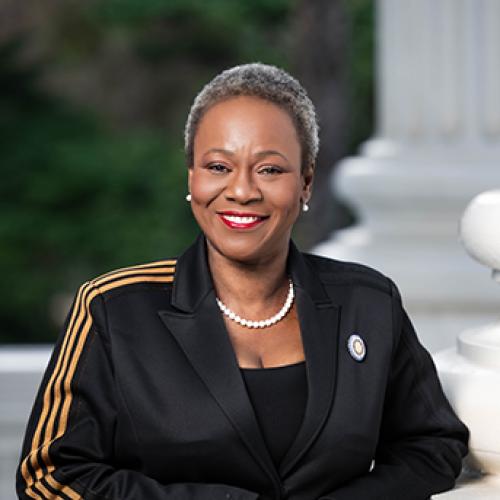
This measure would recognize May 4, 2026, to May 8, 2026, inclusive, and every first full week of May thereafter, as Black Health Equity Advocacy Week and commend the California Black Health Network and other organizations throughout the state for their efforts to improve the health, well-being, and life expectancy of Black Californians.
Asm. Tina McKinnor
Sponsored bills
Existing law establishes the Medi-Cal program, which is administered by the State Department of Health Care Services and under which qualified low-income individuals receive health care services. The Medi-Cal program is in part governed by, and funded pursuant to, federal Medicaid program provisions. Existing federal law, Public Law 119-21, enacted on July 4, 2025, sets forth various changes to different health care programs, including certain requirements for Medicaid eligibility with regard to work or community engagement reporting, redeterminations, and cost sharing, among other factors, for certain Medicaid populations pursuant to a specified implementation timeline. Existing law, the federal Patient Protection and Affordable Care Act, imposes a certain assessment on an applicable large employer, as defined, that offers full-time employees and their dependents the opportunity to enroll in minimum essential coverage, and for whom one or more full-time employees have been certified as having enrolled in a qualified health plan for which a premium tax credit or cost-sharing reduction is allowed or paid. This bill would create the Employer Responsibility for Medi-Cal Trust Fund to consist of new taxes and deposits, including employer penalties specified in the Budget Act of 2026. The bill would continuously appropriate moneys in the fund to the department to fund the costs of administering the Medi-Cal program in a manner necessary to prevent loss of or to restore health care coverage, benefits, or access to care following the passage of Public Law 119-21 and subsequent state budget actions. The bill would state that these provisions would become operative only if the Medicaid provisions of Public Law 119-21 are not repealed prior to January 1, 2027. By creating a continuously appropriated fund, the bill would make an appropriation. This bill would declare that it is to take effect immediately as an urgency statute.
This measure would recognize the significance of Vesak Day to people of Buddhist faith and extend sincere best wishes to the state's Buddhist community in celebrating Vesak Day.
Maddy summaryThis House Resolution recognizes May 17, 2026, as the International Day Against Homophobia, Biphobia, Interphobia, and Transphobia within the California Legislature. The measure formally acknowledges the ongoing discrimination faced by LGBTQ+ individuals globally and reaffirms the state's commitment to equality and civil rights. By adopting this resolution, the Assembly encourages all Californians to support inclusive practices and stand against hate toward the LGBTQ+ community.
The Corporation Tax Law imposes on every corporation doing business in the state, as defined, a tax according to or measured by net income and, in the case of a corporation with income derived from or attributable to sources both within and without this state, apportions the income between this state and other states and foreign countries in accordance with a single sales formula based on the sales within and without this state, except that in the case of an apportioning trade or business that derives more than 50% of its gross business receipts from conducting one or more qualified business activities, as defined, business income is apportioned in accordance with a specified 3-factor formula. Existing federal law, for purposes of determining a taxpayer's gross income for federal income tax purposes, requires that a person who is a United States shareholder of any controlled foreign corporation, as defined, to include in their gross income the net CFC tested income, as provided. The Corporation Tax Law, for taxable years beginning on or after January 1, 2003, for purposes of determining income derived from or attributable to sources within this state, allows corporations to make a statutory election as to whether their income is determined on a "water's-edge" basis or on a worldwide unitary basis. Under existing law, the election to report income on a water's-edge basis remains in effect until terminated, and provides conditions for the termination of the election. This bill, for taxable years beginning on or after January 1, 2026, would require a taxpayer that files on a water's-edge basis to account for net CFC tested income within the water's-edge group, as provided. The bill would require a taxpayer that files on a water's-edge basis to include all income and apportionment factors of any corporation, other than a bank, whose sales factor, instead of the average of 3 factors, in the United States is at least 20%. The bill would also terminate all water's-edge elections for the first taxable year beginning on or after January 1, 2028, and would not allow a taxpayer to make a water's-edge election, or file on a water's-edge basis, for taxable years beginning on or after January 1, 2028. The bill would authorize any taxpayer that has made a water's-edge election to terminate that election without the consent of the Franchise Tax Board for taxable years beginning on or after January 1, 2026, and before January 1, 2028. This bill would include a change in state statute that would result in a taxpayer paying a higher tax within the meaning of Section 3 of Article XIIIA of the California Constitution, and thus would require for passage the approval of 23 of the membership of each house of the Legislature. This bill would take effect immediately as a tax levy.

Maddy summaryThis bill designates the week of May 17 to May 24, 2026, as National Public Works Week throughout California to honor the contributions of public works professionals. It directly affects engineers, managers, and employees in government and the private sector who maintain essential infrastructure like transportation systems, water supplies, and public buildings. The resolution requests that the Governor issue a proclamation encouraging the public to observe the week with educational programs and activities that highlight the importance of these workers.
Maddy summaryThis bill designates April 2026 as Second Chance Month in California to raise awareness about opportunities for individuals reentering society after incarceration. The measure is a ceremonial proclamation that does not alter laws, allocate funding, or change government operations. Its primary purpose is to encourage public recognition of the challenges faced by formerly incarcerated people and to highlight available support resources during that specific month.
This measure would commend President Donald J. Trump for specified comments relating to gun violence and call upon Congress to support legislation and necessary constitutional amendments to end gun violence, as specified.
This measure would proclaim the week of April 20, 2026, to April 24, 2026, inclusive, as California Home Visiting Week, and would encourage all Californians to recognize and celebrate the contributions of home visiting programs and professionals and the families they serve.
Maddy summaryThis bill designates the week of April 19 to April 25, 2026, as Mosquito Awareness Week. The measure is a commemorative resolution that officially recognizes this specific time period to highlight mosquito-related issues. It does not create new laws, impose regulations, or allocate funding, but rather serves to raise public awareness through official designation.